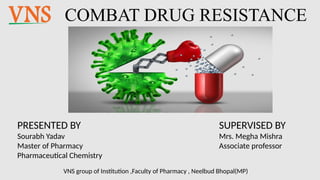
COMBAT DRUG RESISTANCE
PRESENTED BY
Sourabh Yadav
Master of Pharmacy
Pharmaceutical Chemistry
SUPERVISED BY
Mrs. Megha Mishra
Associate professor
VNS group of Institution ,Faculty of Pharmacy , Neelbud Bhopal(MP)
INTRODUCTION
COMBAT DRUG RESISRTANCE : It is the process of preventing and controlling the
ability of microorganism to resist the effect of medicines through rational drug use, infection control
, surveillance , vaccination and development of new therapies.
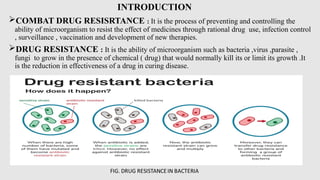
DRUG RESISTANCE : It is the ability of microorganism such as bacteria ,virus ,parasite ,
fungi to grow in the presence of chemical ( drug) that would normally kill its or limit its growth .It
is the reduction in effectiveness of a drug in curing disease.
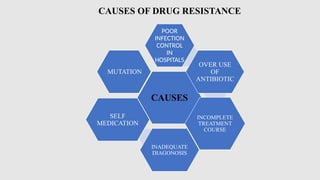
CAUSES OF DRUG RESISTANCE
CAUSES
POOR
INFECTION
CONTROL
IN
HOSPITALS
OVER USE
OF
ANTIBIOTIC
INCOMPLETE
TREATMENT
COURSE
INADEQUATE
DIAGONOSIS
SELF
MEDICATION
MUTATION
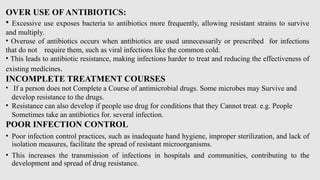
OVER USE OF ANTIBIOTICS:
• Excessive use exposes bacteria to antibiotics more frequently, allowing resistant strains to survive
and multiply.
• Overuse of antibiotics occurs when antibiotics are used unnecessarily or prescribed for infections
that do not require them, such as viral infections like the common cold.
• This leads to antibiotic resistance, making infections harder to treat and reducing the effectiveness of
existing medicines.
INCOMPLETE TREATMENT COURSES
• If a person does not Complete a Course of antimicrobial drugs. Some microbes may Survive and
develop resistance to the drugs.
• Resistance can also develop if people use drug for conditions that they Cannot treat. e.g. People
Sometimes take an antibiotics for. several infection.
POOR INFECTION CONTROL
• Poor infection control practices, such as inadequate hand hygiene, improper sterilization, and lack of
isolation measures, facilitate the spread of resistant microorganisms.
• This increases the transmission of infections in hospitals and communities, contributing to the
development and spread of drug resistance.
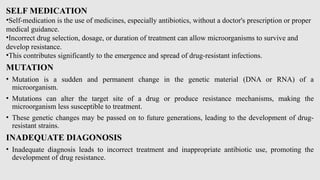
SELF MEDICATION
•Self-medication is the use of medicines, especially antibiotics, without a doctor's prescription or proper
medical guidance.
•Incorrect drug selection, dosage, or duration of treatment can allow microorganisms to survive and
develop resistance.
•This contributes significantly to the emergence and spread of drug-resistant infections.
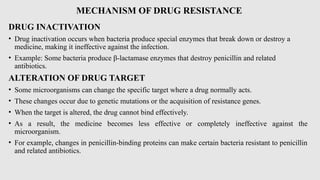
MUTATION
• Mutation is a sudden and permanent change in the genetic material (DNA or RNA) of a
microorganism.
• Mutations can alter the target site of a drug or produce resistance mechanisms, making the
microorganism less susceptible to treatment.
• These genetic changes may be passed on to future generations, leading to the development of drug-
resistant strains.
INADEQUATE DIAGONOSIS
• Inadequate diagnosis leads to incorrect treatment and inappropriate antibiotic use, promoting the
development of drug resistance.
MECHANISM OF DRUG RESISTANCE
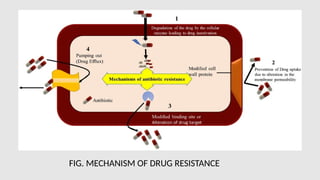
DRUG INACTIVATION
• Drug inactivation occurs when bacteria produce special enzymes that break down or destroy a
medicine, making it ineffective against the infection.
• Example: Some bacteria produce β-lactamase enzymes that destroy penicillin and related
antibiotics.
ALTERATION OF DRUG TARGET
• Some microorganisms can change the specific target where a drug normally acts.
• These changes occur due to genetic mutations or the acquisition of resistance genes.
• When the target is altered, the drug cannot bind effectively.
• As a result, the medicine becomes less effective or completely ineffective against the
microorganism.
• For example, changes in penicillin-binding proteins can make certain bacteria resistant to penicillin
and related antibiotics.
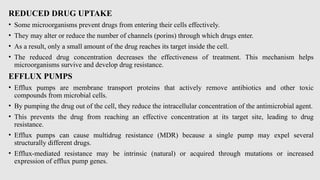
REDUCED DRUG UPTAKE
• Some microorganisms prevent drugs from entering their cells effectively.
• They may alter or reduce the number of channels (porins) through which drugs enter.
• As a result, only a small amount of the drug reaches its target inside the cell.
• The reduced drug concentration decreases the effectiveness of treatment. This mechanism helps
microorganisms survive and develop drug resistance.
EFFLUX PUMPS
• Efflux pumps are membrane transport proteins that actively remove antibiotics and other toxic
compounds from microbial cells.
• By pumping the drug out of the cell, they reduce the intracellular concentration of the antimicrobial agent.
• This prevents the drug from reaching an effective concentration at its target site, leading to drug
resistance.
• Efflux pumps can cause multidrug resistance (MDR) because a single pump may expel several
structurally different drugs.
• Efflux-mediated resistance may be intrinsic (natural) or acquired through mutations or increased
expression of efflux pump genes.
FIG. MECHANISM OF DRUG RESISTANCE
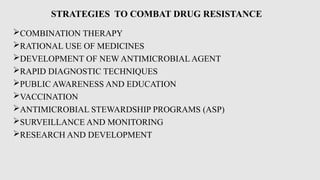
STRATEGIES TO COMBAT DRUG RESISTANCE
COMBINATION THERAPY
RATIONAL USE OF MEDICINES
DEVELOPMENT OF NEW ANTIMICROBIAL AGENT
RAPID DIAGNOSTIC TECHNIQUES
PUBLIC AWARENESS AND EDUCATION
VACCINATION
ANTIMICROBIAL STEWARDSHIP PROGRAMS (ASP)
SURVEILLANCE AND MONITORING
RESEARCH AND DEVELOPMENT
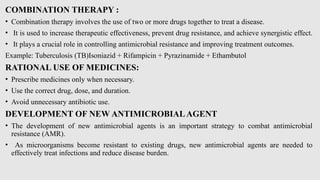
COMBINATION THERAPY :
• Combination therapy involves the use of two or more drugs together to treat a disease.
• It is used to increase therapeutic effectiveness, prevent drug resistance, and achieve synergistic effect.
• It plays a crucial role in controlling antimicrobial resistance and improving treatment outcomes.
Example: Tuberculosis (TB)Isoniazid + Rifampicin + Pyrazinamide + Ethambutol
RATIONAL USE OF MEDICINES:
• Prescribe medicines only when necessary.
• Use the correct drug, dose, and duration.
• Avoid unnecessary antibiotic use.
DEVELOPMENT OF NEW ANTIMICROBIALAGENT
• The development of new antimicrobial agents is an important strategy to combat antimicrobial
resistance (AMR).
• As microorganisms become resistant to existing drugs, new antimicrobial agents are needed to
effectively treat infections and reduce disease burden.
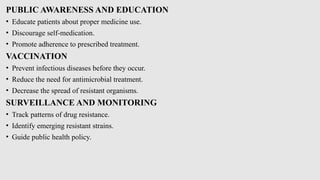
PUBLIC AWARENESS AND EDUCATION
• Educate patients about proper medicine use.
• Discourage self-medication.
• Promote adherence to prescribed treatment.
VACCINATION
• Prevent infectious diseases before they occur.
• Reduce the need for antimicrobial treatment.
• Decrease the spread of resistant organisms.
SURVEILLANCE AND MONITORING
• Track patterns of drug resistance.
• Identify emerging resistant strains.
• Guide public health policy.
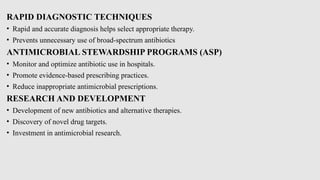
RAPID DIAGNOSTIC TECHNIQUES
• Rapid and accurate diagnosis helps select appropriate therapy.
• Prevents unnecessary use of broad-spectrum antibiotics
ANTIMICROBIAL STEWARDSHIP PROGRAMS (ASP)
• Monitor and optimize antibiotic use in hospitals.
• Promote evidence-based prescribing practices.
• Reduce inappropriate antimicrobial prescriptions.
RESEARCH AND DEVELOPMENT
• Development of new antibiotics and alternative therapies.
• Discovery of novel drug targets.
• Investment in antimicrobial research.
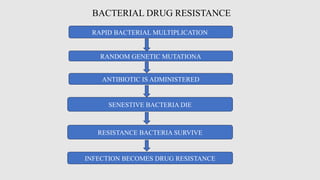
BACTERIAL DRUG RESISTANCE
RAPID BACTERIAL MULTIPLICATION
RANDOM GENETIC MUTATIONA
ANTIBIOTIC IS ADMINISTERED
SENESTIVE BACTERIA DIE
RESISTANCE BACTERIA SURVIVE
INFECTION BECOMES DRUG RESISTANCE
STARTEGIES TO COMBAT DRUG RESISTANCE IN ANTIBIOTIC
COMBINATION THERAPY
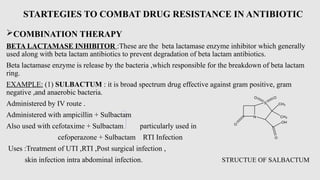
BETA LACTAMASE INHIBITOR :These are the beta lactamase enzyme inhibitor which generally
used along with beta lactam antibiotics to prevent degradation of beta lactam antibiotics.
Beta lactamase enzyme is release by the bacteria ,which responsible for the breakdown of beta lactam
ring.
EXAMPLE: (1) SULBACTUM : it is broad spectrum drug effective against gram positive, gram
negative ,and anaerobic bacteria.
Administered by IV route .
Administered with ampicillin + Sulbactam
Also used with cefotaxime + Sulbactam particularly used in
cefoperazone + Sulbactam RTI Infection
Uses :Treatment of UTI ,RTI ,Post surgical infection ,
skin infection intra abdominal infection. STRUCTUE OF SALBACTUM
N
O
S CH3
CH3
OH
O
O O
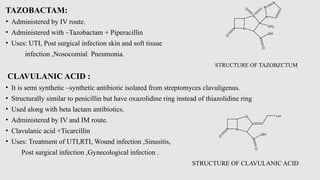
TAZOBACTAM:
• Administered by IV route.
• Administered with –Tazobactam + Piperacillin
• Uses: UTI, Post surgical infection skin and soft tissue
infection ,Nosocomial Pneumonia.
STRUCTURE OF TAZOBZCTUM
CLAVULANIC ACID :
• It is semi synthetic –synthetic antibiotic isolated from streptomyces clavuligenus.
• Structurally similar to penicillin but have oxazolidine ring instead of thiazolidine ring
• Used along with beta lactam antibiotics.
• Administered by IV and IM route.
• Clavulanic acid +Ticarcillin
• Uses: Treatment of UTI,RTI, Wound infection ,Sinusitis,
Post surgical infection ,Gynecological infection .
STRUCTURE OF CLAVULANIC ACID
N
O
S
O O
CH3
N
N
N
OH
O
N
O
O
OH
O
OH
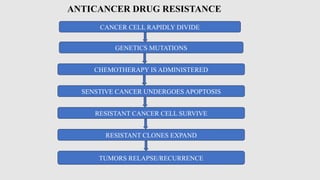
ANTICANCER DRUG RESISTANCE
CANCER CELL RAPIDLY DIVIDE
GENETICS MUTATIONS
CHEMOTHERAPY IS ADMINISTERED
SENSTIVE CANCER UNDERGOES APOPTOSIS
RESISTANT CANCER CELL SURVIVE
RESISTANT CLONES EXPAND
TUMORS RELAPSE/RECURRENCE
STRATEGIES TOCOMBAT RESISTANCE IN ANTI CANCER
1)COMBINATION THERAPY:
• Using more than one drug to reduce the resistance of cancer cells.
• Example: Doxorubicin +5 fluorouracil +Cyclophosphamide used in breast cancer.
2) TARGETED THERAPY
• Drugs designed to hit specific Cancer Cell proteins or pathways (e.g. tyrosine kinase inhibitor) minimize
off-target effects and slow resistance.
• In case of leukemia Imatinib may develop resistance due to mutation, then we have to use and 2nd
generation drug like→Dosatinib and Nilotinib.
3)IMMUNO THERAPY COMBINATION
Combining different immunotherapies (e.g. Checkpoint inhibitors, CAR-T cell. therapy) to overcome
resistance.
4) OVERCOME EFFLUX PUMP RESISTANCE
• They are tiny machines inside Cancer Cell that push Cancer drugs and back out of the cell.
• This makes the medicine less effective because it Can't stay Inside long enough to kill Cancer cell.
doxorubicin + verapamil and Paclitaxel + Tariquidar
REFERNCES
• Blair JMA, Webber MA, Baylay AJ, Ogbolu DO, Piddock LJV. Molecular mechanisms of antibiotic
resistance. Nat Rev Microbiol. 2015;13:42-51. doi:10.1038/nrmicro3380
• Darby EM, Trampari E, Siasat P, Solsona Gaya M, Alav I, Webber MA, et al. Molecular
mechanisms of antibiotic resistance revisited. Nat Rev Microbiol. 2023;21:280-295.
doi:10.1038/s41579-022-00820.
Combat Drug Resistance: Mechanisms and Future Strategies