COLD READING 
ALI.PK 
Pondicherry University. 
Department Of Psychology. 
muhammedalipk9@gmail.com
What Is It..? 
• Cold reading is the process of gaining 
information about someone without that 
person realizing that they are actually 
giving up the information themselves. 
This is achieved using a series of tricks 
and psychological manipulations to coax 
information out of the interviewee, and 
then to pass it off as being generated by 
psychic powers or other means.
CHARACTERISTICS 
The reading is 'cold' because it does not depend 
on any prior knowledge of the client. 
 The 'psychic' combines careful observations of 
the client's characteristics and behavior with a 
series of guesses that are based on deduction, 
knowledge of probabilities, and use of general 
('Barnum') statements that are readily accepted 
by large numbers of people as being true of 
themselves.
TECHNIQUES OF COLD READING 
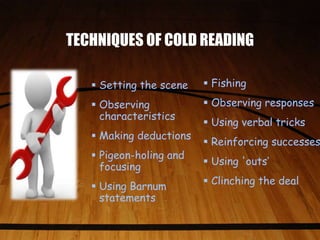
 Setting the scene 
 Observing 
characteristics 
 Making deductions 
 Pigeon-holing and 
focusing 
 Using Barnum 
statements 
 Fishing 
 Observing responses 
 Using verbal tricks 
 Reinforcing successes 
 Using 'outs‘ 
 Clinching the deal
1. SETTING THE SCENE 
• The cold reader must set the scene for the client, 
manage client expectations, and elicit client 
cooperation
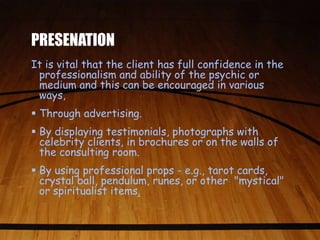
PRESENATION 
It is vital that the client has full confidence in the 
professionalism and ability of the psychic or 
medium and this can be encouraged in various 
ways, 
 Through advertising. 
 By displaying testimonials, photographs with 
celebrity clients, in brochures or on the walls of 
the consulting room. 
 By using professional props - e.g., tarot cards, 
crystal ball, pendulum, runes, or other "mystical" 
or spiritualist items.
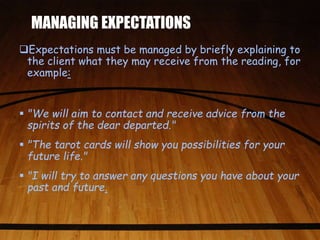
MANAGING EXPECTATIONS 
Expectations must be managed by briefly explaining to 
the client what they may receive from the reading, for 
example: 
 "We will aim to contact and receive advice from the 
spirits of the dear departed." 
 "The tarot cards will show you possibilities for your 
future life." 
 "I will try to answer any questions you have about your 
past and future.
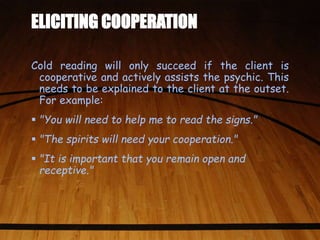
ELICITING COOPERATION 
Cold reading will only succeed if the client is 
cooperative and actively assists the psychic. This 
needs to be explained to the client at the outset. 
For example: 
 "You will need to help me to read the signs." 
 "The spirits will need your cooperation." 
 "It is important that you remain open and 
receptive."
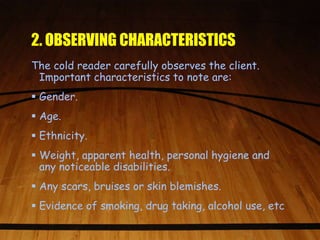
2. OBSERVING CHARACTERISTICS 
The cold reader carefully observes the client. 
Important characteristics to note are: 
 Gender. 
 Age. 
 Ethnicity. 
 Weight, apparent health, personal hygiene and 
any noticeable disabilities. 
 Any scars, bruises or skin blemishes. 
 Evidence of smoking, drug taking, alcohol use, etc
 Clothing, hairstyle, jeweler and badges, body 
decorations. 
 Any transfers on the clothes (e.g., animal or 
human hair, grasses, mud, oil, or stains). 
 Voice quality (regional accent, pitch, pace and 
modulation). 
 Vocabulary
3. MAKING DEDUCTIONS 
From these observations, the psychic will be able 
to make some highly probable guesses about the 
client. This is sometimes referred to as the 
"Sherlock Holmes" technique. For example: 
 An engagement ring will generally indicate an 
impending marriage. 
 Signs that a wedding ring have been removed 
(e.g., by noticing lighter skin tone on the ring 
finger) may indicate a recent separation or 
divorce.
 Educational level may be inferred from voice and 
vocabulary 
 Affluence may be inferred from clothing and 
jewelers. 
 Particular interests may inferred from T-shirts, 
badges, etc. 
 If the reading is done in the client's home, much 
more information can be gleaned (e.g., from 
family photographs, bookshelves).
4. PIGEON-HOLING AND FOCUSSING 
 The cold reader will generally aim to pigeon-hole 
(stereotype) the client into a particular category of 
person. 
 The most basic categories are based on gender and 
age (e.g., teenage female; middle-aged man; elderly 
woman). 
 More specific categories and stereotypes can also be 
useful 
 Having pigeon-holed the client, the reading is then 
focused around areas stereotypically of concern to 
people in this category, and also around any specific 
deductions that can be made based on observations of 
the client.
For example: 
 A mid-teen female is likely to experience difficulties 
relating to popularity, peer pressure and boys. 
 A middle-aged, poorly-dressed man who is rather 
overweight and wears no wedding ring, may have low 
self-esteem. 
 A man wearing a wedding ring whose breath and 
clothes smell of alcohol is very likely to have marital 
problems
5. USING BARNUM STATEMENTS 
 So-called 'Barnum statements' are named after the 
American showman P.T. Barnum who is often credited 
with coining the phrase "there's a sucker born every 
minute. 
 Barnum statements are those that seem to relate to a 
particular individual but actually apply to everyone, or 
almost everyone. Such statements are a typical 
feature of horoscopes and they are used extensively 
in cold reading.
• Research by psychologists (e.g., B.R. Forer) has shown 
that such statements are readily accepted by a person 
if led to believe that the statements apply specifically 
to them. Because they are easily accepted by the 
client, such statements also serve to enhance the 
client's general faith in the psychic. 
 Examples of Barnum statements are: 
 "You have much unused potential." 
 "You get a little anxious in new social situations.“
6. FISHING 
 'Fishing' refers to making some very specific, 
seemingly improbable, statements that may or may 
not be true of the client. 
 If the statement turns out to be true, the strength 
of the "hit" will greatly impress the client, and the 
statement will be clearly remembered. 
 If wrong, then the psychic can simply move on to 
something else and the 'miss' will very likely be 
forgotten by the client. Alternatively the psychic 
may prefer to use an 'out' to excuse the failure.
7. OBSERVING RESPONSES 
 Especially when fishing, you can see the accuracy of 
your statements by observing carefully how the client 
responds. 
 In particular, watch the face and hands, and also look 
out for any uncomfortable shuffling in the seat. 
 These responses can often give away how the client is 
feeling about what you are saying. In this way it is 
generally quite easy to tell if you are on the right 
track, or completely wrong. 
 If you are right, then continue along the same line; if 
wrong, then subtly change track.
8. USING VERBAL TRICKS 
 There are certain tricks and subtleties in the way that 
language can be used that will greatly enhance a cold 
reading. 
Verbal ambiguities 
 Some words have more than one meaning that can be 
usefully exploited by the cold reader. 
 By observing how the client interprets an ambiguous 
word, the reading can then follow up that particular 
meaning.
REPEATING INFORMATION GIVEN BY THE 
CLIENT 
 The cold reader should file away in memory every bit 
of information that the client gives during the reading. 
 This not only allows further deductions to be made 
from the information given, but the psychic can also 
exploit the fact that clients will often forget that 
they have said certain things. 
 This enables the cold reader to repeat back to the 
client, at some later point, information that the client 
has given, as if this information was being received 
psychically.
9. REINFORCING SUCCESSES 
 Whenever the client confirms one of the psychic's 
statements, this should be clearly reinforced by 
saying "That's right", or "Yes ", or "Good", or 
something similar. 
 This will help to convince the client that the reading is 
succeeding.
10. USING 'OUTS' 
 Sometimes the psychic will say something that is 
contradicted by the client. When this happens, the 
cold reader should come up with a plausible 
explanation or excuse for the apparent mistake. 
 This will help to convince the client that the reading is 
succeeding.
BLAME THE CLIENT 
 Often, the psychic can save face by subtly blaming the 
client for not understanding or not agreeing with a 
statement The implication is that the statement is 
true, but the client doesn't realize it, and is wrong to 
disagree with it. 
 This strategy can generally be used whenever there is 
a possibility, however remote, that the original 
statement is true.
• E.g. "You will understand this better later." 
• The psychic can also directly blame the client for 
any resistance to statements, for example: 
• "You must open your heart to these messages, my 
dear." 
• "The spirits will find it easier if you are open to 
what they have to say."
11. CLINCHING THE DEAL 
 At the end of the reading, the psychic should briefly 
summarize the key (correct) information that was 
given (including that which came from the client) 
aiming to do so in a positive way that will provide 
comfort to the client. This should be combined with a 
statement that reinforces how accurate and genuine 
the reading was.
BECOME AN EXPERT 
 Much of your success at cold reading will depend 
on your observational skills, on your ability to 
read character and non-verbal behavior, and on 
your verbal fluency and capacity for quick 
thinking. 
 Some of the techniques mentioned can, however, 
benefit from good preparation.
Thank Ψou 
ALI.PK 
Pondicherry University 
Department Of Psychology. 
muhammedalipk9@gmail.com