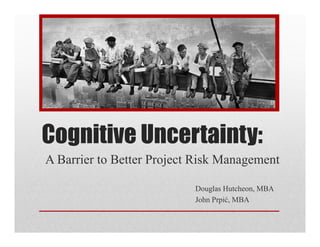
Cognitive Uncertainty:
A Barrier to Better Project Risk Management
Douglas Hutcheon, MBA
John Prpić, MBA
• Understanding that Risk is a form of Uncertainty
• Recognizing Cognitive Bias in your Team
• Actionable Guidance for Better Project Risk Management
Learning Points
Introduction
• Who am I?
• Who is John Prpić?
The Current State
Establishing the Context
• Organizational Structure
• Reporting Lines
• Departmental Autonomy
• Standards, Tools, and Terminologies
• Dueling Academics/Methodologies/Practices/Recommendations
• Role Power
• Profession or Process?
• Strategy
• Missing, Misaligned, Marginalized
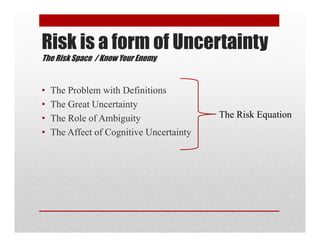
Risk is a form of Uncertainty
The Risk Space / Know Your Enemy
• The Problem with Definitions
• The Great Uncertainty
• The Role of Ambiguity
• The Affect of Cognitive Uncertainty
The Risk Equation
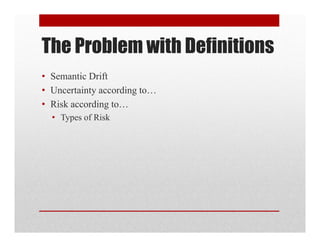
The Problem with Definitions
• Semantic Drift
• Uncertainty according to…
• Risk according to…
• Types of Risk
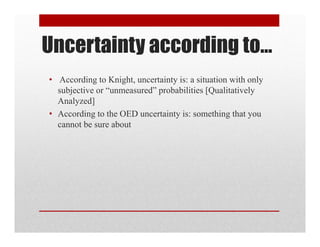
• According to Knight, uncertainty is: a situation with only
subjective or “unmeasured” probabilities [Qualitatively
Analyzed]
• According to the OED uncertainty is: something that you
cannot be sure about
Uncertainty according to…
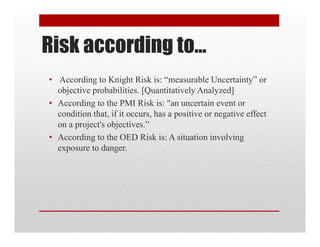
• According to Knight Risk is: “measurable Uncertainty” or
objective probabilities. [Quantitatively Analyzed]
• According to the PMI Risk is: "an uncertain event or
condition that, if it occurs, has a positive or negative effect
on a project's objectives.”
• According to the OED Risk is: A situation involving
exposure to danger.
Risk according to…
Negative
• Tangible impacts are easier to estimate/quantify
• Intangible impacts are more difficult to estimate/quantify
• Require Mitigation
Positive
• Tangible impacts are easier to estimate/quantify
• Intangible impacts are more difficult to estimate/quantify
• Require Exploitation or Capture Planning
Types of Risk
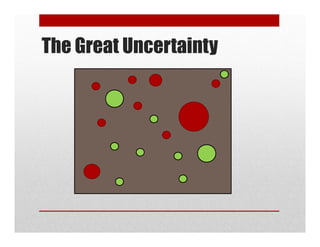
The Great Uncertainty
Ambiguous Data 1
• Affects the precision of your Risk Inputs
• Effects the accuracy of your Risk Outputs/Product/Analysis
Organizational Ambiguity b
• Generally considered a bad thing.
• Can some ambiguity be a good thing?
Ambiguity as Constraint d
• Can ambiguity be designed or planned to illicit better decision
making?
The Role of Ambiguity
Individual
• Differing mix of biases
Situational
• Resource strength i.e. time/budget/people
Mission
• Greater risk taking behavior to achieve established Schedule or Profit
targets
• Reduced appetite for Risk after target met
Casualties
• Higher value resources are not risked as often
• Lower value resources are risked more often
Past Battles
• Past successes make future successes seem more likely
The Affect of Cognitive Uncertainty 1
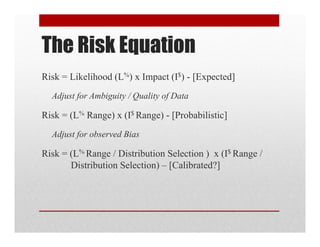
Risk = Likelihood (L%) x Impact (I$) - [Expected]
Adjust for Ambiguity / Quality of Data
Risk = (L% Range) x (I$ Range) - [Probabilistic]
Adjust for observed Bias
Risk = (L% Range / Distribution Selection ) x (I$ Range /
Distribution Selection) – [Calibrated?]
The Risk Equation
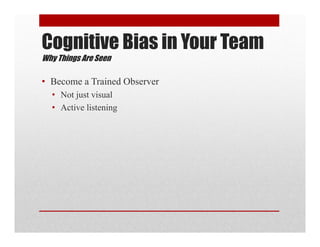
Cognitive Bias in Your Team
Why Things Are Seen
• Become a Trained Observer
• Not just visual
• Active listening
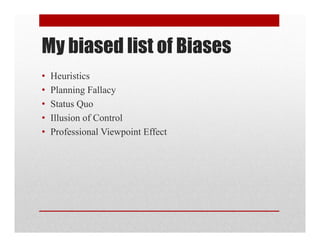
My biased list of Biases
• Heuristics
• Planning Fallacy
• Status Quo
• Illusion of Control
• Professional Viewpoint Effect
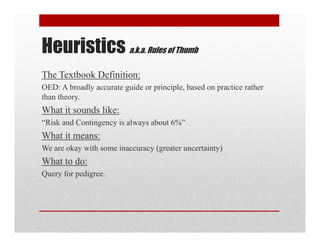
Heuristics a.k.a. Rules of Thumb
The Textbook Definition:
OED: A broadly accurate guide or principle, based on practice rather
than theory.
What it sounds like:
“Risk and Contingency is always about 6%”
What it means:
We are okay with some inaccuracy (greater uncertainty)
What to do:
Query for pedigree.
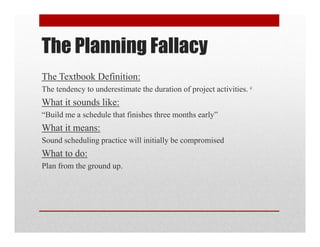
The Planning Fallacy
The Textbook Definition:
The tendency to underestimate the duration of project activities. c
What it sounds like:
“Build me a schedule that finishes three months early”
What it means:
Sound scheduling practice will initially be compromised
What to do:
Plan from the ground up.
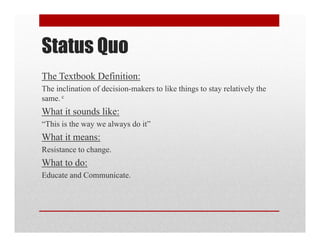
Status Quo
The Textbook Definition:
The inclination of decision-makers to like things to stay relatively the
same. c
What it sounds like:
“This is the way we always do it”
What it means:
Resistance to change.
What to do:
Educate and Communicate.
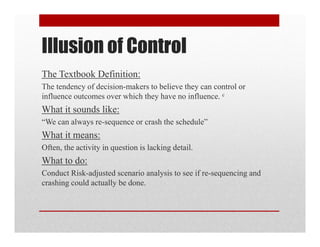
Illusion of Control
The Textbook Definition:
The tendency of decision-makers to believe they can control or
influence outcomes over which they have no influence. c
What it sounds like:
“We can always re-sequence or crash the schedule”
What it means:
Often, the activity in question is lacking detail.
What to do:
Conduct Risk-adjusted scenario analysis to see if re-sequencing and
crashing could actually be done.
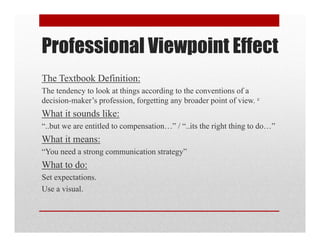
Professional Viewpoint Effect
The Textbook Definition:
The tendency to look at things according to the conventions of a
decision-maker’s profession, forgetting any broader point of view. c
What it sounds like:
“..but we are entitled to compensation…” / “..its the right thing to do…”
What it means:
“You need a strong communication strategy”
What to do:
Set expectations.
Use a visual.
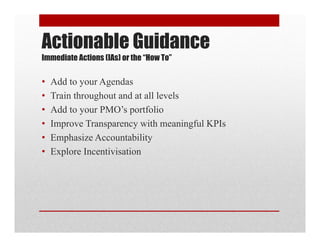
Actionable Guidance
Immediate Actions (IAs) or the “How To”
• Add to your Agendas
• Train throughout and at all levels
• Add to your PMO’s portfolio
• Improve Transparency with meaningful KPIs
• Emphasize Accountability
• Explore Incentivisation
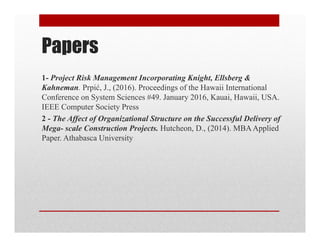
Papers
1- Project Risk Management Incorporating Knight, Ellsberg &
Kahneman. Prpić, J., (2016). Proceedings of the Hawaii International
Conference on System Sciences #49. January 2016, Kauai, Hawaii, USA.
IEEE Computer Society Press
2 - The Affect of Organizational Structure on the Successful Delivery of
Mega- scale Construction Projects. Hutcheon, D., (2014). MBAApplied
Paper. Athabasca University
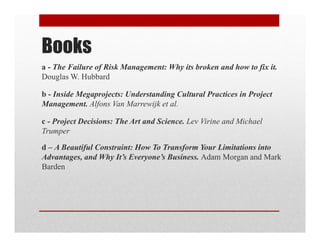
Books
a - The Failure of Risk Management: Why its broken and how to fix it.
Douglas W. Hubbard
b - Inside Megaprojects: Understanding Cultural Practices in Project
Management. Alfons Van Marrewijk et al.
c - Project Decisions: The Art and Science. Lev Virine and Michael
Trumper
d – A Beautiful Constraint: How To Transform Your Limitations into
Advantages, and Why It’s Everyone’s Business. Adam Morgan and Mark
Barden
• Understanding that Risk is a form of Uncertainty
• Recognizing Cognitive Bias in your Team
• Actionable Guidance for Better Project Risk Management
Learning Points
Cognitive Uncertainty:
A Barrier to Better Project Risk Management
Douglas Hutcheon, MBA
John Prpić, MBA