Hosted by GIZ, this Expert Exchange gathered a panel of industry experts and innovators to explore data availability challenges, opportunities and barriers in coal mine methane mitigation, and viable technical solutions from different countries.
Johannes Lohmeyer
IKI JET/GIZ
Speakers
Michal Drabik
UNECE
Tomás de Oliveira Bredariol
IEA
Chiara Giamberardini
UNECE
Suvd-Erdene Otgonbaatar
IKI JET/ GIZ
Sabina Assan
EMBER
Peter Börgardts
Eisenmann Environmental Technology
GmbH
3.
Introduction to theInnovation Regions for
a Just Energy Transition (IKI JET) Project
By Suvd-Erdene Otgonbaatar
4.
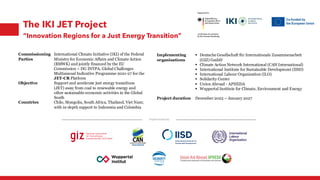
The IKI JETProject
“Innovation Regions for a Just Energy Transition”
Commissioning
Parties
International Climate Initiative (IKI) of the Federal
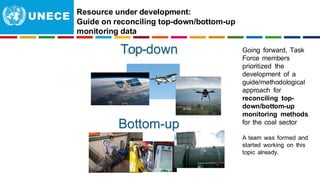
Ministry for Economic Affairs and Climate Action
(BMWK) and jointly financed by the EU
Commission – DG INTPA, Global Challenges
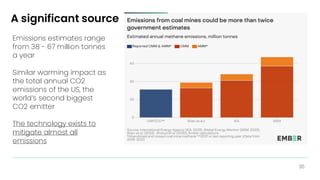
Multiannual Indicative Programme 2021-27 for the
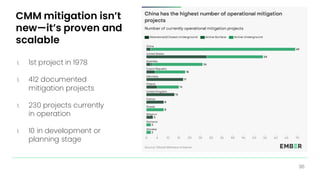
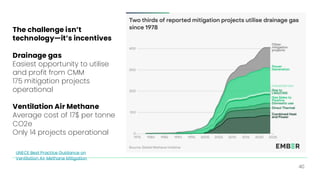
JET-CR Platform
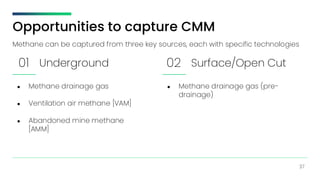
Objective Support and accelerate just energy transitions
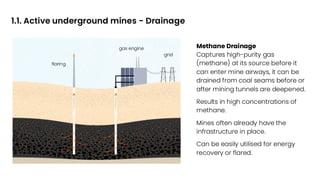
(JET) away from coal to renewable energy and
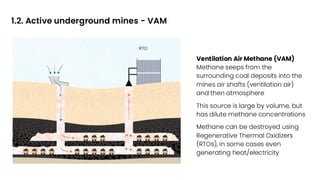
other sustainable economic activities in the Global
South
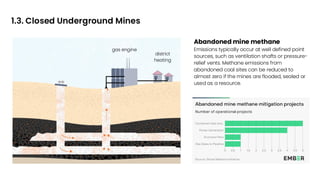
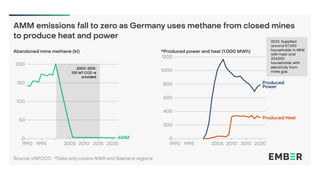
Countries Chile, Mongolia, South Africa, Thailand, Viet Nam;
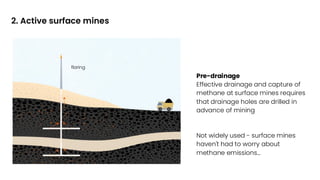
with in-depth support to Indonesia and Colombia
Implementing
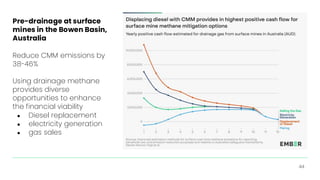
organisations
▪ Deutsche Gesellschaft für Internationale Zusammenarbeit
(GIZ) GmbH
▪ Climate Action Network International (CAN International)
▪ International Institute for Sustainable Development (IISD)
▪ International Labour Organisation (ILO)
▪ Solidarity Center
▪ Union Abroad - APHEDA
▪ Wuppertal Institute for Climate, Environment and Energy
Project duration December 2022 – January 2027
Implemented by
5.
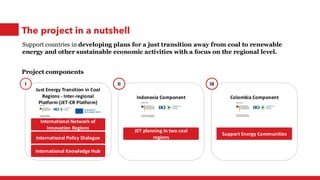
The project ina nutshell
Support countries in developing plans for a just transition away from coal to renewable
energy and other sustainable economic activities with a focus on the regional level.
Project components
International Network of
Innovation Regions
International Knowledge Hub
Just Energy Transition in Coal
Regions - Inter-regional
Platform (JET-CR Platform)
International Policy Dialogue
I
JET planning in two coal
regions
Indonesia Component
II
Colombia Component
III
Support Energy Communities
6.
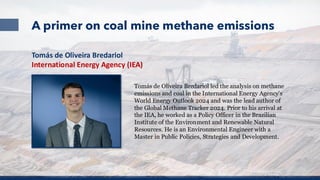
A primer oncoal mine methane emissions
Tomás de Oliveira Bredariol led the analysis on methane
emissions and coal in the International Energy Agency's
World Energy Outlook 2024 and was the lead author of
the Global Methane Tracker 2024. Prior to his arrival at
the IEA, he worked as a Policy Officer in the Brazilian
Institute of the Environment and Renewable Natural
Resources. He is an Environmental Engineer with a
Master in Public Policies, Strategies and Development.
Tomás de Oliveira Bredariol
International Energy Agency (IEA)
7.
IEA 2025 Page11
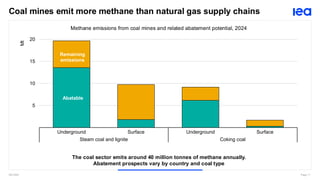
Coal mines emit more methane than natural gas supply chains
The coal sector emits around 40 million tonnes of methane annually.
Abatement prospects vary by country and coal type
Methane emissions from coal mines and related abatement potential, 2024
5
10
15
20
Underground Surface Underground Surface
Steam coal and lignite Coking coal
Mt
Abatable
Remaining
emissions
8.
IEA 2025 Page12
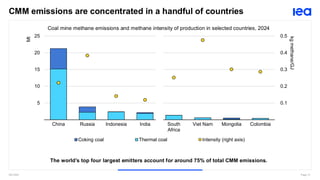
CMM emissions are concentrated in a handful of countries
The world’s top four largest emitters account for around 75% of total CMM emissions.
Coal mine methane emissions and methane intensity of production in selected countries, 2024
0.1
0.2
0.3
0.4
0.5
5
10
15
20
25
China Russia Indonesia India South
Africa
Viet Nam Mongolia Colombia
kg
methane/GJ
Mt
Coking coal Thermal coal Intensity (right axis)
9.
IEA 2025 Page13
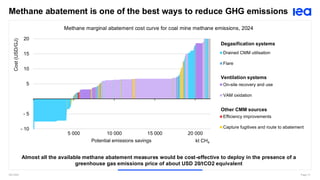
Methane abatement is one of the best ways to reduce GHG emissions
Almost all the available methane abatement measures would be cost-effective to deploy in the presence of a
greenhouse gas emissions price of about USD 20/tCO2 equivalent
Methane marginal abatement cost curve for coal mine methane emissions, 2024
- 10
- 5
5
10
15
20
5 000 10 000 15 000 20 000
Cost
(USD/GJ)
Potential emissions savings
Drained CMM utilisation
Flare
On-site recovery and use
VAM oxidation
Efficiency improvements
Capture fugitives and route to abatement
Degasification systems
Ventilation systems
Other CMM sources
kt CH4
10.
IEA 2025 Page15
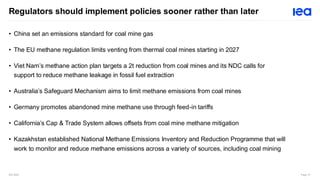
Regulators should implement policies sooner rather than later
• China set an emissions standard for coal mine gas
• The EU methane regulation limits venting from thermal coal mines starting in 2027
• Viet Nam’s methane action plan targets a 2t reduction from coal mines and its NDC calls for
support to reduce methane leakage in fossil fuel extraction
• Australia’s Safeguard Mechanism aims to limit methane emissions from coal mines
• Germany promotes abandoned mine methane use through feed-in tariffs
• California’s Cap & Trade System allows offsets from coal mine methane mitigation
• Kazakhstan established National Methane Emissions Inventory and Reduction Programme that will
work to monitor and reduce methane emissions across a variety of sources, including coal mining
Coal Mine Methane:Data Availability & Measurement
Chiara Giamberardini is Economic Affairs Officer in
the Sustainable Energy Division of the UNECE, and
Secretary of the Group of Experts on Coal Mine Methane
and Just Transition. She has over 20 years of experience
in international development matured across various
organizations and capacities in New York, Geneva and in
developing countries.
United Nations Economic Commission for Europe (UNECE)
Since 2015, Michal Drabik has been employed
with the UNECE. He currently holds a position of an
Economic Affairs Officer in the Sustainable Energy
Division and works on matters related to coal mine
methane and Just Transition.
Chiara Giamberardini Michal Drabik
13.
Expert Exchange onCoal Mine Methane
IKI JET Project «Innovation Regions for a Just Energy
Transition»
Coal Mine Methane:
Data Availability & Measurement
Challenges in Data Access &
Measurement Approaches
Chiara Giamberardini & Michal Drabik
UNECE Group of Experts on Coal Mine Methane
and Just Transition, Secretariat
giamberardini@un.org | michal.drabik@un.org
14.
Group of Expertson Coal Mine Methane &
Just Transition Mandate & Areas of Work
Our Mission:
Promoting an efficient, environmentally sustainable transition of coal-related
industries by:
Reducing greenhouse gas emissions
Ensuring social equity in the transition process
Key Activities:
Methane Recovery & Use – Advancing the capture and use of methane
from active, closed, and abandoned coal mines
Mine Closure & Socio-economic Transition – Supporting coal mines,
regions, and communities in preparing for closure and reorienting local
economies (upon request)
Just Transition Framework – Developing and piloting a principles-based
framework to ensure a just transition for coal-dependent areas
15.
Group of Expertson Coal Mine Methane & Just
Transition Annual Meeting & Task Forces
The Group meets annually in Geneva every March/April
to review the work done by experts through task forces and
other means, discuss strategic issues, and agree on
upcoming priorities.
Task Forces meet online on a regular basis and collaborate towards agreed activities
➢ Methane Emissions Reduction
▪ Advances efforts to measure, reduce, and manage methane emissions from active, closed, and abandoned
coal mines → to reduce risks of methane-related mining incidents, mitigate climate change, and support just
transition and sustainable development
➢ Safe Operations and Closure of Coal Mines
▪ Addresses safety protocols and the responsible, safe closure of coal mines → to protect both workers and the
environment
➢ Just Transition
▪ Focuses on strategies to ensure a just and equitable transition for workers and communities affected by
industry changes → has developed a Just Energy Transition approach to lay the foundation for resilient, low-
carbon economies and societies & is developing Guiding Principles for just transitions
16.
Coal Mine MethaneEmissions Reduction:
The Role of Monitoring, Reporting and Verification
(MRV) Programmes
Why Methane Reduction Matters?
➢ 25% of climate change caused by human-made methane emissions
➢ Methane is 80x more potent than CO₂ over 20 years
➢ Energy sector = 40% of human-caused methane emissions (IEA)
➢ Coal mining contributes ~12% of global anthropogenic methane emissions (US EPA 2019)
International, regional and national obligations / commitments
➢ Countries that are party to the UNFCCC & are committed to the targets set out in the Paris
Agreement are subject to a carbon accounting process that includes requirement to report
methane emissions from coal mining in their inventory submissions
➢ Global Methane Pledge – 150+ countries having committed to reducing methane by 30% by 2030
➢ Aarhus Convention on Access to Information, Public Participation in Decision-making and Access to
Justice in Environmental Matters & its Protocol on Pollutant Release and Transfer Registers
➢ EU Methane Regulation
17.
The Role ofMonitoring, Reporting and Verification (MRV) Programmes
➢ Action to reduce CMM emissions requires a solid understanding of emission sources at
national, subnational and local levels
➢ Many national level inventories are not sufficiently detailed, source-specific, nor reliable
enough to effectively inform mitigation policies
➢ Monitoring, reporting and verification (MRV) programmes help countries better understand the
contribution of coal mining to the overall methane & other GHG emissions and identify opportunities
for mitigation → unfortunately, only a handful of MRV programmes exist
Coal Mine Methane Emissions Reduction:
The Role of Monitoring, Reporting and Verification
(MRV) Programmes
18.
Coal Mine MethaneEmissions Reduction:
Key Challenges in CMM, AMM & SMM Data
Collection & Reporting
“Lack of transparent, reliable, and timely data on coal sector operations and emissions = #1 barrier for CMM projects”
(2023 GMI Coal Mines Subcommittee Meeting)
➢ Lack of globally harmonized, transparent and consistently measured data on CMM, AMM & SMM emissions
➢ Absence of centralized data repositories – while data often exists (e.g. for safety reasons), it remains scattered
across technical reports and inaccessible to policymakers or the public
➢ Insufficient measured/empirical emissions data, with estimates often based on outdated or generic emission
factors rather than direct measurements
➢ Limited deployment of advanced methane monitoring technologies, resulting in infrequent, incomplete and
often unverified or low-quality data
➢ Weak regulatory framework and limited incentives for companies to invest in methane monitoring and
mitigating
➢ Voluntary and infrequent reporting to the UNFCCC, with annual submissions still rare for most coal-
producing countries
➢ High costs associated with installing and maintaining continuous methane monitoring systems, especially
in remote or difficult-to-access mines
➢ Scarcity of historical data hampering the ability to analyze long-term methane emission trends
➢ Poor data-sharing infrastructure and inefficient transfer mechanisms across institutions and borders
19.
Monitoring
➢ Monitoring iscrucial for evaluation of mine safety, as well as planning, executing, and evaluating
methane recovery projects and other emission mitigation and reduction efforts.
➢ Insufficient data creates uncertainty, which hampers accurate estimates of emissions, project feasibility
assessments, adoption of relevant mitigation strategies, and proper regulatory intervention
➢ What are the sources of data?
➢ Site level data
➢ Remote sensing data (drone, aircraft, and satellite obtained emissions observations).
➢ National inventories
➢ Public data and emissions modeling based on public and/or scientific data
➢ The Challenge: Reliability of data
➢ Site-level measurements have the lowest level of uncertainty, but data can be costly to collate and maintain, and depends on
proper calibration of equipment.
➢ Remote sensing is sensitive to weather conditions and often lacks time series data and site-level corroboration.
20.
Site-level Measuring
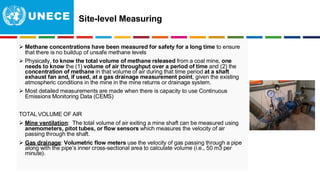
➢ Methaneconcentrations have been measured for safety for a long time to ensure
that there is no buildup of unsafe methane levels
➢ Physically, to know the total volume of methane released from a coal mine, one
needs to know the (1) volume of air throughput over a period of time and (2) the
concentration of methane in that volume of air during that time period at a shaft
exhaust fan and, if used, at a gas drainage measurement point, given the existing
atmospheric conditions in the mine in the mine returns or drainage system.
➢ Most detailed measurements are made when there is capacity to use Continuous
Emissions Monitoring Data (CEMS)
TOTAL VOLUME OF AIR
➢ Mine ventilation: The total volume of air exiting a mine shaft can be measured using
anemometers, pitot tubes, or flow sensors which measures the velocity of air
passing through the shaft.
➢ Gas drainage: Volumetric flow meters use the velocity of gas passing through a pipe
along with the pipe’s inner cross-sectional area to calculate volume (i.e., 50 m3 per
minute).
21.
Site-level Measuring
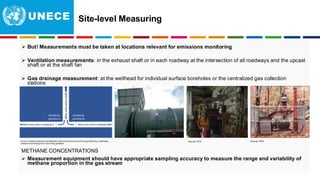
➢ But!Measurements must be taken at locations relevant for emissions monitoring
➢ Ventilation measurements: in the exhaust shaft or in each roadway at the intersection of all roadways and the upcast
shaft or at the shaft fan
➢ Gas drainage measurement: at the wellhead for individual surface boreholes or the centralized gas collection
stations
METHANE CONCENTRATIONS
➢ Measurement equipment should have appropriate sampling accuracy to measure the range and variability of
methane proportion in the gas stream
Source: Australia Clean Energy Regulator, National Greenhouse and Energy Reporting, “Estimating
emissions and energy from coal mining guideline”
Source: EPA Source: EPA
22.
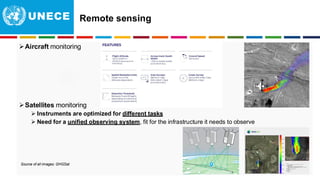
Remote sensing
➢Aircraft monitoring
➢Satellitesmonitoring
➢ Instruments are optimized for different tasks
➢ Need for a unified observing system, fit for the infrastructure it needs to observe
Source of all images: GHGSat
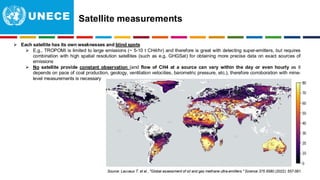
23.
Satellite measurements
Source: LauvauxT. et al., "Global assessment of oil and gas methane ultra-emitters." Science 375.6580 (2022): 557-561.
➢ Each satellite has its own weaknesses and blind spots
➢ E.g., TROPOMI is limited to large emissions (~ 5-10 t CH4/hr) and therefore is great with detecting super-emitters, but requires
combination with high spatial resolution satellites (such as e.g. GHGSat) for obtaining more precise data on exact sources of
emissions
➢ No satellite provide constant observation (and flow of CH4 at a source can vary within the day or even hourly as it
depends on pace of coal production, geology, ventilation velocities, barometric pressure, etc.), therefore corroboration with mine-
level measurements is necessary
24.
Reporting and Verification
➢In addition to sound monitoring, reporting systems and verification are needed to deliver quality
data
➢ Reporting considerations:
➢ Ensure that facilities have the technical capacity to correctly monitor, measure and report data
➢ Need to balance the burden put on reporters and the level of detail sufficient for mitigation
➢ Ensure that cost of requirements match the benefits derived from the reported data
➢ Ensure that reporting system is easy to access and facilitate documentation (data management is in place)
➢ Verification considerations:
➢ Ensure that measurements are consistent, complete, and aligned with equipment standards & procedures
➢ Ensure that results are calculated accurately and checked for consistency
➢ Enable independent verification, if possible.
➢ MRV programs can:
➢ Establish a clear baseline of CH4
➢ Form an understanding of the variation in CH4 flows & concentrations
➢ Provide information for setting up accurate inventories
➢ Provide project developers with confidence in gas availability over time
25.
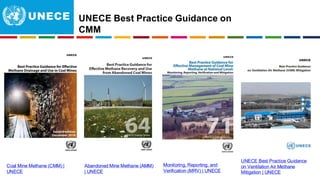
UNECE Best PracticeGuidance on
CMM
Coal Mine Methane (CMM) |
UNECE
Abandoned Mine Methane (AMM)
| UNECE
Monitoring, Reporting, and
Verification (MRV) | UNECE
UNECE Best Practice Guidance
on Ventilation Air Methane
Mitigation | UNECE
26.
Resource at aGlance:
Template for Estimating CMM Emissions
What it does: Provides an easy-to-use, Excel-based template for
collecting necessary data, provides appropriate methodology-based
equations, and calculates total annual emissions for a single facility
(i.e., underground coal mine) consistent with an IPCC Tier 3
approach
Why it is helpful: Estimates facility-specific methane emissions
based on data that may already be collected for safety purposes,
such as methane flow & methane concentration
How it can be accessed: It is freely available on the UNECE and
GMI websites to download, use, and adapt (CMM emissions estimation
template_monthly-final.xlsx)
▪ What data does it require: monthly measurements at monitoring points for ventilation and degasification
systems (customization is possible)
▪ What other information can be included: methane destruction or transportation off-site; remote sensing
campaigns; or information relevant to potential CMM project development
27.
Resource under development:
Guideon reconciling top-down/bottom-up
monitoring data
Top-down
Bottom-up
Going forward, Task
Force members
prioritized the
development of a
guide/methodological
approach for
reconciling top-
down/bottom-up
monitoring methods
for the coal sector
A team was formed and
started working on this
topic already.
28.
Engagement with UNECE
UNECETask Force on Methane Emissions Reduction
Objective:
Dedicated to advancing efforts in measuring,
reducing, and managing methane emissions from
active, closed, and abandoned coal mines. Our goal
is to enhance safety, mitigate climate change,
and support a just transition and sustainable
development.
Areas of Focus:
CMM, AMM, VAM capture & use
Pre-mine drainage strategies
Methane emissions
sources & regulation MRV
(Measurement, Reporting,
Verification) Environmental
Thank you
for inviting
us!
We look
forward to
discussing
&
exchanging
with you
during the
Q&A
session!
29.
CMM Usages: Opportunitiesand Challenges
Sabina joined Ember in 2022 as a Coal Mine Methane Analyst,
raising the profile of coal mine methane and promoting the
technologies and policies to measure and reduce these
emissions. She has over ten years experience in the
environmental sector, including work in measuring fugitive
methane emissions from anthropogenic sites in Europe. She
holds a PhD in Environmental Sciences from Laboratoire des
Sciences du Climat et de L’Environnement
Sabina Assan
EMBER
30.
Emissions estimates range
from38 - 67 million tonnes
a year
Similar warming impact as
the total annual CO2
emissions of the US, the
world’s second biggest
CO2 emitter
The technology exists to
mitigate almost all
emissions
35
A significant source
31.
1. 1st projectin 1978
1. 412 documented
mitigation projects
1. 230 projects currently
in operation
1. 10 in development or
planning stage
36
CMM mitigation isn’t
new—it’s proven and
scalable
32.
01 02
37
Opportunities tocapture CMM
● Methane drainage gas
● Ventilation air methane [VAM]
● Abandoned mine methane
[AMM]
● Methane drainage gas (pre-
drainage)
Underground Surface/Open Cut
Methane can be captured from three key sources, each with specific technologies
33.
1.1. Active undergroundmines - Drainage
Methane Drainage
Captures high-purity gas
(methane) at its source before it
can enter mine airways, it can be
drained from coal seams before or
after mining tunnels are deepened.
Results in high concentrations of
methane.
Mines often already have the
infrastructure in place.
Can be easily utilised for energy
recovery or flared.
flaring
gas engine
grid
34.
1.2. Active undergroundmines - VAM
Ventilation Air Methane (VAM)
Methane seeps from the
surrounding coal deposits into the
mines air shafts (ventilation air)
and then atmosphere
This source is large by volume, but
has dilute methane concentrations
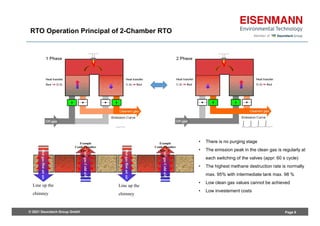
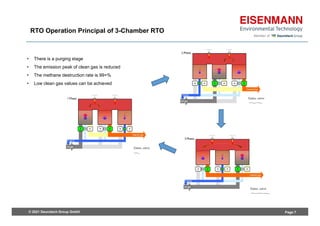
Methane can be destroyed using
Regenerative Thermal Oxidizers
(RTOs), in some cases even
generating heat/electricity
RTO
35.
The challenge isn’t
technology—it’sincentives
Drainage gas
Easiest opportunity to utilise
and profit from CMM
175 mitigation projects
operational
Ventilation Air Methane
Average cost of 17$ per tonne
CO2e
Only 14 projects operational
40
UNECE Best Practice Guidance on
Ventilation Air Methane Mitigation
36.
1.3. Closed UndergroundMines
Abandoned mine methane
Emissions typically occur at well defined point
sources, such as ventilation shafts or pressure-
relief vents. Methane emissions from
abandoned coal sites can be reduced to
almost zero if the mines are flooded, sealed or
used as a resource.
gas engine
district
heating
2. Active surfacemines
Pre-drainage
Effective drainage and capture of
methane at surface mines requires
that drainage holes are drilled in
advance of mining
Not widely used - surface mines
haven't had to worry about
methane emissions…
flaring
39.
Pre-drainage at surface
minesin the Bowen Basin,
Australia
Reduce CMM emissions by
38-46%
Using drainage methane
provides diverse
opportunities to enhance
the financial viability
● Diesel replacement
● electricity generation
● gas sales
44
40.
45
To summarise…
The bestmitigation strategy is to keep the coal in the ground
For active and closed coal mines, the technology to mitigate methane emissions is proven and
has been used globally
Mitigation options can be profitable to mines when the methane is utilised
So what’s holding us back?
● Can sometimes be a costly investment, especially when the methane can’t be utilised
● Lack of incentives for coal mines (carrots/sticks)
● Knowledge gap
● Industry resistance
Coal Mine Methane(CMM) installations in China
Studied process engineering at the University of Stuttgart, graduating with
a degree in engineering (1989)
Experiences:
• Eisenmann Environmental Technology GmbH since 2020 (Head of
Sales)
• Eisenmann Anlagenbau GmbH in the field of environmental
technology (various sales roles up to Head of Sales: 1996-2020)
• PhD from the University of Stuttgart, Faculty of Process Engineering
(1996)
• Fraunhofer Institute for Interfacial Engineering and Biotechnology
(1990-1996)
Peter Börgardts
Eisenmann Environmental Technology GmbH
44.
EISENMANN Coal MineMethane (CMM) installations in China
EISENMANN 10 chamber valveless RTO System with rotating distributor
EISENMANN Environmental Technology GmbH
Dr.-Ing. Peter Börgardts
3
Eisenmann Environmental Technology- Development
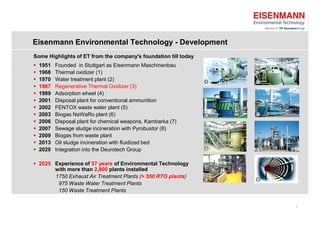
Some Highlights of ET from the company's foundation till today
1951 Founded in Stuttgart as Eisenmann Maschinenbau
1968 Thermal oxidizer (1)
1970 Water treatment plant (2)
1987 Regenerative Thermal Oxidizer (3)
1989 Adsorption wheel (4)
2001 Disposal plant for conventional ammunition
2002 FENTOX waste water plant (5)
2003 Biogas NaWaRo plant (6)
2006 Disposal plant for chemical weapons, Kambarka (7)
2007 Sewage sludge incineration with Pyrobustor (8)
2009 Biogas from waste plant
2013 Oil sludge incineration with fluidized bed
2020 Integration into the Deurotech Group
2025 Experience of 57 years of Environmental Technology
with more than 2,800 plants installed
1750 Exhaust Air Treatment Plants (> 550 RTO plants)
975 Waste Water Treatment Plants
150 Waste Treatment Plants
1 2
3 4
5 6
7 8
5
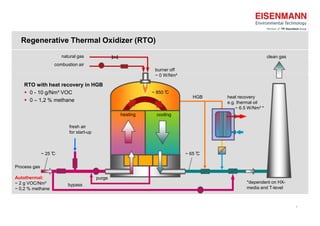
Regenerative Thermal Oxidizer(RTO)
RTO with heat recovery in HGB
0 - 10 g/Nm³ VOC
0 – 1,2 % methane
~ 25 °
C ~ 65 °
C
heating cooling
natural gas
combustion air
bypass
purge
clean gas
~ 850 °
C
fresh air
for start-up
HGB
Process gas
Autothermal:
~ 2 g VOC/Nm³
~ 0,2 % methane
burner off
~ 0 W/Nm³
heat recovery
e.g. thermal oil
~ 6.5 W/Nm³ *
*dependent on HX-
media and T-level
9
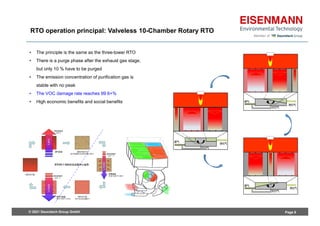
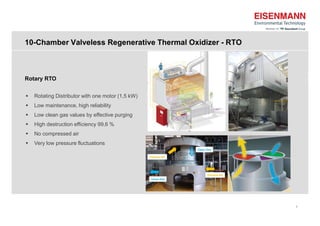
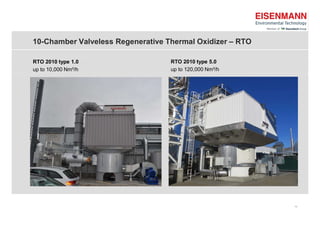
10-Chamber Valveless RegenerativeThermal Oxidizer - RTO
Rotating Distributor with one motor (1,5 kW)
Low maintenance, high reliability
Low clean gas values by effective purging
High destruction efficiency 99,6 %
No compressed air
Very low pressure fluctuations
Rotary RTO
11
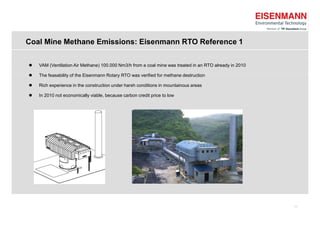
Coal Mine MethaneEmissions: Eisenmann RTO Reference 1
VAM (Ventilation Air Methane) 100.000 Nm3/h from a coal mine was treated in an RTO already in 2010
The feasability of the Eisenmann Rotary RTO was verified for methane destruction
Rich experience in the construction under harsh conditions in mountainous areas
In 2010 not economically viable, because carbon credit price to low
55.
12
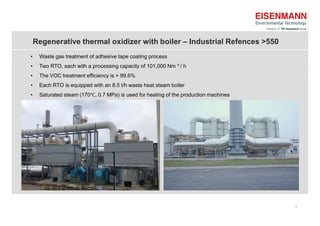
Regenerative thermal oxidizerwith boiler – Industrial Refences >550
• Waste gas treatment of adhesive tape coating process
• Two RTO, each with a processing capacity of 101,000 Nm ³ / h
• The VOC treatment efficiency is > 99.6%
• Each RTO is equipped with an 8.5 t/h waste heat steam boiler
• Saturated steam (170℃, 0.7 MPa) is used for heating of the production machines
14
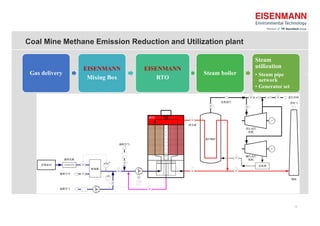
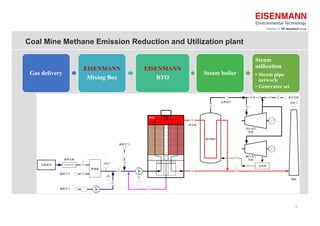
Gas delivery
EISENMANN
Mixing Box
EISENMANN
RTO
Steamboiler
Steam
utilization
• Steam pipe
network
• Generator set
Coal Mine Methane Emission Reduction and Utilization plant
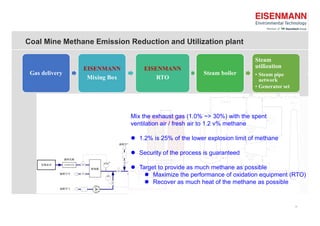
Mix the exhaust gas (1.0% ~> 30%) with the spent
ventilation air / fresh air to 1.2 v% methane
1.2% is 25% of the lower explosion limit of methane
Security of the process is guaranteed
Target to provide as much methane as possible
Maximize the performance of oxidation equipment (RTO)
Recover as much heat of the methane as possible
58.
15
Gas delivery
EISENMANN
Mixing Box
EISENMANN
RTO
Steamboiler
Steam
utilization
• Steam pipe
network
• Generator set
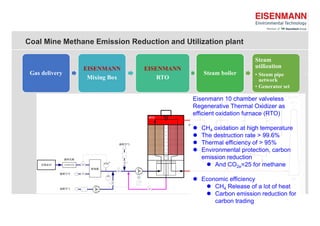
Coal Mine Methane Emission Reduction and Utilization plant
Eisenmann 10 chamber valveless
Regenerative Thermal Oxidizer as
efficient oxidation furnace (RTO)
CH4 oxidation at high temperature
The destruction rate > 99.6%
Thermal efficiency of > 95%
Environmental protection, carbon
emission reduction
And CO2e=25 for methane
Economic efficiency
CH4 Release of a lot of heat
Carbon emission reduction for
carbon trading
59.
16
Gas delivery
EISENMANN
Mixing Box
EISENMANN
RTO
Steamboiler
Steam
utilization
• Steam pipe
network
• Generator set
Coal Mine Methane Emission Reduction and Utilization plant
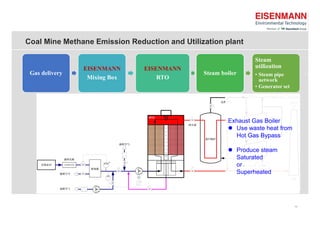
Exhaust Gas Boiler
Use waste heat from
Hot Gas Bypass
Produce steam
Saturated
or
Superheated
60.
17
Gas delivery
EISENMANN
Mixing Box
EISENMANN
RTO
Steamboiler
Steam
utilization
• Steam pipe
network
• Generator set
Coal Mine Methane Emission Reduction and Utilization plant
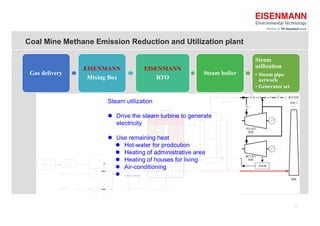
Steam utilization
Drive the steam turbine to generate
electricity
Use remaining heat
Hot-water for prodcution
Heating of administrative area
Heating of houses for living
Air-conditioning
……..
19
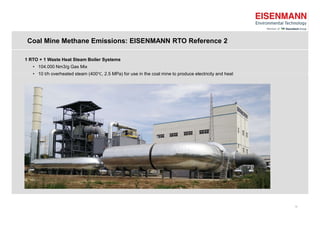
Coal Mine MethaneEmissions: EISENMANN RTO Reference 2
1 RTO + 1 Waste Heat Steam Boiler Systems
• 104.000 Nm3/g Gas Mix
• 10 t/h overheated steam (400℃, 2.5 MPa) for use in the coal mine to produce electricity and heat
63.
20
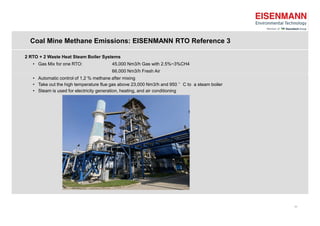
2 RTO +2 Waste Heat Steam Boiler Systems
• Gas Mix for one RTO: 45,000 Nm3/h Gas with 2.5%~3%CH4
66,000 Nm3/h Fresh Air
• Automatic control of 1,2 % methane after mixing
• Take out the high temperature flue gas above 23,000 Nm3/h and 950 °C to a steam boiler
• Steam is used for electricity generation, heating, and air conditioning
Coal Mine Methane Emissions: EISENMANN RTO Reference 3
64.
21
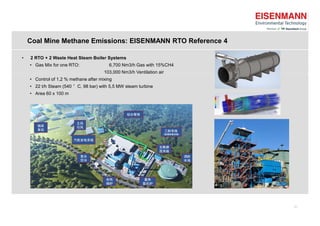
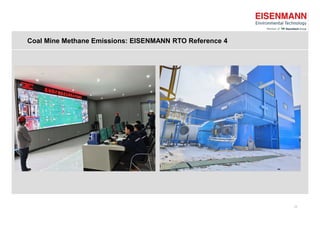
• 2 RTO+ 2 Waste Heat Steam Boiler Systems
• Gas Mix for one RTO: 6,700 Nm3/h Gas with 15%CH4
103,000 Nm3/h Ventilation air
• Control of 1,2 % methane after mixing
• 22 t/h Steam (540 °C, 98 bar) with 5,5 MW steam turbine
• Area 60 x 100 m
Coal Mine Methane Emissions: EISENMANN RTO Reference 4