COACHING 
UNDER-10 
PLAYERS 
CHARACTERISTICS OF U - 10 PLAYERS: 
· Gross and small motor skills becoming more refined and reliable. ¨ Boys and 
girls begin to develop separately. 
· Ability to stay on task is lengthened. They have the ability to sequence 
thought and actions. 
· Greater diversity in playing ability and physical maturity. •Skills are emerging. 
Becoming more predictable and recognizable. 
· Some children begin moving from concrete thinking to abstract thinking. 
· Able to pace themselves, to plan ahead. 
· Increased self-responsibility. They remember to bring their own equipment. 
· Starting to recognize basic tactical concepts, but not exactly sure why certain 
decisions are better. 
· Repetition of technique is very important, but it must be dynamic, not static. 
· Continued positive reinforcement needed. 
· Explainations must be brief, concise, and mention "why". 
· Becoming more "serious". Openly, intensively competitive, without intention of 
fouling. 
· Still mostly intrinsically motivated. ¨ Peer pressure starting to be a factor. 
· Adult outside of the family may take on added significance. 
· Prefer identification with a team. Like to have good uniforms, equipment, 
balls. 
· More inclined towards wanting to play instead of being told to play. Will initiate 
play more. 
INVOLVING THE PARENTS: 
It is imperative that coaches get the parents involved. Not only are they are a major 
resource for your team, but the U-10 player still views their parents as the most 
significant people in their lives. A pre-season meeting should be held with the parents 
so that objectives and team policies can be addressed. Some topics that you may 
want to address at this meeting are: 
· A means of contacting everyone without one person doing all of the calling. 
(Phone chains) 
· Choosing a team administrator, someone to handle all of the details. 
· Complete all paperwork required by your league or club. •Discuss the laws of 
the game. 
· Carpool needs.
· Training and game schedules. How you feel about starting and ending on 
time, what your attendance expectations are, what you think is a good excuse 
to miss training. 
· What each player should bring to training: inflated ball, filled water bottle, 
soccer attire, shin guards cleats or sneakers. 
· Most importantly, your philosophy about coaching U-10 players. Let them 
know that everyone plays; that the game does not look like the older player's 
games; that you are there to ensure that their player is safe and has a good 
time, as well as learn about soccer. 
· What your expectations for them is during game time. How do you want them 
to cheer? Do they know that they should not coach from the sidelines? 
· Above all, try to enjoy yourself. If you do they probably will too. 
THINGS YOU CAN EXPECT: 
Some coaches say that the 9 and 10 year-old players are beginning to "turn the 
corner" and starting to look like real soccer players. However, games are still 
frantically paced and unpredictable for the most part. These players are starting to find 
out how much fun it is to play the game skillfully, but they will still stop and laugh if the 
referee gets hit in the backside with the ball during a game. Some other things that we 
can expect when working with this aged player are: 
· They start to understand offsides, but still forget themselves when the goal is 
in front of them. 
· They will really beat up on each other during practice... especially boy's 
teams. 
· During a game, the parents will scream out "HAND BALL" or "COME ON 
REF, CALL IT BOTH WAYS" at least fifteen times. 
· They might cry after the game if they loose, but will forget it if you ask them if 
you want to go out for burgers and fries. 
· You might actually catch them practicing on their own without you telling them 
to do so. 
· Their parents are telling them to do one thing during the game, you are telling 
them another thing, but what they end up doing might be what their friend is 
telling them to do. 
· You will see a pass that is deliberate. You might even see a "back pass". 
· You will see your first $100 pair of cleats during practice. They will call the 
other team bad names... really bad names. 
COACHING RATIONAL: 
Some of the players that are playing as U - 10's are seasoned veterans of the youth 
soccer scene. Some of them may have already been involved in traveling to play in 
tournaments. As a result, some of them might be very nervous about the whole 
process. It is our job to keep things in perspective for these young, developing 
players. True, some of them are becoming quite skillful and are seeing how fun it is to 
play the game when they can really control the ball. However, many of them are still 
learning the ropes. Even the more experienced players need to have the game be 
fun!!! 
Emphasis is still placed on having players learn how to control the ball with his/her
body, but now, they need to find themselves in more game-like situations. Training is 
more dynamic and starting to have players make simple, basic decisions such as 
"Which way is there more space?" or "Who should I pass to?". 
Following are some more items that a coach of U-10 players should consider: 
· Use small sided games as the main teaching vehicle. Not only will they get 
more touches on the ball, but the full 11-a-side game is still too complicated 
for them to understand. 
· How we group players during training takes on even added significance 
because of the wide margins of ability levels. We need to mix players up 
often. 
· Stretching is becoming more important, along with a good warm-up. Since the 
game is faster, make sure that they also have good shinguards. Safety and 
preventive measures take on added significance. 
· Training twice a week is plenty. Sessions need not go longer than one hour, 
fifteen minutes. 
· They should all come with their own size #4 ball. In fact, they still need to be 
encouraged to play with it by themselves. 
· Put them into competitive environments as much as possible. This will not 
only keep them focused, but, it will allow the game itself to teach them. It also 
will keep things fun for them, and allow you to deal with issues such as 
'winning' and 'loosing' which is now a very big concern for them. 
· Now it is possible to teach them positional play with the expectation that they 
will get it some of the time. However, it is absolutely necessary that you do not 
allow players to specialize in any one position. They need to learn basic 
principles of the game, first. Having them play all of the positions is best for 
their individual development. Remember, our first responsibility is to develop 
players and let them have fun. 
· Whenever possible, allow them to solve their own puzzles. Don't immediately 
give them solutions on how they can play better. 
TYPICAL TRAINING SESSION: 
Here are some items that should be included in a U-10 training session: 
WARM-UP: 
A brief warm-up is appropriate in order to get the players thinking about soccer and to 
prepare them physically for the time ahead. This should involve individual body 
activities that involve the ball. Since there can be one theme to the session, hopefully, 
the warm-up will lead into the theme of the day. Static stretching is also appropriate at 
this time after the players have broken a sweat, again, hopefully done with the ball. 
Again, the warm-up should get the players ready to play. It should be lively, fun, and 
engaging as well as instructional. There is nothing like a good, fast paced activity to 
grab the player's attention and make them glad that they came to practice. 
INDIVIDUAL OR SMALL GROUP ACTIVITIES: 
Follow the warm-up with some kind of individual activity, not necessarily a real 1v.1 
game, but some kind of activity where players act as individuals or cooperate in small 
groups in a game environment. An example would be a kind of tag game, or a keep-away 
game. Keep players in motion at all times. Avoid having them wait on lines. Play 
games of "inclusion" instead of games where the "looser sits". Be creative. These
players like "crazy" games with a lot of action. 
PLAY THE GAME: 
Small sided soccer can be used to heighten intensity and create some good 
competition. Play 4 v.4 up to 8 v.8. Be creative. Play with 4 goals, or 2 balls. Play with 
or without boundaries. Perhaps play to emphasize a particular skill (can only dribble 
the ball over a goal line in order to get a point). Use cones if you don't have real goals. 
Keep players involved. Have more than one game going on at a time if necessary. 
Switch teams often, give everyone a chance to win. Also, it is important that every 
player has a chance to shoot on goal as often as possible. 
WARM-DOWN & HOMEWORK: 
Finish the session with a warm down. Give them some more stretches to do with the 
ball. You may want to review what you started the session with. Also, give them some 
homework so that they practice on their own. Think of some ball trick that you would 
like to see them try to do, like, bounce it off their head, then thigh, then foot, and then 
catch it. Can one player kick a ball to a partner and then back without it hitting the 
ground? Can they do that with their heads? It is important to finish on time. This is 
especially essential if the players are really into it. Stop at this point and you will get 
an enthusiastic return. 
U-10 TRAINING IDEA - "TEAM KNOCK OUT" 
Here is a game to use in the 'Small Group Activity' phase of the practice. It is an 
engaging game that is fun to play and challenges players in almost all aspects of the 
game. 
THE GAME: 
· Divide the squad up into two teams. 
· To start, each player on the team that is inside the field will need a ball. Those 
on the outside of the field do not need a ball. 
· When ready, players on the outside run into the grid, attempt to steal any ball 
they can and put it through any one of the goals that are marked by the 
cones. 
· Players with the ball attempt to keep the ball away from the defenders by 
dribbling or passing to a teammate that has lost their ball. 
· If an attacking player looses a ball, they immediately try to 'steal' it back. 
· The game stops when all of the balls have been kicked through the goals. 
Then the two teams switch roles. 
· Keep track of how long it takes each team to steal all of the balls. 
· If a ball is kicked out of bounds it goes over to the other team for a throw-in. 
This game is good for teaching dribbling skills as players find themselves in situations 
where they have to dribble to keep possession as well as dribble to beat an opponent. 
Also, they find themselves in situations where they may have to pass to a teammate 
as well as find themselves playing defense as well. because there are so many balls, 
and so many goals, it is just a crazy enough game to be appreciated and enjoyed by a 
typical nine- year-old. 
U -10 TRAINING IDEA 
"END ZONE GAME"
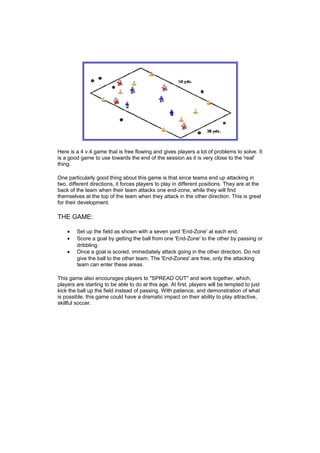
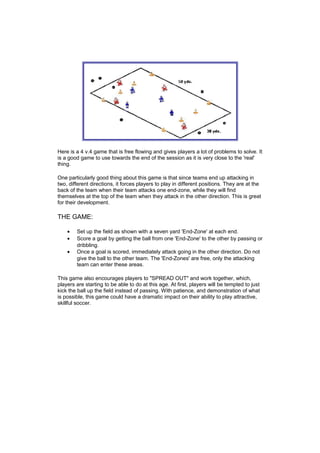
Here is a 4 v.4 game that is free flowing and gives players a lot of problems to solve. It 
is a good game to use towards the end of the session as it is very close to the 'real' 
thing. 
One particularly good thing about this game is that since teams end up attacking in 
two, different directions, it forces players to play in different positions. They are at the 
back of the team when their team attacks one end-zone, while they will find 
themselves at the top of the team when they attack in the other direction. This is great 
for their development. 
THE GAME: 
· Set up the field as shown with a seven yard 'End-Zone' at each end. 
· Score a goal by getting the ball from one 'End-Zone' to the other by passing or 
dribbling. 
· Once a goal is scored, immediately attack going in the other direction. Do not 
give the ball to the other team. The 'End-Zones' are free, only the attacking 
team can enter these areas. 
This game also encourages players to "SPREAD OUT" and work together, which, 
players are starting to be able to do at this age. At first, players will be tempted to just 
kick the ball up the field instead of passing. With patience, and demonstration of what 
is possible, this game could have a dramatic impact on their ability to play attractive, 
skillful soccer.