

PHARMACY PRACTICE
Presented by
- Banny sv
B-Pharmacy
SLVP COLLEGE
Thank you for joining us today. We are excited to share our insights on Interpreting Clinical Laboratory Blood Chemistry Tests: A
Practical Guide
Interpreting Clinical Laboratory Blood
Chemistry Tests: A Practical Guide
Unlocking the vital information held within your blood work to enhance
clinical decision-making and patient care.
Topic
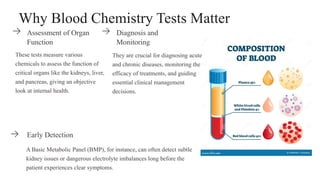
Why Blood Chemistry Tests Matter
Assessment of Organ
Function
Diagnosis and
Monitoring
Early Detection
These tests measure various
chemicals to assess the function of
critical organs like the kidneys, liver,
and pancreas, giving an objective
look at internal health.
They are crucial for diagnosing acute
and chronic diseases, monitoring the
efficacy of treatments, and guiding
essential clinical management
decisions.
A Basic Metabolic Panel (BMP), for instance, can often detect subtle
kidney issues or dangerous electrolyte imbalances long before the
patient experiences clear symptoms.
Common Blood Chemistry Panels
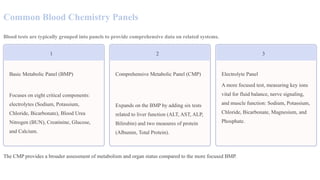
Blood tests are typically grouped into panels to provide comprehensive data on related systems.
1
Basic Metabolic Panel (BMP)
Focuses on eight critical components:
electrolytes (Sodium, Potassium,
Chloride, Bicarbonate), Blood Urea
Nitrogen (BUN), Creatinine, Glucose,
and Calcium.
2
Comprehensive Metabolic Panel (CMP)
Expands on the BMP by adding six tests
related to liver function (ALT, AST, ALP,
Bilirubin) and two measures of protein
(Albumin, Total Protein).
3
Electrolyte Panel
A more focused test, measuring key ions
vital for fluid balance, nerve signaling,
and muscle function: Sodium, Potassium,
Chloride, Bicarbonate, Magnesium, and
Phosphate.
The CMP provides a broader assessment of metabolism and organ status compared to the more focused BMP.
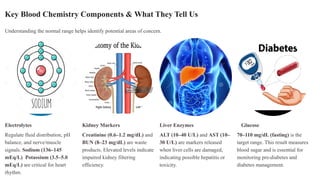
Key Blood Chemistry Components & What They Tell Us
Understanding the normal range helps identify potential areas of concern.
Electrolytes
Regulate fluid distribution, pH
balance, and nerve/muscle
signals. Sodium (136–145
mEq/L) Potassium (3.5–5.0
mEq/L) are critical for heart
rhythm.
Kidney Markers
Creatinine (0.6–1.2 mg/dL) and
BUN (8–23 mg/dL) are waste
products. Elevated levels indicate
impaired kidney filtering
efficiency.
Liver Enzymes
ALT (10–40 U/L) and AST (10–
30 U/L) are markers released
when liver cells are damaged,
indicating possible hepatitis or
toxicity.
Glucose
70–110 mg/dL (fasting) is the
target range. This result measures
blood sugar and is essential for
monitoring pre-diabetes and
diabetes management.
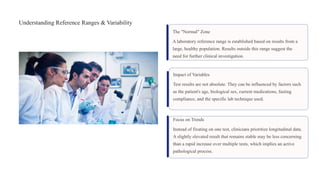
Understanding Reference Ranges & Variability
The "Normal" Zone
A laboratory reference range is established based on results from a
large, healthy population. Results outside this range suggest the
need for further clinical investigation.
Impact of Variables
Test results are not absolute. They can be influenced by factors such
as the patient's age, biological sex, current medications, fasting
compliance, and the specific lab technique used.
Focus on Trends
Instead of fixating on one test, clinicians prioritize longitudinal data.
A slightly elevated result that remains stable may be less concerning
than a rapid increase over multiple tests, which implies an active
pathological process.
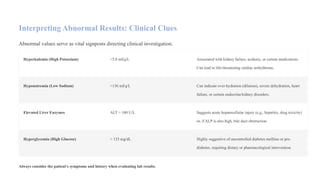
Interpreting Abnormal Results: Clinical Clues
Abnormal values serve as vital signposts directing clinical investigation.
Hyperkalemia (High Potassium) >5.0 mEq/L Associated with kidney failure, acidosis, or certain medications.
Can lead to life-threatening cardiac arrhythmias.
Hyponatremia (Low Sodium) >136 mEq/L Can indicate over-hydration (dilution), severe dehydration, heart
failure, or certain endocrine/kidney disorders.
Elevated Liver Enzymes ALT > 100 U/L Suggests acute hepatocellular injury (e.g., hepatitis, drug toxicity)
or, if ALP is also high, bile duct obstruction.
Hyperglycemia (High Glucose) > 125 mg/dL Highly suggestive of uncontrolled diabetes mellitus or pre-
diabetes, requiring dietary or pharmacological intervention.
Always consider the patient's symptoms and history when evaluating lab results.
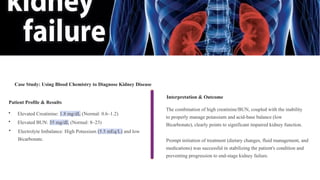
Case Study: Using Blood Chemistry to Diagnose Kidney Disease
The combination of high creatinine/BUN, coupled with the inability
to properly manage potassium and acid-base balance (low
Bicarbonate), clearly points to significant impaired kidney function.
Patient Profile & Results
• Elevated Creatinine: 1.8 mg/dL (Normal: 0.6–1.2)
• Elevated BUN: 35 mg/dL (Normal: 8–23)
• Electrolyte Imbalance: High Potassium (5.5 mEq/L) and low
Bicarbonate.
Interpretation & Outcome
Prompt initiation of treatment (dietary changes, fluid management, and
medications) was successful in stabilizing the patient's condition and
preventing progression to end-stage kidney failure.
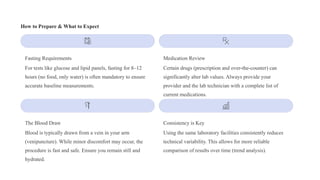
How to Prepare & What to Expect
Fasting Requirements
For tests like glucose and lipid panels, fasting for 8–12
hours (no food, only water) is often mandatory to ensure
accurate baseline measurements.
Medication Review
Certain drugs (prescription and over-the-counter) can
significantly alter lab values. Always provide your
provider and the lab technician with a complete list of
current medications.
The Blood Draw
Blood is typically drawn from a vein in your arm
(venipuncture). While minor discomfort may occur, the
procedure is fast and safe. Ensure you remain still and
hydrated.
Consistency is Key
Using the same laboratory facilities consistently reduces
technical variability. This allows for more reliable
comparison of results over time (trend analysis).
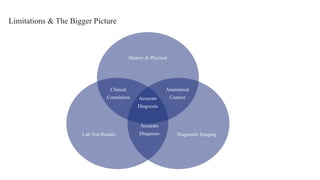
Limitations & The Bigger Picture
History & Physical
Lab Test Results Diagnostic Imaging
Clinical
Correlation
Anatomical
Context
Accurate
Diagnosis
Accurate
Diagnosis
Conclusion: Empowering Health Through Understanding Lab
Tests
Informed Participation
By understanding the fundamentals of blood chemistry, you
become an active, engaged participant in your own healthcare
journey.
Early Action, Better Outcomes
The power of these tests lies in their ability to flag issues early,
allowing for timely intervention and significantly improving
health outcomes.
Contextual Collaboration
Always collaborate with your healthcare provider—they hold the
expertise to interpret your unique results within the context of your
overall health.
Thank You!
We sincerely appreciate your time and attention today.