Detailed insights into enzyme nature, classification, isoenzymes, and their critical roles in disease diagnosis and monitoring, including liver diseases, myocardial infarction, and muscle disorders as per Indian Nursing Syllabus for B.Sc.Nursing 2nd Semester,Subject- Biochemistry
Definition
Enzymes arespecialized proteins (and in some cases RNA molecules) that act
as catalysts in living organisms. They speed up the chemical reactions required
for life by lowering the activation energy, all without being consumed in the
process. Enzymes play a crucial role in everything from digestion and metabolism
to DNA replication and cell communication.
Enzymes are biological catalysts that speed up chemical reactions in living
organisms without being consumed in the process.
They are proteins in nature (except ribozymes, which are RNA molecules with
catalytic activity).
Enzymes lower the activation energy of reactions, thereby increasing the rate of
reaction.
4.
Nature of Enzyme
Enzymes: Biological catalysts that speed up reactions without being consumed.
Apoenzyme: Protein part of enzyme (inactive alone).
Cofactor: Non protein helper (metal ion or organic molecule).
‑
Holoenzyme: Apoenzyme + cofactor (active form).
Prosthetic group: Tightly bound cofactor (e.g., FAD (flavin adenine dinucleotide)
in flavoproteins).
5.
Classification of Enzyme
1. Oxidoreductases: Catalyze redox (help in moving of electron from one molecule to another) reactions (e.g.,
dehydrogenases).
2. Transferases: Transfer (Transfer of one specific chemical substance from one one molecule to another) functional
groups (e.g., kinases-moving phosphate group)., Transaminase- moving amino acids
3. Hydrolases: (uses water to break chemical bonds in larger molecules )Hydrolytic cleavage (e.g., proteases,
lipases).
4. Lyases: Add/remove groups without hydrolysis-without water break or join molecules (e.g., decarboxylases-
Remove Co2 from molecules, Dehydratases-Take away water from molecule).
5. Isomerases: isomerases are a general class of enzymes that convert a molecule from one isomer to another.
Isomerases facilitate intramolecular rearrangements in which bonds are broken and formed. Rearrangement within a
molecule (e.g., mutases).
6. Ligases: Join molecules (Join two large molecule together by forming a new chemical bond) using ATP (e.g., DNA
ligase).
7.
Functions of Enzymes
Enzymes perform a wide variety of essential tasks in the body. Their main role is catalysis
—making reactions happen faster and more efficiently. They also serve highly
specialized roles in regulating and controlling biological pathways. The most important
functions of enzymes include:
Catalysis of metabolic reactions such as glycolysis, fermentation, and the citric acid
cycle.
Digestion of nutrients, including proteins, fats, and carbohydrates.
DNA replication and repair, ensuring genetic information is accurately copied and
maintained.
Cell signalling, where enzymes help transmit messages inside and between cells.
Detoxification of harmful substances (e.g., hydrogen peroxide breakdown by catalase).
Energy production through aerobic and anaerobic respiration.
Macromolecule synthesis, including the production of proteins and nucleic acids.
10.
Isoenzymes – Definition& Properties
Definition
Isoenzymes (or isozymes) are multiple forms of the same enzyme
that catalyze the same biochemical reaction but differ in:
Amino acid sequence
Physical properties {e.g., electrophoretic(Electricity +Movement)
mobility}
Kinetic properties
Regulation and tissue distribution
11.
Properties of Isoenzymes
Catalytic similarity: All isoenzymes catalyze the same type of reaction.
Structural variation: Differ in amino acid composition and quaternary structure.
Tissue specificity: Found in different organs/tissues (e.g., LDH isoenzymes in heart vs
liver).
Diagnostic value: Used as clinical markers to identify tissue damage.
Example: CK MB isoenzyme for myocardial infarction.
‑
Genetic basis: Encoded by different genes or gene families.
Electrophoretic separation: Can be distinguished by electrophoresis due to charge
differences.
Regulation differences: Each isoenzyme may respond differently to inhibitors or
activators.
12.
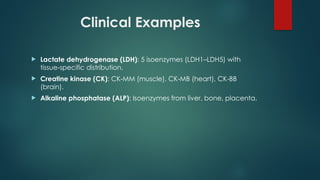
Clinical Examples
Lactatedehydrogenase (LDH): 5 isoenzymes (LDH1–LDH5) with
tissue specific distribution.
‑
Creatine kinase (CK): CK MM (muscle), CK MB (heart), CK BB
‑ ‑ ‑
(brain).
Alkaline phosphatase (ALP): Isoenzymes from liver, bone, placenta.
13.
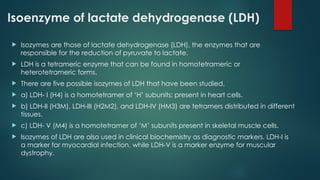
Isoenzyme of lactatedehydrogenase (LDH)
Isozymes are those of lactate dehydrogenase (LDH), the enzymes that are
responsible for the reduction of pyruvate to lactate.
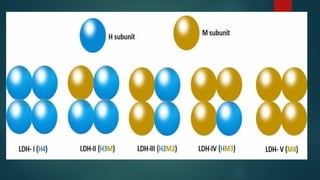
LDH is a tetrameric enzyme that can be found in homotetrameric or
heterotetrameric forms.
There are five possible isozymes of LDH that have been studied.
a) LDH- I (H4) is a homotetramer of ‘H’ subunits; present in heart cells.
b) LDH-II (H3M), LDH-III (H2M2), and LDH-IV (HM3) are tetramers distributed in different
tissues.
c) LDH- V (M4) is a homotetramer of ‘M’ subunits present in skeletal muscle cells.
Isozymes of LDH are also used in clinical biochemistry as diagnostic markers. LDH-I is
a marker for myocardial infection, while LDH-V is a marker enzyme for muscular
dystrophy.
15.
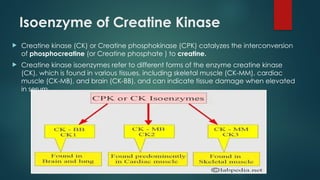
Isoenzyme of CreatineKinase
Creatine kinase (CK) or Creatine phosphokinase (CPK) catalyzes the interconversion
of phosphocreatine (or Creatine phosphate ) to creatine.
Creatine kinase isoenzymes refer to different forms of the enzyme creatine kinase
(CK), which is found in various tissues, including skeletal muscle (CK-MM), cardiac
muscle (CK-MB), and brain (CK-BB), and can indicate tissue damage when elevated
in serum.
16.
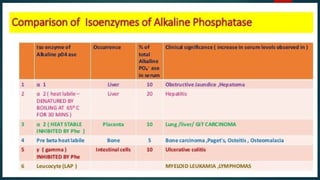
Isoenzyme of alkalinephosphatase (ALP)
Alkaline phosphatase (ALP) is a hydrolase enzyme that removes phosphate groups from
various molecules such as nucleotides, proteins, and alkaloids — this process is called
dephosphorylation. Ex- Glucose-6-phosphate+H2O Glucose+Pi
→
It is present throughout the body, including the liver, bile ducts, bones, kidneys, intestines,
and placenta in pregnant women, and plays a role in metabolism and bone development.
Alkaline phosphatase (ALP) is present in the outer layer of the cell membrane. They are
present in different body tissues and have different physicochemical properties. There are six
types of alkaline phosphatase isoenzymes that are isolated by electrophoresis.
ALP is a monomer, The most important ALP isoenzymes are
1. α1-ALP
2. α2-heat labile ALP,
3. α2-heat stable ALP
4. pre-β ALP
5. γ-ALP
6. Leukocyte ALP
Enzymes of DiagnosticImportance
Enzymes play a crucial role in diagnosing and monitoring various diseases, serving as
valuable biomarkers that provide insights into a patient's health status.
Diagnostic enzymes are specific proteins that catalyze biochemical reactions and are
measured in clinical settings to diagnose or monitor diseases. Their levels or activities can
indicate the presence of tissue damage, inflammation, or disease, making them essential
tools in clinical laboratories.
Key Functions of Diagnostic Enzymes
Early Detection: Enzymes can indicate the presence of a disease before clinical
symptoms manifest, allowing for timely intervention.
Disease Monitoring: They help track the progression or regression of a disease, providing
critical information for treatment adjustments.
Therapeutic Guidance: Enzyme levels can assist in determining the effectiveness of a
treatment, guiding clinical decisions.
Prognostic Value: They provide insights into the likely course and outcome of a disease,
helping in patient management and care planning
19.
Enzymes of DiagnosticImportance
1. Liver Diseases
Aminotransferase or Transaminases
The activities of two ALT (Alanine aminotransferase) also called SGPT ( Serum Glutamate
pyruvate transaminase) marker of hepatocellular injury and AST (Aspartate
aminotransferase) also called SGOT ( Serum glutamate oxaloacetate transaminase )
elevated in liver and also cardiac damage.
ALT is a cytoplasmic enzyme while AST is found in both cytoplasm and mitochondria. The
activity of these enzymes is low in normal serum (ALT-5-40 IU/L, AST-5-45 IU/L)
ALP (Alkaline phosphatase) – ALP is mainly derived from bone and liver (from the cells
lining the bile canaliculi )Normal level of serum ALP in males (20-60 years) and
females (15-60 years ) is 20-90 IU/L while in children (1-2 years ) is up to 350 IU/L, a rise
in serum ALP usually associated with elevated serum bilirubin is a an indicator of
biliary obstruction (raised in obstructive jaundice, bone disease)
GGT (Gamma glutamyl transferase)
‑ – sensitive marker for alcohol induced liver
‑
disease and biliary obstruction.
20.
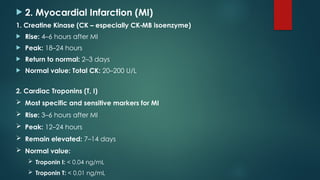
2. MyocardialInfarction (MI)
1. Creatine Kinase (CK – especially CK MB isoenzyme)
‑
Rise: 4–6 hours after MI
Peak: 18–24 hours
Return to normal: 2–3 days
Normal value: Total CK: 20–200 U/L
2. Cardiac Troponins (T, I)
Most specific and sensitive markers for MI
Rise: 3–6 hours after MI
Peak: 12–24 hours
Remain elevated: 7–14 days
Normal value:
Troponin I: < 0.04 ng/mL
Troponin T: < 0.01 ng/mL
21.
3. AspartateAminotransferase (AST)
Rise: 6–12 hours after MI
Peak: 24–48 hours
Return to normal: 3–4 days
Normal value: 5–40 U/L
4. Lactate Dehydrogenase (LDH – LDH1 isoenzyme)
Rise: 12–24 hours after MI
Peak: 2–3 days
Remain elevated: 7–10 days
Normal value:
Total LDH: 140–280 U/L
22.
3. MuscleDiseases
1. Creatine Kinase (CK – CK MM isoenzyme)
‑
Source: Skeletal muscle.
Normal value: 20–200 U/L (CK MM is the predominant fraction in muscle).
‑
Clinical significance:
Elevated in muscular dystrophy (progressive muscle degeneration).
Raised in rhabdomyolysis (massive muscle breakdown → risk of acute kidney injury).
Also increased after severe exercise, trauma, or intramuscular injections.
2. Aldolase
Source: Muscle tissue (glycolytic enzyme).
Normal value: ~1–7 U/L (varies slightly by laboratory).
Clinical significance:
Elevated in muscle damage and myopathies.
Historically used in diagnosis of Duchenne muscular dystrophy.
Less specific than CK, but still exam relevant.
‑
23.
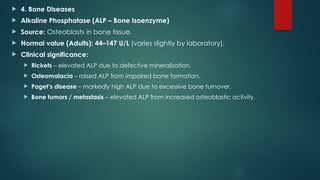
4. BoneDiseases
Alkaline Phosphatase (ALP – Bone Isoenzyme)
Source: Osteoblasts in bone tissue.
Normal value (Adults): 44–147 U/L (varies slightly by laboratory).
Clinical significance:
Rickets – elevated ALP due to defective mineralization.
Osteomalacia – raised ALP from impaired bone formation.
Paget’s disease – markedly high ALP due to excessive bone turnover.
Bone tumors / metastasis – elevated ALP from increased osteoblastic activity.
24.
5. Prostate Cancer
1. PSA (Prostate Specific Antigen)
‑
Source: Secreted by prostate epithelial cells.
Normal value: < 4 ng/mL (most labs use this cutoff; values may vary slightly).
Clinical significance:
Most widely used marker for prostate cancer screening and monitoring.
Elevated in prostate cancer, benign prostatic hyperplasia (BPH), and prostatitis.
Used for screening, staging, prognosis, and monitoring recurrence after
treatment.
2. ACP (Acid Phosphatase – Prostatic Isoenzyme)
Source: Prostate gland (lysosomal enzyme).
Normal value: 0–3.5 ng/mL (serum acid phosphatase; varies by lab).
Clinical significance:
Historically used in prostate cancer diagnosis.
Elevated in advanced or metastatic prostate cancer.
Now largely replaced by PSA, but still exam relevant.
‑