Claude Code
History, Current Capabilities, and Future Directions
A Comprehensive Technical Survey of Anthropic’s Agentic
Software Engineering Platform
Domain: Agentic Artificial Intelligence · Software Engineering
Date: March 2026
Version: 1.0
This paper surveys the emergence, technical architecture, observable capabilities,
and prospective trajectory of Claude Code from its research preview in
February 2025 through early 2026.
Note: This is a speculative analytical survey intended to stimulate discussion.
All claims are grounded in publicly available sources as of March 2026.
Claude Code: History, Capabilities, and Future Directions March 2026
Abstract
Claude Code represents one of the most consequential product launches in the
history of applied artificial intelligence. Released as a terminal-based research
preview in February 2025 and reaching general availability in May 2025, it grew
within roughly six months of GA to an annualised revenue run-rate exceeding one
billion US dollars—faster, by some accounts, than any AI product before it. By
early 2026 that figure had more than doubled to $2.5 billion ARR, contributing
substantially to Anthropic’s emergence as a leading AI company for enterprise. What
began as a simple command-line tool that could read files, run bash commands,
and commit to GitHub has evolved through four distinct developmental eras into a
comprehensive multi-agent software-engineering platform. This paper provides an
extensive account of that evolution: the sociological and technical conditions that
made Claude Code possible; the architectural decisions that distinguished it from
contemporary coding assistants; the expanding feature set—spanning the Model
Context Protocol, custom subagents, hooks, skills, plugins, and agent teams—that
defines its current capabilities; the economic and professional disruptions it has
catalysed; and the forward-looking directions, from autonomous engineering loops
to the democratisation of software creation, that are likely to shape the next phase
of its development.
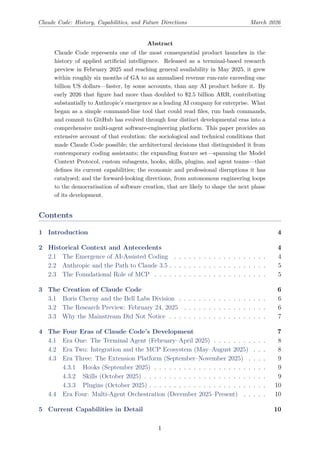
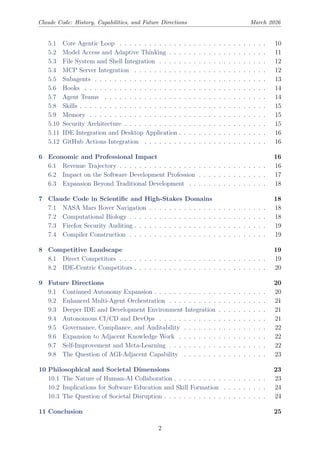
Contents
1 Introduction 4
2 Historical Context and Antecedents 4
2.1 The Emergence of AI-Assisted Coding . . . . . . . . . . . . . . . . . . . 4
2.2 Anthropic and the Path to Claude 3.5 . . . . . . . . . . . . . . . . . . . . 5
2.3 The Foundational Role of MCP . . . . . . . . . . . . . . . . . . . . . . . 5
3 The Creation of Claude Code 6
3.1 Boris Cherny and the Bell Labs Division . . . . . . . . . . . . . . . . . . 6
3.2 The Research Preview: February 24, 2025 . . . . . . . . . . . . . . . . . 6
3.3 Why the Mainstream Did Not Notice . . . . . . . . . . . . . . . . . . . . 7
4 The Four Eras of Claude Code’s Development 7
4.1 Era One: The Terminal Agent (February–April 2025) . . . . . . . . . . . 8
4.2 Era Two: Integration and the MCP Ecosystem (May–August 2025) . . . 8
4.3 Era Three: The Extension Platform (September–November 2025) . . . . 9
4.3.1 Hooks (September 2025) . . . . . . . . . . . . . . . . . . . . . . . 9
4.3.2 Skills (October 2025) . . . . . . . . . . . . . . . . . . . . . . . . . 9
4.3.3 Plugins (October 2025) . . . . . . . . . . . . . . . . . . . . . . . . 10
4.4 Era Four: Multi-Agent Orchestration (December 2025–Present) . . . . . 10
5 Current Capabilities in Detail 10
1
Claude Code: History, Capabilities, and Future Directions March 2026
5.1 Core Agentic Loop . . . . . . . . . . . . . . . . . . . . . . . . . . . . . . 10
5.2 Model Access and Adaptive Thinking . . . . . . . . . . . . . . . . . . . . 11
5.3 File System and Shell Integration . . . . . . . . . . . . . . . . . . . . . . 12
5.4 MCP Server Integration . . . . . . . . . . . . . . . . . . . . . . . . . . . 12
5.5 Subagents . . . . . . . . . . . . . . . . . . . . . . . . . . . . . . . . . . . 13
5.6 Hooks . . . . . . . . . . . . . . . . . . . . . . . . . . . . . . . . . . . . . 14
5.7 Agent Teams . . . . . . . . . . . . . . . . . . . . . . . . . . . . . . . . . 14
5.8 Skills . . . . . . . . . . . . . . . . . . . . . . . . . . . . . . . . . . . . . . 15
5.9 Memory . . . . . . . . . . . . . . . . . . . . . . . . . . . . . . . . . . . . 15
5.10 Security Architecture . . . . . . . . . . . . . . . . . . . . . . . . . . . . . 15
5.11 IDE Integration and Desktop Application . . . . . . . . . . . . . . . . . . 16
5.12 GitHub Actions Integration . . . . . . . . . . . . . . . . . . . . . . . . . 16
6 Economic and Professional Impact 16
6.1 Revenue Trajectory . . . . . . . . . . . . . . . . . . . . . . . . . . . . . . 16
6.2 Impact on the Software Development Profession . . . . . . . . . . . . . . 17
6.3 Expansion Beyond Traditional Development . . . . . . . . . . . . . . . . 18
7 Claude Code in Scientific and High-Stakes Domains 18
7.1 NASA Mars Rover Navigation . . . . . . . . . . . . . . . . . . . . . . . . 18
7.2 Computational Biology . . . . . . . . . . . . . . . . . . . . . . . . . . . . 18
7.3 Firefox Security Auditing . . . . . . . . . . . . . . . . . . . . . . . . . . . 19
7.4 Compiler Construction . . . . . . . . . . . . . . . . . . . . . . . . . . . . 19
8 Competitive Landscape 19
8.1 Direct Competitors . . . . . . . . . . . . . . . . . . . . . . . . . . . . . . 19
8.2 IDE-Centric Competitors . . . . . . . . . . . . . . . . . . . . . . . . . . . 20
9 Future Directions 20
9.1 Continued Autonomy Expansion . . . . . . . . . . . . . . . . . . . . . . . 20
9.2 Enhanced Multi-Agent Orchestration . . . . . . . . . . . . . . . . . . . . 21
9.3 Deeper IDE and Development Environment Integration . . . . . . . . . . 21
9.4 Autonomous CI/CD and DevOps . . . . . . . . . . . . . . . . . . . . . . 21
9.5 Governance, Compliance, and Auditability . . . . . . . . . . . . . . . . . 22
9.6 Expansion to Adjacent Knowledge Work . . . . . . . . . . . . . . . . . . 22
9.7 Self-Improvement and Meta-Learning . . . . . . . . . . . . . . . . . . . . 22
9.8 The Question of AGI-Adjacent Capability . . . . . . . . . . . . . . . . . 23
10 Philosophical and Societal Dimensions 23
10.1 The Nature of Human-AI Collaboration . . . . . . . . . . . . . . . . . . . 23
10.2 Implications for Software Education and Skill Formation . . . . . . . . . 24
10.3 The Question of Societal Disruption . . . . . . . . . . . . . . . . . . . . . 24
11 Conclusion 25
2
Claude Code: History, Capabilities, and Future Directions March 2026
A Timeline of Key Milestones 25
B Glossary 26
References 27
3
Claude Code: History, Capabilities, and Future Directions March 2026
1 Introduction
The history of software development is a history of progressive abstraction. Each succes-
sive generation of tooling has moved the developer further from the physical substrate
of computation—from machine code, through assembly, through high-level languages,
through frameworks and package ecosystems, through the cloud—reducing cognitive
friction and compressing the cycle from idea to working artefact. Claude Code represents
the most dramatic compression yet: a system that, given a natural-language description of
intent, can independently navigate a large codebase, plan a course of action, execute shell
commands, write and revise source files, run tests, and iterate on failures until success
criteria are satisfied—all without human intervention in each step.
This is not an incremental improvement over prior art. Earlier AI coding assistants—
GitHub Copilot, Cursor, Tabnine, and their contemporaries—operated primarily as
sophisticated autocompletion engines or context-aware snippet generators. They could
suggest a function body or complete a pattern, but they were fundamentally reactive and
passive: the human remained the agent, and the AI remained the oracle consulted at each
keystroke. Claude Code inverted this relationship. The AI became the agent; the human
became the architect, specifier, and reviewer.
The practical consequences have been extraordinary. Senior engineers report productivity
gains measured not in percentage points but in multiples. One senior Google engineer de-
scribed Claude Code as having reconstructed a year’s worth of prior work in approximately
one hour. Anthropic’s own internal measurements suggested that employee productiv-
ity increased by roughly 200% on one internal measure, with Claude participating in
approximately 59% of their work. Zapier reported 89% AI adoption organisation-wide
with over 800 agents deployed internally. TELUS teams created more than 13,000 custom
AI solutions while shipping engineering code 30% faster, saving an estimated 500,000
work-hours.
These are not merely efficiency statistics. They signal a structural transformation in the
nature of software engineering as a profession—a transformation that Boris Cherny, the
creator of Claude Code, has compared in scope to the relationship between the printing
press and the scribal tradition. This paper traces that transformation from its origins.
2 Historical Context and Antecedents
2.1 The Emergence of AI-Assisted Coding
The application of machine learning to source code has a history stretching back to
the statistical language models of the early 2010s, but it was the advent of large-scale
transformer architectures in 2017–2018 that made meaningful AI coding assistance feasible.
OpenAI’s Codex model, introduced in 2021 and underpinning the original GitHub Copilot,
demonstrated for the first time that a single neural network could achieve useful levels of
4
Claude Code: History, Capabilities, and Future Directions March 2026
competence across a broad range of programming languages and paradigms when pre-
trained at sufficient scale on publicly available code. Copilot’s commercial launch in 2022
initiated what might be called the autocomplete era of AI-assisted software development.
The autocomplete era was characterised by a particular human–machine relationship: the
developer’s intent was expressed through the code they had already written, and the AI’s
contribution was to extrapolate forward from that context. This was useful—perhaps
more useful than was immediately appreciated—but it was fundamentally limited by the
size of the context window available to the model and by the model’s lack of any capacity
for autonomous action. Copilot could not run the code it suggested, could not observe
whether the suggestion was correct, and could not revise its output in light of execution
feedback.
2.2 Anthropic and the Path to Claude 3.5
Anthropic was founded in 2021 by Dario Amodei, Daniela Amodei, and several colleagues
who had previously worked at OpenAI. From the outset, the company’s research programme
was organised around two complementary commitments: the pursuit of frontier AI
capabilities and the development of rigorous safety techniques, notably Constitutional
AI (1), to ensure that powerful models remained aligned with human values.
Anthropic’s Claude model family evolved rapidly through several generations between
2022 and 2024. The release of Claude 3.5 Sonnet in June 2024 marked a watershed
moment for AI coding in particular. In the first half of 2024, Anthropic had begun
incorporating large volumes of real-world repository data into Claude’s training regime.
When Claude 3.5 Sonnet was released, the programming community took immediate notice
of its substantially improved performance on coding benchmarks and, more importantly,
on real-world coding tasks. Cursor, an AI-native code editor founded by a team in their
twenties, integrated Claude 3.5 Sonnet and saw its user base grow rapidly in the months
that followed.
Importantly, it was also in 2024 that Anthropic began internally testing an approach that
would ultimately become Claude Code: an agent that could be given filesystem access,
shell execution capabilities, and broad autonomy to pursue multi-step coding tasks within
a real developer environment, not merely a sandbox.
2.3 The Foundational Role of MCP
A crucial piece of infrastructure that predated Claude Code’s public launch deserves
particular attention: the Model Context Protocol (MCP). Introduced by Anthropic in
November 2024, MCP is an open standard for connecting AI agents with external tools,
data sources, and services. Rather than requiring each AI application to implement
bespoke API integrations for every external service it might need to query, MCP defines a
standard interface through which any compliant server can expose its capabilities to any
compliant AI client.
5
Claude Code: History, Capabilities, and Future Directions March 2026
The significance of MCP for Claude Code’s eventual capabilities cannot be overstated.
MCP effectively gave Claude Code the capacity to extend itself in arbitrary directions: any
service that implements an MCP server—GitHub, Slack, Salesforce, databases, browser
automation tools, scientific computing libraries—becomes immediately accessible to a
Claude Code session without any modification to Claude Code itself. This architectural
decision established Claude Code as an open platform rather than a closed product, and
catalysed a rich ecosystem of MCP integrations developed both by Anthropic and by the
broader developer community in the months that followed.
3 The Creation of Claude Code
3.1 Boris Cherny and the Bell Labs Division
The immediate genesis of Claude Code can be traced to September 2024, when Boris
Cherny joined Anthropic. Cherny—a Ukrainian-born software engineer who had previously
worked at Meta and was the author of a well-regarded book on TypeScript—was placed in
what colleagues described as a Bell Labs-style experimental division within Anthropic, a
unit explicitly tasked with exploratory projects without immediate commercial obligations.
In his first month, Cherny built a personal experiment: a system that gave Claude broad
access to his computer, allowing the model to interact with the local filesystem, execute
programs, and observe the state of his desktop environment. The experiment’s inaugural
prompt was informal: “What music am I listening to?” Claude opened Cherny’s music
player, captured a screenshot, and correctly identified the song—“Husk” by Men I Trust.
Cherny later described the moment as striking. Claude was not answering a question; it
was taking a sequence of purposeful actions in the world.
Cherny shared his prototype internally. Claude Code spread so rapidly through Anthropic’s
engineering organisation that in Cherny’s first performance review, CEO Dario Amodei
reportedly asked whether he was compelling colleagues to use it. The internal adoption
pattern—engineers integrating the tool into their daily workflows and reporting substantial
productivity gains—was both a proof of concept and a demand signal.
3.2 The Research Preview: February 24, 2025
On February 24, 2025, Anthropic released Claude Code as a research preview, simultane-
ously with Claude 3.7 Sonnet. The launch was deliberately understated: there was no
high-profile event, no viral demonstration, and no mainstream press campaign. Claude
Code was a command-line tool that required technical sophistication to install and operate,
and Anthropic positioned it explicitly as a research preview rather than a finished product.
6
Claude Code: History, Capabilities, and Future Directions March 2026
Milestone
February 24, 2025 — Claude Code research preview released alongside Claude 3.7
Sonnet. Initial capabilities: file reading/writing, bash command execution, GitHub
integration.
The initial version of Claude Code was, by later standards, primitive. It could:
• Read and write files within the current working directory.
• Execute bash commands and observe their output.
• Navigate a codebase by reading file trees and individual source files.
• Make commits to local git repositories.
• Engage in conversational back-and-forth with the developer to clarify intent.
What it lacked was equally revealing: there was no formal subagent architecture, no hook
system, no skills framework, no multi-agent coordination, and no visual interface beyond
the terminal. Yet even in this stripped-down form, the developer community’s response
was immediate and intense. Within the software engineering bubble, Claude Code was
recognised almost instantly as a qualitative departure from prior AI coding tools—not an
improved autocomplete, but a genuine agent capable of sustained autonomous work.
3.3 Why the Mainstream Did Not Notice
The contrast between the intensity of developer adoption and the relative quiet of main-
stream coverage was itself a sociologically interesting phenomenon. Several factors
contributed. The tool required comfort with a terminal, which immediately excluded
the majority of potential technology commentators. The prevailing mental model for
AI in early 2025 was still the chat interface—a question-and-answer paradigm in which
the human remained the agent and the AI remained the oracle. A tool that worked
autonomously in a terminal, pursuing goals over multiple steps without constant human
direction, simply did not fit the available cognitive categories.
This reception pattern would later be recognised as characteristic of genuinely paradigm-
shifting technologies: precisely because they do not fit existing categories, they tend to
be underestimated by generalist observers while simultaneously being enthusiastically
adopted by the communities whose work they most directly affect.
4 The Four Eras of Claude Code’s Development
Claude Code’s evolution from research preview to multi-agent platform can be understood
in terms of four broad developmental eras, each characterised by a distinctive set of
capabilities and a corresponding expansion of what users could accomplish.
7
Claude Code: History, Capabilities, and Future Directions March 2026
4.1 Era One: The Terminal Agent (February–April 2025)
The first era was defined by the core loop: natural-language instruction → codebase
analysis → plan formation → action execution → feedback observation → iteration. Even
without later elaborations, this loop was powerful enough to handle complete feature
implementations, bug investigations, and code review tasks in real production codebases.
The defining technical characteristic of this era was the agentic loop: Claude Code
did not merely respond to a single prompt but maintained state across multiple turns,
observing the consequences of its actions and revising its strategy accordingly. This was a
fundamental architectural departure from chatbot-style coding assistants.
During this era, the primary configuration mechanism was the CLAUDE.md file: a markdown
document placed in the root of a project repository that provided Claude with project-
specific context—coding conventions, architectural decisions, key file locations, testing
procedures, and any other information that a new developer joining the project would
need to be productive. The CLAUDE.md pattern demonstrated something important: that
AI agents could be effectively guided by structured natural-language documentation, not
only by their pre-training.
4.2 Era Two: Integration and the MCP Ecosystem (May–August 2025)
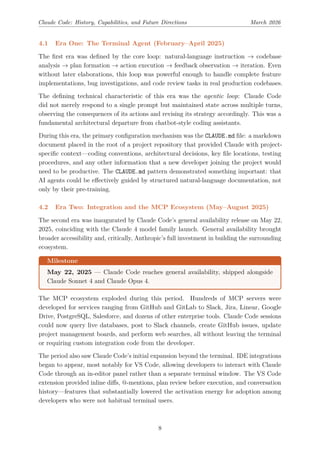
The second era was inaugurated by Claude Code’s general availability release on May 22,
2025, coinciding with the Claude 4 model family launch. General availability brought
broader accessibility and, critically, Anthropic’s full investment in building the surrounding
ecosystem.
Milestone
May 22, 2025 — Claude Code reaches general availability, shipped alongside
Claude Sonnet 4 and Claude Opus 4.
The MCP ecosystem exploded during this period. Hundreds of MCP servers were
developed for services ranging from GitHub and GitLab to Slack, Jira, Linear, Google
Drive, PostgreSQL, Salesforce, and dozens of other enterprise tools. Claude Code sessions
could now query live databases, post to Slack channels, create GitHub issues, update
project management boards, and perform web searches, all without leaving the terminal
or requiring custom integration code from the developer.
The period also saw Claude Code’s initial expansion beyond the terminal. IDE integrations
began to appear, most notably for VS Code, allowing developers to interact with Claude
Code through an in-editor panel rather than a separate terminal window. The VS Code
extension provided inline diffs, @-mentions, plan review before execution, and conversation
history—features that substantially lowered the activation energy for adoption among
developers who were not habitual terminal users.
8
Claude Code: History, Capabilities, and Future Directions March 2026
Economically, this era was characterised by the metric that validated the entire enterprise:
by September 2025, Claude Code usage had grown by more than tenfold in three months,
reaching an annualised revenue run-rate of over $500 million. For a tool that the main-
stream technology press had largely not registered, these were platform-scale adoption
numbers.
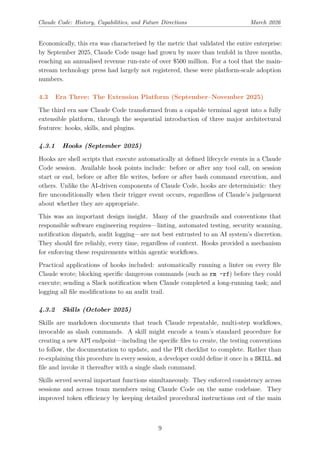
4.3 Era Three: The Extension Platform (September–November 2025)
The third era saw Claude Code transformed from a capable terminal agent into a fully
extensible platform, through the sequential introduction of three major architectural
features: hooks, skills, and plugins.
4.3.1 Hooks (September 2025)
Hooks are shell scripts that execute automatically at defined lifecycle events in a Claude
Code session. Available hook points include: before or after any tool call, on session
start or end, before or after file writes, before or after bash command execution, and
others. Unlike the AI-driven components of Claude Code, hooks are deterministic: they
fire unconditionally when their trigger event occurs, regardless of Claude’s judgement
about whether they are appropriate.
This was an important design insight. Many of the guardrails and conventions that
responsible software engineering requires—linting, automated testing, security scanning,
notification dispatch, audit logging—are not best entrusted to an AI system’s discretion.
They should fire reliably, every time, regardless of context. Hooks provided a mechanism
for enforcing these requirements within agentic workflows.
Practical applications of hooks included: automatically running a linter on every file
Claude wrote; blocking specific dangerous commands (such as rm -rf) before they could
execute; sending a Slack notification when Claude completed a long-running task; and
logging all file modifications to an audit trail.
4.3.2 Skills (October 2025)
Skills are markdown documents that teach Claude repeatable, multi-step workflows,
invocable as slash commands. A skill might encode a team’s standard procedure for
creating a new API endpoint—including the specific files to create, the testing conventions
to follow, the documentation to update, and the PR checklist to complete. Rather than
re-explaining this procedure in every session, a developer could define it once in a SKILL.md
file and invoke it thereafter with a single slash command.
Skills served several important functions simultaneously. They enforced consistency across
sessions and across team members using Claude Code on the same codebase. They
improved token efficiency by keeping detailed procedural instructions out of the main
9
Claude Code: History, Capabilities, and Future Directions March 2026
conversation context until needed. And they created a mechanism for encoding and
sharing institutional knowledge about how a particular codebase should be modified.
Anthropic’s own skill system—examples of which are visible in Claude Code’s documentation—
includes skills for document creation (DOCX, PDF, PPTX), image generation, and
domain-specific coding patterns. The skills framework effectively allowed Claude Code
to be customised for specific domains without requiring any changes to the underlying
model or platform.
4.3.3 Plugins (October 2025)
Plugins extended the skills concept by allowing packaged bundles of capabilities—subagents,
skills, MCP configurations, and hooks—to be installed and shared as reusable units. Plu-
gins could be developed by third parties and distributed through community registries,
creating an ecosystem of Claude Code extensions analogous to the VS Code extension
marketplace.
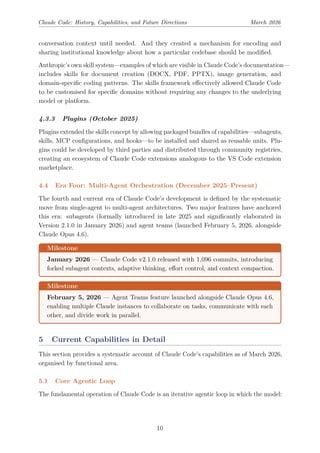
4.4 Era Four: Multi-Agent Orchestration (December 2025–Present)
The fourth and current era of Claude Code’s development is defined by the systematic
move from single-agent to multi-agent architectures. Two major features have anchored
this era: subagents (formally introduced in late 2025 and significantly elaborated in
Version 2.1.0 in January 2026) and agent teams (launched February 5, 2026, alongside
Claude Opus 4.6).
Milestone
January 2026 — Claude Code v2.1.0 released with 1,096 commits, introducing
forked subagent contexts, adaptive thinking, effort control, and context compaction.
Milestone
February 5, 2026 — Agent Teams feature launched alongside Claude Opus 4.6,
enabling multiple Claude instances to collaborate on tasks, communicate with each
other, and divide work in parallel.
5 Current Capabilities in Detail
This section provides a systematic account of Claude Code’s capabilities as of March 2026,
organised by functional area.
5.1 Core Agentic Loop
The fundamental operation of Claude Code is an iterative agentic loop in which the model:
10
Claude Code: History, Capabilities, and Future Directions March 2026
1. Reads the environment: Inspects file trees, reads source files, checks git history,
queries MCP-connected services, and observes any context provided through CLAUDE.md
or skills.
2. Forms a plan: In plan mode, presents a step-by-step implementation strategy for
human review before taking action.
3. Executes actions: Writes and edits files, runs bash commands, spawns subagents,
queries MCP servers, and commits to version control.
4. Observes results: Reads the output of shell commands, test results, compiler errors,
and other feedback signals.
5. Iterates: Revises the approach in light of observed results, continuing until the task is
complete or a human intervenes.
This loop can run for extended periods without human intervention—hours in some
cases—with Claude Code autonomously navigating multi-step workflows, recovering from
errors, and course-correcting when initial approaches prove incorrect.
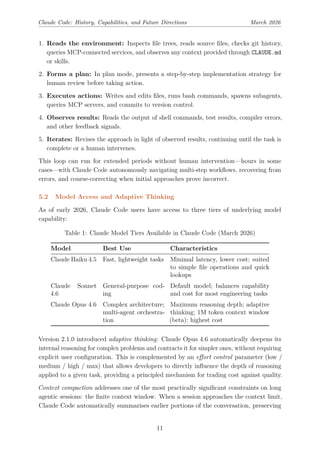
5.2 Model Access and Adaptive Thinking
As of early 2026, Claude Code users have access to three tiers of underlying model
capability:
Table 1: Claude Model Tiers Available in Claude Code (March 2026)
Model Best Use Characteristics
Claude Haiku 4.5 Fast, lightweight tasks Minimal latency, lower cost; suited
to simple file operations and quick
lookups
Claude Sonnet
4.6
General-purpose cod-
ing
Default model; balances capability
and cost for most engineering tasks
Claude Opus 4.6 Complex architecture;
multi-agent orchestra-
tion
Maximum reasoning depth; adaptive
thinking; 1M token context window
(beta); highest cost
Version 2.1.0 introduced adaptive thinking: Claude Opus 4.6 automatically deepens its
internal reasoning for complex problems and contracts it for simpler ones, without requiring
explicit user configuration. This is complemented by an effort control parameter (low /
medium / high / max) that allows developers to directly influence the depth of reasoning
applied to a given task, providing a principled mechanism for trading cost against quality.
Context compaction addresses one of the most practically significant constraints on long
agentic sessions: the finite context window. When a session approaches the context limit,
Claude Code automatically summarises earlier portions of the conversation, preserving
11
Claude Code: History, Capabilities, and Future Directions March 2026
the most relevant information while freeing space for continued operation. This allows
multi-hour autonomous sessions that would otherwise be truncated.
5.3 File System and Shell Integration
Claude Code’s interaction with the file system is highly capable and carefully bounded.
By default, agents begin with read-only access to the project directory and require explicit
human approval—or developer-configured permission allowlists—to write files or execute
commands. This conservative-by-default posture reflects Anthropic’s Constitutional AI
heritage: capable systems should also be safe systems.
Within approved boundaries, Claude Code can:
• Read arbitrary text files, including source code in any language, configuration files,
documentation, and data files.
• Write and edit files with surgical precision, using diff-based editing that modifies only
the specific lines or sections that require change.
• Execute arbitrary shell commands and observe their output, including long-running
processes, build systems, test suites, and deployment scripts.
• Navigate the git repository, inspect history, create branches, stage changes, and make
commits.
• Interact with environment variables, package managers, and the full UNIX toolchain.
5.4 MCP Server Integration
The Model Context Protocol transforms Claude Code from a self-contained tool into a
node in a broader ecosystem of services. MCP servers can be configured in .mcp.json
files at the project or user level, making their tools available to all Claude Code sessions
within the relevant scope.
Well-established MCP integrations as of early 2026 include:
• Version control: GitHub, GitLab (create issues, open PRs, review code, manage
releases).
• Project management: Jira, Linear, Asana, Monday (query tickets, update status,
assign work).
• Communication: Slack, Microsoft Teams (post messages, search history, manage
channels).
• Data: PostgreSQL, MySQL, BigQuery, Snowflake (execute queries, inspect schemas).
• Cloud infrastructure: AWS, Google Cloud, Azure (provision resources, inspect
configurations).
12
Claude Code: History, Capabilities, and Future Directions March 2026
• Design: Figma (inspect designs, extract tokens, generate implementation scaffolding).
• Browser automation: Playwright, Puppeteer (interact with web applications, run
E2E tests).
• Search: Web search tools enabling Claude Code to retrieve current documentation
and reference material.
5.5 Subagents
Subagents are specialised Claude instances that can be spawned by a parent Claude
Code session to handle specific subtasks. They are defined using YAML frontmatter in
markdown files, specifying a name, description, system prompt, tool allowlist or denylist,
model selection, permission mode, MCP server configuration, skills, and memory scope.
Subagents serve two primary architectural purposes. First, they enable parallelisation:
the parent agent can spawn multiple subagents simultaneously to work on independent
subtasks, dramatically reducing wall-clock time for tasks that decompose naturally into
parallel workstreams. Second, they enable context isolation: each subagent maintains its
own context window, preventing the parent’s context from becoming polluted with the
details of subagent operations. The subagent returns only its results to the parent, not its
full internal reasoning.
A typical subagent definition might look as follows:
---
name: security -auditor
description: Specialised agent for security vulnerability
analysis
model: claude -opus -4-6
tools: Read , Grep , Glob , Bash
disallowedTools : Write , Edit
permissionMode : cautious
skills:
- owasp -top -ten
- dependency -scanning
---
You are a security specialist. Analyse the provided code for
vulnerabilities following OWASP guidelines. Report findings
with severity ratings and recommended mitigations.
Listing 1: Example subagent definition (YAML frontmatter)
The tool restriction syntax is particularly significant from a safety perspective: by using
‘disallowedTools: Write, Edit‘, this security auditor subagent is constrained to read-only
operations, preventing it from introducing changes to the codebase even if it were to
misidentify a vulnerability.
13
Claude Code: History, Capabilities, and Future Directions March 2026
In Version 2.1.63, the Task tool was renamed Agent, reflecting the maturation of the
subagent concept from a narrow task-dispatch mechanism into a full agent-spawning
architecture. As of Version 2.1, the parent agent can also restrict which subagent types
it spawns, using syntax such as Agent(worker, researcher), providing fine-grained
control over multi-agent topology.
5.6 Hooks
Hooks are deterministic lifecycle scripts that execute at defined points in Claude Code’s
operation. The hook specification in settings.json identifies an event type (e.g.,
PostToolUse), an optional matcher (e.g., matching only Write tool calls), and a shell
command to execute.
Available hook events include: PreToolUse, PostToolUse, SessionStart, SessionEnd,
PreBashExecute, and PostBashExecute. This coverage allows hooks to intercept and
act at every significant moment in a Claude Code session.
5.7 Agent Teams
Agent Teams, launched on February 5, 2026, represent the most architecturally ambitious
feature in Claude Code’s history. Where subagents are isolated workers that report
back to a single orchestrating parent, agent teams are collaborative ensembles in which
multiple Claude instances communicate bidirectionally, share a task queue, and challenge
or validate each other’s outputs.
The paradigmatic demonstration of agent teams was Anthropic’s own internal project: 16
Claude Opus 4.6 agents collaborating over two weeks to write a C compiler in Rust from
scratch, producing a system capable of compiling the Linux kernel. The total cost was
approximately $20,000 in API tokens—substantial by individual developer standards, but
negligible for an engineering project of this scope. This demonstration was significant not
merely as a technical achievement but as evidence that multi-agent Claude Code systems
could tackle problems of genuine complexity that had historically required teams of expert
engineers working over extended periods.
Agent teams differ architecturally from subagents in several key respects:
• Peer communication: Team members can send messages directly to each other, not
only to the lead agent.
• Shared task queues: Tasks can be self-assigned from a shared pool, enabling dynamic
load balancing.
• Cross-validation: One agent can explicitly challenge or verify another’s findings,
implementing a form of adversarial review.
• Configuration: Unlike subagents (configured in YAML), agent teams are configured
14
Claude Code: History, Capabilities, and Future Directions March 2026
through the prompt itself—the lead agent handles orchestration based on natural-
language task descriptions.
5.8 Skills
Skills are markdown documents that encode repeatable multi-step workflows. They are
invocable via slash commands (e.g., /review-api-endpoint) or through Claude Code’s
automatic skill detection, which identifies when a requested task matches a defined skill
and applies it without explicit invocation.
The skills system has evolved significantly from its October 2025 introduction. Version 2.1
introduced hot-reload support—edits to skill files are reflected immediately in the running
session without requiring a restart—and improved the auto-detection logic to reduce false
positives. Subagents can receive skill content injected into their context at startup through
the skills frontmatter field, giving them domain expertise without requiring them to
search for and load relevant skills during execution.
5.9 Memory
Claude Code’s memory system, introduced in Version 2.1, allows the agent to automatically
record and recall information across sessions. This is distinct from the in-session context:
memory persists after a session ends, enabling Claude Code to retain knowledge about
a project’s conventions, prior decisions, common errors, and other information that
accumulates over time.
The memory system operates at multiple scopes: project-level memory (stored in .claude/memory/)
records project-specific information, while user-level memory (in ~/.claude/memory/)
records preferences and patterns that apply across all projects. This architecture allows
Claude Code to become more effective for a given user over time, not merely within a
single session.
5.10 Security Architecture
Security has been a persistent consideration in Claude Code’s design, reflecting both
Anthropic’s Constitutional AI principles and the practical requirements of enterprise
deployment. The security architecture has several layers.
Filesystem sandboxing restricts Claude Code agents to approved directories. By default,
agents can only access the active project directory; access to other filesystem locations
requires explicit permission.
Git credential isolation is enforced through a git proxy that strips credentials before any
remote interaction, protecting against the class of supply-chain attacks that could exploit
a compromised or confused agent’s git access.
Permission modes allow fine-grained control over what actions require human approval.
15
Claude Code: History, Capabilities, and Future Directions March 2026
The cautious mode requires approval for any file modification or command execution;
intermediate modes selectively trust certain categories of action; and bypassPermissions
mode (intended for highly automated pipelines with appropriate surrounding controls)
allows the agent to proceed without approval prompts.
Subagent permission inheritance ensures that child agents cannot exceed the permissions
of their parent: if the parent requires human approval for file writes, the child cannot
autonomously write files unless the parent has explicitly granted that capability.
5.11 IDE Integration and Desktop Application
Claude Code is accessible through multiple interfaces beyond the original terminal client:
VS Code Extension Provides inline diffs, @-mentions for file and symbol references,
plan review before execution, and conversation history directly within the editor.
Available for VS Code and Cursor.
JetBrains Plugin Equivalent integration for IntelliJ IDEA, PyCharm, WebStorm, and
other JetBrains IDEs.
Desktop Application A standalone application for running Claude Code outside the
IDE or terminal. Features visual diff review, multiple parallel sessions, task schedul-
ing, and cloud session management.
Web Interface Browser-based Claude Code access with no local installation required,
useful for environments where local tool installation is restricted.
5.12 GitHub Actions Integration
Claude Code can be triggered as part of CI/CD pipelines through GitHub Actions,
enabling asynchronous agentic workflows: a developer assigns an issue to Claude Code,
the system executes in a sandboxed GitHub Actions environment, and opens a draft pull
request with its implementation. This coding agent pattern—distinct from the interactive
agent mode used within IDEs—allows Claude Code to be integrated into team workflows
in a way that mirrors existing review and approval processes, preserving human oversight
at the PR review stage.
6 Economic and Professional Impact
6.1 Revenue Trajectory
Claude Code’s financial trajectory has been remarkable. The tool reached $500 million in
annualised revenue by September 2025—roughly seven months after the research preview
and four months after general availability. By the end of 2025 that figure had grown to
over $1 billion ARR. By February 2026, it had more than doubled again to approximately
16
Claude Code: History, Capabilities, and Future Directions March 2026
$2.5 billion ARR, making it one of the fastest-growing software products in technology
history by almost any measure.
This revenue contributed substantially to Anthropic’s broader competitive position. Indus-
try analysts from Epoch and Semianalysis projected in early 2026 that Anthropic was on
trajectory to surpass OpenAI’s revenue by the end of 2026—a prospect that would have
seemed implausible as recently as 2024, when OpenAI’s revenue advantage was widely
regarded as insurmountable.
The revenue story is also notable for what it reveals about enterprise demand for AI coding
tools specifically. Claude Code’s growth was not driven primarily by individual developer
subscriptions but by enterprise adoption—organisations paying for team and enterprise
plans that provided administrative controls, security certifications, and volume pricing.
This pattern suggests that the value Claude Code provides is perceived as strategic, not
merely convenient, by the organisations deploying it.
6.2 Impact on the Software Development Profession
The professional consequences of Claude Code have been far-reaching and, in some quarters,
contentious. Boris Cherny’s public statements on the subject have generated particular
attention. In a February 2026 appearance on Lenny Rachitsky’s podcast, Cherny stated
that he believed the title of “software engineer” might begin to disappear by the end of
2026, replaced by the more general “builder.” He noted that he had not manually edited a
single line of code since November 2025; Claude Code writes 100% of his production code.
This framing provoked a range of responses. Some senior engineers endorsed the character-
isation from personal experience, describing productivity gains that made prior approaches
to software development feel archaeologically remote. Others expressed concern about
the implications for junior developer career paths and the acquisition of foundational
engineering skills. Cherny himself acknowledged that the transition “is going to be painful
for a lot of people,” drawing an analogy to the scribal profession’s relationship with the
printing press: a technology that did not eliminate literacy but fundamentally restructured
who produced written content and how.
Empirical evidence suggests that the effect is heterogeneous. Research from Anthropic’s
Societal Impacts team found that while developers use AI in roughly 60% of their work,
they report being able to “fully delegate” only 0–20% of tasks. AI functions as a constant
collaborator, not a wholesale replacement, at least for the current generation of models.
The tasks most fully delegated tend to be those with clear success criteria: implementing
a specified function, writing tests for existing code, migrating code to a new API, or
fixing a clearly characterised bug. Tasks requiring ambiguous creative judgement—system
design, product strategy, user experience decisions—remain firmly in human hands.
17
Claude Code: History, Capabilities, and Future Directions March 2026
6.3 Expansion Beyond Traditional Development
Perhaps the most sociologically significant trend of 2025–2026 has been Claude Code’s
adoption by people who had never previously written software. The combination of
dramatically improved models and increasingly polished agentic tooling has lowered the
barrier to software creation to the point where technical skill in the traditional sense is no
longer a prerequisite for building functional applications.
This democratisation dynamic is not entirely new: no-code and low-code platforms have
been pursuing this vision for a decade. What distinguishes Claude Code is the depth
of capability accessible through natural language: not simple workflow automation but
production-grade, full-stack applications with authentication, persistent storage, API
integrations, and deployable infrastructure. Users can describe what they want in plain
English and observe it taking shape without touching a line of code or understanding
what the code does.
Anthropic’s response to this demographic expansion was the launch of Claude Cowork in
January 2026—a desktop application explicitly designed for non-technical users who want
to automate tasks involving Google Docs, email, Slack, and other everyday productivity
tools, without the terminal-centric interface of Claude Code proper. Cowork represents a
parallel product track aimed at a different audience, but built on the same underlying
agent architecture.
7 Claude Code in Scientific and High-Stakes Domains
Claude Code’s impact has extended well beyond conventional software engineering into
scientific computing, biological research, and mission-critical engineering applications.
Several notable deployments are worth documenting.
7.1 NASA Mars Rover Navigation
In December 2025, NASA engineers used Claude Code to prepare a route of approximately
400 metres for the Perseverance Mars rover, using the Rover Markup Language (RML).
The application demonstrated Claude Code’s capacity to operate in specialised domain
languages with high-stakes consequences—errors in rover navigation could result in the loss
of irreplaceable scientific equipment. The successful deployment represented a significant
vote of confidence in the reliability of agentic AI for mission-critical engineering tasks.
7.2 Computational Biology
Claude Code has gained traction among computational biologists for applications includ-
ing analysis of large-scale genomic datasets, integration with established bioinformatics
pipelines, and the automation of experimental design workflows. Anthropic’s Head of
Life Sciences, Jonah Cool, has spoken about Claude’s potential to compress decades
of biological research into significantly shorter periods by dramatically accelerating the
18
Claude Code: History, Capabilities, and Future Directions March 2026
execution of experimental and analytical tasks. A partnership between Anthropic and the
Allen Institute formalised this direction, applying Claude Code to work with large-scale
biological datasets including single-cell resolution mouse brain maps.
7.3 Firefox Security Auditing
In a remarkable demonstration of agentic AI’s capacity for security analysis, Claude Code
identified over 100 bugs in Firefox’s codebase during a two-week autonomous scanning
exercise in early 2026, of which 14 were classified as high-severity. This application—
sustained, systematic analysis of a large, complex, mature codebase—is precisely the kind
of task that is cognitively demanding and time-consuming for human security researchers
but naturally suited to an AI agent that can work continuously without fatigue or
distraction.
7.4 Compiler Construction
The agent teams demonstration noted earlier—16 Claude Opus 4.6 instances collaborating
to write a C compiler in Rust capable of compiling the Linux kernel—merits consideration
as a technical milestone in its own right. Compiler construction is one of the most
technically demanding tasks in software engineering, requiring deep knowledge of formal
language theory, code generation, optimisation, and systems programming. The fact
that a coordinated ensemble of AI agents could produce a functional compiler, even an
inefficient one, represents a significant advance in the frontier of what AI systems can
accomplish autonomously.
8 Competitive Landscape
Claude Code’s success has attracted substantial competitive response and shaped the
strategic direction of the broader AI coding tool market.
8.1 Direct Competitors
OpenAI Codex CLI was released in April 2025, approximately two months after Claude
Code’s research preview. Built on the o3 and o4-mini reasoning models, Codex CLI
adopted the same fundamental architecture—a terminal-based agent loop with filesystem
access and shell execution—that Claude Code had established. OpenAI’s strategy of
offering usage allowances well in excess of subscription fees succeeded in growing Codex’s
user base significantly through 2025 and into 2026, though it remained behind Claude
Code by usage share.
Google Gemini CLI followed in June 2025, built on Gemini 2.5 Pro. Like Codex CLI,
it adopted the terminal agent architecture.
Both competitors’ adoption of the fundamental architecture pioneered by Claude Code is
itself significant: it represents the market’s collective judgment that the terminal-based
19
Claude Code: History, Capabilities, and Future Directions March 2026
agentic loop is the correct paradigm for AI coding tools, not a quirk of Anthropic’s specific
product choices.
OpenCode emerged as the leading open-source alternative, growing to over 70,000 GitHub
stars by early 2026. OpenCode is model-agnostic—it can be configured to use Claude,
GPT-4, Gemini, or any other compatible model—making it attractive to developers who
want the agentic coding experience without vendor lock-in.
8.2 IDE-Centric Competitors
Cursor, Windsurf, and GitHub Copilot’s agent mode represent a parallel competitive track
centred on IDE integration rather than the terminal. These tools target developers who
prefer to remain within a graphical editor environment and who may be less comfortable
with command-line interfaces. The boundary between terminal-first tools like Claude
Code and IDE-first tools like Cursor has blurred considerably as both have expanded
their surface area, but the two approaches retain distinct user communities and workflow
philosophies.
9 Future Directions
Projecting the future trajectory of Claude Code requires distinguishing between trends that
are already clearly established and will almost certainly continue, emerging directions that
are technically plausible and strategically motivated, and more speculative longer-term
possibilities.
9.1 Continued Autonomy Expansion
The most clearly established trend is the progressive expansion of the range of tasks that
Claude Code can handle without human intervention. The progression from file editing,
to multi-file refactoring, to complete feature implementation, to sustained long-running
autonomous sessions has been consistent and rapid. Anthropic’s own roadmap language
suggests continued investment in what the company calls the “autonomous research
loop”—sessions in which Claude Code can pursue a complex goal over multiple hours,
recovering from errors, adapting strategy, and producing a finished artefact with minimal
human checkpoints.
Boris Cherny’s prediction that “in a year or two” technical understanding will not be
necessary even for Claude Code use captures the directional thrust, if not the precise
timeline. The practical implication is that the percentage of tasks that can be “fully
delegated” in the Societal Impacts team’s terminology will increase substantially, shifting
from the current 0–20% range toward a majority of conventional software engineering
work.
20
Claude Code: History, Capabilities, and Future Directions March 2026
9.2 Enhanced Multi-Agent Orchestration
Agent teams are the newest major feature, and the infrastructure surrounding them is
still maturing. Several developments are anticipated:
• Orchestration dashboards providing live visualisation of agent dependency graphs,
task assignment, inter-agent communication, and progress tracking.
• Specialised agent marketplaces allowing organisations to publish and share vali-
dated subagent definitions for specific domains (security auditing, API design, docu-
mentation generation, etc.).
• Finer-grained role and permission systems for multi-agent configurations, allowing
precise control over which agents can communicate with which others and what each is
permitted to do.
• Economic optimisation of multi-agent configurations, automatically selecting model
tiers for each agent role based on the complexity of its assigned subtasks.
9.3 Deeper IDE and Development Environment Integration
Current IDE integrations, while functional, represent relatively thin layers on top of the
core Claude Code engine. Future development is likely to include:
• Live codebase indexing that maintains a continuously updated semantic map of the
project, enabling Claude Code to navigate very large codebases (millions of lines) with
the same fluency it currently exhibits in smaller ones.
• Visual debugging integration connecting Claude Code to IDE debuggers, allowing
it to observe program state at breakpoints and reason about runtime behaviour.
• Unified agent management spanning local, background, and cloud sessions from a
single interface, as previewed in GitHub Copilot’s January 2026 multi-agent mode.
9.4 Autonomous CI/CD and DevOps
The GitHub Actions integration established the architectural pattern for integrating
Claude Code into deployment pipelines. The next phase of this direction will likely involve
Claude Code operating as a continuous participant in the software development lifecycle
rather than a tool invoked on demand:
• Automatically identifying and fixing failing tests in CI pipelines.
• Performing automated code review on all pull requests with configurable quality
thresholds.
• Monitoring production error logs and autonomously proposing or implementing fixes.
• Managing dependency updates, security patches, and deprecation migrations.
21
Claude Code: History, Capabilities, and Future Directions March 2026
9.5 Governance, Compliance, and Auditability
As Claude Code penetrates enterprise deployments in regulated industries—financial
services, healthcare, defence, critical infrastructure—the requirements for governance,
compliance, and auditability will become increasingly important competitive considerations.
Anticipated developments include:
• Immutable audit logs of all Claude Code actions within a session, providing complete
traceability for compliance purposes.
• Fine-grained administrative controls allowing enterprise IT teams to restrict Claude
Code’s capabilities in specific contexts.
• SOC 2 Type II, HIPAA, FedRAMP, and equivalent security certifications.
• Integration with enterprise identity and access management systems (SAML, OAuth,
LDAP) to enforce role-based permissions.
Anthropic expanded its enterprise security certifications significantly in the first months
of 2026, and the Responsible Scaling Policy v3.0, published February 24, 2026, introduced
a Frontier Safety Roadmap with specific non-binding targets for Security, Alignment,
Safeguards, and Policy capabilities. This institutional commitment to structured safety
documentation is likely to become a differentiating factor in enterprise sales cycles as
regulatory scrutiny of AI systems increases.
9.6 Expansion to Adjacent Knowledge Work
Cherny’s observation that Claude Code will expand “to pretty much any kind of work that
you can do on a computer” points toward the most expansive possible future direction:
the generalisation of the agentic coding paradigm to knowledge work beyond software
engineering.
This is already happening. Claude Cowork, launched January 2026 for non-technical users,
applies the same agent architecture to tasks like managing email, updating spreadsheets,
and coordinating Slack communications. The underlying model—a capable AI agent
with access to a computer’s files, applications, and network, guided by natural-language
instructions—is the same in both cases. The difference is in the tooling and the interface.
The trajectory suggests that the boundary between “AI coding tool” and “general AI
worker” will become increasingly indistinct as agent capabilities improve and the range of
tasks that can be effectively specified in natural language expands.
9.7 Self-Improvement and Meta-Learning
Among the more speculative but technically plausible future directions is the possibility
of Claude Code participating in its own development: writing code that improves its own
22
Claude Code: History, Capabilities, and Future Directions March 2026
capabilities, identifying patterns in its own failures, and proposing modifications to its
configuration, skills, or hook scripts based on observed session performance.
Rudimentary forms of this are already present in the skills system—developers can ask
Claude Code to create skills from observed workflows—but a more systematic meta-learning
capability, in which Claude Code autonomously identifies opportunities to improve its own
operation, would represent a qualitative advance. This direction raises significant safety
questions that will require careful navigation: the risks of self-modifying systems are well
understood in the theoretical AI safety literature, and ensuring that self-improvement
loops remain bounded and auditable will be a significant engineering and governance
challenge.
9.8 The Question of AGI-Adjacent Capability
Some technical observers have characterised the Claude 4.5 and 4.6 model families, when
combined with the Claude Code agentic scaffold, as the first credible instance of AGI-
adjacent reasoning applied directly to production software workflows. This framing is
contested and its precise meaning depends on definitions of AGI that remain philosophically
contentious. What is empirically clear is that the capabilities accessible through Claude
Code have grown faster than most observers predicted, and that the practical boundary
between what AI can and cannot do autonomously has moved dramatically in a short
period.
Anthropic’s own Responsible Scaling Policy framework, which classifies Claude Opus 4.6
at ASL-3 (“substantially increases catastrophic misuse risk”) and leaves ASL-4 and ASL-5
conditions largely undefined pending better evaluation science, reflects the company’s
acknowledgment that the pace of capability development is outrunning the frameworks
available to assess it. How this uncertainty is managed—both technically and in terms of
deployment policy—will significantly shape the next phase of Claude Code’s development.
10 Philosophical and Societal Dimensions
10.1 The Nature of Human-AI Collaboration
Claude Code’s development has generated sustained reflection on the appropriate relation-
ship between human expertise and AI capability in software engineering. The Anthropic
Societal Impacts research finding—that developers use AI in 60% of their work but fully
delegate only 0–20% of tasks—is important because it suggests that the value of human
judgment is not being displaced but rather redirected.
Cherny’s articulation of this redirection is worth quoting: the parts of his job he now
spends most time on are “figuring out what to build, talking to users, thinking about big
systems, thinking about the future, collaborating with other people on the team.” The
implication is that AI agents are excellent at execution within well-specified problem spaces
and that the irreducible human contribution is the specification itself—the translation of
23
Claude Code: History, Capabilities, and Future Directions March 2026
user needs, business context, and creative vision into the structured problems that agents
can be directed to solve.
This division of labour has precedents in other fields: the architect and the builder, the
composer and the orchestra, the scientist and the laboratory apparatus. In each case,
advances in tooling have shifted the human role toward higher levels of abstraction without
eliminating the need for human judgment. Whether software engineering will follow this
pattern, or whether the judgment required to specify problems will itself be progressively
automated, is an open question that will be answered by the next generation of capability
advances.
10.2 Implications for Software Education and Skill Formation
If the traditional skills of software engineering—syntax mastery, algorithmic thinking,
debugging intuition, system design—are increasingly exercised by AI agents rather than
human developers, the question of what should be taught to people entering the field
becomes genuinely difficult. Cherny’s suggestion that technical understanding may not be
necessary “in a year or two” for Claude Code users implies a significant change in what it
means to be a software professional.
One response is to argue that foundational skills remain important precisely because they
enable effective collaboration with AI agents—that you cannot direct an agent well if you
do not understand what it is doing. This is consistent with Cherny’s own observation
that engineers using Claude Code today still need to understand underlying principles.
The open question is whether this prerequisite will persist as models improve and agent
interfaces become more natural-language accessible.
Another response is to argue that software education should pivot toward the skills of
specification, system design, evaluation, and oversight—the human side of the human-
agent collaboration. This would represent a significant curricular change for computer
science programmes and coding bootcamps alike.
10.3 The Question of Societal Disruption
Cherny acknowledged explicitly that decisions about the broader societal implications of
Claude Code’s capabilities “shouldn’t be up to us,” arguing that society needs to lead the
larger conversation about the future of work. This is a notable statement from the creator
of a product that annualised to $1 billion in revenue in its first six months. It reflects
both a genuine epistemic humility about predicting second-order effects and an implicit
argument that individual technology companies should not be the primary decision-makers
about their products’ societal consequences.
Whether this deference to “society” is adequate, given the pace at which these capabilities
are being deployed at scale, is a question that will occupy researchers, policymakers, and
ethicists for years to come.
24
Claude Code: History, Capabilities, and Future Directions March 2026
11 Conclusion
Claude Code has, in the space of a little over a year, accomplished something rare in
technology: it has genuinely changed what is possible for a large category of productive
work. From its origins as a personal experiment by a single engineer in his first month at
a new company, through a research preview that the mainstream press largely failed to
notice, through four developmental eras of rapidly expanding capability, to its current
position as a multi-agent software engineering platform generating billions of dollars in
annualised revenue—the arc has been remarkably steep.
The capabilities documented in this paper—the agentic loop, adaptive thinking, MCP inte-
gration, subagents, hooks, skills, agent teams, and the surrounding security architecture—
represent not merely a collection of features but a coherent architectural vision: that
software engineering is better understood as a set of tasks to be orchestrated than as a
set of skills to be exercised, and that AI agents are increasingly capable of serving as the
orchestrated rather than merely the tool.
The future directions surveyed—expanded autonomy, deeper multi-agent coordination,
CI/CD integration, self-improvement loops, and the generalisation to adjacent knowledge
work—suggest that what has been accomplished to date is likely to be, in retrospect, the
beginning rather than the culmination of a transformation.
The fundamental questions raised by that transformation—about the future of software
engineering as a profession, about the appropriate governance of capable AI agents in
critical systems, about the distribution of the productivity gains, and about the nature
of human expertise when AI can perform increasing proportions of the work—are not
questions that Claude Code alone will answer. They are questions that the technology,
the organisations deploying it, the people affected by it, and the regulatory and policy
frameworks that govern it will collectively work out over the years ahead.
What Boris Cherny’s printing press analogy captures well is that the answer to these
questions, whatever it turns out to be, will look quite different from any of the answers that
current frameworks and assumptions would suggest. The scribes who watched the first
printing presses operate could not have predicted the consequences for literacy, scholarship,
religious authority, or political power. The engineers watching Claude Code complete its
first autonomous multi-hour sessions in 2025 may be in a similarly limited position. The
work, like the technology, is just beginning.
A Timeline of Key Milestones
Date Event
September 2024 Boris Cherny joins Anthropic; builds initial Claude Code
prototype
25
Claude Code: History, Capabilities, and Future Directions March 2026
Date Event
November 2024 Model Context Protocol (MCP) introduced as open stan-
dard
February 24, 2025 Claude Code research preview released alongside Claude
3.7 Sonnet
April 2025 OpenAI releases Codex CLI (competing terminal agent)
May 22, 2025 Claude Code reaches general availability with Claude 4
launch
June 2025 Google releases Gemini CLI
July 2025 Formal subagent architecture introduced
September 2025 Hooks system introduced; usage grows 10× in three
months; $500M ARR
October 2025 Skills and plugins systems introduced
November 2025 Claude Opus 4.5 released; Boris Cherny stops writing
code manually
December 2025 NASA uses Claude Code for Mars rover route planning;
$1B+ ARR
January 2026 Claude Code v2.1.0 released (1,096 commits); agent
teams previewed
January 2026 Claude Cowork launched for non-technical users
February 5, 2026 Agent Teams feature launched alongside Claude Opus
4.6
February 2026 16-agent team writes C compiler in Rust (compiles Linux
kernel)
February 2026 Claude Code finds 100+ bugs in Firefox (14 high-severity)
February 2026 Claude Code reaches $2.5B ARR
February 24, 2026 Anthropic RSP v3.0 published; Vercept acquisition an-
nounced
March 2026 Claude Sonnet 4.6 becomes default model on Claude
Code
B Glossary
Agentic Loop The iterative read-plan-act-observe-revise cycle that defines Claude Code’s
operation.
Agent Teams Multiple Claude instances that collaborate bidirectionally, share task
queues, and can communicate peer-to-peer.
CLAUDE.md
Project-level markdown configuration file providing Claude with contex-
tual information about the codebase.
26
Claude Code: History, Capabilities, and Future Directions March 2026
Constitutional AI
Anthropic’s framework for training AI systems to be helpful and harmless
using a set of explicit principles.
Context Compaction
Automatic summarisation of earlier conversation segments to preserve
context window space in long sessions.
Hooks Deterministic shell scripts triggered at defined lifecycle events in a Claude
Code session.
MCP (Model Context Protocol)
Open standard for connecting AI agents with external tools and data
sources.
Plugins Packaged bundles of skills, subagents, MCP configurations, and hooks
distributable as reusable units.
Skills Markdown-defined repeatable workflows invocable as slash commands.
Subagents Specialised Claude instances spawned by a parent agent to handle specific
subtasks with isolated context windows.
Vibe Coding Informal term for the earlier AI-assisted coding paradigm in which human
developers steered direction and AI filled in implementations on demand.
References
References
[1] Bai, Y., Jones, A., Ndousse, K., Askell, A., Chen, A., DasSarma, N., et al. (2022).
Constitutional AI: Harmlessness from AI Feedback. arXiv preprint arXiv:2212.08073.
[2] Anthropic. (2025). Responsible Scaling Policy, Version 2.0. Anthropic Technical
Report.
[3] Anthropic. (2026, February 24). Responsible Scaling Policy, Version 3.0. Anthropic
Technical Report.
[4] Time Magazine. (2026, March 11). How Anthropic Became the Most Disruptive
Company in the World. Time.
[5] Fortune. (2026, February 24). The Software Engineer Title Could Be Gone by Year
End, Says Creator of Claude Code. Fortune Media.
[6] Dentro.de/AI. (2026, February 24). Claude Code: The Revolution Nobody Noticed.
Dentro.de.
27
Claude Code: History, Capabilities, and Future Directions March 2026
[7] Anthropic. (2026, January 21). Eight Trends Defining How Software Gets Built in
2026. Anthropic Blog.
[8] LM Po. (2025, January 4). The Evolution of Claude Code in 2025. Medium.
[9] Catalaize. (2026, February 5). Claude Code and the Architecture of Autonomous
Software Engineering in 2026. Catalaize Substack.
[10] SmartScope. (2026, February). GitHub Copilot & Claude Code Multi-Agent Collabo-
ration: Latest Features, Pricing & Usage Strategy. SmartScope Blog.
[11] Ahmad, M. (2026, March). Claude Code Extensions Explained: Skills, MCP, Hooks,
Subagents, Agent Teams & Plugins. Medium.
[12] AI CERTs. (2026, January 13). Claude Code 2.1.0: Next-Gen AI Coding Framework
Autonomy. AI CERTs News.
[13] Anthropic. (2025). Building Agents with the Claude Agent SDK. Anthropic Engineer-
ing Blog.
[14] VS Code Team. (2026, February 5). Your Home for Multi-Agent Development. VS
Code Blog.
[15] Taskade. (2026). What is Anthropic? History of Claude AI & Claude Code. Taskade
Blog.
[16] ClaudeLog. (2026). Claude Code Docs, Guides, Tutorials & Best Practices. claude-
log.com.
28