Welcome!
Good day, dearand learners!
Welcome to a new and exciting school year. This orientation will
help everyone understand the classroom expectations, routines,
school policies, and the new Three-Term School Calendar
implemented by the Department of Education.
Let us work together to make this school year productive, safe,
and meaningful for all learners.
3.
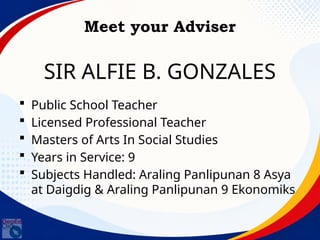
Meet Your Adviser
SIRALFIE B. GONZALES
Public School Teacher
Licensed Professional Teacher
Masters of Arts In Social Studies
Years in Service: 9
Subjects Handled: Araling Panlipunan 8 Asya
at Daigdig & Araling Panlipunan 9 Ekonomiks
Meet your Adviser
4.
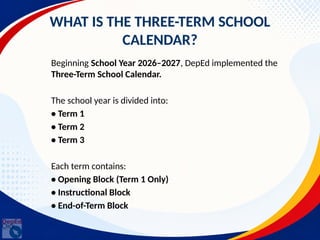
WHAT IS THETHREE-TERM SCHOOL
CALENDAR?
Beginning School Year 2026–2027, DepEd implemented the
Three-Term School Calendar.
The school year is divided into:
• Term 1
• Term 2
• Term 3
Each term contains:
• Opening Block (Term 1 Only)
• Instructional Block
• End-of-Term Block
5.
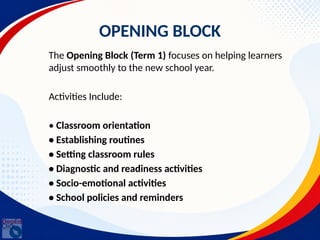
OPENING BLOCK
The OpeningBlock (Term 1) focuses on helping learners
adjust smoothly to the new school year.
Activities Include:
• Classroom orientation
• Establishing routines
• Setting classroom rules
• Diagnostic and readiness activities
• Socio-emotional activities
• School policies and reminders
6.
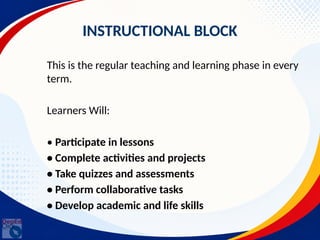
INSTRUCTIONAL BLOCK
This isthe regular teaching and learning phase in every
term.
Learners Will:
• Participate in lessons
• Complete activities and projects
• Take quizzes and assessments
• Perform collaborative tasks
• Develop academic and life skills
7.
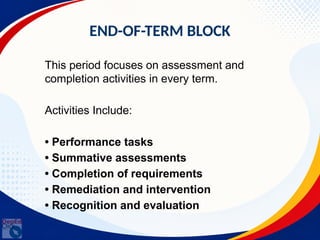
END-OF-TERM BLOCK
This periodfocuses on assessment and
completion activities in every term.
Activities Include:
• Performance tasks
• Summative assessments
• Completion of requirements
• Remediation and intervention
• Recognition and evaluation
9.
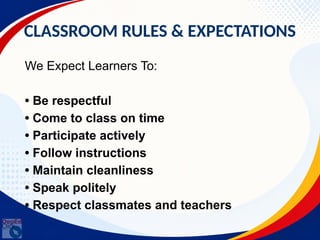
CLASSROOM RULES &EXPECTATIONS
We Expect Learners To:
• Be respectful
• Come to class on time
• Participate actively
• Follow instructions
• Maintain cleanliness
• Speak politely
• Respect classmates and teachers
10.
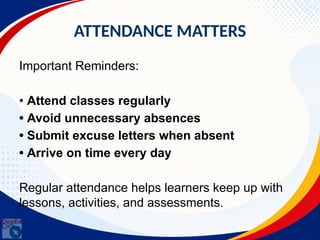
ATTENDANCE MATTERS
Important Reminders:
•Attend classes regularly
• Avoid unnecessary absences
• Submit excuse letters when absent
• Arrive on time every day
Regular attendance helps learners keep up with
lessons, activities, and assessments.
11.
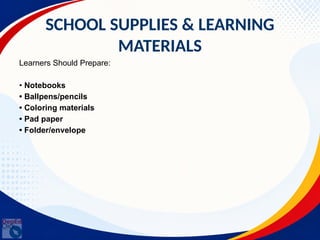
SCHOOL SUPPLIES &LEARNING
MATERIALS
Learners Should Prepare:
• Notebooks
• Ballpens/pencils
• Coloring materials
• Pad paper
• Folder/envelope
12.
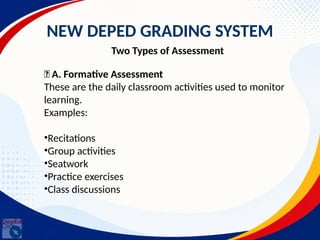
NEW DEPED GRADINGSYSTEM
Two Types of Assessment
✅ A. Formative Assessment
These are the daily classroom activities used to monitor
learning.
Examples:
•Recitations
•Group activities
•Seatwork
•Practice exercises
•Class discussions
13.
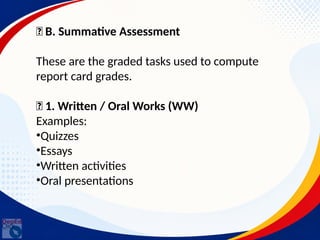
✅ B. SummativeAssessment
These are the graded tasks used to compute
report card grades.
📖 1. Written / Oral Works (WW)
Examples:
•Quizzes
•Essays
•Written activities
•Oral presentations
AWARDS AND RECOGNITION
ForKindergarten to Grade 3:
•There will be NO academic ranking or honors yet.
For Grades 4–12:
•Awards will still be given based on averages.
•Awardees will be listed alphabetically to lessen
unhealthy competition.
18.
HEALTH, SAFETY, ANDDRRM REMINDERS
Safety Practices:
• Follow school safety rules
• Participate in drills seriously
• Observe proper hallway behavior
• Stay alert during emergencies
Learners should prioritize safety at all times.
19.
COMMUNICATION & COORDINATION
OfficialCommunication Channels:
• Parent Messenger Group
• Text messages
• Scheduled conferences
Parents are encouraged to monitor learner progress and
coordinate respectfully with teachers.
20.
PARENTS AS PARTNERS
Parentsplay an important role in the success of every
learner.
Parents Can Help By:
• Monitoring assignments
• Encouraging good study habits
• Guiding learner behavior
• Supporting school activities
21.
Dear Learners…
This classroomis a safe place for learning, growth,
kindness, and respect.
Do your best, believe in yourself, and never be
afraid to ask questions.
Let us make this school year meaningful and
successful together.