Chapter 2: Cell The Building Block of Life
Origin of Life and Importance of Cells
Scientists believe that life first originated in water. Some researchers suggest that
life may have begun in small water pools or hot springs where environmental
conditions changed frequently. Such conditions were present on early Earth about 3.5
billion years ago . The hot springs of Puga Valley in Ladakh are examples of such
environments. These hot springs contain thermophiles , which are heat - loving
unicellular bacteria. Scientists found that calcium carbonate deposits around these
springs may have protect ed early organic molecules from harmful radiation and
helped in forming the first cell membrane.
All living organisms are made up of cells , which are the basic units of life. Some
organisms like bacteria and yeast have only one cell and are called unicellular
organisms , while organisms like plants, animals, and humans have many cells and
are called multicellular organisms . Similar cells form tissues , tissues form organs ,
and organs together form organ systems such as the respiratory system.
NCERTGuide.in
https://www.ncertguide.in/ 1
Cell – The Basic Unit of Life
The cell is called the structural and functional unit of life because all living activities
occur within cells. Even though cells are tiny, they perform all life processes such as
respiration, nutrition, growth, excretion, and reproduction.
How to Study Cells?
The human eye cannot see very tiny objects clearly. The minimum distance at which
two points can be seen separately is called the limit of resolution , which for the
human eye is 0.1 mm. Since most cells are smaller than this, we need microscopes
to study them.
Microscope
A microscope uses convex lenses to
magnify tiny objects.
Robert Hooke first observed cells in 1665
using a microscope while examining cork
and named the box - like structures
“cells.”
Types of Microscopes
1. Light Microscope – Uses visible
light and can magnify objects up to
about 1000 times.
2. Electron Microscope – Uses
electrons instead of light and can
show structures at the nanometre level with very high clarity.
Important Features of a Microscope
✔ Magnification – Makes the object appear larger.
✔ Resolution – Ability to distinguish two close points clearly.
✔ Contrast – Difference in brightness between different parts.
Estimating Cell Size
Scientists estimate cell size by comparing the microscope field diameter with the
number of cells visible across it. Example: If field diameter is 5000 µm and 25 cells
fit across it, then one cell is 200 µm .
Structure of a Cell
Every cell has three main parts:
1. Cell membrane
2. Cytoplasm
3. Nucleus
In addition, eukaryotic cells contain organelles.
NCERTGuide.in
https://www.ncertguide.in/ 2
2.2 Cell Membrane – Universal Feature of a Cell
The cell membrane (or plasma membrane) is a thin protective boundary around the
cell. It separates the cell from its surroundings and controls the movement of
substances.
Selectively Permeable
The cell membrane is selectively permeable , meaning it allows some substances to
pass but blocks others.
Osmosis
The movement of water through a selectively permeable membrane from a dilute
solution to a concentrated solution is called osmosis .
Example:
• Potato in plain water swells because water enters the cells.
• Potato in salt solution shrinks because water leaves the cells.
Diffusion
The movement of particles from higher concentration to lower concentration is called
diffusion .
Types of Solutions
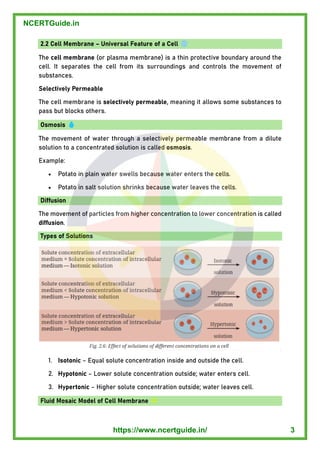
1. Isotonic – Equal solute concentration inside and outside the cell.
2. Hypotonic – Lower solute concentration outside; water enters cell.
3. Hypertonic – Higher solute concentration outside; water leaves cell.
Fluid Mosaic Model of Cell Membrane
NCERTGuide.in
https://www.ncertguide.in/ 3
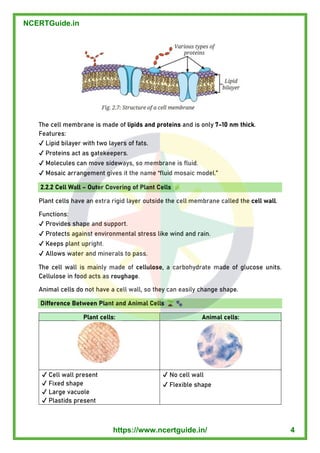
The cell membrane is made of lipids and proteins and is only 7–10 nm thick .
Features:
✔ Lipid bilayer with two layers of fats.
✔ Proteins act as gatekeepers.
✔ Molecules can move sideways, so membrane is fluid.
✔ Mosaic arrangement gives it the name “fluid mosaic model. ”
2.2.2 Cell Wall – Outer Covering of Plant Cells
Plant cells have an extra rigid layer outside the cell membrane called the cell wall .
Functions:
✔ Provides shape and support.
✔ Protects against environmental stress like wind and rain.
✔ Keeps plant upright.
✔ Allows water and minerals to pass.
The cell wall is mainly made of cellulose , a carbohydrate made of glucose units.
Cellulose in food acts as roughage .
Animal cells do not have a cell wall, so they can easily change shape.
Difference Between Plant and Animal Cells
Plant cells: Animal cells:
✔ Cell wall present
✔ Fixed shape
✔ Large vacuole
✔ Plastids present
✔ No cell wall
✔ Flexible shape
NCERTGuide.in
https://www.ncertguide.in/ 4
✔ Small vacuoles
✔ No plastids
2.3 Cell Interior – Coordinated Working System
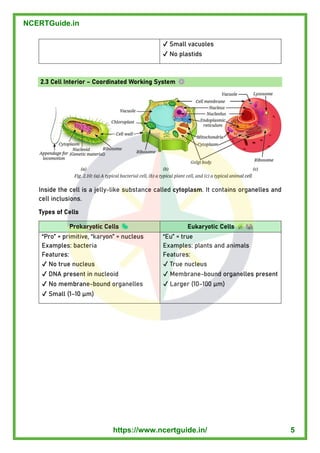
Inside the cell is a jelly - like substance called cytoplasm . It contains organelles and
cell inclusions.
Types of Cells
Prokaryotic Cells Eukaryotic Cells
“Pro” = primitive, “karyon” = nucleus
Examples: bacteria
Features:
✔ No true nucleus
✔ DNA present in nucleoid
✔ No membrane - bound organelles
✔ Small (1 –10µm)
“Eu” = true
Examples: plants and animals
Features:
✔ True nucleus
✔ Membrane - bound organelles present
✔ Larger (10 –100 µm)
NCERTGuide.in
https://www.ncertguide.in/ 5
Cell Organelles and Their Functions
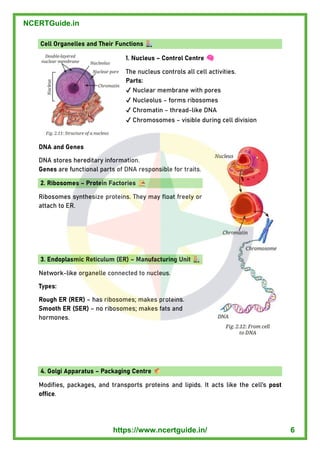
1. Nucleus – Control Centre
The nucleus controls all cell activities.
Parts:
✔ Nuclear membrane with pores
✔ Nucleolus – forms ribosomes
✔ Chromatin – thread - like DNA
✔ Chromosomes – visible during cell division
DNA and Genes
DNA stores hereditary information.
Genes are functional parts of DNA responsible for traits.
2. Ribosomes – Protein Factories
Ribosomes synthesize proteins. They may float freely or
attach to ER.
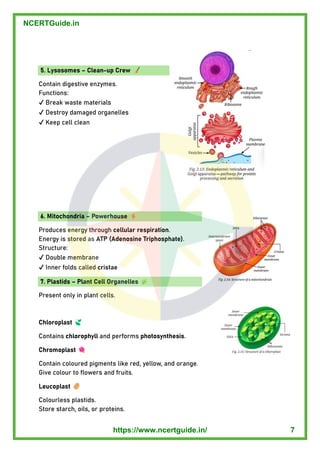
3. Endoplasmic Reticulum (ER) – Manufacturing Unit
Network - like organelle connected to nucleus.
Types:
Rough ER (RER) – has ribosomes; makes proteins.
Smooth ER (SER) – no ribosomes; makes fats and
hormones.
4. Golgi Apparatus – Packaging Centre
Modifies, packages, and transports proteins and lipids. It acts like the cell’s post
office.
NCERTGuide.in
https://www.ncertguide.in/ 6
5. Lysosomes – Clean - up Crew
Contain digestive enzymes.
Functions:
✔ Break waste materials
✔ Destroy damaged organelles
✔ Keep cell clean
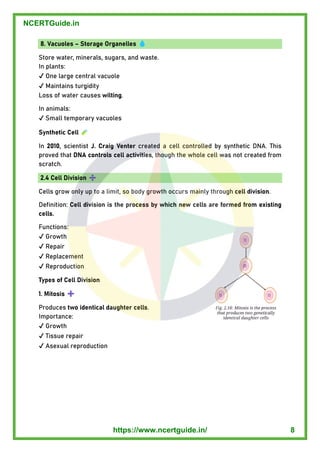
6. Mitochondria – Powerhouse
Produces energy through cellular respiration .
Energy is stored as ATP (Adenosine Triphosphate) .
Structure:
✔ Double membrane
✔ Inner folds called cristae
7. Plastids – Plant Cell Organelles
Present only in plant cells.
Chloroplast
Contains chlorophyll and performs photosynthesis .
Chromoplast
Contain coloured pigments like red, yellow, and orange.
Give colour to flowers and fruits.
Leucoplast
Colourless plastids.
Store starch, oils, or proteins.
NCERTGuide.in
https://www.ncertguide.in/ 7
8. Vacuoles – Storage Organelles
Store water, minerals, sugars, and waste.
In plants:
✔ One large central vacuole
✔ Maintains turgidity
Loss of water causes wilting.
In animals:
✔ Small temporary vacuoles
Synthetic Cell
In 2010, scientist J. Craig Venter created a cell controlled by synthetic DNA. This
proved that DNA controls cell activities , though the whole cell was not created from
scratch.
2.4 Cell Division
Cells grow only up to a limit, so body growth occurs mainly through cell division .
Definition: Cell division is the process by which new cells are formed from existing
cells.
Functions:
✔ Growth
✔ Repair
✔ Replacement
✔ Reproduction
Types of Cell Division
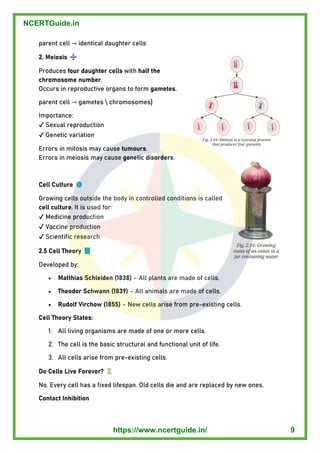
1. Mitosis
Produces two identical daughter cells .
Importance:
✔ Growth
✔ Tissue repair
✔ Asexual reproduction
NCERTGuide.in
https://www.ncertguide.in/ 8
parent cell → identical daughter cells
2. Meiosis
Produces four daughter cells with half the
chromosome number .
Occurs in reproductive organs to form gametes .
parent cell → gametes  chromosomes}
Importance:
✔ Sexual reproduction
✔ Genetic variation
Errors in mitosis may cause tumours .
Errors in meiosis may cause genetic disorders .
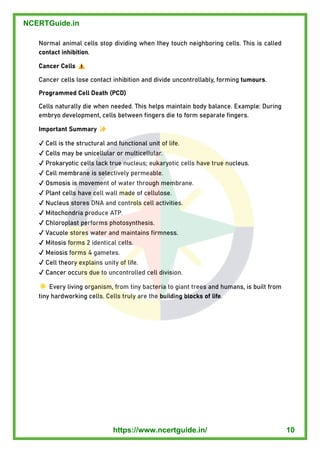
Cell Culture
Growing cells outside the body in controlled conditions is called
cell culture . It is used for:
✔ Medicine production
✔ Vaccine production
✔ Scientific research
2.5 Cell Theory
Developed by:
• Matthias Schleiden (1838) – All plants are made of cells.
• Theodor Schwann (1839) – All animals are made of cells.
• Rudolf Virchow (1855) – New cells arise from pre - existing cells.
Cell Theory States:
1. All living organisms are made of one or more cells.
2. The cell is the basic structural and functional unit of life.
3. All cells arise from pre - existing cells.
Do Cells Live Forever?
No. Every cell has a fixed lifespan. Old cells die and are replaced by new ones.
Contact Inhibition
NCERTGuide.in
https://www.ncertguide.in/ 9
Normal animal cells stop dividing when they touch neighboring cells. This is called
contact inhibition .
Cancer Cells
Cancer cells lose contact inhibition and divide uncontrollably, forming tumours .
Programmed Cell Death (PCD)
Cells naturally die when needed. This helps maintain body balance. Example: During
embryo development, cells between fingers die to form separate fingers.
Important Summary
✔ Cell is the structural and functional unit of life.
✔ Cells may be unicellular or multicellular.
✔ Prokaryotic cells lack true nucleus; eukaryotic cells have true nucleus.
✔ Cell membrane is selectively permeable.
✔ Osmosis is movement of water through membrane.
✔ Plant cells have cell wall made of cellulose.
✔ Nucleus stores DNA and controls cell activities.
✔ Mitochondria produce ATP.
✔ Chloroplast performs photosynthesis.
✔ Vacuole stores water and maintains firmness.
✔ Mitosis forms 2 identical cells.
✔ Meiosis forms 4 gametes.
✔ Cell theory explains unity of life.
✔ Cancer occurs due to uncontrolled cell division.
Every living organism, from tiny bacteria to giant trees and humans, is built from
tiny hardworking cells. Cells truly are the building blocks of life .
NCERTGuide.in
https://www.ncertguide.in/ 10