POWERPOINT PRESENTATION
FOR CLASS 9TH
SCIENCE
AS PER NEW SYLLABUS 2026-27
CHAPTER 8 :- JOURNEY INSIDE AN
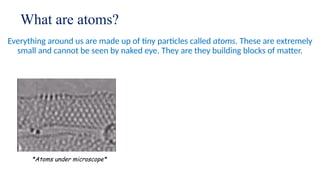
What are atoms?
Everything around us are made up of tiny particles called atoms. These are extremely
small and cannot be seen by naked eye. They are they building blocks of matter.
*Atoms under microscope*
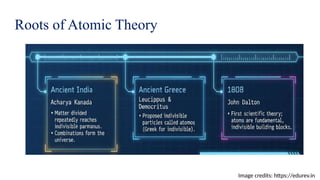
Roots of Atomic Theory
Image credits: https://edurev.in
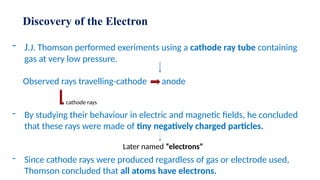
Discovery of the Electron
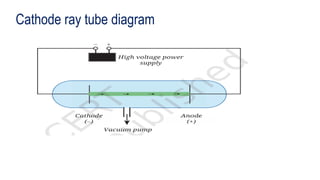
- J.J. Thomson performed exeriments using a cathode ray tube containing
gas at very low pressure.
Observed rays travelling-cathode anode
- By studying their behaviour in electric and magnetic fields, he concluded
that these rays were made of tiny negatively charged particles.
- Since cathode rays were produced regardless of gas or electrode used,
Thomson concluded that all atoms have electrons.
cathode rays
Later named “electrons”
Cathode ray tube diagram
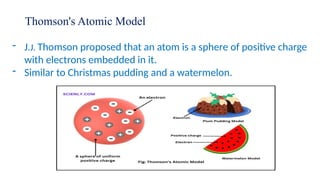
Thomson's Atomic Model
- J.J. Thomson proposed that an atom is a sphere of positive charge
with electrons embedded in it.
- Similar to Christmas pudding and a watermelon.
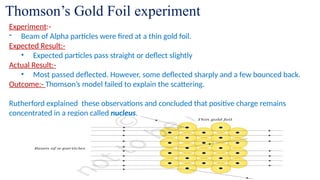
Thomson’s Gold Foil experiment
Experiment:-
- Beam of Alpha particles were fired at a thin gold foil.
Expected Result:-
• Expected particles pass straight or deflect slightly
Actual Result:-
• Most passed deflected. However, some deflected sharply and a few bounced back.
Outcome:- Thomson’s model failed to explain the scattering.
Rutherford explained these observations and concluded that positive charge remains
concentrated in a region called nucleus.
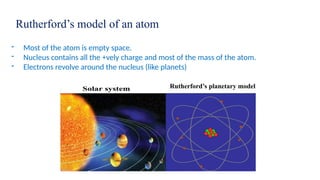
Rutherford’s model of an atom
- Most of the atom is empty space.
- Nucleus contains all the +vely charge and most of the mass of the atom.
- Electrons revolve around the nucleus (like planets)
Rutherford’s planetary model
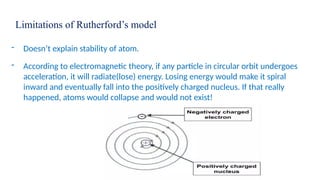
Limitations of Rutherford’s model
- Doesn’t explain stability of atom.
- According to electromagnetic theory, if any particle in circular orbit undergoes
acceleration, it will radiate(lose) energy. Losing energy would make it spiral
inward and eventually fall into the positively charged nucleus. If that really
happened, atoms would collapse and would not exist!
Discovery of proton
- Rutherford discovered protons as positively charged particles in
the nucleus. For an atom to be electrically neutral, the number of
protons must be equal the number of electrons.
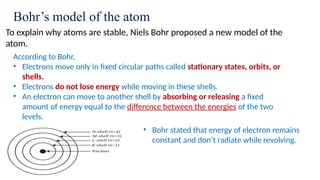
Bohr’s model of the atom
To explain why atoms are stable, Niels Bohr proposed a new model of the
atom.
According to Bohr,
• Electrons move only in fixed circular paths called stationary states, orbits, or
shells.
• Electrons do not lose energy while moving in these shells.
• An electron can move to another shell by absorbing or releasing a fixed
amount of energy equal to the difference between the energies of the two
levels.
• Bohr stated that energy of electron remains
constant and don’t radiate while revolving.
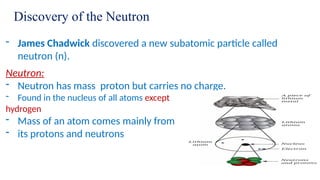
Discovery of the Neutron
- James Chadwick discovered a new subatomic particle called
neutron (n).
Neutron:
- Neutron has mass proton but carries no charge.
- Found in the nucleus of all atoms except
hydrogen
- Mass of an atom comes mainly from
- its protons and neutrons
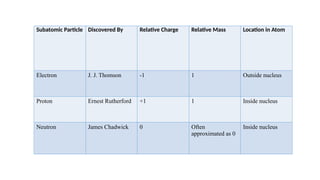
Subatomic Particle Discovered By Relative Charge Relative Mass Location in Atom
Electron J. J. Thomson -1 1 Outside nucleus
Proton Ernest Rutherford +1 1 Inside nucleus
Neutron James Chadwick 0 Often
approximated as 0
Inside nucleus
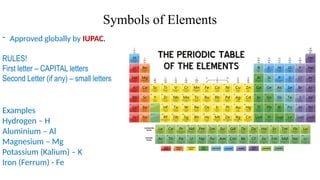
Symbols of Elements
- Approved globally by IUPAC.
RULES!
First letter – CAPITAL letters
Second Letter (if any) – small letters
Examples
Hydrogen – H
Aluminium – Al
Magnesium – Mg
Potassium (Kalium) – K
Iron (Ferrum) - Fe
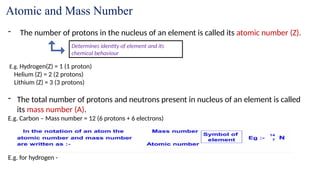
Atomic and Mass Number
- The number of protons in the nucleus of an element is called its atomic number (Z).
E.g. Hydrogen(Z) = 1 (1 proton)
Helium (Z) = 2 (2 protons)
Lithium (Z) = 3 (3 protons)
- The total number of protons and neutrons present in nucleus of an element is called
its mass number (A).
E.g. Carbon – Mass number = 12 (6 protons + 6 electrons)
E.g. for hydrogen -
Determines identity of element and its
chemical behaviour
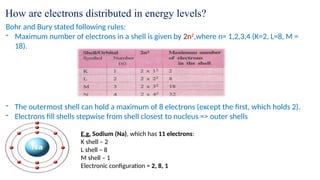
How are electrons distributed in energy levels?
Bohr and Bury stated following rules:
- Maximum number of electrons in a shell is given by 2n2
,where n= 1,2,3,4 (K=2, L=8, M =
18).
- The outermost shell can hold a maximum of 8 electrons (except the first, which holds 2).
- Electrons fill shells stepwise from shell closest to nucleus => outer shells
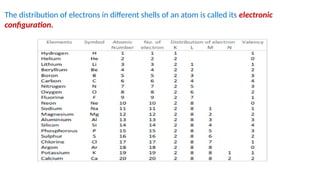
E.g. Sodium (Na), which has 11 electrons:
K shell – 2
L shell – 8
M shell – 1
Electronic configuration = 2, 8, 1
The distribution of electrons in different shells of an atom is called its electronic
configuration.
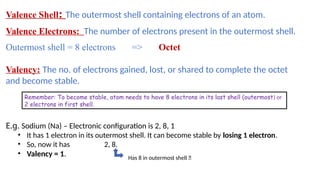
Valence Shell: The outermost shell containing electrons of an atom.
Valence Electrons: The number of electrons present in the outermost shell.
Outermost shell = 8 electrons => Octet
Valency: The no. of electrons gained, lost, or shared to complete the octet
and become stable.
E.g. Sodium (Na) – Electronic configuration is 2, 8, 1
• It has 1 electron in its outermost shell. It can become stable by losing 1 electron.
• So, now it has 2, 8.
• Valency = 1.
Remember: To become stable, atom needs to have 8 electrons in its last shell (outermost) or
2 electrons in first shell.
Has 8 in outermost shell ✅
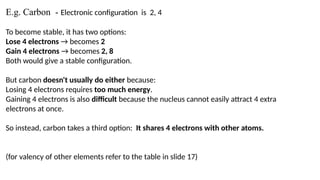
E.g. Carbon - Electronic configuration is 2, 4
To become stable, it has two options:
Lose 4 electrons → becomes 2
Gain 4 electrons → becomes 2, 8
Both would give a stable configuration.
But carbon doesn't usually do either because:
Losing 4 electrons requires too much energy.
Gaining 4 electrons is also difficult because the nucleus cannot easily attract 4 extra
electrons at once.
So instead, carbon takes a third option: It shares 4 electrons with other atoms.
(for valency of other elements refer to the table in slide 17)
ISOTOPES
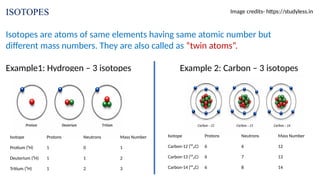
Isotopes are atoms of same elements having same atomic number but
different mass numbers. They are also called as “twin atoms”.
Example1: Hydrogen – 3 isotopes Example 2: Carbon – 3 isotopes
Isotope Protons Neutrons Mass Number
Protium (¹H) 1 0 1
Deuterium (²H) 1 1 2
Tritium (³H) 1 2 3
Isotope Protons Neutrons Mass Number
Carbon-12 (¹²₆C) 6 6 12
Carbon-13 (¹³₆C) 6 7 13
Carbon-14 (¹⁴₆C) 6 8 14
Image credits- https://studyless.in
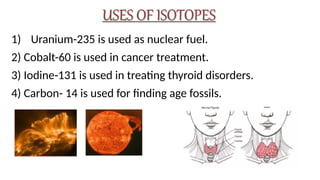
1) Uranium-235 is used as nuclear fuel.
2) Cobalt-60 is used in cancer treatment.
3) Iodine-131 is used in treating thyroid disorders.
4) Carbon- 14 is used for finding age fossils.
Average Atomic Mass
- Average atomic mass is the weighted average of the masses of all
naturally occurring isotopes of an element.
Ex: Chlorine
Cl-35 (more abundant; 75%)
Cl-37 (less abundant; 25%)
Average atomic mass of chlorine=
=35.5 u
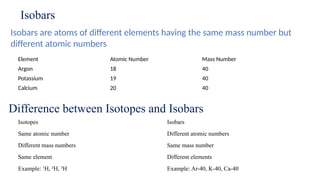
Isobars
Isobars are atoms of different elements having the same mass number but
different atomic numbers
Element Atomic Number Mass Number
Argon 18 40
Potassium 19 40
Calcium 20 40
Difference between Isotopes and Isobars
Isotopes Isobars
Same atomic number Different atomic numbers
Different mass numbers Same mass number
Same element Different elements
Example: ¹H, ²H, ³H Example: Ar-40, K-40, Ca-40
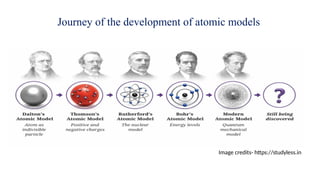
Journey of the development of atomic models
Image credits- https://studyless.in
THANK YOU!!!