Class 8 Science Study Guide Prepared for: CA SUVIDHA CHAPLOT
Easy Notes + Diagrams + Practice Questions CA SUVIDHA CHAPLOT Page 1
CLASS 8 SCIENCE
Chapter 1: Exploring the
Investigative World of Science
Easy Language Notes | Colour Visuals | MCQs | Short & Long Answers
Prepared for
CA SUVIDHA CHAPLOT
Aesthetic study resource for Grade 8 and above learners.
This study guide is a simplified, student-friendly learning resource based on the uploaded Chapter 1 PDF and the
official NCERT Class 8 Science Curiosity syllabus roadmap. It is written in original easy language and includes
original diagrams, revision notes and practice questions.
Class 8 Science Study Guide Prepared for: CA SUVIDHA CHAPLOT
Easy Notes + Diagrams + Practice Questions CA SUVIDHA CHAPLOT Page 2
What This PDF Covers
This PDF recreates the learning material in a more attractive and easy-to-study form. It covers the full
Chapter 1 explanation, the Class 8 Science syllabus roadmap introduced by the chapter, important
diagrams, MCQs, short-answer questions and long-answer questions.
Section Content
1 Chapter 1 simplified explanation
2 Full Class 8 Science syllabus roadmap
3 Scientific method, variables and puri investigation
4 Chapter-wise big ideas introduced by Chapter 1
5 Diagrams, flowcharts and revision mind map
6 40 MCQs with answer key
7 20 short questions with answers
8 10 long questions with answers
9 Activities, projects and quick revision sheet
Learning Outcomes
- Understand that science begins with curiosity and focused questions.
- Learn how to design a simple investigation and fair test.
- Identify variables, observations, measurements and evidence.
- Connect Chapter 1 with the full Class 8 Science journey.
- Prepare for school exams through MCQs and written answers.
Class 8 Science Study Guide Prepared for: CA SUVIDHA CHAPLOT
Easy Notes + Diagrams + Practice Questions CA SUVIDHA CHAPLOT Page 3
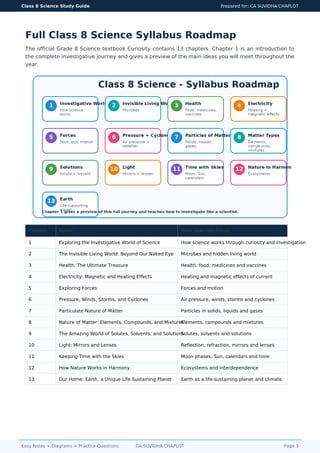
Full Class 8 Science Syllabus Roadmap
The official Grade 8 Science textbook Curiosity contains 13 chapters. Chapter 1 is an introduction to
the complete investigative journey and gives a preview of the main ideas you will meet throughout the
year.
Chapter Name Main Learning Focus
1 Exploring the Investigative World of Science How science works through curiosity and investigation
2 The Invisible Living World: Beyond Our Naked Eye Microbes and hidden living world
3 Health: The Ultimate Treasure Health, food, medicines and vaccines
4 Electricity: Magnetic and Heating Effects Heating and magnetic effects of current
5 Exploring Forces Forces and motion
6 Pressure, Winds, Storms, and Cyclones Air pressure, winds, storms and cyclones
7 Particulate Nature of Matter Particles in solids, liquids and gases
8 Nature of Matter: Elements, Compounds, and Mixtures
Elements, compounds and mixtures
9 The Amazing World of Solutes, Solvents, and Solutions
Solutes, solvents and solutions
10 Light: Mirrors and Lenses Reflection, refraction, mirrors and lenses
11 Keeping Time with the Skies Moon phases, Sun, calendars and time
12 How Nature Works in Harmony Ecosystems and interdependence
13 Our Home: Earth, a Unique Life Sustaining Planet Earth as a life-sustaining planet and climate
Class 8 Science Study Guide Prepared for: CA SUVIDHA CHAPLOT
Easy Notes + Diagrams + Practice Questions CA SUVIDHA CHAPLOT Page 4
Chapter 1 in Easy Language
Chapter 1 welcomes students into the investigative world of science. It reminds us that science does
not start with difficult formulas. It starts with wonder: Why does a puri puff? Why is nature so diverse?
Are there more sand grains or stars? Such questions are invitations to think, observe and investigate.
The chapter says that science is not just learning new facts. It is learning how to find reliable facts.
This means asking focused questions, making careful observations, planning simple experiments and
explaining results clearly.
Main message of the chapter
A student of science should not only ask questions but also design a way to test the question carefully.
Grade 6 introduced wonder and simple questions. Grade 7 showed that scientific ideas keep growing
and changing with new evidence. Grade 8 now takes the next step: students learn to investigate more
systematically.
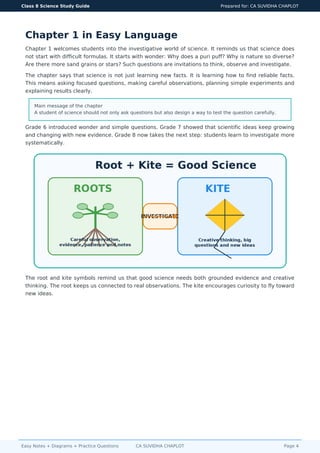
The root and kite symbols remind us that good science needs both grounded evidence and creative
thinking. The root keeps us connected to real observations. The kite encourages curiosity to fly toward
new ideas.
Class 8 Science Study Guide Prepared for: CA SUVIDHA CHAPLOT
Easy Notes + Diagrams + Practice Questions CA SUVIDHA CHAPLOT Page 5
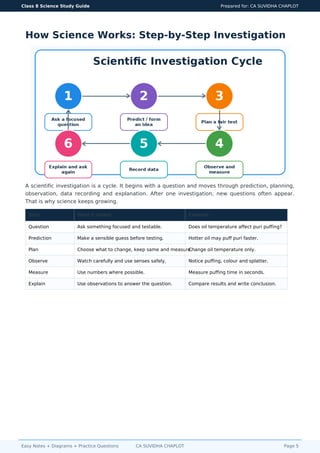
How Science Works: Step-by-Step Investigation
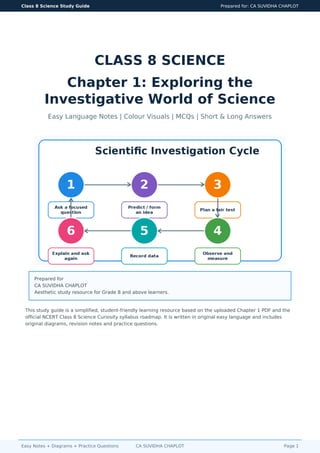
A scientific investigation is a cycle. It begins with a question and moves through prediction, planning,
observation, data recording and explanation. After one investigation, new questions often appear.
That is why science keeps growing.
Step What it means Example
Question Ask something focused and testable. Does oil temperature affect puri puffing?
Prediction Make a sensible guess before testing. Hotter oil may puff puri faster.
Plan Choose what to change, keep same and measure.
Change oil temperature only.
Observe Watch carefully and use senses safely. Notice puffing, colour and splatter.
Measure Use numbers where possible. Measure puffing time in seconds.
Explain Use observations to answer the question. Compare results and write conclusion.
Class 8 Science Study Guide Prepared for: CA SUVIDHA CHAPLOT
Easy Notes + Diagrams + Practice Questions CA SUVIDHA CHAPLOT Page 6
Observation, Inference and Evidence
These three words are very important for science. Students often mix them up, so understand them
clearly.
Term Easy Meaning Example
Observation What you directly notice using senses or instruments.
The puri puffed after 9 seconds.
Inference What you think based on observations. Steam and hot air may have pushed the puri layers apart.
Evidence Reliable observations, measurements and records used to support an explanation.
Times recorded for 5 puris at different oil temperatures.
Conclusion The final answer based on evidence. In this test, puris puffed faster in hotter oil.
Exam Tip
Always write answers using words like observe, measure, fair test, evidence and conclusion. These words
show scientific thinking.
Science becomes stronger when we avoid guessing and depend on evidence. Even a simple question
from the kitchen can become scientific if we record it properly.
Class 8 Science Study Guide Prepared for: CA SUVIDHA CHAPLOT
Easy Notes + Diagrams + Practice Questions CA SUVIDHA CHAPLOT Page 7
Variables in a Fair Test
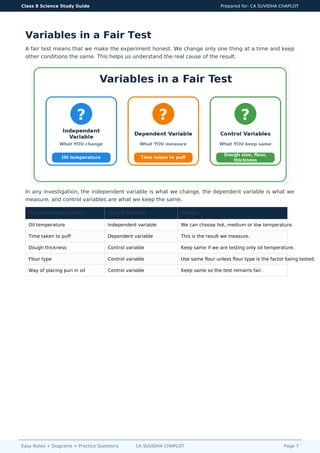
A fair test means that we make the experiment honest. We change only one thing at a time and keep
other conditions the same. This helps us understand the real cause of the result.
In any investigation, the independent variable is what we change, the dependent variable is what we
measure, and control variables are what we keep the same.
Puri Investigation Factor Type of Variable Reason
Oil temperature Independent variable We can choose hot, medium or low temperature.
Time taken to puff Dependent variable This is the result we measure.
Dough thickness Control variable Keep same if we are testing only oil temperature.
Flour type Control variable Use same flour unless flour type is the factor being tested.
Way of placing puri in oil Control variable Keep same so the test remains fair.
Class 8 Science Study Guide Prepared for: CA SUVIDHA CHAPLOT
Easy Notes + Diagrams + Practice Questions CA SUVIDHA CHAPLOT Page 8
Full Explanation: Why One Side of a Puri May
Become Thinner
When rolled dough is put in hot oil, the water inside it quickly turns into steam. Air and steam expand
due to heat. This can push the two layers of dough apart and the puri puffs like a balloon. One side
may become thinner because the dough thickness, heat, trapped steam, stretching and contact with
oil may not be perfectly equal everywhere.
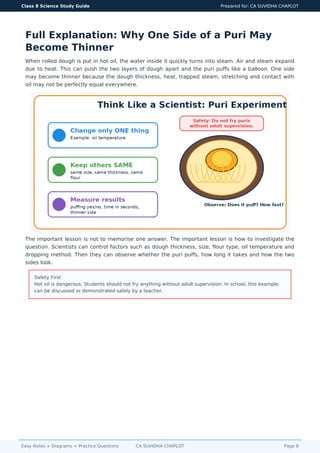
The important lesson is not to memorise one answer. The important lesson is how to investigate the
question. Scientists can control factors such as dough thickness, size, flour type, oil temperature and
dropping method. Then they can observe whether the puri puffs, how long it takes and how the two
sides look.
Safety First
Hot oil is dangerous. Students should not fry anything without adult supervision. In school, this example
can be discussed or demonstrated safely by a teacher.
Class 8 Science Study Guide Prepared for: CA SUVIDHA CHAPLOT
Easy Notes + Diagrams + Practice Questions CA SUVIDHA CHAPLOT Page 9
Sample Investigation Plan: Puri Puffing
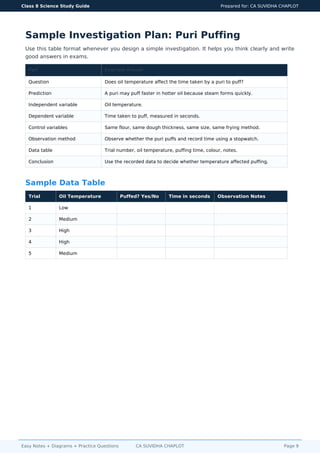
Use this table format whenever you design a simple investigation. It helps you think clearly and write
good answers in exams.
Part Example Answer
Question Does oil temperature affect the time taken by a puri to puff?
Prediction A puri may puff faster in hotter oil because steam forms quickly.
Independent variable Oil temperature.
Dependent variable Time taken to puff, measured in seconds.
Control variables Same flour, same dough thickness, same size, same frying method.
Observation method Observe whether the puri puffs and record time using a stopwatch.
Data table Trial number, oil temperature, puffing time, colour, notes.
Conclusion Use the recorded data to decide whether temperature affected puffing.
Sample Data Table
Trial Oil Temperature Puffed? Yes/No Time in seconds Observation Notes
1 Low
2 Medium
3 High
4 High
5 Medium
Class 8 Science Study Guide Prepared for: CA SUVIDHA CHAPLOT
Easy Notes + Diagrams + Practice Questions CA SUVIDHA CHAPLOT Page 10
Big Ideas Introduced by Chapter 1
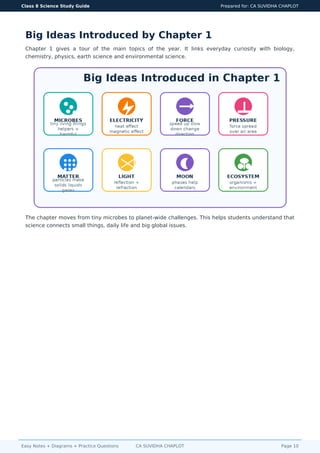
Chapter 1 gives a tour of the main topics of the year. It links everyday curiosity with biology,
chemistry, physics, earth science and environmental science.
The chapter moves from tiny microbes to planet-wide challenges. This helps students understand that
science connects small things, daily life and big global issues.
Class 8 Science Study Guide Prepared for: CA SUVIDHA CHAPLOT
Easy Notes + Diagrams + Practice Questions CA SUVIDHA CHAPLOT Page 11
Syllabus Concepts Explained in Easy Language
Invisible Living World: Microbes
Microbes are tiny living organisms that usually cannot be seen without a microscope. Some microbes
help us digest food, some help make food products, and some are useful in medicines. Some microbes
are harmful and can cause infections. This topic teaches that invisible things can still have a big effect
on our life.
Remember
Microbes can be helpers or troublemakers. We need observation, microscopes and health practices to
understand them.
Health: Food, Exercise, Medicines and Vaccines
Health depends on nutritious food, clean habits, exercise, rest, medicines and vaccines. The body
needs energy and nutrients to grow and repair. Vaccines train the body to fight some infections.
Medicines should be taken only with proper advice.
Remember
A healthy body is a living example of science in action.
Electricity: Heating and Magnetic Effects
Electric current can produce heat and magnetism. Heating effect is used in devices such as heaters,
irons and toasters. Magnetic effect helps motors, bells and machines work. Electricity shows how
invisible energy can create useful changes.
Remember
Electricity connects physics to daily life technology.
Forces and Motion
A force is a push or pull. It can make an object start moving, stop moving, speed up, slow down or
change direction. When we throw a ball up, gravity pulls it down. When brakes are applied, friction
helps slow the vehicle.
Remember
Force helps us understand motion in sports, transport and machines.
Class 8 Science Study Guide Prepared for: CA SUVIDHA CHAPLOT
Easy Notes + Diagrams + Practice Questions CA SUVIDHA CHAPLOT Page 12
Syllabus Concepts Explained in Easy Language
Pressure, Winds, Storms and Cyclones
Pressure is force acting on an area. Air also exerts pressure. Differences in air pressure cause air
movement. A small difference creates gentle wind, while a strong pressure difference can lead to
storms and cyclones.
Remember
Weather is connected to invisible air pressure around us.
Particles of Matter
Everything around us is made of tiny particles. Particles in solids are closely packed and cannot move
much. Particles in liquids can slide, while particles in gases move freely. This explains many properties
of materials.
Remember
Matter becomes easier to understand when we imagine the particles inside it.
Elements, Compounds and Mixtures
Materials can be classified. An element is a pure substance made of one kind of atom. A compound is
formed when elements chemically combine. A mixture contains substances that are mixed and can
usually be separated by physical methods.
Remember
Classification is a powerful scientific habit.
Solutions: Solute and Solvent
A solution forms when a solute dissolves in a solvent. For example, sugar is the solute and water is the
solvent in sugar water. Solutions are common in food, medicine, cleaning and nature.
Remember
Dissolving is a particle-level process we use daily.
Class 8 Science Study Guide Prepared for: CA SUVIDHA CHAPLOT
Easy Notes + Diagrams + Practice Questions CA SUVIDHA CHAPLOT Page 13
Syllabus Concepts Explained in Easy Language
Light: Mirrors and Lenses
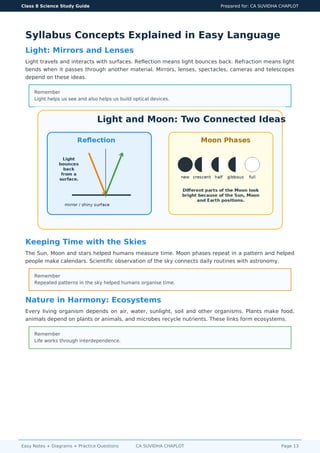
Light travels and interacts with surfaces. Reflection means light bounces back. Refraction means light
bends when it passes through another material. Mirrors, lenses, spectacles, cameras and telescopes
depend on these ideas.
Remember
Light helps us see and also helps us build optical devices.
Keeping Time with the Skies
The Sun, Moon and stars helped humans measure time. Moon phases repeat in a pattern and helped
people make calendars. Scientific observation of the sky connects daily routines with astronomy.
Remember
Repeated patterns in the sky helped humans organise time.
Nature in Harmony: Ecosystems
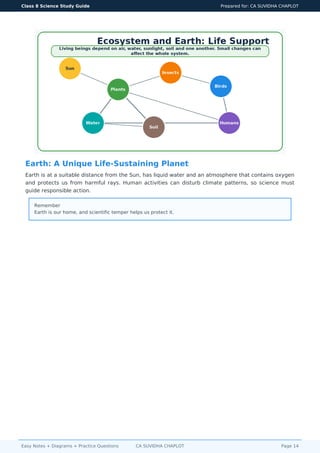
Every living organism depends on air, water, sunlight, soil and other organisms. Plants make food,
animals depend on plants or animals, and microbes recycle nutrients. These links form ecosystems.
Remember
Life works through interdependence.
Class 8 Science Study Guide Prepared for: CA SUVIDHA CHAPLOT
Easy Notes + Diagrams + Practice Questions CA SUVIDHA CHAPLOT Page 14
Earth: A Unique Life-Sustaining Planet
Earth is at a suitable distance from the Sun, has liquid water and an atmosphere that contains oxygen
and protects us from harmful rays. Human activities can disturb climate patterns, so science must
guide responsible action.
Remember
Earth is our home, and scientific temper helps us protect it.
Class 8 Science Study Guide Prepared for: CA SUVIDHA CHAPLOT
Easy Notes + Diagrams + Practice Questions CA SUVIDHA CHAPLOT Page 15
One-Page Revision Mind Map
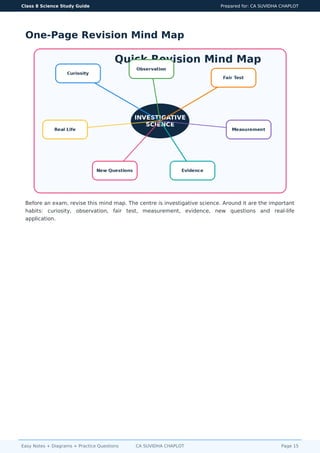
Before an exam, revise this mind map. The centre is investigative science. Around it are the important
habits: curiosity, observation, fair test, measurement, evidence, new questions and real-life
application.
Class 8 Science Study Guide Prepared for: CA SUVIDHA CHAPLOT
Easy Notes + Diagrams + Practice Questions CA SUVIDHA CHAPLOT Page 16
Important Keywords and Meanings
Keyword Easy meaning
Curiosity Desire to know why or how something happens.
Investigation A planned way to answer a question using evidence.
Observation Careful noticing using senses or tools.
Measurement Observation expressed with a number and unit.
Variable A factor that can change in an experiment.
Fair test A test where only one factor is changed at a time.
Hypothesis A testable idea or prediction.
Evidence Data or observations that support an explanation.
Microbe A tiny organism seen only with a microscope.
Vaccine A preparation that helps the body fight a disease.
Force A push or pull.
Pressure Force acting on an area.
Particle A tiny unit that makes up matter.
Element Pure substance made of one kind of atom.
Compound Substance made of elements chemically joined.
Mixture Two or more substances mixed physically.
Solute Substance that dissolves.
Solvent Substance in which solute dissolves.
Reflection Bouncing back of light.
Refraction Bending of light.
Ecosystem Living organisms and their environment together.
Climate Long-term pattern of weather.
Class 8 Science Study Guide Prepared for: CA SUVIDHA CHAPLOT
Easy Notes + Diagrams + Practice Questions CA SUVIDHA CHAPLOT Page 17
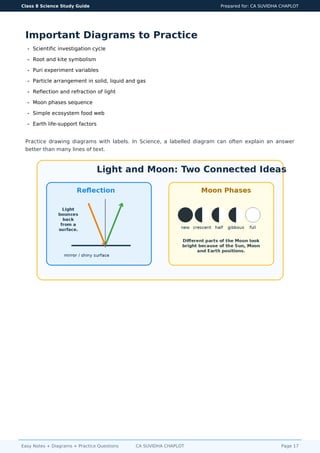
Important Diagrams to Practice
- Scientific investigation cycle
- Root and kite symbolism
- Puri experiment variables
- Particle arrangement in solid, liquid and gas
- Reflection and refraction of light
- Moon phases sequence
- Simple ecosystem food web
- Earth life-support factors
Practice drawing diagrams with labels. In Science, a labelled diagram can often explain an answer
better than many lines of text.
Class 8 Science Study Guide Prepared for: CA SUVIDHA CHAPLOT
Easy Notes + Diagrams + Practice Questions CA SUVIDHA CHAPLOT Page 18
MCQs: Practice Set
Choose the correct answer. Answer key is given after the MCQs.
1. The main aim of scientific investigation is to:
A. memorise facts only
B. ask, test and explain using evidence
C. guess without checking
D. avoid observations
2. A good scientific question is usually:
A. focused and testable
B. impossible to observe
C. only about marks
D. unrelated to evidence
3. In a puri experiment, oil temperature is an
example of:
A. independent variable
B. dependent variable
C. conclusion
D. error
4. The time taken by a puri to puff is:
A. control variable
B. dependent variable
C. hypothesis
D. safety rule
5. A fair test changes:
A. many factors at once
B. no factor at all
C. one factor at a time
D. only the result
6. Roots in the chapter symbolise:
A. flying ideas
B. strong foundation of knowledge
C. noise
D. electricity
7. Kite in the chapter symbolises:
A. curiosity taking flight
B. pressure
C. bacteria
D. mixture
8. Tiny organisms not seen by naked eye are called:
A. planets
B. microbes
C. lenses
D. forces
9. Some microbes are useful because they may
help in:
A. digestion or medicines
B. making stones
C. stopping light
D. removing gravity
10. Vaccines help the body to:
A. fight infections better
B. make mirrors
C. increase pressure only
D. become a magnet
Class 8 Science Study Guide Prepared for: CA SUVIDHA CHAPLOT
Easy Notes + Diagrams + Practice Questions CA SUVIDHA CHAPLOT Page 19
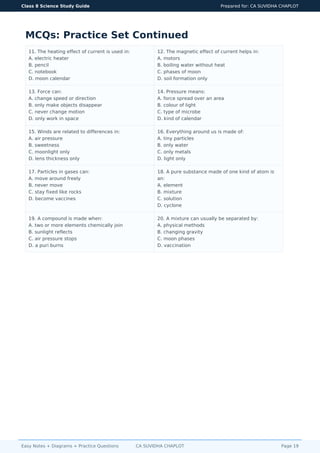
MCQs: Practice Set Continued
11. The heating effect of current is used in:
A. electric heater
B. pencil
C. notebook
D. moon calendar
12. The magnetic effect of current helps in:
A. motors
B. boiling water without heat
C. phases of moon
D. soil formation only
13. Force can:
A. change speed or direction
B. only make objects disappear
C. never change motion
D. only work in space
14. Pressure means:
A. force spread over an area
B. colour of light
C. type of microbe
D. kind of calendar
15. Winds are related to differences in:
A. air pressure
B. sweetness
C. moonlight only
D. lens thickness only
16. Everything around us is made of:
A. tiny particles
B. only water
C. only metals
D. light only
17. Particles in gases can:
A. move around freely
B. never move
C. stay fixed like rocks
D. become vaccines
18. A pure substance made of one kind of atom is
an:
A. element
B. mixture
C. solution
D. cyclone
19. A compound is made when:
A. two or more elements chemically join
B. sunlight reflects
C. air pressure stops
D. a puri burns
20. A mixture can usually be separated by:
A. physical methods
B. changing gravity
C. moon phases
D. vaccination
Class 8 Science Study Guide Prepared for: CA SUVIDHA CHAPLOT
Easy Notes + Diagrams + Practice Questions CA SUVIDHA CHAPLOT Page 20
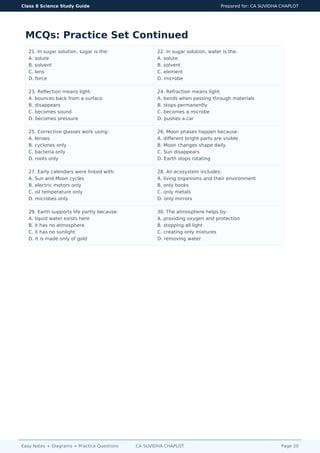
MCQs: Practice Set Continued
21. In sugar solution, sugar is the:
A. solute
B. solvent
C. lens
D. force
22. In sugar solution, water is the:
A. solute
B. solvent
C. element
D. microbe
23. Reflection means light:
A. bounces back from a surface
B. disappears
C. becomes sound
D. becomes pressure
24. Refraction means light:
A. bends when passing through materials
B. stops permanently
C. becomes a microbe
D. pushes a car
25. Corrective glasses work using:
A. lenses
B. cyclones only
C. bacteria only
D. roots only
26. Moon phases happen because:
A. different bright parts are visible
B. Moon changes shape daily
C. Sun disappears
D. Earth stops rotating
27. Early calendars were linked with:
A. Sun and Moon cycles
B. electric motors only
C. oil temperature only
D. microbes only
28. An ecosystem includes:
A. living organisms and their environment
B. only books
C. only metals
D. only mirrors
29. Earth supports life partly because:
A. liquid water exists here
B. it has no atmosphere
C. it has no sunlight
D. it is made only of gold
30. The atmosphere helps by:
A. providing oxygen and protection
B. stopping all light
C. creating only mixtures
D. removing water
Class 8 Science Study Guide Prepared for: CA SUVIDHA CHAPLOT
Easy Notes + Diagrams + Practice Questions CA SUVIDHA CHAPLOT Page 21
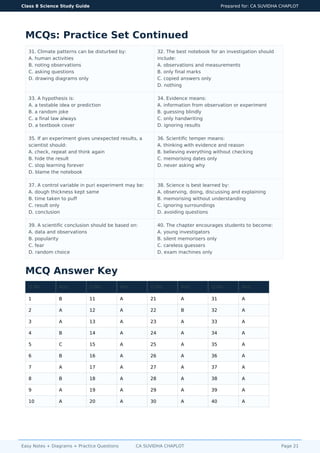
MCQs: Practice Set Continued
31. Climate patterns can be disturbed by:
A. human activities
B. noting observations
C. asking questions
D. drawing diagrams only
32. The best notebook for an investigation should
include:
A. observations and measurements
B. only final marks
C. copied answers only
D. nothing
33. A hypothesis is:
A. a testable idea or prediction
B. a random joke
C. a final law always
D. a textbook cover
34. Evidence means:
A. information from observation or experiment
B. guessing blindly
C. only handwriting
D. ignoring results
35. If an experiment gives unexpected results, a
scientist should:
A. check, repeat and think again
B. hide the result
C. stop learning forever
D. blame the notebook
36. Scientific temper means:
A. thinking with evidence and reason
B. believing everything without checking
C. memorising dates only
D. never asking why
37. A control variable in puri experiment may be:
A. dough thickness kept same
B. time taken to puff
C. result only
D. conclusion
38. Science is best learned by:
A. observing, doing, discussing and explaining
B. memorising without understanding
C. ignoring surroundings
D. avoiding questions
39. A scientific conclusion should be based on:
A. data and observations
B. popularity
C. fear
D. random choice
40. The chapter encourages students to become:
A. young investigators
B. silent memorisers only
C. careless guessers
D. exam machines only
MCQ Answer Key
Q.No. Ans. Q.No. Ans. Q.No. Ans. Q.No. Ans.
1 B 11 A 21 A 31 A
2 A 12 A 22 B 32 A
3 A 13 A 23 A 33 A
4 B 14 A 24 A 34 A
5 C 15 A 25 A 35 A
6 B 16 A 26 A 36 A
7 A 17 A 27 A 37 A
8 B 18 A 28 A 38 A
9 A 19 A 29 A 39 A
10 A 20 A 30 A 40 A
Class 8 Science Study Guide Prepared for: CA SUVIDHA CHAPLOT
Easy Notes + Diagrams + Practice Questions CA SUVIDHA CHAPLOT Page 22
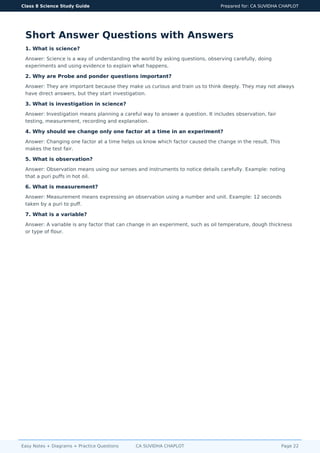
Short Answer Questions with Answers
1. What is science?
Answer: Science is a way of understanding the world by asking questions, observing carefully, doing
experiments and using evidence to explain what happens.
2. Why are Probe and ponder questions important?
Answer: They are important because they make us curious and train us to think deeply. They may not always
have direct answers, but they start investigation.
3. What is investigation in science?
Answer: Investigation means planning a careful way to answer a question. It includes observation, fair
testing, measurement, recording and explanation.
4. Why should we change only one factor at a time in an experiment?
Answer: Changing one factor at a time helps us know which factor caused the change in the result. This
makes the test fair.
5. What is observation?
Answer: Observation means using our senses and instruments to notice details carefully. Example: noting
that a puri puffs in hot oil.
6. What is measurement?
Answer: Measurement means expressing an observation using a number and unit. Example: 12 seconds
taken by a puri to puff.
7. What is a variable?
Answer: A variable is any factor that can change in an experiment, such as oil temperature, dough thickness
or type of flour.
Class 8 Science Study Guide Prepared for: CA SUVIDHA CHAPLOT
Easy Notes + Diagrams + Practice Questions CA SUVIDHA CHAPLOT Page 23
Short Answer Questions Continued
8. Why are notes important during an experiment?
Answer: Notes help us remember exact observations, compare results, find patterns and avoid guessing
later.
9. What do roots and kite symbolise?
Answer: Roots symbolise strong evidence and careful observation. Kite symbolises imagination, curiosity and
new ideas.
10. What are microbes?
Answer: Microbes are very tiny living organisms that cannot usually be seen with the naked eye. Some are
useful and some can cause diseases.
11. How do vaccines help us?
Answer: Vaccines prepare our body to recognise and fight certain disease-causing microbes more effectively.
12. What is force?
Answer: Force is a push or pull that can make an object move, stop, speed up, slow down or change direction.
13. What is pressure?
Answer: Pressure tells how much force is acting on a particular area. The same force on a smaller area
produces more pressure.
14. What is a solution?
Answer: A solution is a uniform mixture in which a solute dissolves in a solvent, such as sugar dissolved in
water.
Class 8 Science Study Guide Prepared for: CA SUVIDHA CHAPLOT
Easy Notes + Diagrams + Practice Questions CA SUVIDHA CHAPLOT Page 24
Short Answer Questions Continued
15. What is reflection of light?
Answer: Reflection is the bouncing back of light from a surface, such as a mirror or shiny spoon.
16. What are Moon phases?
Answer: Moon phases are the different shapes of the bright part of the Moon visible from Earth during its
monthly cycle.
17. What is an ecosystem?
Answer: An ecosystem is a system where living organisms interact with air, water, soil, sunlight and each
other.
18. Why is Earth suitable for life?
Answer: Earth has liquid water, suitable temperature, atmosphere with oxygen and protection from harmful
rays.
19. Why is climate change a scientific concern?
Answer: It can disturb rainfall, temperature, storms, ecosystems, agriculture and human life, so it must be
studied using evidence.
20. What is systematic investigation?
Answer: Systematic investigation is a planned, step-by-step method of studying a question using fair tests,
observations and evidence.
Class 8 Science Study Guide Prepared for: CA SUVIDHA CHAPLOT
Easy Notes + Diagrams + Practice Questions CA SUVIDHA CHAPLOT Page 25
Long Answer Questions with Answers
1. Explain how science is different from only memorising facts.
Answer: Science is not only a collection of facts. It is also a method of finding reliable knowledge. A scientist
starts with curiosity, asks a focused question, observes carefully, plans a fair test, measures results, records
data and forms an explanation. If the explanation is incomplete, the scientist asks a better question and
investigates again. Therefore, science is active learning, not blind memorisation.
2. Describe the steps of a scientific investigation with an example.
Answer: First, ask a focused question, such as "Does oil temperature affect how fast a puri puffs?" Second,
predict what may happen. Third, plan a fair test by changing only oil temperature and keeping dough size,
thickness and flour the same. Fourth, observe and measure the time taken to puff. Fifth, record the data in a
table. Sixth, compare results and write a conclusion. Finally, ask new questions based on the results.
3. Why does Chapter 1 use the example of a puri?
Answer: The puri example shows that science is present in daily life. A kitchen observation can become a
scientific investigation. We can think about the thickness of dough, type of flour, oil temperature and way of
dropping the puri. We can measure puffing time and note whether one side becomes thinner. This example
teaches variables, fair testing, observation, measurement and note-taking in a simple way.
4. Explain the meaning of root and kite in science learning.
Answer: The root represents being grounded in real observations, evidence, careful measurement and
cultural/natural surroundings. The kite represents imagination, curiosity and ideas that rise toward new
possibilities. Good science needs both. Without roots, ideas may become guesses. Without a kite, learning
may stop at facts. Together, they build investigative thinking.
Class 8 Science Study Guide Prepared for: CA SUVIDHA CHAPLOT
Easy Notes + Diagrams + Practice Questions CA SUVIDHA CHAPLOT Page 26
Long Answer Questions Continued
5. Write a short note on the Class 8 Science journey introduced in Chapter 1.
Answer: The chapter introduces a wide science journey. It begins with microbes, health and vaccines. Then it
moves to electricity, forces and pressure. It further explores matter through particles, elements, compounds,
mixtures and solutions. After that it discusses light, lenses, Moon phases and calendars. Finally, it connects
ecosystems, Earth as a life-supporting planet and climate challenges. The whole journey is linked by
observation and investigation.
6. How are force, pressure, winds and cyclones connected?
Answer: Force is a push or pull. Pressure is force acting on an area. Air also exerts pressure. When air
pressure differs from one place to another, air moves from high-pressure regions to low-pressure regions. A
small pressure difference may cause a gentle breeze, while a strong difference can cause fast winds. Under
certain conditions, such winds may become storms or cyclones.
7. Explain how the study of particles helps us understand materials.
Answer: Everything around us is made of tiny particles. In solids, particles are closely packed and cannot
move much. In liquids, particles are less tightly packed and can slide past each other. In gases, particles are
far apart and move freely. This idea helps us understand boiling, dissolving, pressure of gases and
classification of materials into elements, compounds and mixtures.
8. How do light and Moon phases connect to observation in science?
Answer: Light reflects from mirrors and rough surfaces and refracts through lenses. These observations help
us understand mirrors, spoons, lenses and glasses. The Moon does not make its own light; we see the part of
the Moon lit by the Sun. The changing visible part creates Moon phases. Careful observation of the Moon and
Sun helped people create calendars, showing how repeated observation builds knowledge.
Class 8 Science Study Guide Prepared for: CA SUVIDHA CHAPLOT
Easy Notes + Diagrams + Practice Questions CA SUVIDHA CHAPLOT Page 27
Long Answer Questions Continued
9. Why are ecosystems important for life?
Answer: An ecosystem includes living organisms and non-living factors such as air, water, sunlight and soil.
Plants depend on sunlight, water and soil. Animals depend on plants or other animals for food. Microbes help
in decomposition. If one part of the ecosystem is disturbed, other parts are affected. Ecosystems show that
life is interconnected.
10. How can students develop scientific temper?
Answer: Students can develop scientific temper by asking why and how, checking evidence before believing,
doing simple experiments safely, recording observations honestly, discussing ideas respectfully, accepting
correction, and applying science to daily life problems such as health, environment, water use and waste
reduction.
Class 8 Science Study Guide Prepared for: CA SUVIDHA CHAPLOT
Easy Notes + Diagrams + Practice Questions CA SUVIDHA CHAPLOT Page 28
Activities and Project Ideas
These activities are designed for class discussion, homework or science notebook work. Follow safety
rules and take adult help where needed.
Project Task
Curiosity Journal Write 10 why/how questions from your home, school or nature. Choose one question and expl
Microbe Awareness Poster Make a poster showing useful microbes and harmful microbes with hygiene tips.
Electricity Around Us List 10 appliances and identify whether they use heating effect, magnetic effect or both.
Force Diary Observe 5 examples of push, pull, friction or gravity in one day and explain them.
Weather Watch Record wind, clouds and temperature for 7 days. Write a conclusion about weather changes.
Moon Observation Observe the Moon for 10 nights and draw its visible shape each night.
Ecosystem Web Draw a food web from a garden or pond ecosystem.
Earth Protection Plan Write 5 actions students can take to reduce waste, save water and protect nature.
Class 8 Science Study Guide Prepared for: CA SUVIDHA CHAPLOT
Easy Notes + Diagrams + Practice Questions CA SUVIDHA CHAPLOT Page 29
Last-Minute Exam Revision Sheet
- Science starts with curiosity, not memorisation.
- A good question should be focused and testable.
- Observe carefully and measure when possible.
- Change one variable at a time for a fair test.
- Keep a record of all observations, even unexpected ones.
- Use evidence to form conclusions.
- Chapter 1 previews the whole Class 8 Science journey.
- Microbes, health, electricity, forces, pressure, matter, solutions, light, Moon, ecosystems and Earth
are linked through investigation.
- In the puri example, oil temperature, flour type and dough thickness are possible variables.
- Scientific temper means thinking with reason, evidence and honesty.
Final Thought
A good science student is not someone who knows every answer. A good science student is someone who
asks better questions and tries to find evidence-based answers.
Prepared for: CA SUVIDHA CHAPLOT
End of PDF study guide.