1
D R . N I KH I L KU M A R S SA KL E
A S S I S TA N T P R OF E S S OR
D E PA RT M E N T O F P HA R M A C O L OG Y
Y. B . C HAVA N C O L L E G E O F P HA R M A C Y,
A U R A N G A B A D
Chronopharmacology
2
Introduction
ď‚— Chronopharmacology
Chronopharmacology is the study of how biological
rhythms (especially circadian rhythms) influence the
effects, efficacy, and toxicity of drugs, and how
timing of drug administration can optimize
therapeutic outcomes.
3
ď‚— Biological rhythms are natural, internal cycles
that regulate bodily functions like sleep, hormone
release, and metabolism, typically synchronized by
light/dark cues.
ď‚— Chronobiology
 It is the study of endogenous biological rhythms—
internal "clocks"—that allow organisms to anticipate
and adapt to daily, seasonal, and monthly
environmental variations.
4
5
Key Concept
ď‚— 1. Circadian Rhythm
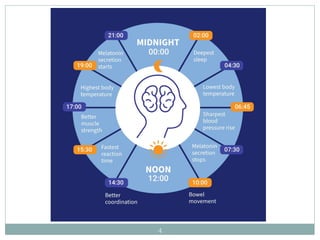
ď‚— A ~24-hour internal biological clock regulated by the
suprachiasmatic nucleus (SCN) in the brain.
ď‚— Controls physiological processes such as:
 Hormone secretion (e.g., cortisol, melatonin)
 Blood pressure
 Gastric activity
 Enzyme levels
6
ď‚— 2. Chronokinetics
ď‚— Time-dependent variation in pharmacokinetics (PK):
 Absorption
 Distribution
 Metabolism
 Excretion
ď‚— Example: Hepatic enzyme activity varies during the
day affects drug metabolism.
→
7
ď‚— 3. Chronodynamics
ď‚— Time-dependent variation in pharmacodynamics
(PD):
 Drug receptor sensitivity
 Cellular response
ď‚— Example: Antihypertensive drugs may work better
when taken at night.
8
Types of Biological Rhythms (Chronopharmacology)
ď‚— Biological rhythms are classified based on their time
duration (periodicity). These rhythms play a key role
in chronopharmacology, influencing drug response
and optimal dosing time.
ď‚— 1. Circadian Rhythm
ď‚— 2. Ultradian Rhythm
ď‚— 3. Infradian Rhythm
ď‚— 4. Circannual Rhythm (Subtype of Infradian)
ď‚— 5. Diurnal Rhythm
9
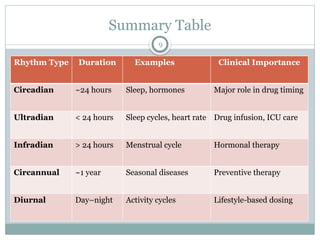
Summary Table
Rhythm Type Duration Examples Clinical Importance
Circadian ~24 hours Sleep, hormones Major role in drug timing
Ultradian < 24 hours Sleep cycles, heart rate Drug infusion, ICU care
Infradian > 24 hours Menstrual cycle Hormonal therapy
Circannual ~1 year Seasonal diseases Preventive therapy
Diurnal Day–night Activity cycles Lifestyle-based dosing
10
Zeitgeber (Chronopharmacology)
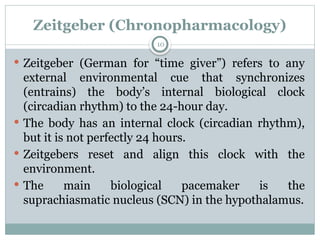
 Zeitgeber (German for “time giver”) refers to any
external environmental cue that synchronizes
(entrains) the body’s internal biological clock
(circadian rhythm) to the 24-hour day.
ď‚— The body has an internal clock (circadian rhythm),
but it is not perfectly 24 hours.
ď‚— Zeitgebers reset and align this clock with the
environment.
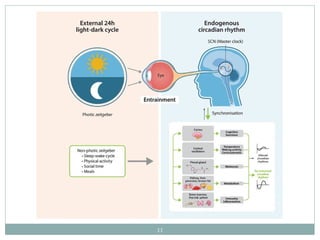
ď‚— The main biological pacemaker is the
suprachiasmatic nucleus (SCN) in the hypothalamus.
11
12
Types of Zeitgebers
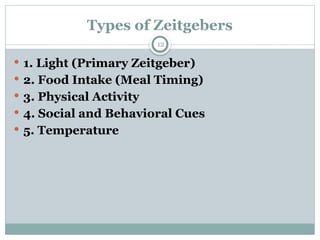
ď‚— 1. Light (Primary Zeitgeber)
ď‚— 2. Food Intake (Meal Timing)
ď‚— 3. Physical Activity
ď‚— 4. Social and Behavioral Cues
ď‚— 5. Temperature
13
ď‚— 1. Light (Primary Zeitgeber)
ď‚— Most powerful regulator
ď‚— Light enters through the retina signals SCN
→ →
regulates melatonin
ď‚— Effect:
ď‚— Daylight suppresses melatonin promotes
→ →
wakefulness
ď‚— Darkness increases melatonin induces sleep
→ →
14
ď‚— 2. Food Intake (Meal Timing)
ď‚— Influences peripheral clocks (liver, gut)
ď‚— Example:
ď‚— Irregular eating disrupts metabolic rhythms
ď‚— Important in diabetes and obesity management
15
ď‚— 3. Physical Activity
ď‚— Exercise can shift circadian phase
ď‚— Example:
ď‚— Morning exercise advances rhythm
→
ď‚— Night exercise may delay sleep
→
16
ď‚— 4. Social and Behavioral Cues
ď‚— Work schedules, social interactions, sleep habits
ď‚— Example:
ď‚— Shift work circadian misalignment
→
17
ď‚— 5. Temperature
ď‚— Body and environmental temperature cycles also act
as minor zeitgebers
18
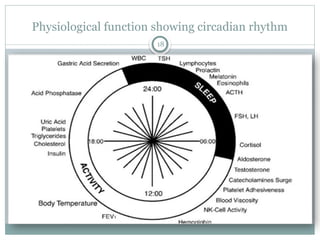
Physiological function showing circadian rhythm
19
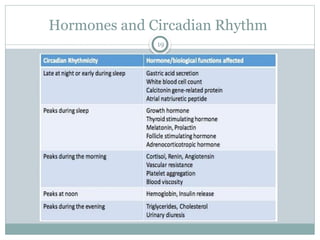
Hormones and Circadian Rhythm
20
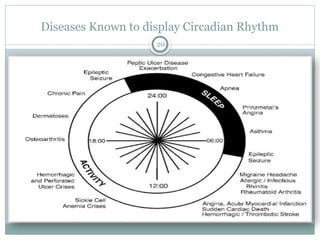
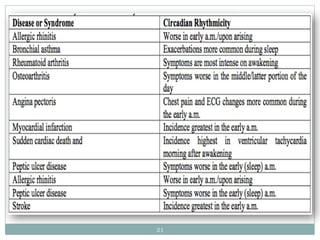
Diseases Known to display Circadian Rhythm
21
22
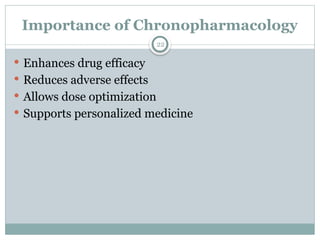
Importance of Chronopharmacology
ď‚— Enhances drug efficacy
ď‚— Reduces adverse effects
ď‚— Allows dose optimization
ď‚— Supports personalized medicine
23
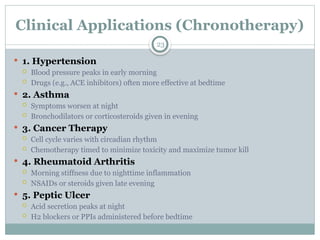
Clinical Applications (Chronotherapy)
ď‚— 1. Hypertension
 Blood pressure peaks in early morning
 Drugs (e.g., ACE inhibitors) often more effective at bedtime
ď‚— 2. Asthma
 Symptoms worsen at night
 Bronchodilators or corticosteroids given in evening
ď‚— 3. Cancer Therapy
 Cell cycle varies with circadian rhythm
 Chemotherapy timed to minimize toxicity and maximize tumor kill
ď‚— 4. Rheumatoid Arthritis
 Morning stiffness due to nighttime inflammation
 NSAIDs or steroids given late evening
ď‚— 5. Peptic Ulcer
 Acid secretion peaks at night
 H2 blockers or PPIs administered before bedtime
24
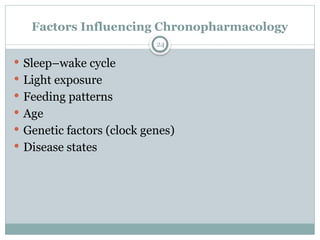
Factors Influencing Chronopharmacology
 Sleep–wake cycle
ď‚— Light exposure
ď‚— Feeding patterns
ď‚— Age
ď‚— Genetic factors (clock genes)
ď‚— Disease states
25
Future Perspectives
ď‚— Chronotherapeutic drug delivery systems
ď‚— Pulsatile release formulations
ď‚— Time-controlled nanoparticles (relevant to your
nanocarrier research)
ď‚— Integration with:
 AI-based dosing schedules
 Wearable circadian monitoring devices
 Precision medicine based on individual circadian profiles