Chemists' Impact on Food Safety and Medicine: Pasteur and Lister's Legacy
Explore how Pasteur's pasteurization and Lister's antiseptic surgery revolutionized food safety and medical hygiene, improving public health and surgical outcomes.
Chemists' Impact on Food Safety and Medicine: Pasteur and Lister's Legacy
1.
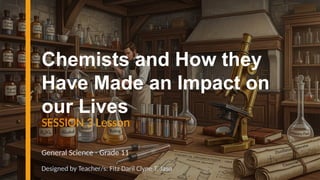
Chemists and Howthey
Have Made an Impact on
our Lives
SESSION 3 Lesson
General Science - Grade 11
Designed by Teacher/s: Fitz Daril Clyne T. Jaso
2.
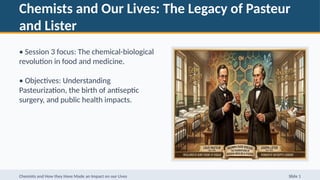
Chemists and OurLives: The Legacy of Pasteur
and Lister
• Session 3 focus: The chemical-biological
revolution in food and medicine.
• Objectives: Understanding
Pasteurization, the birth of antiseptic
surgery, and public health impacts.
Chemists and How they Have Made an Impact on our Lives Slide 1
3.
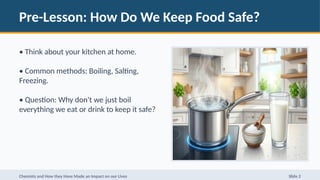
Pre-Lesson: How DoWe Keep Food Safe?
• Think about your kitchen at home.
• Common methods: Boiling, Salting,
Freezing.
• Question: Why don't we just boil
everything we eat or drink to keep it safe?
Chemists and How they Have Made an Impact on our Lives Slide 2
4.
Elicit: Boiling vs.Pasteurizing
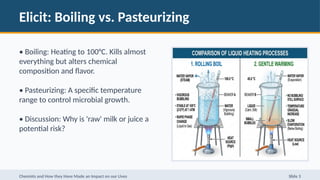
• Boiling: Heating to 100°C. Kills almost
everything but alters chemical
composition and flavor.
• Pasteurizing: A specific temperature
range to control microbial growth.
• Discussion: Why is 'raw' milk or juice a
potential risk?
Chemists and How they Have Made an Impact on our Lives Slide 3
5.
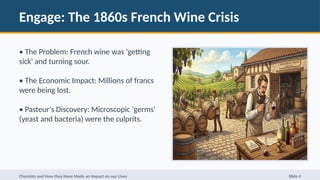
Engage: The 1860sFrench Wine Crisis
• The Problem: French wine was 'getting
sick' and turning sour.
• The Economic Impact: Millions of francs
were being lost.
• Pasteur's Discovery: Microscopic 'germs'
(yeast and bacteria) were the culprits.
Chemists and How they Have Made an Impact on our Lives Slide 4
6.
Explore: Finding the'Sweet Spot'
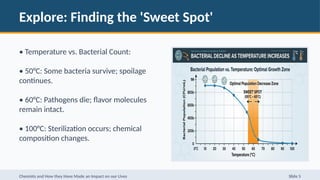
• Temperature vs. Bacterial Count:
• 50°C: Some bacteria survive; spoilage
continues.
• 60°C: Pathogens die; flavor molecules
remain intact.
• 100°C: Sterilization occurs; chemical
composition changes.
Chemists and How they Have Made an Impact on our Lives Slide 5
7.
Explain: Pasteurization vs.Sterilization
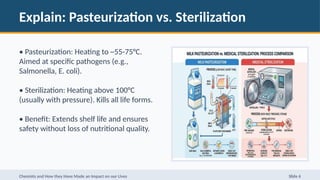
• Pasteurization: Heating to ~55-75°C.
Aimed at specific pathogens (e.g.,
Salmonella, E. coli).
• Sterilization: Heating above 100°C
(usually with pressure). Kills all life forms.
• Benefit: Extends shelf life and ensures
safety without loss of nutritional quality.
Chemists and How they Have Made an Impact on our Lives Slide 6
8.
Formative Assessment -Part 1
1. Pasteurization involves heating a liquid
to:
A) Exactly 100°C
B) A temperature that kills pathogens
but preserves quality
C) Absolute zero
D) Boiling point for 5 hours
2. Pasteur initially developed
pasteurization to save which industry?
Chemists and How they Have Made an Impact on our Lives Slide 7
9.
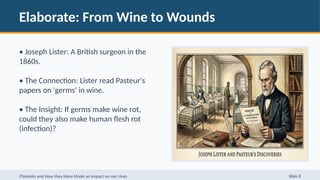
Elaborate: From Wineto Wounds
• Joseph Lister: A British surgeon in the
1860s.
• The Connection: Lister read Pasteur's
papers on 'germs' in wine.
• The Insight: If germs make wine rot,
could they also make human flesh rot
(infection)?
Chemists and How they Have Made an Impact on our Lives Slide 8
10.
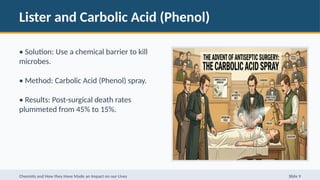
Lister and CarbolicAcid (Phenol)
• Solution: Use a chemical barrier to kill
microbes.
• Method: Carbolic Acid (Phenol) spray.
• Results: Post-surgical death rates
plummeted from 45% to 15%.
Chemists and How they Have Made an Impact on our Lives Slide 9
11.
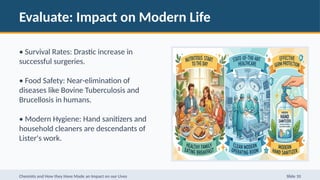
Evaluate: Impact onModern Life
• Survival Rates: Drastic increase in
successful surgeries.
• Food Safety: Near-elimination of
diseases like Bovine Tuberculosis and
Brucellosis in humans.
• Modern Hygiene: Hand sanitizers and
household cleaners are descendants of
Lister's work.
Chemists and How they Have Made an Impact on our Lives Slide 10
12.
Formative Assessment -Part 2
3. Which scientist applied Pasteur’s germ
theory to surgery?
A) Isaac Newton B) Joseph Lister C)
Charles Darwin D) Marie Curie
4. What is the main chemical-biological
benefit of pasteurization?
A) Makes food taste sweeter B) Reduces
the risk of infection from food C) Turns
water into wine D) Increases food weight
5. Antiseptics like carbolic acid work by:
Chemists and How they Have Made an Impact on our Lives Slide 11
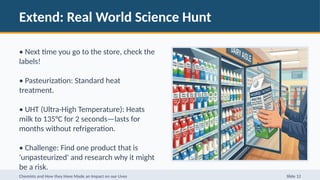
13.
Extend: Real WorldScience Hunt
• Next time you go to the store, check the
labels!
• Pasteurization: Standard heat
treatment.
• UHT (Ultra-High Temperature): Heats
milk to 135°C for 2 seconds—lasts for
months without refrigeration.
• Challenge: Find one product that is
'unpasteurized' and research why it might
be a risk.
Chemists and How they Have Made an Impact on our Lives Slide 12
Editor's Notes
#1 Welcome the class. Today's topic is Chemists and How they Have Made an Impact on our Lives.
#2 Welcome everyone to Session 3. Today, we are looking at two titans of chemistry and medicine: Louis Pasteur and Joseph Lister. Their work in the mid-to-late 19th century fundamentally changed how we eat and how we survive surgery. We will explore how a chemist's understanding of microbes saved the French wine industry and eventually saved millions of lives in hospitals.
#3 Before we dive into the history, let's talk about today. We use salt to preserve meat and boiling to kill germs in water. But think about milk. If you boil milk, the taste changes completely. This was the exact challenge Louis Pasteur faced. How do we kill the 'bad stuff' without ruining the 'good stuff'?
#4 Class, what is the difference between boiling milk and pasteurizing it? Boiling is aggressive—it hits 100 degrees Celsius and can denature proteins and change flavors. Pasteurization is a more delicate chemical-biological balance. It targets the pathogens without destroying the product's essence.
#5 In the 1860s, France had a major problem. Their wine industry—a cornerstone of their economy—was failing because the wine kept turning into vinegar. Napoleon III asked Louis Pasteur to investigate. Pasteur used his microscope and realized that 'diseases' in wine were actually caused by specific microbes. This was a turning point in the history of science.
#6 Look at these data trends. At 50 degrees, we don't kill enough bacteria. At 100 degrees, we kill everything but ruin the wine's flavor. Pasteur discovered that heating the wine to about 55 to 60 degrees Celsius for a short time was the 'sweet spot.' It was enough of a chemical shock to the bacteria to kill them, but not enough to ruin the wine. This is the essence of pasteurization.
#7 Let's define our terms. Pasteurization is a controlled heat treatment. It doesn't kill *all* microbes, but it kills the ones that make us sick. Sterilization, like what we do with surgical tools, kills every single living microbe. For food, pasteurization is often better because it keeps the vitamins and proteins in their natural state.
#8 Let's check our understanding. For question 1, the answer is B—it's about finding that balance. For question 2, remember the French crisis—the answer is B, the Wine industry. It's fascinating how a solution for wine became a standard for our daily milk!
#9 Now we meet Joseph Lister. He was a surgeon during a time when half of all patients died from infections after surgery. He read Pasteur’s work and had a 'Eureka' moment: if microbes cause wine to go bad, maybe they are also the 'invisible killers' causing surgical wounds to turn septic. This is where chemistry meets surgery.
#10 Lister began using Carbolic Acid, a chemical we now call Phenol, to clean tools, wounds, and even spray the air during surgery. It was a harsh chemical, but it worked. It destroyed the cell walls of bacteria. This was the birth of antiseptic surgery. Before this, surgeons didn't even wash their hands between patients!
#11 How has this impacted us? Think about it. Because of Pasteur and Lister, we can buy milk that lasts for weeks and undergo surgery with a very low risk of infection. We evaluate their impact through the lens of 'Public Health.' Their chemical-biological insights moved us from the dark ages of medicine into the modern era.
#12 Let's finish our assessment. Question 3: The answer is B, Joseph Lister. Question 4: The answer is B, reducing the risk of infection. And Question 5: Antiseptics work by chemically destroying the microbes, so the answer is B. Well done, everyone.
#13 I have a challenge for you. Next time you are at the grocery store, look at the milk and juice labels. You'll see 'Pasteurized.' You might also see 'UHT.' Ultra-High Temperature processing is a more modern chemical feat that allows milk to sit on a shelf for months. Science is everywhere in our daily lives—especially in the aisles of your local shop!