Household Cleaning Products
✓Cleaningproducts include detergent, bleach, disinfectant,
drain cleaner, and air freshener or purifier. These products
contain different components depending on its function and
purpose.
3.
✓Detergents
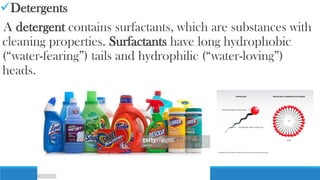
A detergent containssurfactants, which are substances with
cleaning properties. Surfactants have long hydrophobic
(“water-fearing”) tails and hydrophilic (“water-loving”)
heads.
4.
✓Bleach
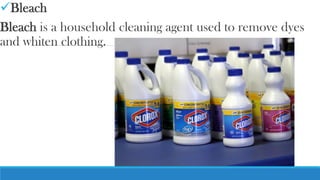
Bleach is ahousehold cleaning agent used to remove dyes
and whiten clothing.
5.
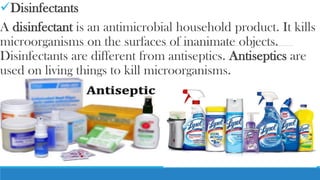
✓Disinfectants
A disinfectant isan antimicrobial household product. It kills
microorganisms on the surfaces of inanimate objects.
Disinfectants are different from antiseptics. Antiseptics are
used on living things to kill microorganisms.
6.
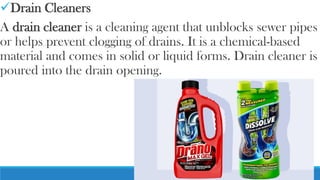
✓Drain Cleaners
A draincleaner is a cleaning agent that unblocks sewer pipes
or helps prevent clogging of drains. It is a chemical-based
material and comes in solid or liquid forms. Drain cleaner is
poured into the drain opening.
7.
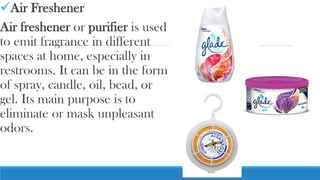
✓Air Freshener
Air fresheneror purifier is used
to emit fragrance in different
spaces at home, especially in
restrooms. It can be in the form
of spray, candle, oil, bead, or
gel. Its main purpose is to
eliminate or mask unpleasant
odors.
8.
Personal Care Products
✓Personalcare products are consumer products used in
personal hygiene and for beautification. These products
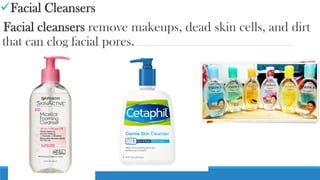
include shampoo, conditioner, soap, facial cleanser,
antiperspirant or deodorant, and toothpaste.
9.
✓Shampoo and HairConditioners
Shampoo and conditioner are both hair care products. They
are viscous liquids used to clean hair. They are applied
directly to wet hair and are massaged into the scalp before
rinsing them with water.
10.
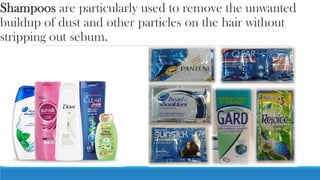
Shampoos are particularlyused to remove the unwanted
buildup of dust and other particles on the hair without
stripping out sebum.
11.
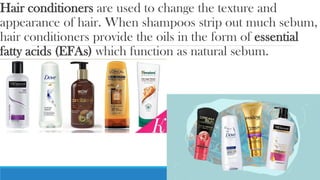
Hair conditioners areused to change the texture and
appearance of hair. When shampoos strip out much sebum,
hair conditioners provide the oils in the form of essential
fatty acids (EFAs) which function as natural sebum.
12.
✓Soap
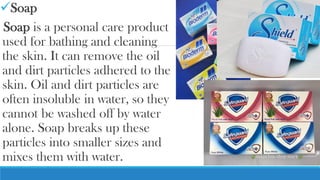
Soap is apersonal care product
used for bathing and cleaning
the skin. It can remove the oil
and dirt particles adhered to the
skin. Oil and dirt particles are
often insoluble in water, so they
cannot be washed off by water
alone. Soap breaks up these
particles into smaller sizes and
mixes them with water.
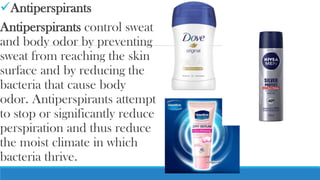
✓Antiperspirants
Antiperspirants control sweat
andbody odor by preventing
sweat from reaching the skin
surface and by reducing the
bacteria that cause body
odor. Antiperspirants attempt
to stop or significantly reduce
perspiration and thus reduce
the moist climate in which
bacteria thrive.
15.
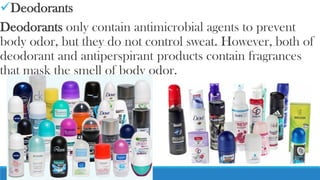
✓Deodorants
Deodorants only containantimicrobial agents to prevent
body odor, but they do not control sweat. However, both of
deodorant and antiperspirant products contain fragrances
that mask the smell of body odor.
16.
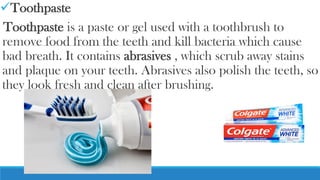
✓Toothpaste
Toothpaste is apaste or gel used with a toothbrush to
remove food from the teeth and kill bacteria which cause
bad breath. It contains abrasives , which scrub away stains
and plaque on your teeth. Abrasives also polish the teeth, so
they look fresh and clean after brushing.
17.
Ingredients Found inCleaning
Agents and Personal Care Products
✓An active ingredient pertains to the substance that is
mainly responsible for the chemical property of the
product. Most of the time, the active ingredients present in
commercial cleaning products can be categorized into the
following: acids, bases, chelants, and surfactants.
18.
✓Acids
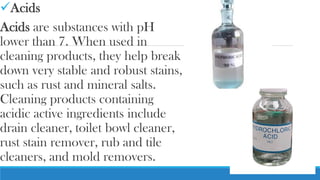
Acids are substanceswith pH
lower than 7. When used in
cleaning products, they help break
down very stable and robust stains,
such as rust and mineral salts.
Cleaning products containing
acidic active ingredients include
drain cleaner, toilet bowl cleaner,
rust stain remover, rub and tile
cleaners, and mold removers.
19.
✓Bases
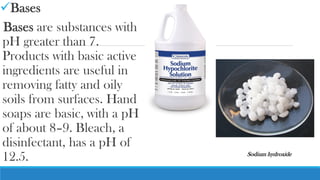
Bases are substanceswith
pH greater than 7.
Products with basic active
ingredients are useful in
removing fatty and oily
soils from surfaces. Hand
soaps are basic, with a pH
of about 8–9. Bleach, a
disinfectant, has a pH of
12.5. Sodium hydroxide
20.
✓Surfactants
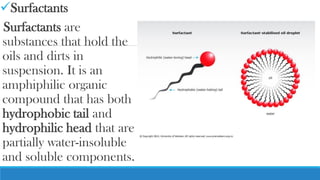
Surfactants are
substances thathold the
oils and dirts in
suspension. It is an
amphiphilic organic
compound that has both
hydrophobic tail and
hydrophilic head that are
partially water-insoluble
and soluble components.
21.
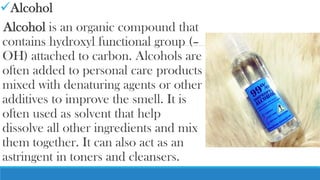
✓Alcohol
Alcohol is anorganic compound that
contains hydroxyl functional group (–
OH) attached to carbon. Alcohols are
often added to personal care products
mixed with denaturing agents or other
additives to improve the smell. It is
often used as solvent that help
dissolve all other ingredients and mix
them together. It can also act as an
astringent in toners and cleansers.
22.
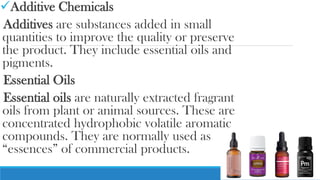
✓Additive Chemicals
Additives aresubstances added in small
quantities to improve the quality or preserve
the product. They include essential oils and
pigments.
Essential Oils
Essential oils are naturally extracted fragrant
oils from plant or animal sources. These are
concentrated hydrophobic volatile aromatic
compounds. They are normally used as
“essences” of commercial products.
23.
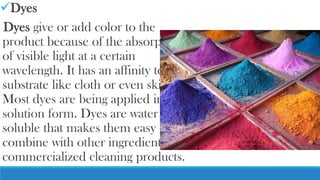
✓Dyes
Dyes give oradd color to the
product because of the absorption
of visible light at a certain
wavelength. It has an affinity to
substrate like cloth or even skin.
Most dyes are being applied in
solution form. Dyes are water
soluble that makes them easy to
combine with other ingredients of
commercialized cleaning products.
24.
Precautionary Measures on
theUse of Various Products
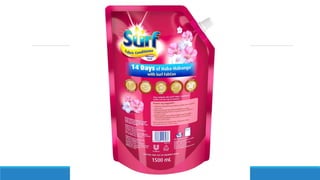
✓Labels are piece of coating materials around the container
or product that contain the information or symbols
regarding the product. Most of the time, labels come as
information printed directly on the packaging of the
material. Product labels are important in providing
information on the product's origin manufacturer, shelf-life,
utilization, and even disposal procedures.
25.
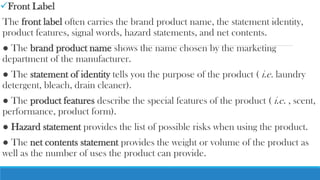
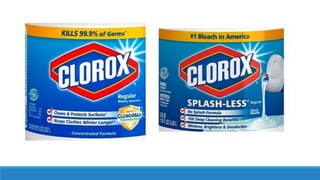
✓Front Label
The frontlabel often carries the brand product name, the statement identity,
product features, signal words, hazard statements, and net contents.
● The brand product name shows the name chosen by the marketing
department of the manufacturer.
● The statement of identity tells you the purpose of the product ( i.e. laundry
detergent, bleach, drain cleaner).
● The product features describe the special features of the product ( i.e. , scent,
performance, product form).
● Hazard statement provides the list of possible risks when using the product.
● The net contents statement provides the weight or volume of the product as
well as the number of uses the product can provide.
27.
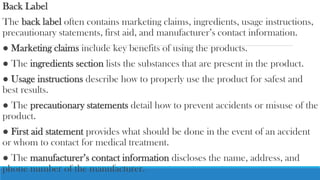
Back Label
The backlabel often contains marketing claims, ingredients, usage instructions,
precautionary statements, first aid, and manufacturer’s contact information.
● Marketing claims include key benefits of using the products.
● The ingredients section lists the substances that are present in the product.
● Usage instructions describe how to properly use the product for safest and
best results.
● The precautionary statements detail how to prevent accidents or misuse of the
product.
● First aid statement provides what should be done in the event of an accident
or whom to contact for medical treatment.
● The manufacturer’s contact information discloses the name, address, and
phone number of the manufacturer.
29.
Common Precautionary Measuresin Using Commercial
Products
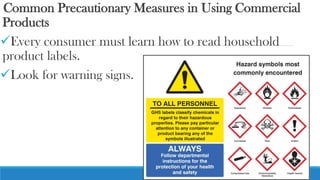
✓Every consumer must learn how to read household
product labels.
✓Look for warning signs.
30.
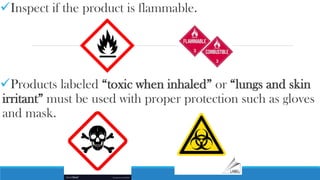
✓Inspect if theproduct is flammable.
✓Products labeled “toxic when inhaled” or “lungs and skin
irritant” must be used with proper protection such as gloves
and mask.
31.
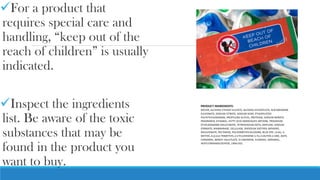
✓For a productthat
requires special care and
handling, “keep out of the
reach of children” is usually
indicated.
✓Inspect the ingredients
list. Be aware of the toxic
substances that may be
found in the product you
want to buy.