S.173- Information in cognizable
cases.
• (1) If you know about a serious crime (called a cognizable offence), you can report it to the
police in person or electronically, no matter where it happened. If you report it:
• In person: The police officer will write it down, read it back to you, and you will sign it.
• Electronically: You must sign it within three days, and the police will record it in their system.
• If the report is about a crime against a woman, it must be recorded by a woman police officer. If
the person reporting the crime is disabled, the information can be recorded at their home or
another convenient place, with the help of an interpreter or special educator, and the process
will be video recorded.
• (2) A copy of the information will be given to the informant or victim free of charge.
• (3) If the crime is punishable for 3 to 7 years, the police may first conduct a preliminary inquiry
within 14 days to see if there's enough evidence. If there is, they will start the investigation.
• (4) If a police officer refuses to record the information, the person can send the details in
writing to the Superintendent of Police, who will decide whether to investigate the case. If they
refuse, the person can go to the Magistrate.
Example
• Priya, a woman, is harassed by a group of men while walking home from work. She
manages to escape and goes to the nearest police station to report the incident, which
is a cognizable offence. The police officer records her information orally, writes it
down, reads it back to her, and asks her to sign it. Since the offence falls under
sections 64 to 79 of the Bharatiya Nyaya Sanhita, 2023, a woman police officer is
called to record Priya’s statement, and the entire process is videographed to ensure
proper documentation. Priya is provided with a free copy of the recorded information,
and the police officer proceeds with the investigation after obtaining any necessary
permissions, if required
• State of Haryana v. Bhajan Lal (1992 SCC (Cri) 426)-The Supreme Court
held that under Section 156 of the Criminal Procedure Code (CrPC), the
police have the power to investigate cognizable offences without
requiring permission from a magistrate
S.174
• When someone informs the police about a minor crime (non-
cognizable offence) within their area, the police are required to record
the details in a special book, as prescribed by the State Government.
Additionally, the police must send a report of all such cases to the
Magistrate every two weeks. The police cannot begin an investigation
into a non-cognizable offence without obtaining permission from a
Magistrate who has the authority to try or commit the case for trial.
Once the Magistrate grants permission, the police can investigate the
case, exercising the same powers as they would in a cognizable case,
except for the power to arrest without a warrant. If the case involves
both non-cognizable and cognizable offences, it will be treated as a
cognizable case, regardless of the minor nature of the other offences.
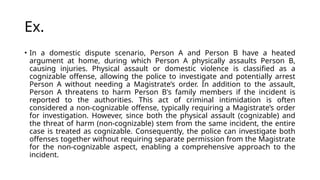
Ex.
• In a domestic dispute scenario, Person A and Person B have a heated
argument at home, during which Person A physically assaults Person B,
causing injuries. Physical assault or domestic violence is classified as a
cognizable offense, allowing the police to investigate and potentially arrest
Person A without needing a Magistrate’s order. In addition to the assault,
Person A threatens to harm Person B's family members if the incident is
reported to the authorities. This act of criminal intimidation is often
considered a non-cognizable offense, typically requiring a Magistrate’s order
for investigation. However, since both the physical assault (cognizable) and
the threat of harm (non-cognizable) stem from the same incident, the entire
case is treated as cognizable. Consequently, the police can investigate both
offenses together without requiring separate permission from the Magistrate
for the non-cognizable aspect, enabling a comprehensive approach to the
incident.
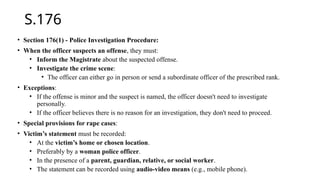
S.176
• Section 176(1) - Police Investigation Procedure:
• When the officer suspects an offense, they must:
• Inform the Magistrate about the suspected offense.
• Investigate the crime scene:
• The officer can either go in person or send a subordinate officer of the prescribed rank.
• Exceptions:
• If the offense is minor and the suspect is named, the officer doesn't need to investigate
personally.
• If the officer believes there is no reason for an investigation, they don't need to proceed.
• Special provisions for rape cases:
• Victim’s statement must be recorded:
• At the victim’s home or chosen location.
• Preferably by a woman police officer.
• In the presence of a parent, guardian, relative, or social worker.
• The statement can be recorded using audio-video means (e.g., mobile phone).
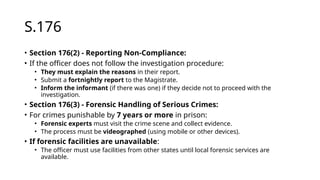
S.176
• Section 176(2) - Reporting Non-Compliance:
• If the officer does not follow the investigation procedure:
• They must explain the reasons in their report.
• Submit a fortnightly report to the Magistrate.
• Inform the informant (if there was one) if they decide not to proceed with the
investigation.
• Section 176(3) - Forensic Handling of Serious Crimes:
• For crimes punishable by 7 years or more in prison:
• Forensic experts must visit the crime scene and collect evidence.
• The process must be videographed (using mobile or other devices).
• If forensic facilities are unavailable:
• The officer must use facilities from other states until local forensic services are
available.
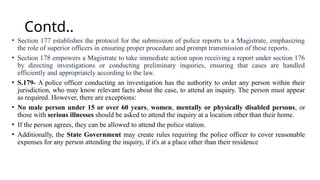
Contd..
• Section 177 establishes the protocol for the submission of police reports to a Magistrate, emphasizing
the role of superior officers in ensuring proper procedure and prompt transmission of these reports.
• Section 178 empowers a Magistrate to take immediate action upon receiving a report under section 176
by directing investigations or conducting preliminary inquiries, ensuring that cases are handled
efficiently and appropriately according to the law.
• S.179- A police officer conducting an investigation has the authority to order any person within their
jurisdiction, who may know relevant facts about the case, to attend an inquiry. The person must appear
as required. However, there are exceptions:
• No male person under 15 or over 60 years, women, mentally or physically disabled persons, or
those with serious illnesses should be asked to attend the inquiry at a location other than their home.
• If the person agrees, they can be allowed to attend the police station.
• Additionally, the State Government may create rules requiring the police officer to cover reasonable
expenses for any person attending the inquiry, if it's at a place other than their residence
S.180
• Examining witnesses during a police investigation:
1.Examination of Witnesses: Any police officer conducting an investigation, or an officer of the rank
prescribed by the State Government, can examine a person who may have knowledge about the
case. The officer can ask oral questions to gather information.
2.Obligation to Answer: The person being questioned is required to answer all questions truthfully,
but they cannot be forced to answer questions that could incriminate them or lead to penalties.
3.Recording Statements: The police officer may write down any statement made during the
examination. If the statement is recorded in writing, the officer must create a separate, accurate
record for each person. Additionally, the statement may also be recorded using audio-video
means.
4.Special Provision for Women: If a woman is giving a statement related to specific offenses (such
as assault, harassment, etc.), the statement must be recorded by a woman police officer or any
other female officer. This ensures sensitivity and respect in handling such cases.
A police officer investigating a theft can summon a neighbor who might have witnessed the incident
to answer questions about what they saw. If a witness is asked questions during the examination,
they must respond truthfully, but they can refuse to answer if it might lead to self-incrimination. A
woman alleging assault will have her statement recorded only by a female officer to ensure comfort
and sensitivity in the process.
S.181
• Section 181 of the Bharatiya Nagarik Suraksha Sanhita, 2023 addresses the
use of statements made by individuals to the police during an investigation. It
states:
1.No Use of Statements in Trial: Any statement made to the police during an
investigation cannot be used in court (in a trial or inquiry) unless specific
conditions are met. These statements, if written down, should not be signed by
the person making them, and they cannot be used as evidence directly in the
trial.
2.Exception for Contradiction: If a witness is called to testify in the trial, and their
statement to the police is written down, the defense can use parts of that
statement to challenge or contradict what the witness says in court, but only
with the court's permission. The prosecution can also use parts of the statement
during re-examination, but only to clarify any matters raised in the cross-
examination.
Example.
• Rajesh is a shopkeeper in Mumbai. One day, his shop is robbed,
and he calls the police. During the investigation, Rajesh gives a
detailed statement to the police officer about the incident. The
police officer writes down Rajesh's statement in his diary. Later,
during the trial, the defense lawyer tries to use Rajesh's written
statement to prove inconsistencies in his testimony. According to
Section 181 of the Bharatiya Nagarik Suraksha Sanhita 2023,
Rajesh's written statement to the police cannot be used directly in
the trial unless it is used to contradict his testimony as per the
provisions of the Bharatiya Sakshya Adhiniyam, 2023. The court
allows the defense to use the written statement to highlight
contradictions, but only in the manner prescribed by law.
S.182
Section 182 of the Bharatiya Nagarik Suraksha Sanhita, 2023 emphasizes the
importance of voluntary statements in police investigations. It strictly prohibits
any form of inducement or coercion by police officers or authorities, ensuring
that individuals can make statements freely without influence. This section
underscores the commitment to fair investigative practices while noting specific
exceptions related to other legal provisions.
1.A police officer cannot threaten a suspect to confess to a crime or offer a
reward for information during an investigation.
2.If a witness wants to provide a statement voluntarily, a police officer cannot
stop them or discourage them from doing so.
3.If the police were to offer a deal for leniency in exchange for information, it
would violate this section.
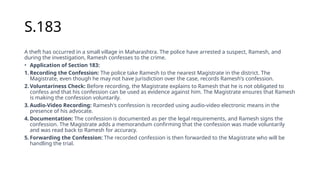
S.183
A theft has occurred in a small village in Maharashtra. The police have arrested a suspect, Ramesh, and
during the investigation, Ramesh confesses to the crime.
• Application of Section 183:
1. Recording the Confession: The police take Ramesh to the nearest Magistrate in the district. The
Magistrate, even though he may not have jurisdiction over the case, records Ramesh's confession.
2. Voluntariness Check: Before recording, the Magistrate explains to Ramesh that he is not obligated to
confess and that his confession can be used as evidence against him. The Magistrate ensures that Ramesh
is making the confession voluntarily.
3. Audio-Video Recording: Ramesh's confession is recorded using audio-video electronic means in the
presence of his advocate.
4. Documentation: The confession is documented as per the legal requirements, and Ramesh signs the
confession. The Magistrate adds a memorandum confirming that the confession was made voluntarily
and was read back to Ramesh for accuracy.
5. Forwarding the Confession: The recorded confession is then forwarded to the Magistrate who will be
handling the trial.
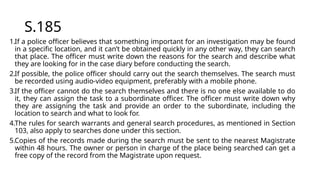
S.185
1.If a police officer believes that something important for an investigation may be found
in a specific location, and it can’t be obtained quickly in any other way, they can search
that place. The officer must write down the reasons for the search and describe what
they are looking for in the case diary before conducting the search.
2.If possible, the police officer should carry out the search themselves. The search must
be recorded using audio-video equipment, preferably with a mobile phone.
3.If the officer cannot do the search themselves and there is no one else available to do
it, they can assign the task to a subordinate officer. The officer must write down why
they are assigning the task and provide an order to the subordinate, including the
location to search and what to look for.
4.The rules for search warrants and general search procedures, as mentioned in Section
103, also apply to searches done under this section.
5.Copies of the records made during the search must be sent to the nearest Magistrate
within 48 hours. The owner or person in charge of the place being searched can get a
free copy of the record from the Magistrate upon request.
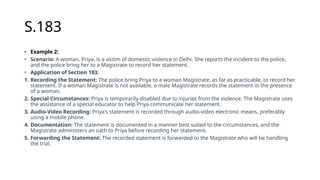
S.183
• Example 2:
• Scenario: A woman, Priya, is a victim of domestic violence in Delhi. She reports the incident to the police,
and the police bring her to a Magistrate to record her statement.
• Application of Section 183:
1. Recording the Statement: The police bring Priya to a woman Magistrate, as far as practicable, to record her
statement. If a woman Magistrate is not available, a male Magistrate records the statement in the presence
of a woman.
2. Special Circumstances: Priya is temporarily disabled due to injuries from the violence. The Magistrate uses
the assistance of a special educator to help Priya communicate her statement.
3. Audio-Video Recording: Priya's statement is recorded through audio-video electronic means, preferably
using a mobile phone.
4. Documentation: The statement is documented in a manner best suited to the circumstances, and the
Magistrate administers an oath to Priya before recording her statement.
5. Forwarding the Statement: The recorded statement is forwarded to the Magistrate who will be handling
the trial.
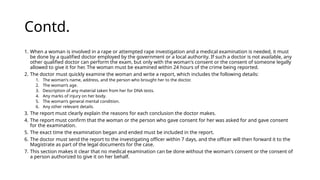
Contd.
1. When a woman is involved in a rape or attempted rape investigation and a medical examination is needed, it must
be done by a qualified doctor employed by the government or a local authority. If such a doctor is not available, any
other qualified doctor can perform the exam, but only with the woman's consent or the consent of someone legally
allowed to give it for her. The woman must be examined within 24 hours of the crime being reported.
2. The doctor must quickly examine the woman and write a report, which includes the following details:
1. The woman's name, address, and the person who brought her to the doctor.
2. The woman’s age.
3. Description of any material taken from her for DNA tests.
4. Any marks of injury on her body.
5. The woman’s general mental condition.
6. Any other relevant details.
3. The report must clearly explain the reasons for each conclusion the doctor makes.
4. The report must confirm that the woman or the person who gave consent for her was asked for and gave consent
for the examination.
5. The exact time the examination began and ended must be included in the report.
6. The doctor must send the report to the investigating officer within 7 days, and the officer will then forward it to the
Magistrate as part of the legal documents for the case.
7. This section makes it clear that no medical examination can be done without the woman's consent or the consent of
a person authorized to give it on her behalf.
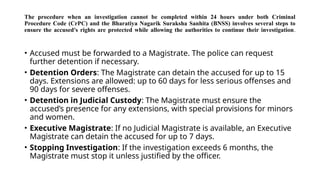
The procedure when an investigation cannot be completed within 24 hours under both Criminal
Procedure Code (CrPC) and the Bharatiya Nagarik Suraksha Sanhita (BNSS) involves several steps to
ensure the accused's rights are protected while allowing the authorities to continue their investigation.
• Accused must be forwarded to a Magistrate. The police can request
further detention if necessary.
• Detention Orders: The Magistrate can detain the accused for up to 15
days. Extensions are allowed: up to 60 days for less serious offenses and
90 days for severe offenses.
• Detention in Judicial Custody: The Magistrate must ensure the
accused’s presence for any extensions, with special provisions for minors
and women.
• Executive Magistrate: If no Judicial Magistrate is available, an Executive
Magistrate can detain the accused for up to 7 days.
• Stopping Investigation: If the investigation exceeds 6 months, the
Magistrate must stop it unless justified by the officer.
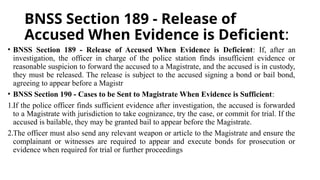
BNSS Section 189 - Release of
Accused When Evidence is Deficient:
• BNSS Section 189 - Release of Accused When Evidence is Deficient: If, after an
investigation, the officer in charge of the police station finds insufficient evidence or
reasonable suspicion to forward the accused to a Magistrate, and the accused is in custody,
they must be released. The release is subject to the accused signing a bond or bail bond,
agreeing to appear before a Magistr
• BNSS Section 190 - Cases to be Sent to Magistrate When Evidence is Sufficient:
1.If the police officer finds sufficient evidence after investigation, the accused is forwarded
to a Magistrate with jurisdiction to take cognizance, try the case, or commit for trial. If the
accused is bailable, they may be granted bail to appear before the Magistrate.
2.The officer must also send any relevant weapon or article to the Magistrate and ensure the
complainant or witnesses are required to appear and execute bonds for prosecution or
evidence when required for trial or further proceedings
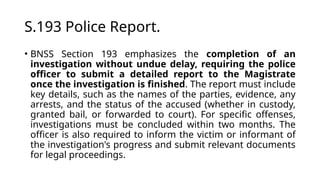
S.193 Police Report.
• BNSS Section 193 emphasizes the completion of an
investigation without undue delay, requiring the police
officer to submit a detailed report to the Magistrate
once the investigation is finished. The report must include
key details, such as the names of the parties, evidence, any
arrests, and the status of the accused (whether in custody,
granted bail, or forwarded to court). For specific offenses,
investigations must be concluded within two months. The
officer is also required to inform the victim or informant of
the investigation's progress and submit relevant documents
for legal proceedings.
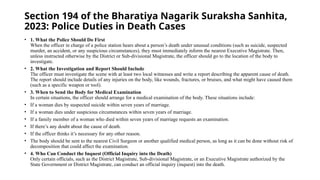
Section 194 of the Bharatiya Nagarik Suraksha Sanhita,
2023: Police Duties in Death Cases
• 1. What the Police Should Do First
When the officer in charge of a police station hears about a person’s death under unusual conditions (such as suicide, suspected
murder, an accident, or any suspicious circumstances), they must immediately inform the nearest Executive Magistrate. Then,
unless instructed otherwise by the District or Sub-divisional Magistrate, the officer should go to the location of the body to
investigate.
• 2. What the Investigation and Report Should Include
The officer must investigate the scene with at least two local witnesses and write a report describing the apparent cause of death.
The report should include details of any injuries on the body, like wounds, fractures, or bruises, and what might have caused them
(such as a specific weapon or tool).
• 3. When to Send the Body for Medical Examination
In certain situations, the officer should arrange for a medical examination of the body. These situations include:
• If a woman dies by suspected suicide within seven years of marriage.
• If a woman dies under suspicious circumstances within seven years of marriage.
• If a family member of a woman who died within seven years of marriage requests an examination.
• If there’s any doubt about the cause of death.
• If the officer thinks it’s necessary for any other reason.
• The body should be sent to the nearest Civil Surgeon or another qualified medical person, as long as it can be done without risk of
decomposition that could affect the examination.
• 4. Who Can Conduct the Inquest (Official Inquiry into the Death)
Only certain officials, such as the District Magistrate, Sub-divisional Magistrate, or an Executive Magistrate authorized by the
State Government or District Magistrate, can conduct an official inquiry (inquest) into the death.
Section 195 of the Bharatiya Nagarik Suraksha
Sanhita, 2023: Authority to Summon Individuals
• 1. Police Authority to Summon Individuals
A police officer investigating a case under Section 194 can issue a written order to summon two or
more people to assist with the investigation. The officer can also summon anyone who might have
relevant information about the case. People who are summoned must attend and truthfully answer
questions, except those that could incriminate them or lead to penalties.
• 2. Exemptions for Certain Groups
Certain people are not required to attend outside their residence unless they choose to:
• Males under 15 or over 60 years old.
• Women.
• Individuals who are mentally or physically disabled.
• People suffering from serious illness.
• These individuals may answer questions from their home rather than traveling to the police station
or another location.
• 3. If No Cognizable Offence is Found
If the investigation does not reveal a cognizable offence that would warrant a Magistrate’s
involvement, the summoned individuals are not required to attend a Magistrate’s Court.
Section 196 of the Bharatiya Nagarik Suraksha Sanhita, 2023: Magistrate Inquiry into Cause of Death
• 1. When a Magistrate Inquiry is Needed
A Judicial Magistrate must conduct an inquiry when:
• There is a case of suspected suicide or suspicious death within seven years of marriage as mentioned in Section 194(3)(i) and (ii).
• A person dies or disappears, or rape is alleged, while in police custody or any other custody authorized by a Magistrate or Court.
• In other situations involving suspicious deaths, a Magistrate may also conduct an inquiry if needed, in addition to a police
investigation.
• 2. Powers of the Magistrate
During the inquiry, the Magistrate has the same powers as in an investigation of an offence. This includes the authority to
summon witnesses, collect evidence, and examine facts.
• 3. Recording Evidence
The Magistrate must document the evidence gathered during the inquiry based on the situation.
• 4. Exhuming a Body
If necessary, the Magistrate can order the disinterment (exhumation) of a buried body to determine the cause of death.
• 5. Informing Relatives
The Magistrate should inform the relatives of the deceased (parents, children, siblings, or spouse) and allow them to attend the
inquiry if possible.
• 6. Timeline for Medical Examination
Within twenty-four hours of the death, the Magistrate or police officer must send the body to the nearest Civil Surgeon or
qualified medical person for examination. If this is not possible, reasons must be recorded in writing.
Custodial torture remains a grave human rights concern, with an estimated
1,723 custodial deaths in 2019, averaging nearly five deaths per day.
Lawyer Seeks Justice for Custodial Death, Cites Police
Inaction and Delays in Investigation
• Mr. Shadab Ansari, representing Babita Devi (widow of Umesh Singh) and her
minor children, argued before the court that Umesh Singh was unlawfully
detained and later died in police custody at the Ghanudih police outpost. Singh
was arrested at his home on the night of June 23, 2015, by Pawan Singh, a police
officer, allegedly on the orders of Officer-in-Charge Harinarayan Ram. Singh was
taken in connection with a case filed against residents protesting mine blasting,
which had damaged his house.
• The next day, Singh's body was found near Ghanuadih Joria, clothed only in
undergarments and bearing multiple injuries. His shirt was later identified by his
family in the police station lockup, with the discovery recorded on video. Babita
Devi subsequently filed an FIR against several officers, but Mr. Ansari informed the
court that despite the serious nature of the case, the investigating officer failed to
record statements from the family for over a year and a half, highlighting delays
and raising concerns about justice for Singh’s custodial death.
Contd..
• Mr. Kerketta, representing the State, informed the court that the
case was initially investigated by local police but was later
transferred to the CID for a more thorough examination. Following a
review by the ADG, CID, Jharkhand, the case was deemed suspicious,
prompting additional instructions to the investigating officer for a
comprehensive investigation. The CID conducted extensive inquiries,
including polygraph and brain mapping tests, and submitted a final
report (Form No. 115 of 2022) on April 28, 2022, concluding a lack of
evidence and exonerating the police officials involved. Based on
these findings, Mr. Kerketta argued that the court should refrain
from further intervention in the case at this stage.
• Analyse…
Contd..
• According to information submitted in the Rajya Sabha by the Ministry of Home Affairs (MHA), there has been
a nationwide increase in the number of deaths while under the custody of the police of over 60% over the past
three years and 75% over the past two years.
• The terrible deaths of a father and son duo while they were being held in jail in Tamil Nadu’s Tuticorin district
outraged the country and attracted attention from around the world. The event started when J. Bennix, the
proprietor of a small mobile phone store, received a warning from the police for keeping his store open past
the curfew set in place because of the COVID-19 outbreak. Bennix allegedly got into a fight with the police,
which resulted in the arrest and detention of his father P. Jayaraj.
• According to eyewitnesses, Bennix was severely beaten by the police in front of his friends, who were present
when the incident occurred. Both the father and the child were covered in blood due to the severity of the
assault. According to family members, Bennix endured additional torture, including the insertion of a baton
into his anus, which caused uncontrollable bleeding. Jayaraj received numerous shoe-toe kicks to the chest.
They were hauled to a magistrate without receiving medical care despite their wounds. The pair was booked
into a nearby sub-jail after being accused of several crimes under the Indian Penal Code. However, as their
health declined, they were only sent to the hospital after it was already too late.
Contd..
• Police nabbed two people by the names of Vignesh and Suresh on April 18, 2022, while
conducting a vehicle check. They were found to be in possession of marijuana and liquor
bottles by the police. Doctors declared Vignesh dead the following day, which led to questions
regarding the circumstances of his passing. The police said that Vignesh had died due to a
seizure, however on investigation it was found that he was mercilessly beaten to death. Six
police officers implicated in the death in custody were detained after a comprehensive
investigation.
https://youtu.be/MOPAQWgoK_g.
https://www.hrw.org/report/2016/12/19/bound-brotherhood/indias-failure-end-killings-police-c
ustody
.
contd
https://www.livemint.com/mint-lounge/ideas/custodial-death
s-jai-bhim-shows-little-has-changed-in-70-years-11163721354
2733.html
.
Chapter 13 information to police to power to investigate.pptx