C C S3 4 5
Ethics and Artificial Intelligence
U N I T V
AI Ethics: Challenges
and Opportunities
Opportunities of AI · Challenges · Societal Issues · Industrial Decision Making · National &
International Strategies
2.
Introduction to AIEthics
OVERVIEW
▪ Artificial Intelligence (AI) is transforming industries — healthcare, retail,
manufacturing, government and more
▪ As AI grows more powerful, ethical concerns around fairness, privacy,
accountability, and safety increase
▪ AI Ethics: the study of moral principles that guide the design, use, and
impact of AI systems
▪ Unit V covers: Opportunities, Challenges, Societal Issues in Medicine,
Industrial AI, and National / International Strategies
▪ Key principle: AI must benefit humans and not do more harm than good
AI in E-Commerce
OPPORTUNITIESOF AI
Key Features
▪ AI helps organisations establish strong
user engagement
▪ Personalization: shows products based
on user interest patterns
▪ Dynamic Pricing: adjusts price
automatically based on demand data
▪ Fake Review Detection: AI algorithms
detect and remove fake reviews
▪ AI Chatbots: provide instant customer
support 24/7
Real-World Example
▪ Amazon uses AI for product
recommendations based on browsing
history
▪ Flipkart uses dynamic pricing to
change product prices during sales
▪ E-commerce platforms use NLP-based
chatbots to handle thousands of
customer queries simultaneously
5.
AI in Education
OPPORTUNITIESOF AI
▪ AI helps faculty and students through personalised course recommendations
▪ Automated messages: AI sends reminders to students/parents about vacations,
test results, events
▪ Voice Assistants: AI-powered assistants help save time and answer academic
queries
▪ Gamification: e-learning platforms use AI to design interactive games so students
learn in a fun way
▪ Adaptive Learning: AI adjusts difficulty level based on individual student
performance
▪ Example: Platforms like BYJU'S, Coursera use AI to recommend the next lesson
based on progress
6.
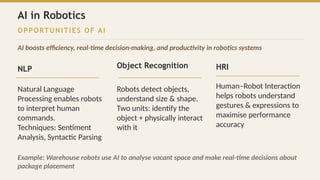
AI in Robotics
OPPORTUNITIESOF AI
AI boosts efficiency, real-time decision-making, and productivity in robotics systems
NLP
Natural Language
Processing enables robots
to interpret human
commands.
Techniques: Sentiment
Analysis, Syntactic Parsing
Object Recognition
Robots detect objects,
understand size & shape.
Two units: identify the
object + physically interact
with it
HRI
Human–Robot Interaction
helps robots understand
gestures & expressions to
maximise performance
accuracy
Example: Warehouse robots use AI to analyse vacant space and make real-time decisions about
package placement
7.
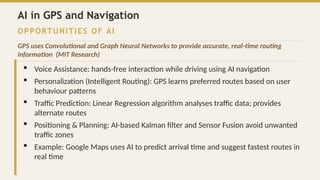
AI in GPSand Navigation
OPPORTUNITIES OF AI
GPS uses Convolutional and Graph Neural Networks to provide accurate, real-time routing
information (MIT Research)
▪ Voice Assistance: hands-free interaction while driving using AI navigation
▪ Personalization (Intelligent Routing): GPS learns preferred routes based on user
behaviour patterns
▪ Traffic Prediction: Linear Regression algorithm analyses traffic data; provides
alternate routes
▪ Positioning & Planning: AI-based Kalman filter and Sensor Fusion avoid unwanted
traffic zones
▪ Example: Google Maps uses AI to predict arrival time and suggest fastest routes in
real time
8.
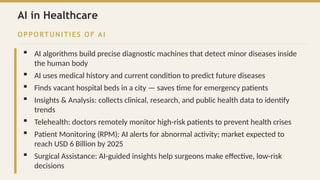
AI in Healthcare
OPPORTUNITIESOF AI
▪ AI algorithms build precise diagnostic machines that detect minor diseases inside
the human body
▪ AI uses medical history and current condition to predict future diseases
▪ Finds vacant hospital beds in a city — saves time for emergency patients
▪ Insights & Analysis: collects clinical, research, and public health data to identify
trends
▪ Telehealth: doctors remotely monitor high-risk patients to prevent health crises
▪ Patient Monitoring (RPM): AI alerts for abnormal activity; market expected to
reach USD 6 Billion by 2025
▪ Surgical Assistance: AI-guided insights help surgeons make effective, low-risk
decisions
9.
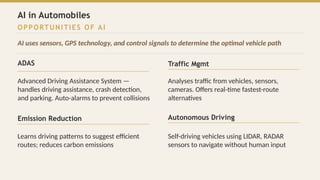
AI in Automobiles
OPPORTUNITIESOF AI
AI uses sensors, GPS technology, and control signals to determine the optimal vehicle path
ADAS
Advanced Driving Assistance System —
handles driving assistance, crash detection,
and parking. Auto-alarms to prevent collisions
Traffic Mgmt
Analyses traffic from vehicles, sensors,
cameras. Offers real-time fastest-route
alternatives
Emission Reduction
Learns driving patterns to suggest efficient
routes; reduces carbon emissions
Autonomous Driving
Self-driving vehicles using LIDAR, RADAR
sensors to navigate without human input
10.
AI in Agriculture
OP P O R T U N I T I E S O F A I
CCS345 – Ethics and Artificial Intelligence | Unit V
▪ AI detects soil parameters: water & moisture levels, nutrient deficiencies
▪ Machines use AI to locate where weeds grow and where soil is infertile
▪ Stock Monitoring: CN (Convolutional Network) monitors crop feeds live and alerts on
abnormalities
▪ Supply Chain: AI analyses inventory to ensure demands are met with minimal loss
▪ Pest Management: AI identifies early pest warnings; reduces use of harmful pesticides
▪ Forecasting: AI analyses weather and crop growth data to help farmers make better decisions
Challenge 1 —Biases in AI
CHALLENGES OF AI
Training data must be diverse and balanced; biased data creates biased AI systems
▪ We need data to train AI — but biased training data creates biased AI outcomes
▪ Example: ImageNet database has far more white faces than non-white → facial
recognition fails on non-white faces
▪ Built-in bias can have a huge social impact — leading to discrimination in hiring,
lending, healthcare
▪ Solution: Proactively identify and eliminate bias during AI training and evaluation
stages
▪ Being aware of the potential for bias in AI solutions is the first step toward fairness
13.
Challenge 2 —Control and Morality of AI
▪ As AI is used more widely, machines are being asked to make increasingly
important decisions
▪ Current approach: Patchwork of rules and regulations (e.g., international
convention on autonomous drones requires human approval before missile
deployment)
▪ Problem: AI must sometimes make split-second decisions — no time for human
oversight
▪ Example 1: High-frequency trading — over 90% of financial trades are algorithm-
driven; no human control possible
▪ Example 2: Autonomous cars must react immediately if a child runs onto the road
▪ Ethical challenge: Balancing machine autonomy with human moral responsibility
14.
Challenge 3 —Privacy and Consent
▪ Privacy and consent for data usage is a long-standing ethical dilemma in AI
▪ AI systems assume users are adults who can give informed consent — but this is
not always true
▪ Example: AI-enabled Barbie doll collects data from children's conversations —
where does this data go?
▪ Many companies collect user data and sell it to other organisations without clear
consent
▪ Question: What legislation should be in place to protect private user data?
▪ Need: Stronger data protection laws, transparent data usage policies, and user
awareness
15.
Challenge 4 —Power Balance
"Whoever wins the race in AI will probably become the ruler of the world." — President Putin,
Russia
▪ Large companies (Amazon, Facebook, Google) use AI to dominate markets and
eliminate competition
▪ Countries like China have ambitious government-backed AI strategies
▪ A few nations racing ahead of the rest creates dangerous global inequality
▪ Challenge: Ensuring AI monopolies distribute wealth equally — not just benefit the
powerful
▪ Global collaboration and shared AI governance frameworks are urgently needed
16.
Challenge 5 —Ownership of AI-Generated Content
▪ AI can now create text, bots, deepfake videos, art, and music — raising complex
ownership questions
▪ Deepfakes: misleading AI-generated content can spread as fake news — who is
legally responsible?
▪ AI-generated art and music: Who holds intellectual property rights? Who gets
paid?
▪ Current laws do not clearly address ownership of AI-created content
▪ Challenge: Updating copyright and IP frameworks to handle AI-generated works
▪ Example: AI tools like DALL·E, Suno, ChatGPT generate original content —
ownership remains legally unclear
17.
Challenge 6 —Environmental Impact
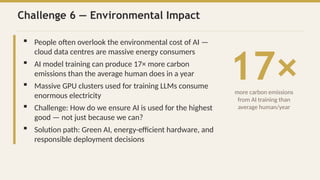
17×
more carbon emissions
from AI training than
average human/year
▪ People often overlook the environmental cost of AI —
cloud data centres are massive energy consumers
▪ AI model training can produce 17× more carbon
emissions than the average human does in a year
▪ Massive GPU clusters used for training LLMs consume
enormous electricity
▪ Challenge: How do we ensure AI is used for the highest
good — not just because we can?
▪ Solution path: Green AI, energy-efficient hardware, and
responsible deployment decisions
18.
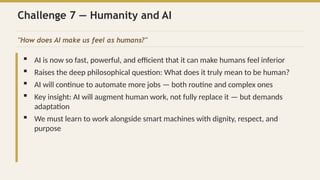
Challenge 7 —Humanity and AI
"How does AI make us feel as humans?"
▪ AI is now so fast, powerful, and efficient that it can make humans feel inferior
▪ Raises the deep philosophical question: What does it truly mean to be human?
▪ AI will continue to automate more jobs — both routine and complex ones
▪ Key insight: AI will augment human work, not fully replace it — but demands
adaptation
▪ We must learn to work alongside smart machines with dignity, respect, and
purpose
19.
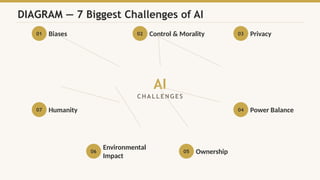
DIAGRAM — 7Biggest Challenges of AI
AI
CHALL ENGES
01 Biases 02 Control & Morality 03 Privacy
04 Power Balance
05 Ownership
06
Environmental
Impact
07 Humanity
20.
03
Societal Issues: AIin Medicine
Ethical and social challenges of applying AI in healthcare
21.
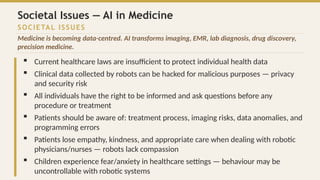
Societal Issues —AI in Medicine
SOCIETAL ISSUES
Medicine is becoming data-centred. AI transforms imaging, EMR, lab diagnosis, drug discovery,
precision medicine.
▪ Current healthcare laws are insufficient to protect individual health data
▪ Clinical data collected by robots can be hacked for malicious purposes — privacy
and security risk
▪ All individuals have the right to be informed and ask questions before any
procedure or treatment
▪ Patients should be aware of: treatment process, imaging risks, data anomalies, and
programming errors
▪ Patients lose empathy, kindness, and appropriate care when dealing with robotic
physicians/nurses — robots lack compassion
▪ Children experience fear/anxiety in healthcare settings — behaviour may be
uncontrollable with robotic systems
22.
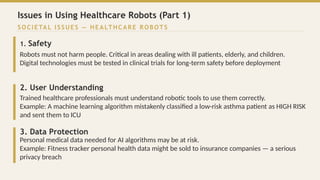
Issues in UsingHealthcare Robots (Part 1)
SOCIETA L ISSUES — HE ALTHC ARE ROBOT S
1. Safety
Robots must not harm people. Critical in areas dealing with ill patients, elderly, and children.
Digital technologies must be tested in clinical trials for long-term safety before deployment
2. User Understanding
Trained healthcare professionals must understand robotic tools to use them correctly.
Example: A machine learning algorithm mistakenly classified a low-risk asthma patient as HIGH RISK
and sent them to ICU
3. Data Protection
Personal medical data needed for AI algorithms may be at risk.
Example: Fitness tracker personal health data might be sold to insurance companies — a serious
privacy breach
23.
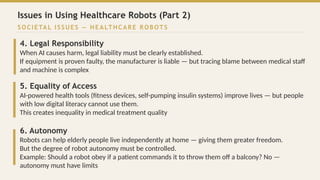
Issues in UsingHealthcare Robots (Part 2)
SOCIETA L ISSUES — HE ALTHC ARE ROBOT S
4. Legal Responsibility
When AI causes harm, legal liability must be clearly established.
If equipment is proven faulty, the manufacturer is liable — but tracing blame between medical staff
and machine is complex
5. Equality of Access
AI-powered health tools (fitness devices, self-pumping insulin systems) improve lives — but people
with low digital literacy cannot use them.
This creates inequality in medical treatment quality
6. Autonomy
Robots can help elderly people live independently at home — giving them greater freedom.
But the degree of robot autonomy must be controlled.
Example: Should a robot obey if a patient commands it to throw them off a balcony? No —
autonomy must have limits
24.
04
AI in IndustrialDecision Making
How AI drives manufacturing, quality, and operational efficiency
25.
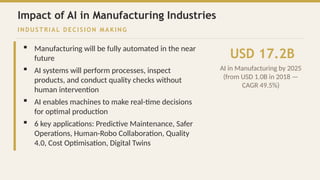
Impact of AIin Manufacturing Industries
INDU STRIAL DECISION MAKING
USD 17.2B
AI in Manufacturing by 2025
(from USD 1.0B in 2018 —
CAGR 49.5%)
▪ Manufacturing will be fully automated in the near
future
▪ AI systems will perform processes, inspect
products, and conduct quality checks without
human intervention
▪ AI enables machines to make real-time decisions
for optimal production
▪ 6 key applications: Predictive Maintenance, Safer
Operations, Human-Robo Collaboration, Quality
4.0, Cost Optimisation, Digital Twins
26.
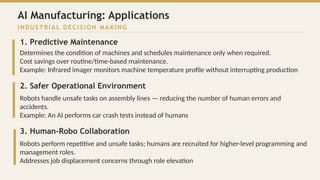
AI Manufacturing: Applications
INDUSTRIAL DECISION MAKING
1. Predictive Maintenance
Determines the condition of machines and schedules maintenance only when required.
Cost savings over routine/time-based maintenance.
Example: Infrared imager monitors machine temperature profile without interrupting production
2. Safer Operational Environment
Robots handle unsafe tasks on assembly lines — reducing the number of human errors and
accidents.
Example: An AI performs car crash tests instead of humans
3. Human-Robo Collaboration
Robots perform repetitive and unsafe tasks; humans are recruited for higher-level programming and
management roles.
Addresses job displacement concerns through role elevation
27.
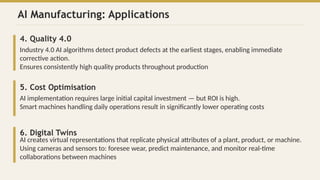
AI Manufacturing: Applications
4.Quality 4.0
Industry 4.0 AI algorithms detect product defects at the earliest stages, enabling immediate
corrective action.
Ensures consistently high quality products throughout production
5. Cost Optimisation
AI implementation requires large initial capital investment — but ROI is high.
Smart machines handling daily operations result in significantly lower operating costs
6. Digital Twins
AI creates virtual representations that replicate physical attributes of a plant, product, or machine.
Using cameras and sensors to: foresee wear, predict maintenance, and monitor real-time
collaborations between machines
28.
05
National & InternationalStrategies on AI
How governments and global institutions are governing responsible AI
29.
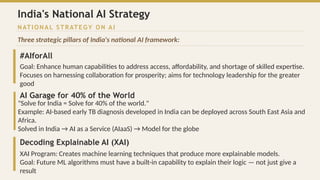
India's National AIStrategy
NATIONAL ST RATE GY ON AI
Three strategic pillars of India's national AI framework:
#AIforAll
Goal: Enhance human capabilities to address access, affordability, and shortage of skilled expertise.
Focuses on harnessing collaboration for prosperity; aims for technology leadership for the greater
good
AI Garage for 40% of the World
"Solve for India = Solve for 40% of the world."
Example: AI-based early TB diagnosis developed in India can be deployed across South East Asia and
Africa.
Solved in India → AI as a Service (AIaaS) → Model for the globe
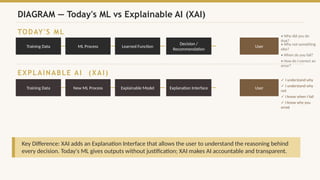
Decoding Explainable AI (XAI)
XAI Program: Creates machine learning techniques that produce more explainable models.
Goal: Future ML algorithms must have a built-in capability to explain their logic — not just give a
result
30.
DIAGRAM — Today'sML vs Explainable AI (XAI)
TODAY'S ML
Training Data ML Process Learned Function
Decision /
Recommendation
User
• Why did you do
that?
• Why not something
else?
• When do you fail?
• How do I correct an
error?
EXPLAINABLE AI (XAI)
Training Data New ML Process Explainable Model Explanation Interface User
✓ I understand why
✓ I understand why
not
✓ I know when I fail
✓ I know why you
erred
Key Difference: XAI adds an Explanation Interface that allows the user to understand the reasoning behind
every decision. Today's ML gives outputs without justification; XAI makes AI accountable and transparent.
31.
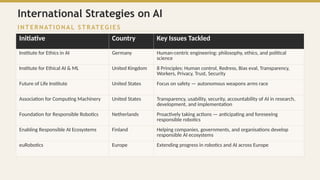
International Strategies onAI
INT ERNAT IONAL ST RATE GIE S
Initiative Country Key Issues Tackled
Institute for Ethics in AI Germany Human-centric engineering: philosophy, ethics, and political
science
Institute for Ethical AI & ML United Kingdom 8 Principles: Human control, Redress, Bias eval, Transparency,
Workers, Privacy, Trust, Security
Future of Life Institute United States Focus on safety — autonomous weapons arms race
Association for Computing Machinery United States Transparency, usability, security, accountability of AI in research,
development, and implementation
Foundation for Responsible Robotics Netherlands Proactively taking actions — anticipating and foreseeing
responsible robotics
Enabling Responsible AI Ecosystems Finland Helping companies, governments, and organisations develop
responsible AI ecosystems
euRobotics Europe Extending progress in robotics and AI across Europe
32.
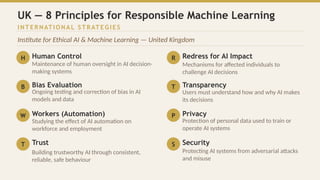
UK — 8Principles for Responsible Machine Learning
INT ERNAT IONAL ST RATE GIE S
Institute for Ethical AI & Machine Learning — United Kingdom
H Human Control
Maintenance of human oversight in AI decision-
making systems
R Redress for AI Impact
Mechanisms for affected individuals to
challenge AI decisions
B Bias Evaluation
Ongoing testing and correction of bias in AI
models and data
T Transparency
Users must understand how and why AI makes
its decisions
W Workers (Automation)
Studying the effect of AI automation on
workforce and employment
P Privacy
Protection of personal data used to train or
operate AI systems
T Trust
Building trustworthy AI through consistent,
reliable, safe behaviour
S Security
Protecting AI systems from adversarial attacks
and misuse
33.
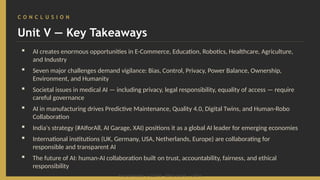
C O NC L U S I O N
Unit V — Key Takeaways
▪ AI creates enormous opportunities in E-Commerce, Education, Robotics, Healthcare, Agriculture,
and Industry
▪ Seven major challenges demand vigilance: Bias, Control, Privacy, Power Balance, Ownership,
Environment, and Humanity
▪ Societal issues in medical AI — including privacy, legal responsibility, equality of access — require
careful governance
▪ AI in manufacturing drives Predictive Maintenance, Quality 4.0, Digital Twins, and Human-Robo
Collaboration
▪ India's strategy (#AIforAll, AI Garage, XAI) positions it as a global AI leader for emerging economies
▪ International institutions (UK, Germany, USA, Netherlands, Europe) are collaborating for
responsible and transparent AI
▪ The future of AI: human-AI collaboration built on trust, accountability, fairness, and ethical
responsibility
Anna University | CCS345 – Ethics and AI | Unit V