Explore biofloc technology for sustainable aquaculture, its challenges, species suitability, oxygen consumption rates, and business potential in India post-COVID-19 for eco-friendly fish and shrimp farming.
Introduction - Wasteto Resource
Conversion
• In BFT, microbial processes are used to convert
waste nutrients, primarily nitrogen compounds, into
microbial biomass.
• This microbial biomass serves as a high-protein food
source for cultured aquatic species.
• 4000+ Biofloc are already installed in India under
Pmmsy which are either not operational or under
utilized mainly due to ;
species selection,
knowledge gap, and
on field training facilities.
3.
• Key goal:Maintain water quality and
enhance feed utilization, drastically
reducing the need for water exchange and
external feed.
• Targeted harvestable size should be ≤500
gm of species like Tilapia, Roopchanda,
Pangasius and for shrimps like L.vannamei
it should be 40-50 count.
4.
Problems faced byfarmers in BFT
• Oxygen Depletion - Dense microbial flocs consume large amounts of DO,
risking fish suffocation. Continuous aeration is mandatory — power failures
are fatal.
• Toxic Gas Buildup - Poor C:N ratio management causes ammonia and
nitrite spikes, leading to mass mortality. Constant water chemistry monitoring
is critical.
• Sludge Accumulation - Excess TSS clog gills and degrade water quality.
Regular sludge removal is labor-intensive and technically demanding.
• Disease & Pathogen Risk - High stocking density and organic load create
ideal conditions for pathogens. Biosecurity lapses can trigger system-wide
disease outbreaks.
• High Operating Costs - Continuous aeration, monitoring equipment, and
carbon source inputs drive up costs — making BFT economically
challenging for small-scale farmers.
• Technical Knowledge Gap - BFT demands expertise in microbiology, water
chemistry, and system management. Lack of training leads to system
crashes and financial losses.
5.
Achieving 12 Tonsof Tilapia:
A Biofloc Case Study
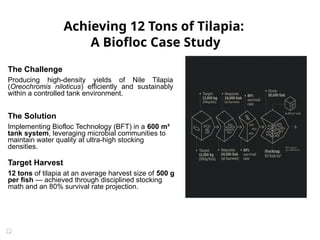
The Challenge
Producing high-density yields of Nile Tilapia
(Oreochromis niloticus) efficiently and sustainably
within a controlled tank environment.
The Solution
Implementing Biofloc Technology (BFT) in a 600 m³
tank system, leveraging microbial communities to
maintain water quality at ultra-high stocking
densities.
Target Harvest
12 tons of tilapia at an average harvest size of 500 g
per fish — achieved through disciplined stocking
math and an 80% survival rate projection.
Key Research Insight: BFT studies support stocking densities up to 800 fish/m³. This case uses a conservative 50 fish/m³, pro
significant headroom for growth and water quality management — making 12 tons a highly achievable, well-validated target.
6.
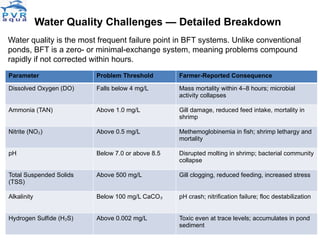
Water Quality Challenges— Detailed Breakdown
Water quality is the most frequent failure point in BFT systems. Unlike conventional
ponds, BFT is a zero- or minimal-exchange system, meaning problems compound
rapidly if not corrected within hours.
Parameter Problem Threshold Farmer-Reported Consequence
Dissolved Oxygen (DO) Falls below 4 mg/L Mass mortality within 4–8 hours; microbial
activity collapses
Ammonia (TAN) Above 1.0 mg/L Gill damage, reduced feed intake, mortality in
shrimp
Nitrite (NO )
₂ Above 0.5 mg/L Methemoglobinemia in fish; shrimp lethargy and
mortality
pH Below 7.0 or above 8.5 Disrupted molting in shrimp; bacterial community
collapse
Total Suspended Solids
(TSS)
Above 500 mg/L Gill clogging, reduced feeding, increased stress
Alkalinity Below 100 mg/L CaCO₃ pH crash; nitrification failure; floc destabilization
Hydrogen Sulfide (H S)
₂ Above 0.002 mg/L Toxic even at trace levels; accumulates in pond
sediment
7.
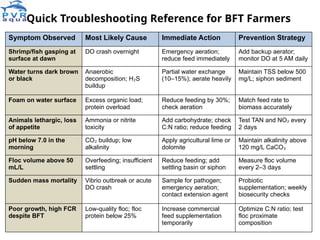
Quick Troubleshooting Referencefor BFT Farmers
Symptom Observed Most Likely Cause Immediate Action Prevention Strategy
Shrimp/fish gasping at
surface at dawn
DO crash overnight Emergency aeration;
reduce feed immediately
Add backup aerator;
monitor DO at 5 AM daily
Water turns dark brown
or black
Anaerobic
decomposition; H S
₂
buildup
Partial water exchange
(10–15%); aerate heavily
Maintain TSS below 500
mg/L; siphon sediment
Foam on water surface Excess organic load;
protein overload
Reduce feeding by 30%;
check aeration
Match feed rate to
biomass accurately
Animals lethargic, loss
of appetite
Ammonia or nitrite
toxicity
Add carbohydrate; check
C:N ratio; reduce feeding
Test TAN and NO every
₂
2 days
pH below 7.0 in the
morning
CO buildup; low
₂
alkalinity
Apply agricultural lime or
dolomite
Maintain alkalinity above
120 mg/L CaCO₃
Floc volume above 50
mL/L
Overfeeding; insufficient
settling
Reduce feeding; add
settling basin or siphon
Measure floc volume
every 2–3 days
Sudden mass mortality Vibrio outbreak or acute
DO crash
Sample for pathogen;
emergency aeration;
contact extension agent
Probiotic
supplementation; weekly
biosecurity checks
Poor growth, high FCR
despite BFT
Low-quality floc; floc
protein below 25%
Increase commercial
feed supplementation
temporarily
Optimize C:N ratio; test
floc proximate
composition