Introduction
Patient mobility assistanceinvolves techniques, tools, and care
strategies used to help patients safely move and transfer from one
position or location to another - whether in bed, to a chair, to a
wheelchair, or when walking. It encompasses both manual
handling and the use of assistive devices.
Significance in Healthcare and Homecare:
Proper mobility assistance prevents injuries, supports recovery,
encourages independence, and enhances the quality of life for
patients while reducing strain and risk to caregivers.
3.
Objective Detailed Description
1.Promote Safe Mobility
Assist patients in maintaining functional
independence through safe movement.
2. Prevent Injuries
Protect patients from falls and caregivers
from musculoskeletal strain.
3. Maintain Dignity
Provide comfort and privacy during
transfers and movement.
4. Facilitate Recovery
Encourages circulation, muscle activity,
and participation in rehabilitation.
5. Ensure Legal and Ethical
Compliance
Adheres to safety protocols and
standards set by institutions (TESDA,
DOH, etc.).
4.
Principles of PatientMobility and Transfer
Principle Application Rationale
1. Individual
Assessment
Assess strength, weight-
bearing ability, cooperation,
cognitive status, and pain.
Prevent
complications and
choose correct
method/device.
2. Proper Body
Mechanics
Stand close, bend knees,
straight back, wide stance,
avoid twisting.
Prevent back and
muscle strain.
3. Patient
Communication
Explain the process in
simple terms; involve them
if possible.
Reduces anxiety,
builds trust, and
improves
cooperation.
4. Equipment Readiness
Use clean, functioning, and
appropriate devices (e.g.,
gait belt, walker).
Prevents equipment-
related accidents.
5. Environment Safety
Dry floors, remove
obstructions, proper
lighting,
bed/chair/wheelchair
locked.
Reduces risk of
slipping, tripping, or
collisions.
5.
Key Transfer Techniqueswith Step-by-Step Guidance
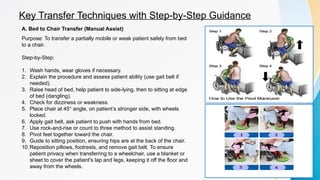
A. Bed to Chair Transfer (Manual Assist)
Purpose: To transfer a partially mobile or weak patient safely from bed
to a chair.
Step-by-Step:
1. Wash hands, wear gloves if necessary.
2. Explain the procedure and assess patient ability (use gait belt if
needed).
3. Raise head of bed, help patient to side-lying, then to sitting at edge
of bed (dangling).
4. Check for dizziness or weakness.
5. Place chair at 45° angle, on patient’s stronger side, with wheels
locked.
6. Apply gait belt, ask patient to push with hands from bed.
7. Use rock-and-rise or count to three method to assist standing.
8. Pivot feet together toward the chair.
9. Guide to sitting position, ensuring hips are at the back of the chair.
10.Reposition pillows, footrests, and remove gait belt. To ensure
patient privacy when transferring to a wheelchair, use a blanket or
sheet to cover the patient's lap and legs, keeping it off the floor and
away from the wheels.
6.
B. Wheelchair toBed Transfer
Purpose: Helps a patient safely move from a
wheelchair to a bed.
Steps:
1. Position the wheelchair close to bed, lock
brakes, and remove footrests.
2. Assist the patient to slide forward in the
wheelchair.
3. Use gait belt, have them lean forward and push
off armrests.
4. Assist to stand, then pivot toward the bed.
5. Gently guide the patient to sit on bed edge, then
help to lie down comfortably.
7.
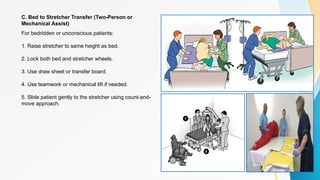
C. Bed toStretcher Transfer (Two-Person or
Mechanical Assist)
For bedridden or unconscious patients:
1. Raise stretcher to same height as bed.
2. Lock both bed and stretcher wheels.
3. Use draw sheet or transfer board.
4. Use teamwork or mechanical lift if needed.
5. Slide patient gently to the stretcher using count-and-
move approach.
8.
Assistive Devices inMobility and Transfer
Device Function When to Use
Gait Belt
Strap worn around
patient’s waist to provide
grip and support.
During standing and pivot
transfers.
Canes
Offers balance and light
weight support.
Patients with slight weakness
or balance issues.
Walkers
Four-legged frame offering
maximum support.
Frail patients or those with
lower limb weakness.
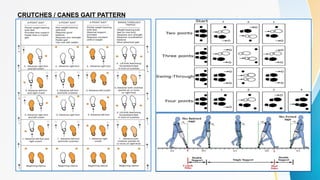
Crutches
Transfers weight to arms
and shoulders.
Post-surgery or injury to one
leg.
Slide/Transfer Board
Flat board that bridges two
surfaces.
Bed to wheelchair for
paraplegic or weak patients.
Mechanical Hoist
(Hoyer Lift)
Lifting device with sling to
move patients.
Non-ambulatory, heavy, or
fully dependent patients.
How to Usea Mechanical Hoist (Briefly)
1.Position the sling under the patient properly (head
and thigh support).
2.Attach sling to hoist securely.
3.Operate hoist to lift patient slowly and smoothly.
4.Pivot and lower patient onto new surface.
5.Detach sling gently and ensure comfort.
Caution: Use two caregivers for hoist transfers to guide
and stabilize the patient.
11.
Safety Precautions andRisk Management
Precaution Purpose
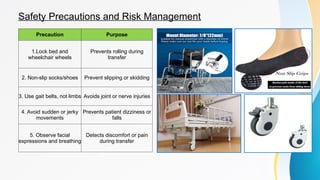
1.Lock bed and
wheelchair wheels
Prevents rolling during
transfer
2. Non-slip socks/shoes Prevent slipping or skidding
3. Use gait belts, not limbs Avoids joint or nerve injuries
4. Avoid sudden or jerky
movements
Prevents patient dizziness or
falls
5. Observe facial
expressions and breathing
Detects discomfort or pain
during transfer
12.
Post-Transfer Care andDocumentation
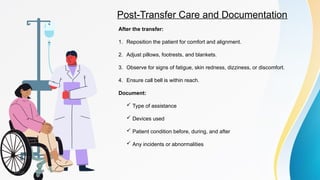
After the transfer:
1. Reposition the patient for comfort and alignment.
2. Adjust pillows, footrests, and blankets.
3. Observe for signs of fatigue, skin redness, dizziness, or discomfort.
4. Ensure call bell is within reach.
Document:
Type of assistance
Devices used
Patient condition before, during, and after
Any incidents or abnormalities
13.
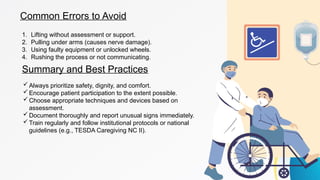
Common Errors toAvoid
1. Lifting without assessment or support.
2. Pulling under arms (causes nerve damage).
3. Using faulty equipment or unlocked wheels.
4. Rushing the process or not communicating.
Summary and Best Practices
Always prioritize safety, dignity, and comfort.
Encourage patient participation to the extent possible.
Choose appropriate techniques and devices based on
assessment.
Document thoroughly and report unusual signs immediately.
Train regularly and follow institutional protocols or national
guidelines (e.g., TESDA Caregiving NC II).