A D ULT H E A LT H N U R S I N G I I • 4 T H S E M E S T E R
CH AP TE R : NU RS I NG CA R E O F TH E E L D E R LY
Nursing Care of the
Elderly
Gerontological Nursing: Concepts, Assessment & Comprehensive Care of the Older Adult
B.Sc. Nursing | Unit: Care of the Elderly / Geriatric Nursing
Presented by
Pratiksha Chaudhary
Clinical Instructor
2.
OV E RVIE W
What We Will Cover
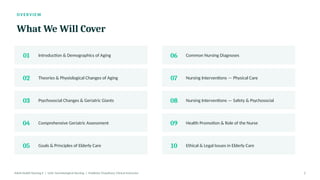
01 Introduction & Demographics of Aging
02 Theories & Physiological Changes of Aging
03 Psychosocial Changes & Geriatric Giants
04 Comprehensive Geriatric Assessment
05 Goals & Principles of Elderly Care
06 Common Nursing Diagnoses
07 Nursing Interventions — Physical Care
08 Nursing Interventions — Safety & Psychosocial
09 Health Promotion & Role of the Nurse
10 Ethical & Legal Issues in Elderly Care
Adult Health Nursing II | Unit: Gerontological Nursing | Pratiksha Chaudhary, Clinical Instructor 2
3.
I NTRO DU C TI O N
Aging & the Growing Elderly Population
Ageing is a normal, progressive, and irreversible biological process that leads to a
gradual decline in structural and functional capacity of body systems. WHO and
most national policies define "elderly" or "older adult" as a person aged 60 years
and above. Because of this decline, elderly individuals are more vulnerable to
chronic illness, disability, and dependency — making gerontological nursing an
essential and growing specialty within adult health nursing.
World's elderly population is rising faster than any other age group
Increased life expectancy + falling birth rates drive population ageing
Elderly are more prone to chronic, multiple, and disabling illnesses
Creates growing demand for skilled gerontological nursing care
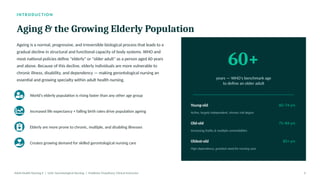
60+
years — WHO's benchmark age
to define an older adult
Young-old 60–74 yrs
Active, largely independent, chronic risk begins
Old-old 75–84 yrs
Increasing frailty & multiple comorbidities
Oldest-old 85+ yrs
High dependency, greatest need for nursing care
Adult Health Nursing II | Unit: Gerontological Nursing | Pratiksha Chaudhary, Clinical Instructor 3
4.
FOU NDATI ONS
Theories of Aging
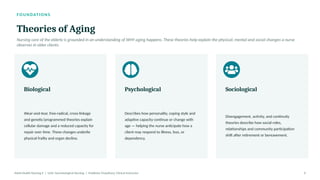
Nursing care of the elderly is grounded in an understanding of WHY aging happens. These theories help explain the physical, mental and social changes a nurse
observes in older clients.
Biological
Wear-and-tear, free-radical, cross-linkage
and genetic/programmed theories explain
cellular damage and a reduced capacity for
repair over time. These changes underlie
physical frailty and organ decline.
Psychological
Describes how personality, coping style and
adaptive capacity continue or change with
age — helping the nurse anticipate how a
client may respond to illness, loss, or
dependency.
Sociological
Disengagement, activity, and continuity
theories describe how social roles,
relationships and community participation
shift after retirement or bereavement.
Adult Health Nursing II | Unit: Gerontological Nursing | Pratiksha Chaudhary, Clinical Instructor 4
K EY CONC EP T
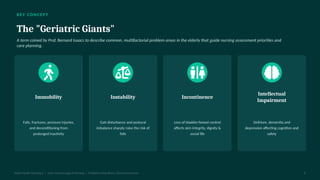
The "Geriatric Giants"
A term coined by Prof. Bernard Isaacs to describe common, multifactorial problem areas in the elderly that guide nursing assessment priorities and
care planning.
Immobility
Falls, fractures, pressure injuries,
and deconditioning from
prolonged inactivity
Instability
Gait disturbance and postural
imbalance sharply raise the risk of
falls
Incontinence
Loss of bladder/bowel control
affects skin integrity, dignity &
social life
Intellectual
Impairment
Delirium, dementia and
depression affecting cognition and
safety
Adult Health Nursing II | Unit: Gerontological Nursing | Pratiksha Chaudhary, Clinical Instructor 6
7.
W EL LB E I NG
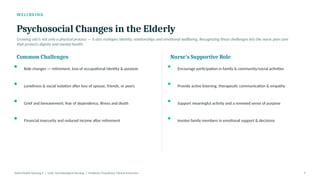
Psychosocial Changes in the Elderly
Growing old is not only a physical process — it also reshapes identity, relationships and emotional wellbeing. Recognizing these challenges lets the nurse plan care
that protects dignity and mental health.
Common Challenges
Role changes — retirement, loss of occupational identity & purpose
Loneliness & social isolation after loss of spouse, friends, or peers
Grief and bereavement; fear of dependency, illness and death
Financial insecurity and reduced income after retirement
Nurse's Supportive Role
Encourage participation in family & community/social activities
Provide active listening, therapeutic communication & empathy
Support meaningful activity and a renewed sense of purpose
Involve family members in emotional support & decisions
Adult Health Nursing II | Unit: Gerontological Nursing | Pratiksha Chaudhary, Clinical Instructor 7
8.
ASS ESS MENT
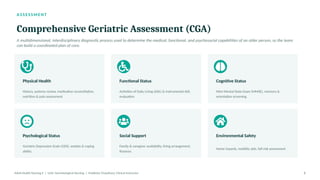
Comprehensive Geriatric Assessment (CGA)
A multidimensional, interdisciplinary diagnostic process used to determine the medical, functional, and psychosocial capabilities of an older person, so the team
can build a coordinated plan of care.
Physical Health
History, systems review, medication reconciliation,
nutrition & pain assessment
Functional Status
Activities of Daily Living (ADL) & Instrumental ADL
evaluation
Cognitive Status
Mini-Mental State Exam (MMSE), memory &
orientation screening
Psychological Status
Geriatric Depression Scale (GDS), anxiety & coping
ability
Social Support
Family & caregiver availability, living arrangement,
finances
Environmental Safety
Home hazards, mobility aids, fall-risk assessment
Adult Health Nursing II | Unit: Gerontological Nursing | Pratiksha Chaudhary, Clinical Instructor 8
9.
CAR E PHI LOS OP H Y
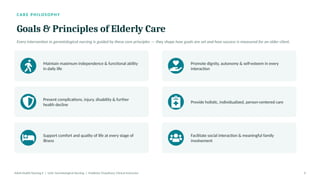
Goals & Principles of Elderly Care
Every intervention in gerontological nursing is guided by these core principles — they shape how goals are set and how success is measured for an older client.
Maintain maximum independence & functional ability
in daily life
Promote dignity, autonomy & self-esteem in every
interaction
Prevent complications, injury, disability & further
health decline
Provide holistic, individualized, person-centered care
Support comfort and quality of life at every stage of
illness
Facilitate social interaction & meaningful family
involvement
Adult Health Nursing II | Unit: Gerontological Nursing | Pratiksha Chaudhary, Clinical Instructor 9
10.
NU R SING PR OC ESS
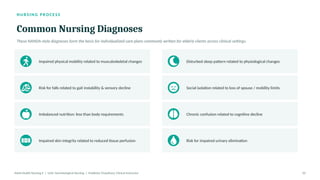
Common Nursing Diagnoses
These NANDA-style diagnoses form the basis for individualized care plans commonly written for elderly clients across clinical settings.
Impaired physical mobility related to musculoskeletal changes
Risk for falls related to gait instability & sensory decline
Imbalanced nutrition: less than body requirements
Impaired skin integrity related to reduced tissue perfusion
Disturbed sleep pattern related to physiological changes
Social isolation related to loss of spouse / mobility limits
Chronic confusion related to cognitive decline
Risk for impaired urinary elimination
Adult Health Nursing II | Unit: Gerontological Nursing | Pratiksha Chaudhary, Clinical Instructor 10
11.
I NTE RVEN TI O NS
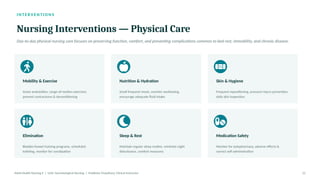
Nursing Interventions — Physical Care
Day-to-day physical nursing care focuses on preserving function, comfort, and preventing complications common to bed rest, immobility, and chronic disease.
Mobility & Exercise
Assist ambulation, range-of-motion exercises;
prevent contractures & deconditioning
Nutrition & Hydration
Small frequent meals, monitor swallowing,
encourage adequate fluid intake
Skin & Hygiene
Frequent repositioning, pressure-injury prevention,
daily skin inspection
Elimination
Bladder/bowel training programs, scheduled
toileting, monitor for constipation
Sleep & Rest
Maintain regular sleep routine, minimize night
disturbance, comfort measures
Medication Safety
Monitor for polypharmacy, adverse effects &
correct self-administration
Adult Health Nursing II | Unit: Gerontological Nursing | Pratiksha Chaudhary, Clinical Instructor 11
12.
I NTE RVEN TI O NS
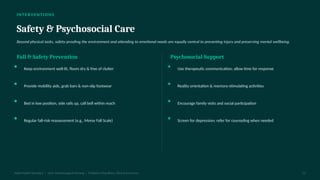
Safety & Psychosocial Care
Beyond physical tasks, safety-proofing the environment and attending to emotional needs are equally central to preventing injury and preserving mental wellbeing.
Fall & Safety Prevention
Keep environment well-lit, floors dry & free of clutter
Provide mobility aids, grab bars & non-slip footwear
Bed in low position, side rails up, call bell within reach
Regular fall-risk reassessment (e.g., Morse Fall Scale)
Psychosocial Support
Use therapeutic communication; allow time for response
Reality orientation & memory-stimulating activities
Encourage family visits and social participation
Screen for depression; refer for counseling when needed
Adult Health Nursing II | Unit: Gerontological Nursing | Pratiksha Chaudhary, Clinical Instructor 12
13.
NU R SE' S RO L E
Health Promotion & Role of the Gerontological Nurse
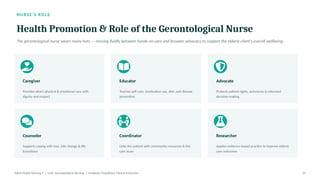
The gerontological nurse wears many hats — moving fluidly between hands-on care and broader advocacy to support the elderly client's overall wellbeing.
Caregiver
Provides direct physical & emotional care with
dignity and respect
Educator
Teaches self-care, medication use, diet, and disease
prevention
Advocate
Protects patient rights, autonomy & informed
decision-making
Counselor
Supports coping with loss, role change & life
transitions
Coordinator
Links the patient with community resources & the
care team
Researcher
Applies evidence-based practice to improve elderly
care outcomes
Adult Health Nursing II | Unit: Gerontological Nursing | Pratiksha Chaudhary, Clinical Instructor 13
14.
PR AC TICE CO N SI D ER ATI O NS
Ethical & Legal Issues in Elderly Care
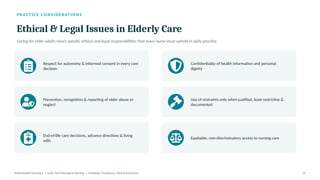
Caring for older adults raises specific ethical and legal responsibilities that every nurse must uphold in daily practice.
Respect for autonomy & informed consent in every care
decision
Confidentiality of health information and personal
dignity
Prevention, recognition & reporting of elder abuse or
neglect
Use of restraints only when justified, least restrictive &
documented
End-of-life care decisions, advance directives & living
wills
Equitable, non-discriminatory access to nursing care
Adult Health Nursing II | Unit: Gerontological Nursing | Pratiksha Chaudhary, Clinical Instructor 14
15.
SU MMA RY
KeyTakeaways
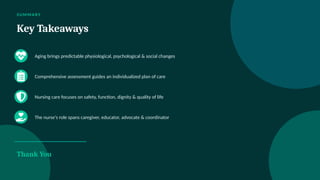
Aging brings predictable physiological, psychological & social changes
Comprehensive assessment guides an individualized plan of care
Nursing care focuses on safety, function, dignity & quality of life
The nurse's role spans caregiver, educator, advocate & coordinator
Thank You