CARE AND
MAINTENANCE OF
CROPS
TYPE OF CROPS
There are six categories of crops:
food crops, feed crops, fiber
crops, oil, crops, ornamental
crops, and industrial crops
FOOD CROPS
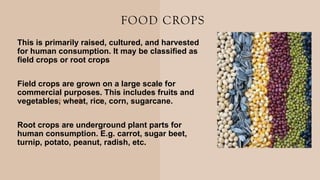
This is primarily raised, cultured, and harvested
for human consumption. It may be classified as
field crops or root crops
Field crops are grown on a large scale for
commercial purposes. This includes fruits and
vegetables, wheat, rice, corn, sugarcane.
Root crops are underground plant parts for
human consumption. E.g. carrot, sugar beet,
turnip, potato, peanut, radish, etc.
CASH CROPS
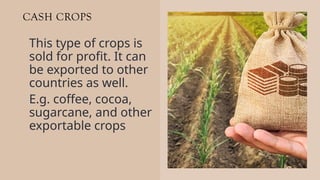
This type of crops is
sold for profit. It can
be exported to other
countries as well.
E.g. coffee, cocoa,
sugarcane, and other
exportable crops
FEED/FORAGE CROPS
This type of plant is usually
raised, cultured, and harvested
for livestock consumption.
E.g. corn, pasture grasses
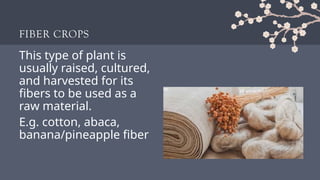
FIBER CROPS
This type of plant is
usually raised, cultured,
and harvested for its
fibers to be used as a
raw material.
E.g. cotton, abaca,
banana/pineapple fiber
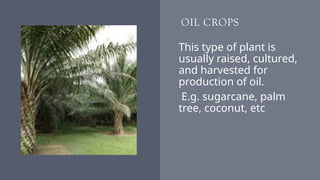
OIL CROPS
This type of plant is
usually raised, cultured,
and harvested for
production of oil.
E.g. sugarcane, palm
tree, coconut, etc
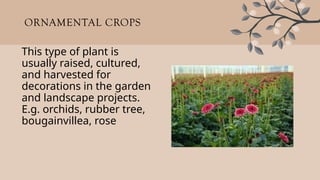
ORNAMENTAL CROPS
This type of plant is
usually raised, cultured,
and harvested for
decorations in the garden
and landscape projects.
E.g. orchids, rubber tree,
bougainvillea, rose
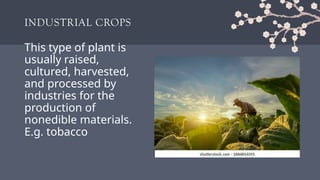
INDUSTRIAL CROPS
This type of plant is
usually raised,
cultured, harvested,
and processed by
industries for the
production of
nonedible materials.
E.g. tobacco
Crops are also classified according to growth
habits: this includes herb, vine, liana, shrub, tree,
evergreen, and deciduous.
In addition, these crops may be considered as
annual, biennial, or perennial crops.
There are many variables
that influence crop
production. These include
water, soil, wind,
temperature, sunlight, seed
selection, knowledge, and
crop care and maintenance.
It is deemed important to
consider these factors as
they affect the growth of
the plant and as well as the
produce/harvest.
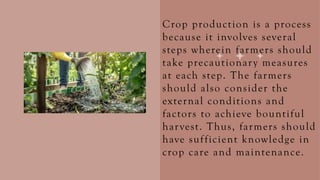
Crop production is a process
because it involves several
steps wherein farmers should
take precautionary measures
at each step. The farmers
should also consider the
external conditions and
factors to achieve bountiful
harvest. Thus, farmers should
have sufficient knowledge in
crop care and maintenance.
THE PRACTICES OF CROP CARE AND
MAINTENANCE
1.Cultivation.
2.Seed sowing/Planting seedlings.
3.Irrigation.
4.Fertilizer Application.
5.Weed Control.
6.Pests and Diseases Control.
7.Support for Climbing plants.
CULTIVATION
This is the first stage of crop production.
Cultivation refers to the stirring the soil through
plowing or harrowing. Cultivating the soil is one
of the most effective way to control weeds and
pests. Cultivating the soil loosens the soil around
the plant which provides air for the root of the
plants. This technique is called conventional
tillage. Reduced or no-tillage can lead to
accumulation of soil carbon, consequently
benefitting soil health and improving crop yields.
SEED SOWING/PLANTING SEEDLINGS.
Good quality and healthy seeds and seedlings
should be considered prior to sowing, and
planting, respectively. Correct depth of soil of
1.5 to 2 inches deep is important for sowing
seeds to ensure proper moisture. In sowing
the seeds or planting the seedlings, farmers
should consider the proper spacing to allow
plants on its optimal growth.
IRRIGATION
Crops require water because water prevents crops from drying out
especially during drought. The amount of water differs from each
variety of crops. There are ways in which farmers irrigate the crops:
manual, drip, and sprinkler irrigation.
Manual irrigation is labor-intensive and time-consuming method which uses
laborers to irrigate water using water cans.
Drip irrigation is the most effective way to supply water and nutrients to crops.
It provides water and nutrients directly to the zone of plants in proper amount
and proper time.
Sprinkler irrigation uses pipes and spray to irrigate the whole field. Pipelines
may be used when water is scarce to eliminate water losses. Finally, soil and
plant factors determine the irrigation requirements of the crops.
FERTILIZER APPLICATION
If the soil is deprived of nutrients, it requires
management of nutrient such as application
of fertilizers, manures, and compost to enrich
the soil content. There are methods of
fertilizer application: scattering and mixing
with the soil before planting.
WEED CONTROL
Weeds lead to the reduction of crop yield, increased production costs, and
increased incidence of pests and diseases. To control weeds, methods employed
including: hand weeding, mechanical cultivation, application of pesticides.
Manual weeding/hand weeding is time-consuming and labor-intensive method.
Laborers uses their hands and or sickle/scythe to remove weeds.
Mechanical weeding uses machineries to remove weeds such as cono-weeder,
power tiller, basket hoe.
Chemical weeding uses herbicides to remove seeds. They may be considered
selective or non-selective herbicides. Selective herbicides aim the weeds only with
effect to the crops while non-selective herbicides harm both main crops and the
weeds. Thus, skill is needed to applying this kind of herbicide.
PESTS AND DISEASES CONTROL
To drive away pests, farmers apply pesticides. There are different
varieties of pesticides and each of them has a particular function.
This includes herbicides, insecticides, fungicides, molluscicides,
and rodenticides. However, farmers are encouraged to employ eco-
safe and eco-friendly ways to control pests and diseases. This may
include production of organic pesticides and encouragement on the
presence of organisms that kills pests.
SUPPORT FOR CLIMBING PLANTS
There is a need to provide support for climbing and crawling plants
such as bitter gourd, squash, string beans. Trellis may be made or
wood or metal.
HARVESTING AND
PRESERVATION.
Click icon to add picture
Farmers harvest when crops reach maturity.
Farmers have various ways to gather and
harvest crops such as traditional technique
and modern ways. This stage of the
development of vegetables when harvested
influences the quality of produce. There are
factors that determine the harvest date of the
crops such as genetic composition of the
vegetable variety, planting date, and
environmental conditions.
Manual harvesting is employed
through the use of mechanical tools
such as sickle/scythe for broccoli,
cabbage, cauliflower. Some vegetables
are mechanically harvested.
Changes in the post-harvest are
influenced by various factors such as kind
of crop, temperature, oxygen and carbon
dioxide content, relative humidity, and
disease-incitant organisms.
Storing the produce contributes price
stabilization. It also contributes to the
preservation of the produce.
Vegetable storage should consider the following
parameters: free from mechanical, insect, and
disease injury, and matured crops.
There are changes that occur on the produce
such as water loss, conversion of starch and
sugar, flavor changes, color changes,
toughening/ softening, vitamin gain/loss,
sprouting, rooting, and decay. These deteriorates
the quality of produce. So, proper storage is
needed.
Common (unrefrigerated storage) and cold
(refrigerated storage)
methods to store vegetables. There is a lack of
precise control of temperature and humidity in
common storage. This uses insulated storage
houses, outdoor cellars, or mounds. Cold
storage, on the other hand, allows precise
regulation of
temperature and humidity, and maintenance of
constant conditions with the use of
refrigeration.
Premarketing operations and selling.
This stage involves washing, trimming, waxing, precooling,
grading, prepackaging, and packaging.
• Precooling involves rapid removal of heat from freshly
harvested vegetables, slows natural deterioration of the
produce, slows the growth of decay, and retards water loss.
Hydrocooling is done by cooling the produce by direct
contact with cold water flowing through the packed
containers.
Contact icing uses crushed ice placed in the package or
spread over a stack of packages to precool the contents.
Vacuum cooling produces rapid evaporation of small
quantity of water that lowers the temperature of the
crops. Air cooling is done through exposure of vegetables to
cold air.
• Grading ensures that the crops are classified
according to their size, shape, color, and ripeness.
This establishes a good trade.
• Packaging. The products are placed in bags, trays,
cartons, crates, and hampers of various kinds and
sizes. This furnishes a convenient means for
transport, loading, and stacking with security and
economy space.
• Selling. Farmers sell their produce through retail
or wholesale. Retail sales are done when consumers
buy produce often though roadside stands. Wholesale
marketing is made when produce is sold to retailers,
commercial, institutional or other large-scale owners.
Other additional practices to increase crop
productivity and farm profitability include:
1. Increase crop diversity
2. Enhance beneficial pollinators population
3. Employ more eco-friendly weed control measures
4. Improve soil quality
5. Manage labor and input costs
6. Keep track of all the records including expenses
and profit
7. Involve in creative marketing
QUIZ
1. Which of the followings factors helps the plants to produce their own food through
photosynthesis?
a. Water c. Seed/Seedlings
b. Sunlight d. temperature
2. This factor influence the growth of the plant by irrigation to maintaining the moisture
in the soil.
a. Water c. Seed/Seedlings
b. Sunlight d. temperature
3. Providing the primary needs of the plants such as cultivation, fertilizer, irrigation,
application of pesticides, weed control, provision of support is generally referred to as
_________________.
a. Harvesting c. Crop care and maintenance
b. Post harvesting d. Pre-production
QUIZ
4. Providing trellis to the crawling and climbing plants is a way of _____________.
a. Provision of support c. Application of pesticides
b. Application of fertilizer d. Weed control
5. This crop care and maintenance helps loosens the hardened soil around the
plant. Large acres of farms use mechanical aids in plowing and harrowing
a. Weed control c. Pests and Diseases Control
b. Cultivation d. Irrigation
6. This practice is being carried out if the soil is deprived of nutrients.
a. Storage c. Fertilizer Application
b. Harvesting d. Pests and Diseases Control
QUIZ
7. _______________ is done when crops reach maturity and it influences the
quality of produce.
a. Post harvesting c. Storag
b. Harvesting d. temperature
8. This postharvest practice classifies the produce according to their size, shape,
color and ripeness.
a. Selling c. Packaging
b. Harvesting d. Grading
9. When produce are sold through retail or whole sale, this postharvest practice
is called ___________.
a. Selling c. Packaging
b. Harvesting d. Gradinge
10. To ensure proper moisture of the seeds sown, the depth should be __________.
a. 0.5- to 1-inch c. 2- to 2.5-inch
b. 1- to 1.5-inch d. 1.5- to 2-inch
Answer Key:
1. b
2. a
3. c
4. a
5. b
6. c
7. b
8. d
9. a
10.d