Captured Moments: Exploring Physics' Role in Everyday Life and Safety
This Grade 11 lesson plan explores physics principles in daily activities, safety, work efficiency, and leisure, using hands-on experiments and real-life applications to enhance understanding and appreciation of physics.
Captured Moments: Exploring Physics' Role in Everyday Life and Safety
1.
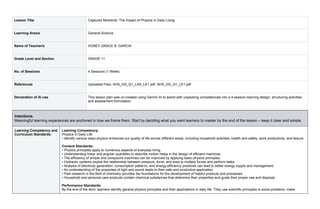
Lesson Title CapturedMoments: The Impact of Physics in Daily Living
Learning Area/s General Science
Name of Teacher/s HONEY GRACE B. GARCIA
Grade Level and Section GRADE 11
No. of Sessions 4 Sessions (1 Week)
References Uploaded Files: SHS_GS_Q1_LAS_LE1.pdf, SHS_GS_Q1_LE1.pdf
Declaration of AI use This lesson plan was co-created using Gemini AI to assist with unpacking competencies into a 4-session learning design, structuring activities,
and assessment formulation.
Intentions.
Meaningful learning experiences are anchored in how we frame them. Start by deciding what you want learners to master by the end of the lesson – keep it clear and simple.
Learning Competency and
Curriculum Standards:
Learning Competency:
Physics in Daily Life:
• Identify various ways physics enhances our quality of life across different areas, including household activities, health and safety, work productivity, and leisure.
Content Standards:
• Physics principles apply to numerous aspects of everyday living.
• Understanding linear and angular quantities to describe motion helps in the design of efficient machines.
• The efficiency of simple and compound machines can be improved by applying basic physics principles.
• Hydraulic systems exploit the relationship between pressure, force, and area to multiply forces and perform tasks.
• Analysis of electricity generation, consumption patterns, and energy-efficiency practices can lead to better energy supply and management.
• An understanding of the properties of light and sound leads to their safe and productive application.
• Past research in the field of chemistry provides the foundations for the development of helpful products and processes.
• Household and personal care products contain chemical substances that determine their properties and guide their proper use and disposal.
Performance Standards:
By the end of the term, learners identify general physics principles and their applications in daily life. They use scientific principles to solve problems, make
2.
informed decisions, andillustrate the applications of physics for self, society, and the environment. They design simple and compound machines and hydraulic
systems to demonstrate applications of force, torque, center of mass, and hydraulic-related principles. They evaluate energy-efficient practices in electricity
supply and consumption at home and local businesses and explore the advantages and drawbacks of light and sound in medical imaging, security,
communication, and entertainment.
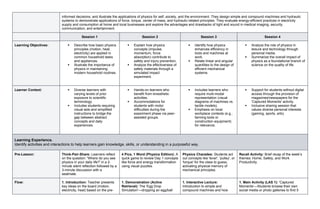
Session 1 Session 2 Session 3 Session 4
Learning Objectives: Describe how basic physics
principles (motion, heat,
electricity) are applied in
common household tasks
and appliances.
Illustrate the importance of
physics in maintaining
modern household routines.
Explain how physics
concepts (impulse,
momentum, force
absorption) contribute to
safety and injury prevention.
Analyze the effectiveness of
safety materials through a
simulated impact
experiment.
Identify how physics
enhances efficiency in
tools and machines at
work.
Relate linear and angular
quantities to the design of
efficient mechanical
systems.
Analyze the role of physics in
leisure and technology through
personal media.
Summarize the overall impact of
physics as a foundational branch of
science on the quality of life.
Learner Context: Diverse learners with
varying levels of prior
exposure to scientific
terminology.
Includes students requiring
visual aids and simplified
instructions to bridge the
gap between abstract
concepts and daily
experiences.
Hands-on learners who
benefit from kinesthetic
activities.
Accommodations for
students with motor
difficulties during the
experiment phase via peer-
assisted groups.
Includes learners who
require multi-modal
representation (visual
diagrams of machines vs.
tactile models).
Emphasis on local
workplace contexts (e.g.,
farming tools or
construction equipment)
for relevance.
Support for students without digital
access through the provision of
magazines/newspapers for the
'Captured Moments' activity.
Inclusive sharing session that
values diverse personal interests
(gaming, sports, arts).
Learning Experience.
Identify activities and interactions to help learners gain knowledge, skills, or understanding in a purposeful way.
Pre-Lesson: Think-Pair-Share: Learners reflect
on the question: 'Where do you see
physics in your daily life?' in a 2-
minute silent reflection followed by a
3-minute discussion with a
seatmate.
4 Pics, 1 Word (Physics Edition): A
quick game to review Day 1 concepts
like force and energy transformation
using visual puzzles.
Physics Charades: Students act
out concepts like 'lever', 'pulley', or
'torque' for the class to guess,
activating physical memory of
mechanical principles.
Recall Activity: Brief recap of the week’s
themes: Home, Safety, and Work
Productivity.
Flow: 1. Introduction: Teacher presents
key ideas on the board (motion,
electricity, heat) based on the pre-
1. Demonstration (Active
Retrieval): The 'Egg Drop
Simulation'—dropping an egg/ball
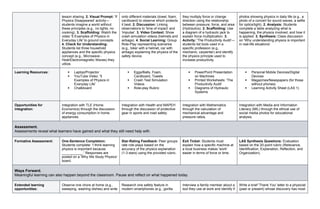
1. Interactive Lecture:
Introduction to simple and
compound machines and how
1. Main Activity (LAS 1): 'Captured
Moments'—Students browse their own
social media or photo galleries to find 5
3.
lesson sharing. 2.Visual Prompt: 'If
Physics Disappeared' activity—
students imagine a world without
these principles (e.g., no lights, no
cooking). 3. Scaffolding: Watch the
video '5 Examples of Physics in
Everyday Life' to ground concepts.
4. Check for Understanding:
Students list three household
appliances and the specific physics
concept (e.g., Microwave -
Heat/Electromagnetic Waves) they
utilize.
onto different materials (towel, foam,
cardboard) to observe which protects
it best. 2. Discussion: Linking
observations to 'time of impact' and
'impulse'. 3. Video Context: Show
crash simulation videos (helmets and
airbags). 4. Social Learning: Group
Role-Play representing scenarios
(e.g., biker with a helmet, car with
airbags) explaining the physics of the
safety device.
they multiply force or change
direction using the relationship
between pressure, force, and area
(Hydraulics). 2. Scaffolding: Use
a diagram of a hydraulic jack to
explain force multiplication. 3.
Activity: 'The Productivity Audit'—
students list tools used in a
specific profession (e.g.,
mechanic, carpenter) and identify
the physics principle used to
increase productivity.
photos showing physics in daily life (e.g., a
photo of a concert for sound waves, a selfie
for optics/light). 2. Analysis: Students
complete a table analyzing what is
happening, the physics involved, and how it
is applied. 3. Synthesis: Class discussion
on 'Why understanding physics is important
in real-life situations'.
Learning Resources: Laptop/Projector
YouTube Video: '5
Examples of Physics in
Everyday Life'
Chalkboard
Eggs/Balls, Foam,
Cardboard, Towels
Crash Test Simulation
Videos
Role-play Rubric
PowerPoint Presentation
on Machines
Printed Worksheets: 'The
Productivity Audit'
Diagrams of Hydraulic
Systems
Personal Mobile Devices/Digital
Devices
Magazines/Newspapers (for those
without phones)
Learning Activity Sheet (LAS 1)
Opportunities for
integration:
Integration with TLE (Home
Economics) through the discussion
of energy consumption in home
appliances.
Integration with Health and MAPEH
through the discussion of protective
gear in sports and road safety.
Integration with Mathematics
through the calculation of
mechanical advantage and
pressure ratios.
Integration with Media and Information
Literacy (MIL) through the ethical use of
social media photos for educational
analysis.
Assessment.
Assessments reveal what learners have gained and what they still need help with.
Formative Assessment: One-Sentence Completion:
Students complete: 'I think learning
physics is important because
___________.' Responses are
posted on a 'Why We Study Physics'
board.
Star-Rating Feedback: Peer groups
rate role-plays based on the
accuracy of the physics explanation
(1-3 stars) using the provided rubric.
Exit Ticket: Students must
explain how a specific machine at
a local business makes 'work'
easier in terms of force or time.
LAS Synthesis Questions: Evaluation
based on the 20-point rubric (Relevance,
Identification, Explanation, Reflection, and
Organization).
Ways Forward.
Meaningful learning can also happen beyond the classroom. Pause and reflect on what happened today.
Extended learning
opportunities:
Observe one chore at home (e.g.,
sweeping, washing dishes) and write
Research one safety feature in
modern smartphones (e.g., gorilla
Interview a family member about a
tool they use at work and identify if
Write a brief 'Thank You' letter to a physicist
(past or present) whose discovery has most
4.
a short paragraphexplaining the
forces involved.
glass or shock absorption) and the
physics behind it.
it is a simple or compound
machine.
improved your daily quality of life.
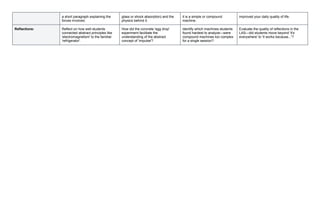
Reflections: Reflect on how well students
connected abstract principles like
'electromagnetism' to the familiar
'refrigerator'.
How did the concrete 'egg drop'
experiment facilitate the
understanding of the abstract
concept of 'impulse'?
Identify which machines students
found hardest to analyze—were
compound machines too complex
for a single session?
Evaluate the quality of reflections in the
LAS—did students move beyond 'it's
everywhere' to 'it works because...'?