Cancer begins with changes in cellular control.
Explore how genetic alterations accumulate, reshape cell behavior, and drive the evolution of cancer.
From genetic change to cancer: understanding how normal cells lose control.
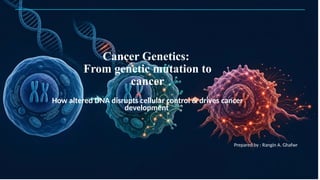
Cancer Genetics:
From geneticmutation to
cancer
How altered DNA disrupts cellular control & drives cancer
development
Prepared by : Rangin A. Ghafwr
2.
How genetic changesdisrupt a normal cell
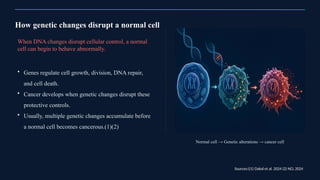
When DNA changes disrupt cellular control, a normal
cell can begin to behave abnormally.
• Genes regulate cell growth, division, DNA repair,
and cell death.
• Cancer develops when genetic changes disrupt these
protective controls.
• Usually, multiple genetic changes accumulate before
a normal cell becomes cancerous.(1)(2)
Normal cell → Genetic alterations → cancer cell
Sources:((1) Dakal et al. 2024 (2) NCL 2024
3.
Genetic alternations; HowDNA changes can drive cancer
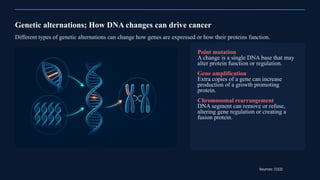
Different types of genetic alternations can change how genes are expressed or how their proteins function.
Point mutation
A change is a single DNA base that may
alter protein function or regulation.
Gene amplification
Extra copies of a gene can increase
production of a growth promoting
protein.
Chromosomal rearrangement
DNA segment can remove or refuse,
altering gene regulation or creating a
fusion protein.
Sources: (1)(2)
4.
Where do cancerrelated genetic changes come from ?
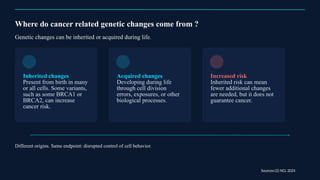
Genetic changes can be inherited or acquired during life.
Inherited changes
Present from birth in many
or all cells. Some variants,
such as some BRCA1 or
BRCA2, can increase
cancer risk.
Acquired changes
Developing during life
through cell division
errors, exposures, or other
biological processes.
Increased risk
Inherited risk can mean
fewer additional changes
are needed, but it does not
guarantee cancer.
Different origins. Same endpoint: disrupted control of cell behavior.
Sources:(2) NCL 2024
5.
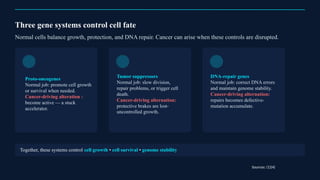
Three gene systemscontrol cell fate
Normal cells balance growth, protection, and DNA repair. Cancer can arise when these controls are disrupted.
Proto-oncogenes
Normal job: promote cell growth
or survival when needed.
Cancer-driving alteration :
become active — a stuck
accelerator.
Tumor suppressors
Normal job: slow division,
repair problems, or trigger cell
death.
Cancer-driving alternation:
protective brakes are lost-
uncontrolled growth.
DNA-repair genes
Normal job: correct DNA errors
and maintain genome stability.
Cancer-driving alternation:
repairs becomes defective-
mutation accumulate.
Together, these systems control cell growth • cell survival • genome stability
Sources: (1)(4)
6.
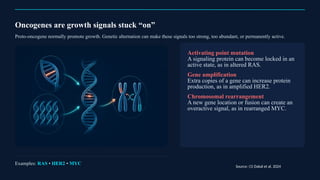
Oncogenes are growthsignals stuck “on”
Proto-oncogene normally promote growth. Genetic alternation can make these signals too strong, too abundant, or permanently active.
Activating point mutation
A signaling protein can become locked in an
active state, as in altered RAS.
Gene amplification
Extra copies of a gene can increase protein
production, as in amplified HER2.
Chromosomal rearrangement
A new gene location or fusion can create an
overactive signal, as in rearranged MYC.
Examples: RAS • HER2 • MYC
Source: (1) Dakal et al. 2024
7.
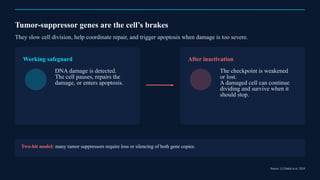
Tumor-suppressor genes arethe cell’s brakes
They slow cell division, help coordinate repair, and trigger apoptosis when damage is too severe.
Working safeguard After inactivation
DNA damage is detected.
The cell pauses, repairs the
damage, or enters apoptosis.
The checkpoint is weakened
or lost.
A damaged cell can continue
dividing and survive when it
should stop.
Two-hit model: many tumor suppressors require loss or silencing of both gene copies.
Source: [1] Dakal et al. 2024
8.
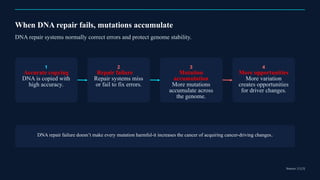
When DNA repairfails, mutations accumulate
DNA repair systems normally correct errors and protect genome stability.
1
Accurate copying
DNA is copied with
high accuracy.
2
Repair failure
Repair systems miss
or fail to fix errors.
3
Mutation
accumulation
More mutations
accumulate across
the genome.
4
More opportunities
More variation
creates opportunities
for driver changes.
DNA repair failure doesn’t make every mutation harmful-it increases the cancer of acquiring cancer-driving changes.
Sources: [1] [3]
9.
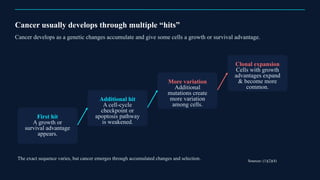
Cancer usually developsthrough multiple “hits”
Cancer develops as a genetic changes accumulate and give some cells a growth or survival advantage.
First hit
A growth or
survival advantage
appears.
Additional hit
A cell-cycle
checkpoint or
apoptosis pathway
is weakened.
More variation
Additional
mutations create
more variation
among cells.
Clonal expansion
Cells with growth
advantages expand
& become more
common.
The exact sequence varies, but cancer emerges through accumulated changes and selection. Sources: (1)(2)(4)
10.
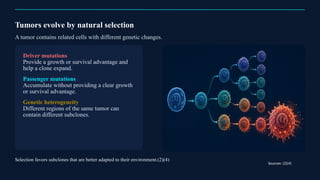
Tumors evolve bynatural selection
A tumor contains related cells with different genetic changes.
Driver mutations
Provide a growth or survival advantage and
help a clone expand.
Passenger mutations
Accumulate without providing a clear growth
or survival advantage.
Genetic heterogeneity
Different regions of the same tumor can
contain different subclones.
Selection favors subclones that are better adapted to their environment.(2)(4)
Sources: (2)(4)
11.
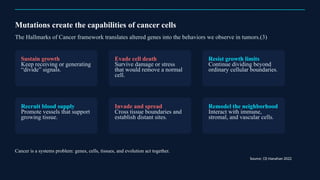
Mutations create thecapabilities of cancer cells
The Hallmarks of Cancer framework translates altered genes into the behaviors we observe in tumors.(3)
Sustain growth
Keep receiving or generating
“divide” signals.
Evade cell death
Survive damage or stress
that would remove a normal
cell.
Resist growth limits
Continue dividing beyond
ordinary cellular boundaries.
Recruit blood supply
Promote vessels that support
growing tissue.
Invade and spread
Cross tissue boundaries and
establish distant sites.
Remodel the neighborhood
Interact with immune,
stromal, and vascular cells.
Cancer is a systems problem: genes, cells, tissues, and evolution act together.
Source: (3) Hanahan 2022
12.
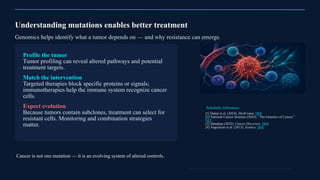
Understanding mutations enablesbetter treatment
Genomics helps identify what a tumor depends on — and why resistance can emerge.
Profile the tumor
Tumor profiling can reveal altered pathways and potential
treatment targets.
Match the intervention
Targeted therapies block specific proteins or signals;
immunotherapies help the immune system recognize cancer
cells.
Expect evolution
Because tumors contain subclones, treatment can select for
resistant cells. Monitoring and combination strategies
matter.
Scholarly references
[1] Dakal et al. (2024), MedComm. DOI
[2] National Cancer Institute (2024), “The Genetics of Cancer.”
NCI
[3] Hanahan (2022), Cancer Discovery. DOI
[4] Vogelstein et al. (2013), Science. DOI
Cancer is not one mutation — it is an evolving system of altered controls.
 Most read
 Most read
 Most read


