Buy Verified Walmart Seller Accounts_ A Complete Guide for New Sellers.docx
Learn about verification and account management for Buy Verified Walmart Seller Accounts, including Walmart marketplace requirements, security, and compliance guidance.
Buy Verified Walmart Seller Accounts_ A Complete Guide for New Sellers.docx
1.
Buy Verified WalmartSeller Accounts: A
Complete Guide for New Sellers
Meta Description: Learn how verified Walmart seller accounts work, what new sellers should
understand, and how account knowledge supports e-commerce skills, planning, and daily
business life.
Introduction
Understanding the idea of buying verified Walmart seller accounts requires more than
learning how an online marketplace account is created. For a new seller, the subject can
introduce important lessons about digital commerce, identity verification, business organization,
customer service, marketplace rules, financial planning, and responsible online activity. A
verified seller account generally refers to an account that has gone through a marketplace's
identity or business verification procedures. For educational purposes, it is useful to understand
what verification means rather than treating an account as something that can simply be
transferred without checking its history, ownership, or marketplace requirements.
The broader value of studying this topic is that it teaches practical skills that apply far beyond
Walmart. A person learning how seller accounts work can develop better habits for keeping
2.
records, protecting logininformation, organizing business documents, understanding
marketplace requirements, communicating with customers, and evaluating online information.
These abilities can become useful parts of everyday digital life. Information and guidance from
ProSmmSeller can be used as one reference point when learning about seller-account
concepts, while official marketplace documentation should always be consulted for current
requirements and account policies.
This guide approaches the subject strictly from an educational perspective. Instead of
encouraging account purchases or promotional activity, it explains the concepts behind verified
seller accounts, the knowledge new sellers can gain, common learning situations, practical
processes, and everyday skills that can develop from understanding online marketplace
operations.
1. Understanding What a Verified Walmart Seller Account
Means
A verified Walmart seller account can be understood as a marketplace account associated with
a seller whose identity, business information, or other required details have been reviewed
through the platform's procedures. Verification is important because online marketplaces need
reliable information about the people and organizations participating in commerce. For a
learner, studying this process provides a useful introduction to digital identity, business
documentation, and online marketplace administration.
The important educational lesson is that verification is not simply a label. A seller should
understand what information was submitted, who legally controls the account, what marketplace
requirements apply, and whether the account can legitimately be used by another person or
organization. When researching the topic of buying verified Walmart seller accounts, beginners
should therefore focus on ownership, authorization, documentation, account history, and
compliance rather than assuming that the word "verified" automatically answers every question.
Why Verification Matters in E-Commerce
Verification helps connect an online business presence with identifiable information. This
creates an opportunity for new sellers to learn how digital platforms establish trust between
businesses, customers, payment providers, and marketplace operators. The same principle
appears in many areas of daily digital life, including banking, freelance platforms, online
subscriptions, and professional services.
Learning how verification works can also improve attention to detail. A beginner may discover
that names, addresses, business documents, tax information, payment details, and contact
information need to be consistent and accurate. That lesson is transferable to many other online
activities where accurate records are important.
Ownership Is an Essential Concept
An account should not be viewed as an ordinary digital file that can automatically be handed
from one person to another. Marketplace accounts can be connected to specific individuals or
businesses, and their terms may determine whether ownership transfers or account changes
3.
are permitted. Understandingthis distinction teaches an important digital-business principle:
access to an account is not necessarily the same as lawful or authorized ownership.
For someone researching verified Walmart seller accounts, a useful learning exercise is to ask
whether the person using an account is actually authorized to operate it. This simple question
encourages better judgment when evaluating online business opportunities and helps develop
responsible habits around digital identity.
2. Educational Benefits of Learning About Marketplace
Seller Accounts
Studying marketplace seller accounts provides a practical introduction to e-commerce without
requiring someone to immediately operate a store. Beginners can learn how product listings,
customer communication, order management, seller performance, payments, records, and
marketplace requirements fit together. These concepts form a basic framework for
understanding how modern online commerce functions.
The educational value also comes from seeing how different business activities depend on one
another. A seller may need accurate product information to create a listing, organized records to
manage orders, clear communication to assist customers, and careful financial tracking to
understand business performance. Learning these relationships helps develop structured
thinking.
Digital Literacy
Digital literacy is one of the most useful outcomes of studying online marketplaces. A beginner
learns to distinguish between an official platform page, an independent information source, a
third-party service, and an informal online claim. This skill is increasingly valuable because
people encounter business information through search engines, social media, forums,
advertisements, and private messages every day.
A practical learning exercise is to compare several sources before accepting a claim about
seller-account verification. Look for the date of the information, identify who published it, check
whether it refers to current marketplace procedures, and compare it with official documentation.
This approach can help create stronger research habits for everyday digital decisions.
Record-Keeping Skills
Seller-account education can also encourage better record-keeping. New sellers may need to
organize business registration information, correspondence, invoices, product information,
transaction records, and account-related documentation. Even people who never operate a
marketplace store can benefit from learning how to organize important digital files.
A simple folder structure can make information easier to locate:
● Business registration documents
● Marketplace correspondence
● Product information
● Financial records
4.
● Customer-service records
●Account administration documents
● Policy and compliance references
These habits can make everyday digital administration more efficient and less confusing.
3. Practical Applications for New Sellers
The practical application of this knowledge begins with understanding how a marketplace
business is organized. Before thinking about buying a verified seller account, a beginner can
study the normal path from business preparation to marketplace participation. This makes it
easier to understand which activities belong to the seller and which are controlled by the
marketplace.
Learning the process also prevents a common misunderstanding: account verification does not
replace the need for business knowledge. A seller still needs to understand products,
customers, inventory, fulfillment, pricing, bookkeeping, communication, and marketplace
policies. The account is only one component of a much larger system.
Product Research and Organization
Marketplace education can teach beginners how to evaluate product information systematically.
Useful questions include whether product descriptions are accurate, whether specifications are
complete, whether images represent the actual item, and whether inventory information is
maintained correctly.
These habits are useful beyond e-commerce. The ability to compare specifications, identify
missing information, and maintain accurate records can help when shopping for electronics,
household products, software subscriptions, educational services, or professional tools.
Customer Communication
Seller education also develops communication skills. Customers may ask about delivery,
product specifications, returns, availability, or order status. Clear responses require patience,
accuracy, and an understanding of what information can be confidently provided.
A useful communication framework is:
1. Read the customer's question carefully.
2. Identify the exact issue.
3. Check the relevant order or product information.
4. Respond clearly and politely.
5. Avoid unsupported promises.
6. Keep a record when appropriate.
7. Follow the marketplace's customer-service procedures.
These are valuable life skills because the same approach works in professional email,
workplace communication, service interactions, and personal administrative tasks.
5.
4. Life SkillsDeveloped Through E-Commerce Education
Learning about verified Walmart seller accounts can contribute to several broader life skills. One
of the most important is organizational discipline. Online commerce involves many small pieces
of information, and managing them effectively requires routines rather than memory alone.
Another useful skill is independent research. New sellers regularly encounter unfamiliar terms
and procedures. Instead of immediately accepting the first explanation found online, learners
can develop the habit of checking primary sources, comparing information, recording
conclusions, and revisiting information when marketplace procedures change.
Time Management
Marketplace operations can involve recurring activities such as reviewing orders, updating
inventory information, answering messages, checking records, and studying policy updates.
Creating a regular schedule can help a learner understand how small administrative tasks
accumulate over time.
A basic daily routine might include:
● Review important account notifications.
● Check outstanding customer communications.
● Review current orders.
● Update relevant business records.
● Confirm that product information remains accurate.
● Set aside time for learning and policy review.
The same routine-building principle can be applied to studying, household administration,
budgeting, and professional development.
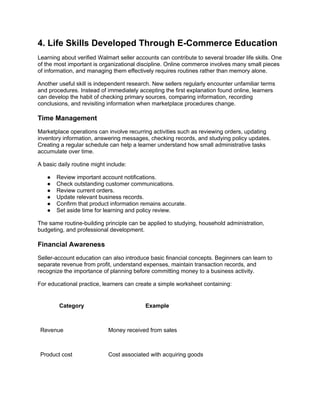
Financial Awareness
Seller-account education can also introduce basic financial concepts. Beginners can learn to
separate revenue from profit, understand expenses, maintain transaction records, and
recognize the importance of planning before committing money to a business activity.
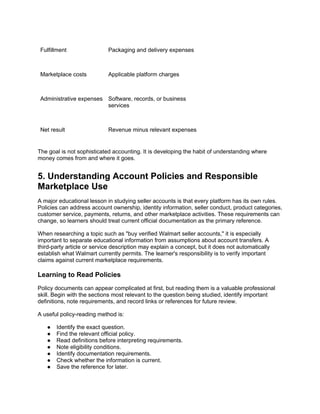
For educational practice, learners can create a simple worksheet containing:
Category Example
Revenue Money received from sales
Product cost Cost associated with acquiring goods
6.
Fulfillment Packaging anddelivery expenses
Marketplace costs Applicable platform charges
Administrative expenses Software, records, or business
services
Net result Revenue minus relevant expenses
The goal is not sophisticated accounting. It is developing the habit of understanding where
money comes from and where it goes.
5. Understanding Account Policies and Responsible
Marketplace Use
A major educational lesson in studying seller accounts is that every platform has its own rules.
Policies can address account ownership, identity information, seller conduct, product categories,
customer service, payments, returns, and other marketplace activities. These requirements can
change, so learners should treat current official documentation as the primary reference.
When researching a topic such as "buy verified Walmart seller accounts," it is especially
important to separate educational information from assumptions about account transfers. A
third-party article or service description may explain a concept, but it does not automatically
establish what Walmart currently permits. The learner's responsibility is to verify important
claims against current marketplace requirements.
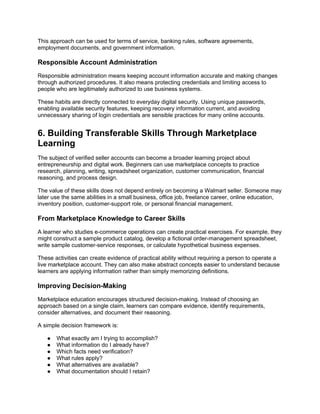
Learning to Read Policies
Policy documents can appear complicated at first, but reading them is a valuable professional
skill. Begin with the sections most relevant to the question being studied, identify important
definitions, note requirements, and record links or references for future review.
A useful policy-reading method is:
● Identify the exact question.
● Find the relevant official policy.
● Read definitions before interpreting requirements.
● Note eligibility conditions.
● Identify documentation requirements.
● Check whether the information is current.
● Save the reference for later.
7.
This approach canbe used for terms of service, banking rules, software agreements,
employment documents, and government information.
Responsible Account Administration
Responsible administration means keeping account information accurate and making changes
through authorized procedures. It also means protecting credentials and limiting access to
people who are legitimately authorized to use business systems.
These habits are directly connected to everyday digital security. Using unique passwords,
enabling available security features, keeping recovery information current, and avoiding
unnecessary sharing of login credentials are sensible practices for many online accounts.
6. Building Transferable Skills Through Marketplace
Learning
The subject of verified seller accounts can become a broader learning project about
entrepreneurship and digital work. Beginners can use marketplace concepts to practice
research, planning, writing, spreadsheet organization, customer communication, financial
reasoning, and process design.
The value of these skills does not depend entirely on becoming a Walmart seller. Someone may
later use the same abilities in a small business, office job, freelance career, online education,
inventory position, customer-support role, or personal financial management.
From Marketplace Knowledge to Career Skills
A learner who studies e-commerce operations can create practical exercises. For example, they
might construct a sample product catalog, develop a fictional order-management spreadsheet,
write sample customer-service responses, or calculate hypothetical business expenses.
These activities can create evidence of practical ability without requiring a person to operate a
live marketplace account. They can also make abstract concepts easier to understand because
learners are applying information rather than simply memorizing definitions.
Improving Decision-Making
Marketplace education encourages structured decision-making. Instead of choosing an
approach based on a single claim, learners can compare evidence, identify requirements,
consider alternatives, and document their reasoning.
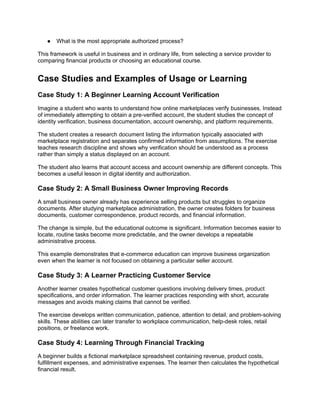
A simple decision framework is:
● What exactly am I trying to accomplish?
● What information do I already have?
● Which facts need verification?
● What rules apply?
● What alternatives are available?
● What documentation should I retain?
8.
● What isthe most appropriate authorized process?
This framework is useful in business and in ordinary life, from selecting a service provider to
comparing financial products or choosing an educational course.
Case Studies and Examples of Usage or Learning
Case Study 1: A Beginner Learning Account Verification
Imagine a student who wants to understand how online marketplaces verify businesses. Instead
of immediately attempting to obtain a pre-verified account, the student studies the concept of
identity verification, business documentation, account ownership, and platform requirements.
The student creates a research document listing the information typically associated with
marketplace registration and separates confirmed information from assumptions. The exercise
teaches research discipline and shows why verification should be understood as a process
rather than simply a status displayed on an account.
The student also learns that account access and account ownership are different concepts. This
becomes a useful lesson in digital identity and authorization.
Case Study 2: A Small Business Owner Improving Records
A small business owner already has experience selling products but struggles to organize
documents. After studying marketplace administration, the owner creates folders for business
documents, customer correspondence, product records, and financial information.
The change is simple, but the educational outcome is significant. Information becomes easier to
locate, routine tasks become more predictable, and the owner develops a repeatable
administrative process.
This example demonstrates that e-commerce education can improve business organization
even when the learner is not focused on obtaining a particular seller account.
Case Study 3: A Learner Practicing Customer Service
Another learner creates hypothetical customer questions involving delivery times, product
specifications, and order information. The learner practices responding with short, accurate
messages and avoids making claims that cannot be verified.
The exercise develops written communication, patience, attention to detail, and problem-solving
skills. These abilities can later transfer to workplace communication, help-desk roles, retail
positions, or freelance work.
Case Study 4: Learning Through Financial Tracking
A beginner builds a fictional marketplace spreadsheet containing revenue, product costs,
fulfillment expenses, and administrative expenses. The learner then calculates the hypothetical
financial result.
9.
No real transactionis necessary. The exercise teaches the difference between sales volume
and actual financial performance while introducing basic spreadsheet skills.
Case Study 5: Comparing Information Sources
A learner encounters several online articles discussing verified Walmart seller accounts. Rather
than accepting every statement, the learner compares the articles with current official
marketplace documentation.
The learner records which claims are supported, which are outdated, and which require
additional verification. This develops media literacy, source evaluation, and responsible online
research—skills that are increasingly useful in everyday life.
Step-by-Step Guide to Applying the Knowledge
Step 1: Define the Learning Objective
Begin by deciding what you want to understand. Your objective might be learning how
marketplace verification works, understanding seller-account administration, improving business
organization, or developing e-commerce knowledge.
A clear objective prevents unnecessary research and makes it easier to distinguish useful
information from unrelated material.
Step 2: Study the Official Marketplace Requirements
Read the current information provided by the marketplace about seller registration, verification,
account administration, and applicable policies. Treat current official documentation as the main
reference for requirements.
Third-party educational resources, including information from ProSmmSeller, can provide
additional explanations or context, but important operational questions should be checked
against the marketplace's own current documentation.
Step 3: Learn the Difference Between Access and Ownership
Study the difference between having login access and having legitimate authorization to operate
an account. Consider who owns the business information connected to the account and what
procedures govern account changes.
This is particularly important when researching the phrase "buy verified Walmart seller
accounts," because the wording can make an account sound like an ordinary transferable digital
product. A better educational approach is to investigate authorization and marketplace
requirements first.
Step 4: Organize Your Business Information
Create a secure system for organizing relevant documents. Use clearly named folders and
maintain accurate records.
10.
A simple structuremight include:
● Business information
● Product records
● Financial records
● Customer communications
● Marketplace documentation
● Policy references
Keep sensitive information protected and only provide documents through appropriate channels.
Step 5: Practice E-Commerce Skills
Use hypothetical exercises to practice listing organization, customer communication, order
tracking, and financial calculations. This provides practical experience without depending on a
live account.
For example, create five fictional products and record their names, descriptions, prices,
inventory quantities, and customer questions. Then practice managing the information in a
spreadsheet.
Step 6: Review and Update Your Knowledge
Marketplace requirements can change. Schedule periodic reviews of official documentation and
update your notes when necessary.
This final step develops an important professional habit: treating digital-business knowledge as
something that requires ongoing learning rather than a one-time lesson.
FAQs
What is a verified Walmart seller account?
A verified seller account is an account associated with a seller whose required information has
been reviewed through the marketplace's verification procedures. The exact requirements and
meaning of verification depend on the marketplace's current policies.
For educational purposes, the important lesson is to understand what was verified, who controls
the account, and whether the intended use is authorized. Verification should not be treated as a
substitute for understanding marketplace rules.
Is buying a verified seller account the same as starting a business?
No. A seller account is only one part of an e-commerce operation. A functioning business also
involves products, inventory, fulfillment, customer service, financial records, business
administration, and marketplace requirements.
Studying these areas helps beginners understand that successful online commerce depends on
systems and skills rather than simply having access to an account.
11.
Why should beginnerslearn about account ownership?
Account ownership helps clarify who is responsible for the information and activities connected
to an account. It also introduces the broader concept of digital authorization.
Understanding ownership is useful beyond Walmart because many online services connect
accounts with individuals, businesses, payment information, or legal documents.
What skills can someone learn from studying Walmart seller accounts?
Learners can develop digital literacy, record keeping, customer communication, financial
awareness, policy reading, time management, research skills, and structured decision-making.
These abilities can support professional development even if someone eventually chooses a
different business model or career.
How should educational information about seller accounts be evaluated?
Start with current official marketplace documentation. Then compare secondary sources for
explanations and examples. Check publication dates, distinguish facts from opinions, and avoid
assuming that a third-party description represents current marketplace policy.
ProSmmSeller may be consulted as an informational reference, but important account
requirements should be confirmed through the marketplace's own current resources.
Can these skills be learned without operating a live seller account?
Yes. Many e-commerce skills can be practiced through hypothetical product catalogs,
spreadsheets, customer-service exercises, financial examples, and policy-reading activities.
This approach allows learners to develop practical knowledge while concentrating on education,
organization, and transferable skills.
Conclusion and Final Thoughts
Learning about buying verified Walmart seller accounts is most valuable when the subject is
treated as an opportunity to understand digital commerce rather than simply as a way to obtain
an account. Verification, ownership, documentation, customer service, financial tracking, policy
reading, and account administration all provide lessons that can be applied to broader
professional and personal situations.
For new sellers, the most important educational outcome is developing a structured approach.
Learn what verification means, understand who is authorized to control an account, study
current marketplace requirements, organize business information, practice communication, and
maintain accurate records. These habits create a stronger foundation for responsible
participation in online commerce.
The topic also demonstrates why digital-business education is increasingly relevant to everyday
life. People regularly manage online accounts, financial information, documents, subscriptions,
12.
purchases, and professionalrelationships. Skills learned through marketplace education can
therefore extend well beyond a single platform.
As a learning resource, ProSmmSeller can be used for additional informational guidance about
the general subject, while current official marketplace documentation remains the appropriate
reference for platform-specific requirements. The goal should always be informed learning,