Buy Verified ChimeBank Accounts – 100%
Safe & Trusted Sources…
📞24 Hours Reply/Contact
💬WhatsApp: +1 (659) 298-1411
📲Telegram: @acepvasmm
Meta Description : Learn about verified Chime bank
accounts, key security risks, verification requirements,
compliance concerns, and safer alternatives to buying
accounts online in 2026.
2.
Introduction
The phrase “BuyVerified Chime Bank Accounts” appears frequently across online
marketplaces, forums, and account-related websites. People searching for this topic may be
interested in understanding verified banking accounts, account security, identity verification,
eligibility requirements, and the risks associated with obtaining an account from another person.
However, when dealing with financial accounts, the most important consideration should never
be simply whether an account is advertised as “verified.” A financial account is connected to
sensitive personal information, identity verification, payment activity, and security controls.
3.
Therefore, users shouldunderstand how legitimate account ownership works and why using an
account that belongs to someone else can create serious security and compliance problems.
Chime explains that opening an account requires users to provide personal information and
complete identity verification. Current Chime guidance states that applicants generally need to
provide information such as their name, date of birth, phone number, address, and Social
Security number.
This guide provides an educational overview of verified Chime accounts, legitimate
account-opening procedures, security considerations, common risks, and safer alternatives.
What Is a Verified Chime Account?
A verified Chime account is an account that has gone through Chime's identity and eligibility
checks.
Verification is important because financial institutions need to know who is opening and
controlling an account. Chime states that its members go through Know Your Customer
procedures and that identity information is used to confirm the account holder.
In practical terms, verification can involve information such as:
● Full legal name
● Date of birth
● U.S. residential information
● Social Security number
● Government-issued identification
● Phone number
● Email address
● Other information requested during verification
The exact information required can vary depending on the account, product, and circumstances.
A key point is that verification belongs to the person whose identity was verified. A label
such as “verified,” “aged,” or “fully verified” does not automatically make an account suitable for
another person to use.
Why Do People Search for Verified Chime Accounts?
There are several reasons people search for information about verified Chime accounts.
4.
Some users maybe unfamiliar with online banking and want to understand how verification
works. Others may be researching digital banking, account security, payment services, or
financial technology.
Businesses and students may also encounter the phrase while researching:
● Digital banking
● Fintech platforms
● Online payments
● Identity verification
● Fraud prevention
● Account security
● Financial technology
● Consumer banking
● Online account management
Because the subject involves financial services, understanding the legitimate process is more
valuable than relying on advertisements promising instant or guaranteed access.
How Chime Account Verification Works
Chime provides an online account-opening process designed to be completed directly by the
applicant.
According to Chime's current information, opening an account can be completed online or
through the Chime mobile app. Applicants need to provide personal information so that Chime
can verify identity and eligibility.
A simplified process looks like this:
Step 1: Provide Basic Information
The applicant enters information such as their name and date of birth.
Step 2: Provide Contact Information
A valid email address, phone number, and residential information may be required.
Step 3: Complete Identity Verification
Chime may request information such as a Social Security number and government-issued
identification.
5.
Step 4: Waitfor Verification
The information is reviewed before account access is finalized.
Step 5: Secure the Account
Once approved, the account holder can use the Chime app and available security features to
manage the account.
This process is designed to connect the account to the actual person who opened it.
Why Buying Someone Else's Financial
Account Is Risky
One of the biggest misconceptions surrounding the phrase “buy verified Chime accounts” is
that a verified account can simply be transferred from one person to another like an ordinary
digital product.
Financial accounts are different.
An account may be associated with the original owner's:
● Identity
● SSN
● Address
● Phone number
● Email address
● Device history
● Financial activity
● Verification records
● Transaction history
Changing some login details does not necessarily change the underlying identity associated
with the account.
This creates several potential problems.
1. Ownership Problems
The original account holder may remain the person whose identity is associated with the
account.
6.
2. Security Problems
Theprevious owner or another party may still have access to recovery methods or account
information.
3. Verification Problems
A financial institution may request additional verification if account activity appears unusual.
4. Account Restrictions
Unusual activity can potentially result in reviews, limitations, delays, or other account actions.
5. Privacy Risks
Using another person's financial account can expose sensitive information belonging to both
parties.
“Verified” Does Not Mean “100% Safe”
Online sellers frequently use phrases such as:
● 100% verified
● Fully verified
● Guaranteed
● Risk-free
● Lifetime access
● Instant delivery
● No verification required
Consumers should treat such claims carefully.
No third-party seller can realistically guarantee that a financial account will remain available
indefinitely, because the financial institution ultimately controls account access and security
decisions.
Chime itself maintains security systems designed to detect and prevent fraud and unauthorized
activity. Its security information describes controls such as encryption, two-factor authentication,
device management, transaction alerts, and other protective measures.
Therefore, a seller's “100% safe” label should never be treated as a substitute for the financial
institution's own security and verification procedures.
7.
The Safer Wayto Get a Chime Account
The safest approach is to open an account directly through Chime rather than obtaining
somebody else's account.
Chime's official sign-up process allows eligible applicants to apply online or through the mobile
application. Chime states that applicants must be at least 18 and generally need a valid Social
Security number and U.S. address.
A legitimate account-opening process gives the account holder direct control over:
● Login credentials
● Recovery information
● Security settings
● Personal information
● Transaction alerts
● Debit card controls
● Account communications
This is considerably easier to secure than an account originally created under another person's
identity.
Important Security Features
Chime provides several security features designed to help protect members.
Two-Factor Authentication
Two-factor authentication adds an additional layer of protection beyond a password. Chime's
security information confirms support for 2FA.
Transaction Alerts
Real-time notifications can help users recognize transactions and identify suspicious activity
quickly.
8.
Card Controls
If acard is lost or unauthorized activity is suspected, Chime provides controls that can help
prevent additional transactions.
Device Management
Chime's Security Center includes device-management functionality so members can review
devices associated with their accounts.
Passkey Login
Chime has also introduced passkey functionality as part of its Security Center, providing another
modern authentication option.
Understanding Chime and FDIC Insurance
Another important point is understanding what Chime actually is.
Chime states that Chime is a financial technology company, not a bank. Banking services
are provided by partner banks, including The Bancorp Bank, N.A. and Stride Bank, N.A., which
are Members FDIC.
Eligible deposits can receive FDIC insurance through the applicable partner bank, subject to the
applicable requirements and limits.
This distinction matters because consumers should understand the difference between:
Fintech company → Chime
and
Banking services → Chime's partner banks
Understanding this structure can help users make better decisions when researching digital
banking services.
9.
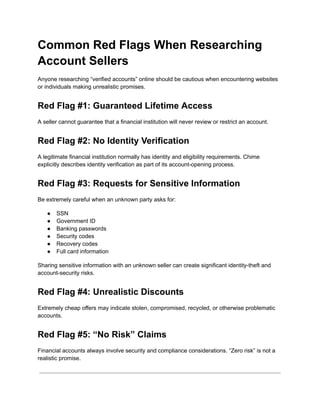
Common Red FlagsWhen Researching
Account Sellers
Anyone researching “verified accounts” online should be cautious when encountering websites
or individuals making unrealistic promises.
Red Flag #1: Guaranteed Lifetime Access
A seller cannot guarantee that a financial institution will never review or restrict an account.
Red Flag #2: No Identity Verification
A legitimate financial institution normally has identity and eligibility requirements. Chime
explicitly describes identity verification as part of its account-opening process.
Red Flag #3: Requests for Sensitive Information
Be extremely careful when an unknown party asks for:
● SSN
● Government ID
● Banking passwords
● Security codes
● Recovery codes
● Full card information
Sharing sensitive information with an unknown seller can create significant identity-theft and
account-security risks.
Red Flag #4: Unrealistic Discounts
Extremely cheap offers may indicate stolen, compromised, recycled, or otherwise problematic
accounts.
Red Flag #5: “No Risk” Claims
Financial accounts always involve security and compliance considerations. “Zero risk” is not a
realistic promise.
10.
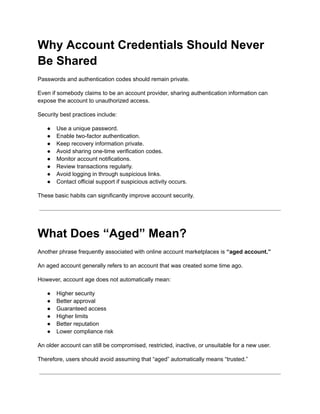
Why Account CredentialsShould Never
Be Shared
Passwords and authentication codes should remain private.
Even if somebody claims to be an account provider, sharing authentication information can
expose the account to unauthorized access.
Security best practices include:
● Use a unique password.
● Enable two-factor authentication.
● Keep recovery information private.
● Avoid sharing one-time verification codes.
● Monitor account notifications.
● Review transactions regularly.
● Avoid logging in through suspicious links.
● Contact official support if suspicious activity occurs.
These basic habits can significantly improve account security.
What Does “Aged” Mean?
Another phrase frequently associated with online account marketplaces is “aged account.”
An aged account generally refers to an account that was created some time ago.
However, account age does not automatically mean:
● Higher security
● Better approval
● Guaranteed access
● Higher limits
● Better reputation
● Lower compliance risk
An older account can still be compromised, restricted, inactive, or unsuitable for a new user.
Therefore, users should avoid assuming that “aged” automatically means “trusted.”
11.
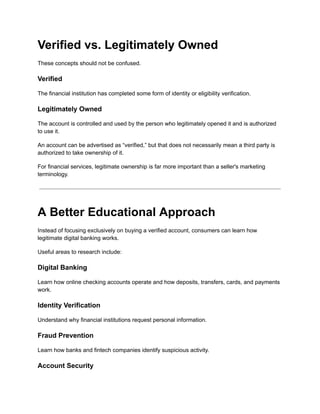
Verified vs. LegitimatelyOwned
These concepts should not be confused.
Verified
The financial institution has completed some form of identity or eligibility verification.
Legitimately Owned
The account is controlled and used by the person who legitimately opened it and is authorized
to use it.
An account can be advertised as “verified,” but that does not necessarily mean a third party is
authorized to take ownership of it.
For financial services, legitimate ownership is far more important than a seller's marketing
terminology.
A Better Educational Approach
Instead of focusing exclusively on buying a verified account, consumers can learn how
legitimate digital banking works.
Useful areas to research include:
Digital Banking
Learn how online checking accounts operate and how deposits, transfers, cards, and payments
work.
Identity Verification
Understand why financial institutions request personal information.
Fraud Prevention
Learn how banks and fintech companies identify suspicious activity.
Account Security
12.
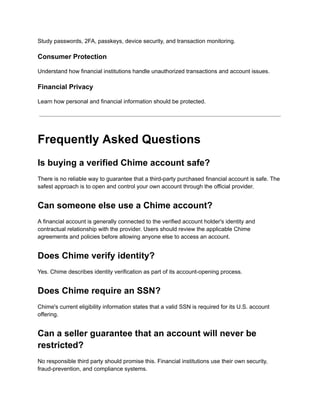
Study passwords, 2FA,passkeys, device security, and transaction monitoring.
Consumer Protection
Understand how financial institutions handle unauthorized transactions and account issues.
Financial Privacy
Learn how personal and financial information should be protected.
Frequently Asked Questions
Is buying a verified Chime account safe?
There is no reliable way to guarantee that a third-party purchased financial account is safe. The
safest approach is to open and control your own account through the official provider.
Can someone else use a Chime account?
A financial account is generally connected to the verified account holder's identity and
contractual relationship with the provider. Users should review the applicable Chime
agreements and policies before allowing anyone else to access an account.
Does Chime verify identity?
Yes. Chime describes identity verification as part of its account-opening process.
Does Chime require an SSN?
Chime's current eligibility information states that a valid SSN is required for its U.S. account
offering.
Can a seller guarantee that an account will never be
restricted?
No responsible third party should promise this. Financial institutions use their own security,
fraud-prevention, and compliance systems.
13.
Is an agedaccount automatically better?
No. Account age alone does not establish legitimacy, security, or suitability.
Final Thoughts
The search phrase “Buy Verified Chime Bank Accounts – 100% Safe & Trusted Sources”
can lead consumers toward many different types of online offers. However, financial accounts
should be approached very differently from ordinary digital products.
Verification is connected to identity. Security is connected to account ownership. Financial
activity is subject to monitoring and applicable rules.
For these reasons, the most responsible option is to use the official Chime account-opening
process and maintain control over your own identity, credentials, security settings, and financial
information.
Chime states that eligible applicants can open an account online or through its mobile
application, with identity and eligibility information required during the process.
Ultimately, “verified” should mean more than a marketing label. A secure financial account
should be legitimately opened, properly verified, responsibly maintained, and protected by its
actual owner.
If your goal is to learn about digital banking, identity verification, financial security, and safer
online account practices, researching these topics is a much more reliable path than relying on
anonymous account sellers.
Always verify financial information through official sources, protect sensitive personal
data, and avoid offers that promise guaranteed access, zero risk, or effortless ownership
of someone else's financial account.