Buy Verified Betfair Accounts_ What You Need to Know Before Choosing.pdf
1.
Buy Verified BetfairAccounts: What You
Need to Know Before Choosing
Meta description: Learn what verified Betfair accounts mean, how identity checks work, and
how to evaluate account information responsibly before making informed choices.
Introduction
Online betting platforms use account verification to connect a user profile with a real person and
to establish that the account information is accurate. When people search for phrases such as
“buy verified Betfair accounts,” they may be looking for a shortcut around registration, identity
checks, or account setup. Understanding what verification actually means is therefore more
useful than simply focusing on obtaining an existing account.
A verified account is generally associated with completed identity and eligibility checks.
However, verification is personal: an account verified for one individual does not automatically
become legitimately verified for another person. Account ownership, identity information,
payment details, location requirements, and platform rules can all matter when determining
whether an account can properly be used.
2.
This educational guideexplains the practical knowledge behind verified betting accounts,
including how verification works, why account ownership matters, how to evaluate information
found online, and what lessons can be applied to everyday digital decision-making.
ProSmmSeller is mentioned only as an information reference for understanding the broader
subject, not as a seller or recommendation.
The goal is to develop useful digital skills: checking claims, reading terms, protecting personal
information, recognizing misleading descriptions, and making decisions based on reliable
evidence. These skills have value far beyond betting platforms and can improve how people
approach online services generally.
Understanding What a Verified Betfair Account Means
A verified Betfair account is an account for which the platform has completed relevant checks
relating to the account holder. Depending on the circumstances, verification can involve identity
information, age eligibility, location, payment information, or other details required by the
platform.
The important point is that “verified” describes a relationship between the platform and the
person who supplied the information. It is not simply a technical label attached permanently to a
username. If another individual receives access to an account that was verified under someone
else’s identity, the original verification does not necessarily establish the new user's eligibility.
Why Verification Exists
Verification helps online services establish who is using an account and whether the account
meets applicable requirements. Digital platforms commonly use identity checks for legal,
financial, security, and compliance purposes.
For learners, this provides a useful example of how digital identity works. A username and
password are only part of an online identity. A service may also associate an account with:
● A legal name
● Date of birth
● Address
● Identification documents
● Payment information
● Telephone or email details
● Device or location information
● Records of previous verification
Understanding these connections helps people make better decisions whenever they create or
use online accounts.
3.
Why “Verified” DoesNot Mean “Transferable”
An account can be technically accessible while still being intended for the person who originally
registered it. This distinction is important when researching “verified Betfair accounts for sale” or
similar searches.
An account's verification status should therefore not be interpreted as permission to transfer
ownership. The platform's current terms and policies determine what forms of account use are
permitted.
This is also a broader digital lesson: access is not the same as ownership. Having login
credentials does not necessarily give someone the contractual or legal right to use an online
account.
The Educational Value of Understanding Account
Verification
Learning how account verification works can improve digital literacy. Rather than treating
verification as a mysterious technical process, users can understand it as a system that
connects personal information with access to a particular service.
This knowledge is useful in everyday situations involving banks, marketplaces, social networks,
payment applications, gaming services, and subscription platforms. Whenever an online service
requests identification, users can better understand why the information may be requested and
what questions they should ask.
Learning to Read Platform Terms
One of the most useful skills is learning how to locate and understand the rules governing
account ownership. Terms of service often explain whether accounts can be transferred, shared,
sold, or operated by someone other than the registered user.
A practical reading method is to look for sections concerning:
● Account registration
● Eligibility
● Identity verification
● Account ownership
● Payments and withdrawals
● Account suspension or closure
● Geographic restrictions
● Responsible use
● Privacy
● Third-party access
4.
This method canbe applied to almost any online platform.
Instead of relying solely on a third-party description such as “fully verified,” users can compare
the claim with the platform's own documentation. That simple habit helps separate advertising
language from actual platform requirements.
Developing Information-Checking Skills
Online marketplaces and forums may use terms such as “verified,” “aged,” “ready to use,” or
“fully approved.” These descriptions can sound precise while leaving important questions
unanswered.
A good learner asks:
1. Who originally verified the account?
2. Whose identity is attached to it?
3. Does the platform permit another person to operate it?
4. Can the new user complete verification under their own identity?
5. What happens if identity information needs to be updated?
6. Are payment details required to match the registered account holder?
7. What does the official platform documentation say?
These questions develop transferable research skills.
Practical Applications in Everyday Digital Life
The knowledge gained from studying verified accounts can be applied to many situations
beyond betting. Modern life involves constant interaction with digital identities, so understanding
account ownership can prevent confusion when using online services.
For example, someone buying a second-hand digital service subscription may need to
determine whether the service permits account transfers. A person taking control of a business
social-media profile may need to establish whether the platform allows changes to the account
owner. Someone managing a family member's digital services may need to understand
delegated access instead of simply using another person's credentials.
Application 1: Digital Identity Management
Digital identity management means understanding what information identifies you online and
how different services use it. A verified account provides a clear example because identity
information may be closely connected to the account.
Useful habits include:
● Keeping personal information accurate
5.
● Using uniquepasswords
● Enabling available security controls
● Reviewing account activity
● Understanding who has account access
● Reading privacy policies
● Keeping copies of important account records where appropriate
These habits help create a more organized digital life.
Application 2: Evaluating Online Claims
The phrase “buy verified Betfair account” can produce many online results. The educational
challenge is learning how to evaluate them without immediately accepting their claims.
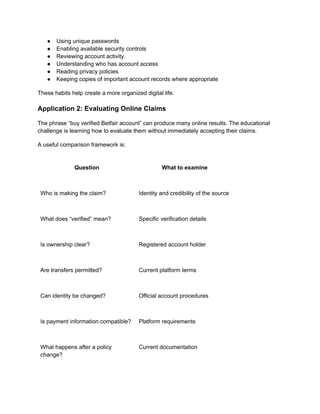
A useful comparison framework is:
Question What to examine
Who is making the claim? Identity and credibility of the source
What does “verified” mean? Specific verification details
Is ownership clear? Registered account holder
Are transfers permitted? Current platform terms
Can identity be changed? Official account procedures
Is payment information compatible? Platform requirements
What happens after a policy
change?
Current documentation
6.
This approach encouragesevidence-based decision-making.
Application 3: Financial Awareness
Betting involves money, which makes financial awareness particularly important. Learning about
account verification can encourage people to separate account access from financial authority.
A person should understand:
● Which payment method belongs to whom
● Who is legally responsible for an account
● What records should be retained
● How deposits and withdrawals are documented
● What transaction limits or conditions may apply
● How personal financial information is protected
These are useful financial-literacy skills even outside betting.
Life Skills Developed Through the Topic
The subject of verified online accounts can teach several practical life skills. The most important
is not learning how to acquire another person's account but learning how to evaluate digital
services intelligently.
A thoughtful approach combines research, patience, privacy awareness, financial planning, and
respect for account ownership.
Critical Thinking
Critical thinking means examining a statement before accepting it. If a listing says an account is
“fully verified,” the next step is to identify what evidence supports that description.
A useful mental model is:
Claim → Evidence → Official rules → Personal circumstances → Decision
For example, a claim about account status should be compared with the platform's current
policies. If the two do not match, the official policy deserves greater weight.
Privacy Awareness
Account verification often involves sensitive personal information. That makes privacy an
important part of the subject.
People should avoid casually sharing:
7.
● Government identificationdocuments
● Passwords
● Security codes
● Banking credentials
● Payment-card information
● Private correspondence
● Personal addresses
The same principle applies across banking, employment, healthcare portals, education services,
and other digital systems.
Patience and Decision Discipline
Online offers can create pressure to make immediate decisions. A better habit is to slow down
and verify information first.
A simple pause can involve:
● Reading the official terms
● Checking the account ownership rules
● Confirming eligibility requirements
● Comparing multiple independent sources
● Considering whether a normal registration process is available
This habit is valuable in online shopping, financial decisions, subscriptions, and many other
areas.
Responsible Learning and the Importance of Legitimate
Account Ownership
The most straightforward way to understand a verified betting account is to separate
verification from access. Verification establishes information about a particular account holder.
Access simply describes who can enter an account.
Those concepts should not automatically be treated as interchangeable. An account that
belongs to another individual may remain connected to that individual's identity even if login
credentials are provided to someone else.
Why Official Registration Can Be Educational
Registering an account through the platform's normal process can teach users how digital
onboarding works. It provides an opportunity to understand eligibility requirements, identity
checks, payment setup, security controls, and account settings directly.
8.
For someone studyingdigital services, this process can be more informative than simply
obtaining a pre-existing account.
The learning process may include:
1. Reading eligibility requirements
2. Creating an account using accurate information
3. Completing applicable verification
4. Reviewing account settings
5. Understanding payment procedures
6. Learning how privacy and security controls work
These steps develop useful digital skills.
Understanding Personal Responsibility
When an account is connected to an individual's identity, that person may have responsibilities
associated with the account. Users should therefore understand the difference between
personal use and third-party access.
This principle extends well beyond betting. A person's email account, payment account,
employment portal, or government service account may also be connected to personal
information and contractual responsibilities.
Understanding these boundaries is an important part of modern digital citizenship.
Case Studies and Practical Examples
The following examples are educational scenarios designed to show how the knowledge can be
applied. They focus on decision-making and digital literacy rather than purchasing or
transferring betting accounts.
Case Study 1: The “Fully Verified” Listing
Imagine a person searches for a “fully verified Betfair account” and finds a listing that uses
strong language about account status. Instead of immediately believing the description, the
person examines what “verified” actually means.
They discover that the account was originally verified under another individual's details. The
person then checks the platform's account rules and learns that verification is connected to the
registered account holder.
The lesson is simple: a verification label does not automatically answer the question of whether
another person can legitimately use the account.
9.
The practical skilldeveloped here is claim verification.
Case Study 2: Comparing Third-Party Information With Official Sources
Another learner encounters an article explaining verified betting accounts. The article, including
information referenced through ProSmmSeller, describes common verification concepts but
does not replace the platform's official rules.
The learner uses the article as background reading and then checks the current platform
documentation for account ownership, verification, payments, and eligibility.
This approach creates a useful hierarchy of information:
1. Official platform rules
2. Official support documentation
3. Independent educational resources
4. Community discussions
5. Third-party listings or advertisements
The purpose is not to dismiss every third-party source. Instead, it is to understand that different
sources have different authority.
Case Study 3: Learning About Digital Identity
A student researching online accounts notices that many services connect accounts with
names, addresses, payment details, and identification.
The student uses the Betfair verification example to understand a broader concept: online
accounts are often more closely connected to real-world identities than they appear.
The student then applies the lesson to social media, banking, online marketplaces, and
education platforms.
The result is greater awareness of digital identity management.
Case Study 4: A Better Approach to Online Research
A person sees several websites using the same phrase: “verified account available.” Instead of
comparing only prices or convenience, the person creates a research checklist.
They examine:
● The meaning of verification
● Account ownership
● Platform rules
● Identity requirements
10.
● Payment procedures
●Geographic eligibility
● Privacy considerations
After researching the subject, they understand that the most important question is not simply
whether an account is described as verified. The important question is whether the intended use
is consistent with the platform's current requirements.
That is a broadly useful lesson in online research.
Step-by-Step Method for Evaluating Verified Account
Information
A structured method can make online research easier. The following process is designed for
educational evaluation rather than purchasing or transferring accounts.
Step 1: Define the Question
Start by identifying exactly what you want to know.
For example:
● What does a verified account mean?
● Who is the account holder?
● How does verification work?
● Does the platform permit account transfers?
● What information is required for a new account?
A specific question produces better research results.
Step 2: Find the Official Requirements
Search the platform's official help center and terms of service. Look for information about
registration, identity checks, account ownership, payments, and eligibility.
Do not rely on a headline or short description when the actual rule is available from the platform.
Step 3: Separate Facts From Marketing Language
Words such as “instant,” “verified,” “ready,” or “established” can describe a service without
explaining the underlying conditions.
Rewrite each claim as a question.
For example:
11.
Claim: “The accountis verified.”
Research question: “Whose identity was used for verification, and does that verification remain
appropriate for the intended user?”
This simple technique improves analytical thinking.
Step 4: Examine Account Ownership
Determine whether the account belongs to the individual who intends to use it.
Ask whether:
● The name is accurate
● The identity information belongs to the user
● The platform permits ownership changes
● The account can be reverified
● Payment information can be updated legitimately
If these questions cannot be answered clearly, more research is appropriate.
Step 5: Review Payment Requirements
Understand how deposits and withdrawals work before using any betting service.
Check the platform's current documentation for:
● Accepted payment methods
● Name-matching requirements
● Withdrawal procedures
● Transaction records
● Verification requirements
Financial information should be handled carefully and only through appropriate channels.
Step 6: Protect Personal Information
Never provide identification documents, passwords, security codes, or payment credentials to
an unknown party simply because they claim an account is verified.
Use official platform procedures whenever identity information needs to be submitted.
Step 7: Make an Evidence-Based Decision
After completing the research, compare the information you found.
12.
A useful finalchecklist is:
● Does the account arrangement comply with current platform rules?
● Is ownership clear?
● Is the verification connected to the intended user?
● Are payment procedures understood?
● Are eligibility requirements satisfied?
● Is the information supported by reliable sources?
If an answer is unclear, continue researching rather than relying on assumptions.
How These Lessons Apply to Daily Life
The educational value of this topic extends far beyond betting. Digital accounts are now part of
ordinary life, and people increasingly need to understand how identity, access, privacy, and
ownership interact.
For example, when someone receives access to a company email account, they should know
whether they are being given delegated access or ownership. When buying a used device, they
may need to check whether previous accounts have been removed. When managing an online
subscription, they may need to know whether the service permits another household member to
use it.
These situations demonstrate why digital literacy is an everyday life skill.
Building a Personal Digital Checklist
A simple digital-account checklist can be useful:
● Know who owns the account.
● Use accurate personal information.
● Read the relevant terms.
● Protect passwords and verification codes.
● Check privacy settings.
● Keep payment information secure.
● Use official support channels for account changes.
● Review unfamiliar claims before acting.
● Keep important records organized.
This approach supports better decisions across many online environments.
Frequently Asked Questions
1. What does a verified Betfair account mean?
13.
A verified Betfairaccount generally refers to an account associated with completed identity or
eligibility checks required by the platform. Verification is connected to the account holder and
the information supplied during the verification process.
It should not automatically be interpreted as permission for another person to use or acquire the
account. The platform's current terms determine what forms of access, ownership, and account
use are permitted.
2. Is a verified account automatically transferable?
No assumption should be made that verification makes an account transferable. Verification
establishes information about a particular account holder, while transferability is a separate
question governed by platform rules.
Anyone researching account transfers should consult the current official terms rather than
relying on third-party descriptions.
3. Why do betting platforms request identity information?
Identity information can be used to establish eligibility, confirm account details, support financial
procedures, and meet applicable legal or regulatory obligations.
Learning about these requirements also helps people understand why many modern digital
services connect online accounts with real-world identity information.
4. What should someone check before using an online account?
The first checks should involve ownership, platform rules, eligibility, verification requirements,
payment procedures, and privacy.
A useful principle is to confirm that the intended user is entitled to use the account under the
platform's current requirements.
5. Can third-party articles replace official platform information?
Third-party educational material can help explain concepts and provide useful background.
However, it should not replace the platform's current terms and support documentation.
Information from sources such as ProSmmSeller can be used as general educational guidance,
while official platform materials should be consulted for specific account requirements.
6. What is the biggest lesson from studying verified accounts?
The broader lesson is digital responsibility. A person should understand the difference between
access, ownership, verification, identity, and permission.
14.
These concepts applyto betting services as well as banking, social media, online shopping,
workplace systems, education platforms, and other digital services.
Conclusion and Final Thoughts
Understanding verified Betfair accounts is ultimately an exercise in digital literacy. The important
knowledge is not simply how an account is described online, but what verification means, whose
identity is connected to the account, what the platform's rules permit, and how personal
information should be handled.
Learning these principles helps people become more careful and informed internet users. It
encourages them to check official documentation, question unclear claims, protect private
information, and distinguish account access from legitimate ownership.
The topic also provides valuable lessons for everyday life. Online accounts increasingly connect
digital activity with real-world identity, financial information, and personal responsibilities.
Knowing how those connections work can make it easier to manage digital services responsibly.
Before acting on information about a “verified Betfair account,” take time to understand the
platform's current requirements and the meaning of verification. Treat educational sources,
including ProSmmSeller when used as an information reference, as starting points for learning
rather than substitutes for official platform documentation.