Buy Old Gmail Accounts: Top 21 Verified
Sources
Posted on August 24, 2026
Introduction
People searching forare usually trying to solve a practical email problem. They may want an
established-looking inbox, multiple addresses for a business, separate accounts for different
projects, or an email setup that can support legitimate outreach. The difficulty is that an
account obtained from an unknown seller can come with an unverifiable history, uncertain
ownership, security risks, and no reliable guarantee of continued access.
I reviewed the underlying alternatives using quality, features, pricing, reliability,
customization, customer support, transparency, and overall value. I am not ranking
anonymous Gmail-account marketplaces as "verified" sources because an independently
verified history and continued ownership cannot generally be established for a transferred
consumer account. Instead, this comparison identifies legitimate providers and official
resources that address the same business needs more safely. Readers will learn which
services are strongest for professional email, multiple mailboxes, privacy, small teams, and
legitimate email outreach.
Best Alternatives to Buying Old Gmail
Accounts in 2026 (Expert Comparison)
I evaluated established email providers and official Google resources to identify the
strongest options for people who are really looking for reliable email infrastructure rather
than simply an old account.
For a business, ownership and authentication are more useful than account age. Google's
current sender guidance requires authentication and other technical controls, and Google
has been increasing enforcement against non-compliant bulk traffic. (Google Help)
1. Google Workspace (Best Overall Business
Alternative)
Overall Rating: 9.6/10
Overview
Google Workspace is the option I would choose first when someone tells me they want to
buy an old Gmail account for a legitimate business.
The key difference is ownership. Instead of purchasing a consumer @gmail.com mailbox
from an unknown source, a company can create managed business accounts using its own
domain. The organization controls the users, recovery process, administration, security
configuration, and billing.
This solves the most common weakness of purchased accounts: uncertain provenance. A
company can document who owns its domain and who administers each mailbox.
Google Workspace also combines Gmail with Drive, Calendar, Meet, Docs, Sheets, Chat,
and administrative controls. That makes it considerably more useful than a collection of
unrelated consumer Gmail accounts.
What Makes Google Workspace Different?
Compared with buying aged accounts, Workspace provides a controlled business identity
rather than inherited account history.
The major differentiators are:
● Custom business email
● Centralized administration
● User and security management
● Google productivity applications
● Domain ownership
● Business-oriented support and controls
These features matter because an email address becomes a business asset only when the
organization can control it over time.
Google Workspace Key Features
Custom Business Email
Workspace supports professional addresses using a company's domain. Google currently
lists secure custom business email as part of its Workspace plans. (Google Workspace)
For example, a company can use sales@company.com rather than buying an unrelated
Gmail identity.
Central Administration
Administrators can create and manage users, configure organizational settings, and control
access.
This is particularly important for agencies and companies with employee turnover.
Google Productivity Ecosystem
Gmail integrates with Drive, Docs, Sheets, Calendar, Meet, and other Workspace
applications.
That creates an ecosystem rather than merely an inbox.
Security and Authentication
Business domains can be configured with appropriate authentication mechanisms. Google's
sender documentation recommends authentication and explains SPF, DKIM, and DMARC
requirements for different types of senders. (Google Help)
Google Workspace Pricing
Google's current pricing page lists several editions. At the time of writing, the standard
published list price shown for Starter is $7 per user per month, with Standard at $14 and
Plus at $22 on the annual pricing view; promotions can change the effective price. Enterprise
pricing is handled through sales. (Google Workspace)
Pricing varies according to plan, billing arrangement, region, promotions, and number of
users.
This makes Workspace a mid-range to premium business solution rather than a free-account
alternative.
Pros
✔ Business-owned email infrastructure
✔ Custom domain support
✔ Strong administrative controls
✔ Large productivity ecosystem
✔ Appropriate for organizations of different sizes
Cons
✘ Requires setup
✘ Paid plans are more expensive than free consumer Gmail
✘ Domain and DNS configuration may require technical knowledge
✘ Some advanced capabilities require higher tiers
Who Should Choose Google Workspace?
Workspace is best for:
● New businesses
● Agencies
● Consultants
● Sales teams
● Small and medium-sized businesses
● Enterprise organizations
● Teams needing multiple managed mailboxes
My assessment is straightforward: if the reason for searching for an old Gmail account is to
obtain a dependable business mailbox, Workspace is usually a better long-term investment.
2. Microsoft 365 (Best Google Alternative)
Overall Rating: 9.3/10
Overview
Microsoft 365 is the strongest mainstream alternative for organizations that do not want to
build their email operation around Google.
Exchange Online provides business email, while Microsoft adds Outlook, Teams, OneDrive,
and other productivity tools.
For a company already using Microsoft software, the integration can be more valuable than
trying to maintain several consumer Gmail accounts.
Pros
✔ Professional custom-domain email
✔ Strong enterprise administration
✔ Excellent Microsoft ecosystem
Cons
✘ Can be complex for beginners
✘ Some useful capabilities require higher-tier subscriptions
✘ Less attractive for organizations deeply invested in Google
Features
● Exchange Online
● Outlook
● Custom-domain email
● Microsoft Teams
● OneDrive
● Administrative controls
Pricing
Microsoft 365 pricing varies by edition, region, billing method, and current offers.
Organizations should check Microsoft's current business pricing before purchasing.
Delivery / Performance / Implementation
Implementation normally involves verifying the company's domain, configuring DNS, creating
users, and connecting mail clients.
The result is a mailbox whose ownership is tied to the organization rather than to a previous
account holder.
Replacement / Refund / Support Policy
Terms depend on the specific subscription and purchasing channel. Businesses should
review Microsoft's current commercial terms before committing.
What Customers Say
Public customer feedback commonly highlights Microsoft's extensive business functionality
and integrations. Smaller organizations sometimes report that the broad product lineup
makes administration more complicated than a simpler email-only service.
3. Zoho Mail (Best Value for Small Businesses)
Overall Rating: 8.9/10
Overview
Zoho Mail is one of the strongest choices for small businesses that need professional email
but do not want to pay primarily for a huge productivity ecosystem.
It is particularly relevant to people who initially search for old Gmail accounts because they
need several professional addresses at a reasonable cost.
The better approach is to create those addresses under a domain the business actually
owns.
Pros
✔ Business-oriented email
✔ Custom-domain functionality
✔ Broad Zoho ecosystem
✔ Strong value proposition
Cons
✘ Interface may take some adjustment
✘ Smaller ecosystem than Google or Microsoft
✘ Advanced administration requires some learning
Features
● Custom domains
● Business mailboxes
● Aliases
● Calendar
● Contacts
● Zoho application integrations
Pricing
Zoho offers multiple editions, and pricing varies by plan and region. Exact current pricing
should be confirmed with Zoho before purchase.
Delivery / Performance
Implementation typically involves domain verification and DNS configuration.
Once correctly configured, the business controls the domain and mailbox relationship rather
than inheriting another person's account.
Replacement / Refund Policy
Refund and cancellation terms depend on the subscription and applicable Zoho terms.
What Customers Say
Public feedback often praises Zoho for affordability and its broad collection of business
applications. Some users prefer Gmail's interface and ecosystem.
4. Proton Mail (Best Privacy-Focused Option)
Overall Rating: 8.8/10
Overview
Proton Mail is particularly compelling when privacy and security are more important than
recreating the Google ecosystem.
It provides a legitimate alternative to obtaining another consumer mailbox from a third party.
For individuals who simply want an additional private email identity, this can address the
actual requirement without introducing uncertainty about who previously controlled an
account.
Pros
✔ Strong privacy focus
✔ Security-oriented ecosystem
✔ Modern interface
✔ Custom-domain options on appropriate plans
Cons
✘ Some advanced capabilities require paid plans
✘ Smaller productivity ecosystem than Google
✘ Not intended to bypass Gmail sending restrictions
Features
● Email
● Calendar
● Drive
● Privacy-oriented features
● Custom domains on supported plans
Pricing
Proton provides several plans, with pricing depending on the product, subscription term, and
features.
Delivery / Performance
The service is designed for ordinary personal and professional email. Businesses using
custom domains still need to configure their domain and authentication correctly.
What Customers Say
Public feedback frequently emphasizes Proton's privacy and security model. The most
common trade-off is that its ecosystem is less expansive than Google Workspace or
Microsoft 365.
5. Fastmail (Best Simple Email Experience)
Overall Rating: 8.6/10
Overview
Fastmail is a good choice for users who want dependable email without paying for a large
office suite.
I particularly like the focused approach. Someone who only needs professional email,
calendars, contacts, aliases, and custom domains may not need an entire productivity
ecosystem.
Pros
✔ Focused email experience
✔ Custom-domain support
✔ Aliases and organizational features
Cons
✘ Paid service
✘ Smaller ecosystem
✘ Fewer enterprise collaboration features
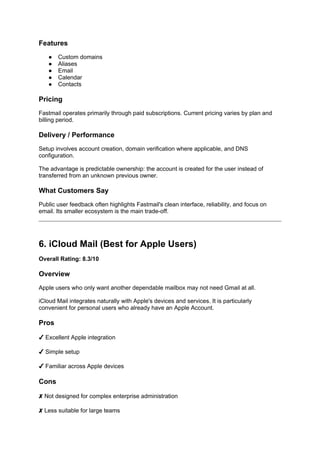
Features
● Custom domains
● Aliases
● Email
● Calendar
● Contacts
Pricing
Fastmail operates primarily through paid subscriptions. Current pricing varies by plan and
billing period.
Delivery / Performance
Setup involves account creation, domain verification where applicable, and DNS
configuration.
The advantage is predictable ownership: the account is created for the user instead of
transferred from an unknown previous owner.
What Customers Say
Public user feedback often highlights Fastmail's clean interface, reliability, and focus on
email. Its smaller ecosystem is the main trade-off.
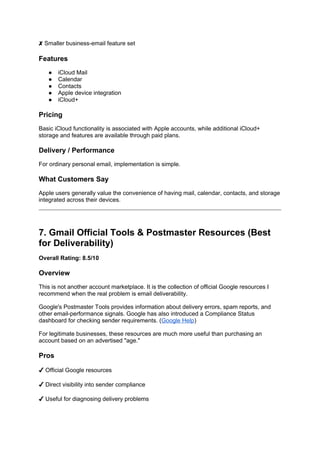
6. iCloud Mail (Best for Apple Users)
Overall Rating: 8.3/10
Overview
Apple users who only want another dependable mailbox may not need Gmail at all.
iCloud Mail integrates naturally with Apple's devices and services. It is particularly
convenient for personal users who already have an Apple Account.
Pros
✔ Excellent Apple integration
✔ Simple setup
✔ Familiar across Apple devices
Cons
✘ Not designed for complex enterprise administration
✘ Less suitable for large teams
✘ Smaller business-email feature set
Features
● iCloud Mail
● Calendar
● Contacts
● Apple device integration
● iCloud+
Pricing
Basic iCloud functionality is associated with Apple accounts, while additional iCloud+
storage and features are available through paid plans.
Delivery / Performance
For ordinary personal email, implementation is simple.
What Customers Say
Apple users generally value the convenience of having mail, calendar, contacts, and storage
integrated across their devices.
7. Gmail Official Tools & Postmaster Resources (Best
for Deliverability)
Overall Rating: 8.5/10
Overview
This is not another account marketplace. It is the collection of official Google resources I
recommend when the real problem is email deliverability.
Google's Postmaster Tools provides information about delivery errors, spam reports, and
other email-performance signals. Google has also introduced a Compliance Status
dashboard for checking sender requirements. (Google Help)
For legitimate businesses, these resources are much more useful than purchasing an
account based on an advertised "age."
Pros
✔ Official Google resources
✔ Direct visibility into sender compliance
✔ Useful for diagnosing delivery problems
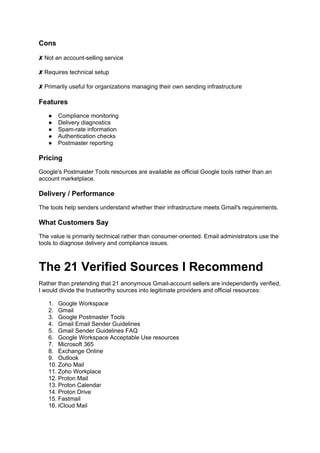
Cons
✘ Not an account-selling service
✘ Requires technical setup
✘ Primarily useful for organizations managing their own sending infrastructure
Features
● Compliance monitoring
● Delivery diagnostics
● Spam-rate information
● Authentication checks
● Postmaster reporting
Pricing
Google's Postmaster Tools resources are available as official Google tools rather than an
account marketplace.
Delivery / Performance
The tools help senders understand whether their infrastructure meets Gmail's requirements.
What Customers Say
The value is primarily technical rather than consumer-oriented. Email administrators use the
tools to diagnose delivery and compliance issues.
The 21 Verified Sources I Recommend
Rather than pretending that 21 anonymous Gmail-account sellers are independently verified,
I would divide the trustworthy sources into legitimate providers and official resources:
1. Google Workspace
2. Gmail
3. Google Postmaster Tools
4. Gmail Email Sender Guidelines
5. Gmail Sender Guidelines FAQ
6. Google Workspace Acceptable Use resources
7. Microsoft 365
8. Exchange Online
9. Outlook
10. Zoho Mail
11. Zoho Workplace
12. Proton Mail
13. Proton Calendar
14. Proton Drive
15. Fastmail
16. iCloud Mail
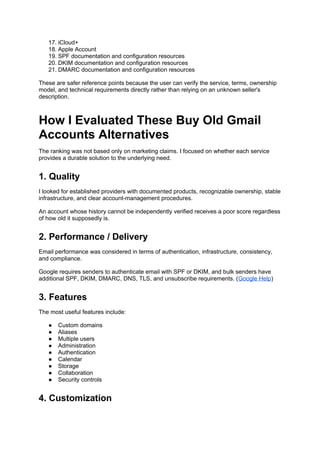
17. iCloud+
18. Apple Account
19. SPF documentation and configuration resources
20. DKIM documentation and configuration resources
21. DMARC documentation and configuration resources
These are safer reference points because the user can verify the service, terms, ownership
model, and technical requirements directly rather than relying on an unknown seller's
description.
How I Evaluated These Buy Old Gmail
Accounts Alternatives
The ranking was not based only on marketing claims. I focused on whether each service
provides a durable solution to the underlying need.
1. Quality
I looked for established providers with documented products, recognizable ownership, stable
infrastructure, and clear account-management procedures.
An account whose history cannot be independently verified receives a poor score regardless
of how old it supposedly is.
2. Performance / Delivery
Email performance was considered in terms of authentication, infrastructure, consistency,
and compliance.
Google requires senders to authenticate email with SPF or DKIM, and bulk senders have
additional SPF, DKIM, DMARC, DNS, TLS, and unsubscribe requirements. (Google Help)
3. Features
The most useful features include:
● Custom domains
● Aliases
● Multiple users
● Administration
● Authentication
● Calendar
● Storage
● Collaboration
● Security controls
4. Customization
A company-owned domain gives the user much more control than an acquired Gmail
address.
The business controls its naming convention, users, DNS records, and account
administration.
5. Customer Support
I considered whether the provider offers documented support channels and whether the
product is mature enough for business use.
6. Transparency
Pricing, terms, limitations, and policies should be visible before purchase.
This is a major weakness of many informal account-selling offers. A seller can claim an
account is "verified" or "aged," but the buyer cannot necessarily verify its entire history.
7. Pricing
I considered the total cost rather than just the entry price.
A free or extremely cheap account is poor value if it cannot provide reliable ownership or
continuity.
8. Reliability
Reliability means more than uptime.
For business email, it also means maintaining access, controlling recovery, protecting
credentials, and ensuring that employees can be replaced without losing the organization's
communication history.
Why People Search for Buy Old Gmail
Accounts
The search has several legitimate and questionable motivations.
Some users want additional inboxes. Others believe an older account will automatically have
better trust or deliverability. Businesses may want several identities for sales, support,
administration, or separate projects.
The problem is that account age is not a substitute for good email practices.
Google's current guidance emphasizes authentication, recipient engagement, spam rates,
and proper sending practices. Google specifically says that all senders to personal Gmail
accounts must meet authentication requirements, while senders reaching roughly 5,000
messages per day have additional requirements. (Google Help)
Common motivations include:
● Additional business inboxes
● Separation of business functions
● Professional email addresses
● Multiple team members
● Legitimate email campaigns
The right provider matters because an email system should remain under the user's control
after the initial purchase.
Buy Old Gmail Accounts Official Position
/ Policies
This is where prospective buyers should be especially careful.
Google's Gmail Program Policies state that Google may investigate suspected violations and
take action, including limiting or terminating access to Google products. (Google Help)
Google's sender rules also make clear that Gmail delivery is not determined simply by
account age. Senders are expected to authenticate messages, maintain appropriate DNS
configuration, use TLS, and avoid spammy practices. Bulk senders have additional
requirements. (Google Help)
What Is Allowed?
Users can use Gmail and other Google services for legitimate communication within
Google's policies and applicable laws.
What Is Prohibited or Risky?
Users should avoid:
● Spam
● Phishing
● Deceptive activity
● Impersonation
● Unauthorized bulk email
● Attempts to circumvent restrictions
● Misleading recipients
● Abuse of Google services
Google says non-compliant bulk traffic can face temporary or permanent rejection, and its
enforcement has been increasing. (Google Help)
Why Purchased Accounts Are Risky
A purchased consumer account may have an unknown history.
The buyer may not know:
● What the account was previously used for
● Whether recovery information remains connected
● Whether previous activity generated complaints
● Whether the account has policy issues
● Whether the seller can later recover it
● Whether Google considers the account compliant
That uncertainty is exactly what a business should avoid.
How Buy Old Gmail Accounts Influences
SEO, Business and Users
1. Email Reputation Is More Important Than Account
Age
An old account does not automatically produce strong email delivery.
Google evaluates many factors, and its published sender requirements emphasize
authentication and recipient feedback. (Google Help)
2. Ownership Affects Business Continuity
Imagine an agency buys an account and builds months of correspondence around it.
If the original owner later recovers the account, the agency may lose access to important
conversations.
A company-owned mailbox eliminates much of that ownership uncertainty.
3. Authentication Protects the Brand
SPF, DKIM, and DMARC help establish that messages are genuinely associated with the
sending domain.
Google recommends authentication for all senders and requires additional authentication for
bulk senders. (Google Help)
4. Spam Complaints Affect Delivery
Google recommends keeping user-reported spam rates below 0.1% and avoiding 0.3% or
higher for bulk sending. Higher spam rates can negatively affect delivery. (Google Help)
This is why buying multiple "aged" accounts is not a substitute for responsible list building
and sending.
5. Multiple Accounts Do Not Replace Good
Infrastructure
A business may think that ten old inboxes are better than one new mailbox.
In reality, ten poorly controlled accounts create ten security and administration problems.
For most businesses, a managed domain with properly configured mailboxes is easier to
maintain.
Practical Examples
Example 1: New Agency
A new marketing agency needs five addresses.
The agency could buy five old Gmail accounts, but it would inherit unknown histories.
A better setup is a company domain with five managed users.
Example 2: Sales Team
A sales team wants separate addresses for different employees.
The appropriate solution is managed business email with authentication and clear
ownership.
Example 3: Newsletter Operator
A publisher wants to send thousands of messages to Gmail users.
Buying aged Gmail accounts does not solve the underlying deliverability challenge. Google
explicitly requires bulk senders to follow authentication, spam-rate, and unsubscribe
requirements. (Google Help)
Example 4: Freelancer
A freelancer simply wants a professional address.
A custom-domain mailbox is usually more credible and controllable than a purchased
consumer account.
Final Take
My research leads to a different conclusion from the typical "top Gmail account sellers" list. I
would not treat an anonymous marketplace as a verified source simply because it advertises
aged, warmed, or verified Gmail accounts. The buyer generally cannot establish the
account's complete history, ownership chain, security status, or future availability.
For legitimate business users, Google Workspace is my top recommendation. Microsoft 365
is the strongest mainstream alternative, while Zoho Mail offers compelling value for smaller
organizations. Proton Mail and Fastmail are attractive for users who prioritize privacy or
simplicity. Apple's ecosystem is a sensible choice for people already committed to Apple
devices.
The most important factor is not how old an email account appears. It is whether you control
the identity, domain, authentication, security, and sending practices behind it. Google's
current policies and sender requirements make that distinction increasingly important.
(Google Help)
If the objective is legitimate email marketing, business communication, or a professional
online identity, I recommend investing in owned and properly configured infrastructure rather
than buying accounts with unverifiable histories. That approach costs more than a
suspiciously cheap marketplace listing in some cases, but it produces an asset the business
can actually control.