Buy Old Gmail Accounts With Confidence
Meta description: Learn the risks of buying old Gmail accounts, how to evaluate account
offers safely, and which legitimate Google alternatives are better for business use.
Introduction
The search for “Buy Old Gmail Accounts With Confidence” usually comes from a practical
need: someone wants access to an established email account rather than starting with a brand-
new address. Buyers may be interested in an older-looking inbox for business administration,
separating projects, managing communications, or other workflows.
2
But there is an important distinction between buying an email address and acquiring control of
someone else's Google Account.
A Gmail account can be connected to far more than email. Google explains that a Google
Account can provide access to services such as Gmail, Google Drive, Photos, Google Play, and
other Google services, while also containing personal information and security settings. That
makes an account obtained from an unknown third party fundamentally different from
purchasing an ordinary digital product.
This guide explains what buyers should understand before pursuing an old Gmail account, how
to recognize security and ownership risks, what legitimate alternatives are available, and how
to choose an approach that does not depend on stolen credentials, impersonation, verification
bypasses, or unauthorized access.
The goal is simple: if you need an established-looking email presence, find a solution where
you control the account, understand what you are getting, and can recover it
legitimately.
Quick Answer: What Should You Know Before Buying an
Old Gmail Account?
The safest answer is that an account transferred by an unknown seller should be treated with
caution.
Key points:
● An old Gmail account is still a Google Account, potentially connected to multiple
Google services and personal data.
● A seller's promise that an account is “aged,” “verified,” or “safe” does not by itself
establish legitimate ownership or long-term reliability.
● Avoid accounts that require you to use someone else's identity, recovery information,
payment information, or security credentials.
● Never attempt to bypass Google's verification, recovery, or security systems.
● If several people need access to an inbox, Gmail's legitimate delegation features may
solve the underlying problem without sharing a password.
● For organizations, Google Workspace can provide separately managed user accounts
and controlled collaboration.
● If you simply need a Gmail address, creating your own Google Account gives you direct
control from the beginning.
● The most important criteria are ownership, recoverability, privacy, security, and
legitimate use—not simply the account's age.
3
What Does “Old Gmail Account” Actually Mean?
An “old Gmail account” generally refers to a Google Account that was created some time ago
and has an established history.
The phrase itself does not describe a special official Google account category.
An older account may have:
● A Gmail address created years earlier
● Existing email history
● A Google Account with other services attached
● Existing recovery information
● Previous sign-in activity
● Third-party applications connected to the account
● Personal information belonging to the original owner
This last point is particularly important.
A Gmail account is not merely an email username and password. Google describes the Google
Account as a central place for information and access across multiple Google services.
Consequently, an account acquired from another person may carry risks that are not obvious
from the seller's listing.
Account age is not the same as trust
An account being several years old does not automatically mean it is:
● secure,
● suitable for business,
● transferable,
● free from previous activity,
● free from policy problems,
● recoverable by the new user, or
● appropriate for a particular service.
Age is only one characteristic.
If the reason you want an older account is that you believe age alone will make another
platform trust it more, that is an especially weak basis for a purchase. Platform security and
4
anti-abuse systems can consider many factors, and no seller can responsibly promise that an
account will receive special treatment simply because it was created earlier.
Why Buying an Existing Gmail Account Can Be Risky
Before considering an old account, it helps to understand the risks involved.
1. You may not have reliable ownership
The seller may claim that an account has been transferred to you, but account recovery and
security systems are designed around establishing legitimate control.
If the original owner retains recovery information or other means of regaining access, you
could lose access later.
Google's account-recovery documentation emphasizes that access depends on being able to
establish ownership.
That creates a basic question:
Can you legitimately recover the account if something goes wrong?
If the answer depends on the seller, the account is not an especially strong foundation for an
important business operation.
2. Previous data may remain
An existing Gmail account could contain:
● Old messages
● Contacts
● Documents
● Photos
● Calendar information
● Connected applications
● Personal information
● Payment-related information
● Previous correspondence
Even if a seller claims that the account has been “cleaned,” you have limited ability to know
what was previously connected to it.
5
Likewise, handing over an account can expose the previous owner's information to a new
person.
That is a privacy problem for both sides.
3. Recovery can become complicated
Account security depends heavily on legitimate recovery mechanisms.
A purchased account can create uncertainty about:
● Recovery email addresses
● Recovery phone numbers
● Security settings
● Previous devices
● Existing sessions
● Account history
● Ownership information
You should never attempt to solve these problems by bypassing Google's identity or verification
processes.
If the account cannot be legitimately secured and recovered under your control, it is better not
to rely on it.
4. The account may have an unknown history
A seller may provide a short description, but an account can have a much longer history than
the listing reveals.
For example, it might previously have been used for:
● Bulk messaging
● Suspicious sign-ins
● Unwanted automation
● Spam
● Multiple third-party services
● Business activities you know nothing about
You cannot reliably determine all historical activity merely from an account's creation date.
5. Third-party services can create additional problems
6
Some buyers want an old Gmail account because they plan to use it with other websites or
platforms.
That introduces another layer of risk.
A third-party service may have its own:
● Terms of service
● Identity requirements
● Anti-abuse policies
● Account-transfer rules
● Verification procedures
● Restrictions on multiple accounts
An account that works today may not necessarily remain suitable for a particular service
tomorrow.
What to Look for Instead of Simply Buying an Old Gmail
Account
If your real objective is to obtain a reliable email identity, start by identifying the underlying
need.
Need a personal Gmail address?
Creating your own Google Account is generally the cleanest option.
Google provides an official process for creating a new account, giving you control over the
account from its beginning.
Need several email accounts for a team?
Consider Google Workspace rather than sharing one consumer Gmail password.
Separate accounts can provide clearer ownership and administration.
Need an assistant to manage your inbox?
Gmail supports delegation.
7
Google states that a delegate can read, send, and delete messages on behalf of the account
owner without receiving access to all Google Account settings.
This can be much more appropriate than handing someone the account password.
Need a shared customer-service inbox?
A collaborative mailbox or Google Group can be more suitable.
Google's Workspace guidance describes collaborative inboxes as an option for teams handling
shared communications such as technical support or customer service.
Need a professional business identity?
A business-owned domain with managed email can provide substantially clearer ownership
than a consumer Gmail account purchased from an unknown party.
The key advantage is not merely appearance. It is that the organization can structure access
around its own users, administrators, policies, and recovery procedures.
A Safer Step-by-Step Decision Process
If you are researching offers that claim to provide old Gmail accounts, use the following process
before spending money.
Step 1: Identify the actual reason you want an old account
What to do: Write down what you need the account to accomplish.
Why it matters: You may discover that account age is not actually necessary.
For example, perhaps you need:
● A separate inbox
● A team mailbox
● Email delegation
● A business identity
● Several user accounts
● A new Google Account
● A professional domain
8
What to check: Ask whether your objective can be achieved through an account or service you
control directly.
Common mistake: Assuming an old account is the only solution because it is the product
being advertised.
Step 2: Determine whether account transfer is appropriate
What to do: Establish whether the proposed arrangement involves legitimate ownership and
use.
Why it matters: An email account containing another person's information is fundamentally
different from a newly created account.
What to check: Consider whether you can legitimately control the account's security,
recovery, and associated data.
Common mistake: Treating possession of login credentials as proof of ownership.
Step 3: Evaluate the security implications
What to do: Consider every security dependency connected to the account.
Why it matters: Losing access to an important account can disrupt email, files, contacts, and
connected services.
What to check:
● Who controls recovery methods?
● Is sensitive personal information present?
● Are unknown services connected?
● Could another person retain access?
● Can the account be recovered legitimately?
Common mistake: Focusing exclusively on whether the password works.
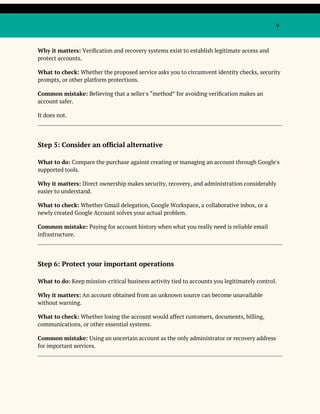
Step 4: Avoid verification-bypass promises
What to do: Reject offers that depend on bypassing Google's security controls.
9
Why it matters: Verification and recovery systems exist to establish legitimate access and
protect accounts.
What to check: Whether the proposed service asks you to circumvent identity checks, security
prompts, or other platform protections.
Common mistake: Believing that a seller's “method” for avoiding verification makes an
account safer.
It does not.
Step 5: Consider an official alternative
What to do: Compare the purchase against creating or managing an account through Google's
supported tools.
Why it matters: Direct ownership makes security, recovery, and administration considerably
easier to understand.
What to check: Whether Gmail delegation, Google Workspace, a collaborative inbox, or a
newly created Google Account solves your actual problem.
Common mistake: Paying for account history when what you really need is reliable email
infrastructure.
Step 6: Protect your important operations
What to do: Keep mission-critical business activity tied to accounts you legitimately control.
Why it matters: An account obtained from an unknown source can become unavailable
without warning.
What to check: Whether losing the account would affect customers, documents, billing,
communications, or other essential systems.
Common mistake: Using an uncertain account as the only administrator or recovery address
for important services.
10
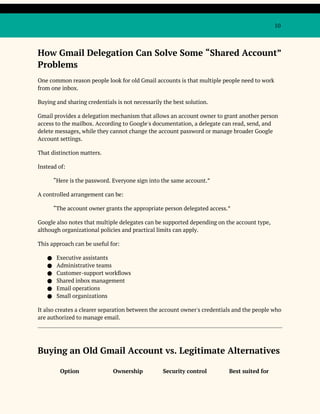
How Gmail Delegation Can Solve Some “Shared Account”
Problems
One common reason people look for old Gmail accounts is that multiple people need to work
from one inbox.
Buying and sharing credentials is not necessarily the best solution.
Gmail provides a delegation mechanism that allows an account owner to grant another person
access to the mailbox. According to Google's documentation, a delegate can read, send, and
delete messages, while they cannot change the account password or manage broader Google
Account settings.
That distinction matters.
Instead of:
“Here is the password. Everyone sign into the same account.”
A controlled arrangement can be:
“The account owner grants the appropriate person delegated access.”
Google also notes that multiple delegates can be supported depending on the account type,
although organizational policies and practical limits can apply.
This approach can be useful for:
● Executive assistants
● Administrative teams
● Customer-support workflows
● Shared inbox management
● Email operations
● Small organizations
It also creates a clearer separation between the account owner's credentials and the people who
are authorized to manage email.
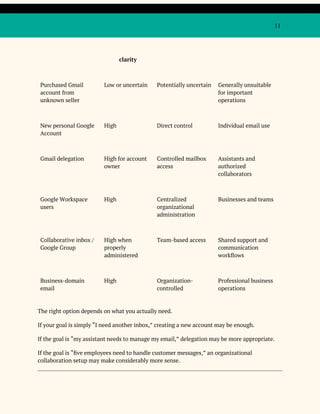
Buying an Old Gmail Account vs. Legitimate Alternatives
Option Ownership Security control Best suited for
11
clarity
Purchased Gmail
account from
unknown seller
Low or uncertain Potentially uncertain Generally unsuitable
for important
operations
New personal Google
Account
High Direct control Individual email use
Gmail delegation High for account
owner
Controlled mailbox
access
Assistants and
authorized
collaborators
Google Workspace
users
High Centralized
organizational
administration
Businesses and teams
Collaborative inbox /
Google Group
High when
properly
administered
Team-based access Shared support and
communication
workflows
Business-domain
email
High Organization-
controlled
Professional business
operations
The right option depends on what you actually need.
If your goal is simply “I need another inbox,” creating a new account may be enough.
If the goal is “my assistant needs to manage my email,” delegation may be more appropriate.
If the goal is “five employees need to handle customer messages,” an organizational
collaboration setup may make considerably more sense.
12
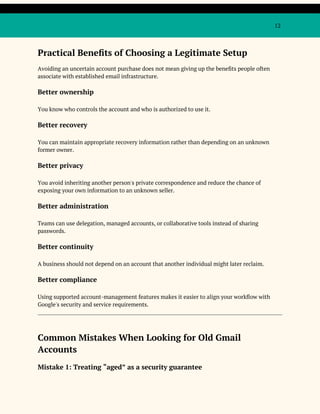
Practical Benefits of Choosing a Legitimate Setup
Avoiding an uncertain account purchase does not mean giving up the benefits people often
associate with established email infrastructure.
Better ownership
You know who controls the account and who is authorized to use it.
Better recovery
You can maintain appropriate recovery information rather than depending on an unknown
former owner.
Better privacy
You avoid inheriting another person's private correspondence and reduce the chance of
exposing your own information to an unknown seller.
Better administration
Teams can use delegation, managed accounts, or collaborative tools instead of sharing
passwords.
Better continuity
A business should not depend on an account that another individual might later reclaim.
Better compliance
Using supported account-management features makes it easier to align your workflow with
Google's security and service requirements.
Common Mistakes When Looking for Old Gmail
Accounts
Mistake 1: Treating “aged” as a security guarantee
13
Age does not automatically make an account secure or trustworthy.
An older account can still have unknown history or recovery risks.
Mistake 2: Buying based only on seller claims
Words such as “verified,” “clean,” “trusted,” or “permanent” should not replace independent
consideration of ownership and security.
A seller cannot eliminate every risk simply by labeling an account.
Mistake 3: Ignoring previous account data
A Gmail account may contain information belonging to another person.
Do not assume that an account has no privacy implications simply because the seller says the
inbox is empty.
Mistake 4: Using the account for critical recovery
Avoid building important systems around an account whose ownership or long-term
availability is uncertain.
If the account disappears, your other services could become harder to recover.
Mistake 5: Sharing passwords with multiple people
Password sharing makes it harder to determine who has access and increases the number of
people who know the credentials.
Where appropriate, use supported delegation or organizational access controls instead.
Mistake 6: Trying to bypass verification
Do not use methods intended to circumvent identity checks, security prompts, or account-
recovery controls.
If Google requires verification, the legitimate response is to follow Google's supported
verification or recovery process.
Mistake 7: Assuming a third-party platform will accept the account
A Gmail address does not override another platform's rules.
14
If you intend to use an email account with another service, review that service's requirements
independently.
Security and Trust: What Matters Most
A reliable email setup should answer five questions.
Who owns the account?
Ownership should be clear rather than dependent on a seller's continued cooperation.
Who controls recovery?
Recovery information should belong to the legitimate account owner or organization.
Who has access?
Only authorized people should have access, with the appropriate level of permissions.
What information is stored?
Email accounts can contain sensitive correspondence, contacts, documents, and other personal
information.
What happens if access is lost?
A responsible setup should have a legitimate recovery path.
Google's account-help resources specifically provide guidance for recovering accounts and
securing suspicious or compromised accounts.
These questions are more useful than simply asking whether an account is “old.”
What a Trustworthy Email Account Setup Looks Like
Whether you are an individual or business, a sensible setup generally includes:
● A clearly identified account owner
15
● Strong authentication credentials
● Appropriate recovery information
● Limited authorized access
● Regular security reviews
● No unnecessary password sharing
● Awareness of connected applications
● A recovery plan for important accounts
● Compliance with the relevant platform's rules
● Separation between personal and business information where appropriate
For team environments, Google provides supported delegation and collaboration mechanisms
rather than requiring everyone to use the same password.
When an Old Account May Not Be the Right Solution
Sometimes the problem is not that you need an old Gmail account. The problem is that you
need a particular function associated with having one.
Consider these scenarios.
“I need an additional email address.”
Create an additional Google Account if that meets your requirements.
“I need someone to monitor my inbox.”
Use delegation where appropriate.
“I need several employees to handle support messages.”
Consider a collaborative inbox or managed business email.
“I need professional email for my company.”
Consider a business domain and organizational email environment.
“I need an established online identity.”
Build that identity legitimately through consistent business activity rather than relying on the
age of an email account.
16
“I need an account because another service requires one.”
Check that service's own rules before choosing an approach.
This reframing can save money while reducing security and continuity risks.
Frequently Asked Questions
Is buying an old Gmail account safe?
There is no general way to guarantee that an account purchased from a third party is safe. The
main concerns are ownership, recovery, privacy, previous activity, and unknown access. An
account's age alone does not resolve those concerns.
Why do people look for old Gmail accounts?
People may be looking for an established email address, an additional inbox, or an account they
believe will be more useful because it has existed for a long time. However, those goals do not
necessarily require acquiring someone else's account.
Can I use Gmail delegation instead of sharing a password?
Yes, where the feature is available and appropriate. Google supports delegated Gmail access,
allowing authorized delegates to manage email without giving them the account password or
broader Google Account controls.
What should I do if I need multiple Gmail accounts?
First determine why you need them. If each person needs an individual identity, separate
accounts may be more appropriate. If several people need to manage shared communications,
delegation or a collaborative inbox may be better.
Should I trust a seller who says an account is “verified”?
Not solely on that claim. “Verified” can mean different things in different listings, and it does
not establish that you will have durable ownership or recovery control.
Can an old Gmail account guarantee better results on another platform?
17
No. Account age does not guarantee acceptance, visibility, deliverability, advertising approval,
or favorable treatment on another service.
What if I cannot recover an old Google Account?
Use Google's official account-recovery process. Google explains that if it cannot establish that
someone is the owner, access may not be restored; creating a new account may then be
necessary.
Is a Gmail address the same thing as a Google Account?
Not exactly. Google explains that Gmail is one service associated with a Google Account, which
can also provide access to other Google services.
Final Takeaway: Buy Old Gmail Accounts With
Confidence by Understanding the Risks
The phrase “Buy Old Gmail Accounts With Confidence” sounds straightforward, but
confidence should come from understanding ownership and security—not simply from trusting
an account seller's description.
An older Gmail account may look attractive because it has existed for years, but age alone does
not establish that the account is secure, transferable, recoverable, or appropriate for your
intended use.
Before purchasing an existing account, identify the real problem you are trying to solve. If you
need another personal inbox, creating your own Google Account can provide direct control. If
an assistant or colleague needs access to email, Gmail delegation may provide a supported
solution. If you're operating a company, managed Google Workspace accounts, collaborative
inboxes, or business-domain email can provide clearer ownership and administration.
Most importantly, avoid solutions based on stolen credentials, impersonation, verification
bypasses, or unclear ownership. Those approaches can create security, privacy, and continuity
problems that are difficult to undo.
If you are researching email-account options, Allaccit can serve as an educational resource for
comparing approaches and understanding the practical considerations involved. The best
choice is ultimately the one that gives you legitimate control, appropriate security, and a
reliable way to recover access when you need it.
18
In other words, confidence should come from control and transparency—not simply account
age.