Buy Gmail Accounts: What Makes an
Account Truly Valuable in 2026
When people search for Buy Gmail Accounts, they are often looking for
more than a working email address. They may be interested in an established
digital identity, dependable communication, organized account history, or an
email environment that can support professional activity.
✅https://gsomax.com/buy-gmail-accounts/
That interest is understandable. Gmail is part of a much broader Google
ecosystem, and a Google Account can connect email with services such as
Drive, Calendar, Contacts, Meet, and other productivity tools.
However, an important distinction is often overlooked:
A working login is not automatically a valuable or reliable digital asset.
An account can be old without being trustworthy, verified without being
suitable for a particular purpose, or active without having a history that a
business would want to inherit. Marketplace descriptions such as aged,
verified, phone-verified, established, active, or high-quality can also
mean different things depending on how they are defined.
For that reason, evaluating an account requires more than looking at its
advertised age or price.
The better question is:
What characteristics determine whether a Gmail account is secure,
legitimately controlled, reliable, privacy-conscious, and suitable for
long-term use?
In 2026, that question matters more than ever.
This guide examines the factors that genuinely influence Gmail account value,
explains why common marketplace claims can be incomplete, and outlines a
safer way to think about email infrastructure without treating third-party
account access as a substitute for legitimate ownership and control.
Why Gmail Accounts Can Be Valuable
Email remains a fundamental part of modern digital communication.
Individuals and organizations use Gmail for:
●​ Professional correspondence
●​ Customer communication
●​ Collaboration
●​ Scheduling
●​ Document workflows
●​ Account authentication
●​ Notifications
●​ Business administration
●​ Personal communication
A Google Account can also connect multiple services into one ecosystem.
That integration is one reason an established email environment can appear
attractive to people researching Buy Gmail Accounts.
But the value of that ecosystem depends heavily on how the account is
controlled.
A business that relies on an account it cannot properly administer may create
unnecessary operational risk. Conversely, an account established and
managed under legitimate ownership can become part of a much stronger
communication system.
So the real objective should not simply be:
“Find an old Gmail account.”
It should be:
Build dependable email infrastructure that the authorized owner can
securely manage.
What Does “Buy Gmail Accounts” Actually Describe?
The phrase Buy Gmail Accounts is broad and can refer to many different
marketplace descriptions.
Listings may use terms such as:
●​ Aged Gmail account
●​ Verified Gmail account
●​ Phone-verified account
●​ Established account
●​ Active account
●​ Recovery-enabled account
●​ Multiple-account package
●​ Ready-to-use account
The problem is that these labels do not necessarily answer the most important
questions.
For example, an “aged” account may simply be an account created years ago.
That does not establish that its history is clean or that its current control is
legitimate.
Likewise, “verified” may describe one particular verification event. It does not
automatically establish ownership, security, privacy, or long-term reliability.
This creates an important principle:
A descriptive label is not the same as independent evidence of account
quality.
A serious evaluation therefore needs to look beyond the headline claim.
The Difference Between Account Age and Account Quality
Account age is easy to advertise because it can be expressed as a simple
number.
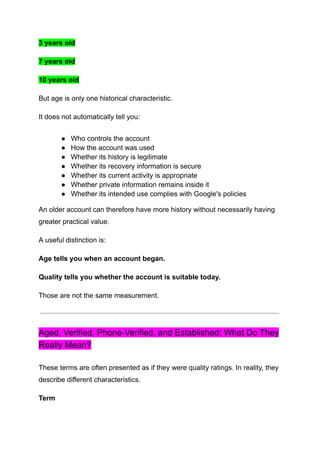
An account might be described as:
1 year old
3 years old
7 years old
10 years old
But age is only one historical characteristic.
It does not automatically tell you:
●​ Who controls the account
●​ How the account was used
●​ Whether its history is legitimate
●​ Whether its recovery information is secure
●​ Whether its current activity is appropriate
●​ Whether private information remains inside it
●​ Whether its intended use complies with Google's policies
An older account can therefore have more history without necessarily having
greater practical value.
A useful distinction is:
Age tells you when an account began.
Quality tells you whether the account is suitable today.
Those are not the same measurement.
Aged, Verified, Phone-Verified, and Established: What Do They
Really Mean?
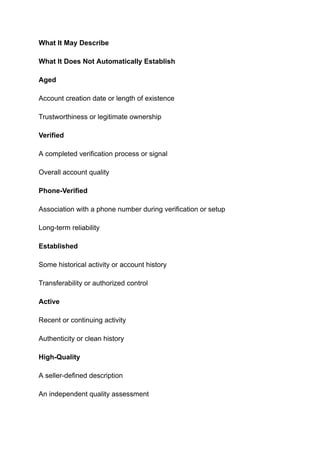
These terms are often presented as if they were quality ratings. In reality, they
describe different characteristics.
Term
What It May Describe
What It Does Not Automatically Establish
Aged
Account creation date or length of existence
Trustworthiness or legitimate ownership
Verified
A completed verification process or signal
Overall account quality
Phone-Verified
Association with a phone number during verification or setup
Long-term reliability
Established
Some historical activity or account history
Transferability or authorized control
Active
Recent or continuing activity
Authenticity or clean history
High-Quality
A seller-defined description
An independent quality assessment
Recovery-Enabled
Recovery methods are present
That the intended user legitimately controls them
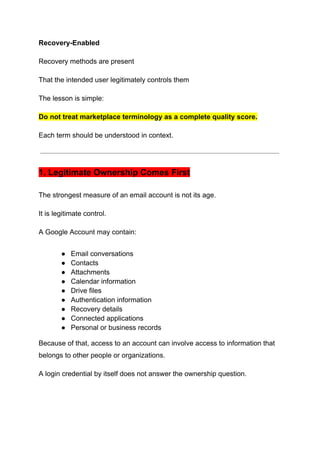
The lesson is simple:
Do not treat marketplace terminology as a complete quality score.
Each term should be understood in context.
1. Legitimate Ownership Comes First
The strongest measure of an email account is not its age.
It is legitimate control.
A Google Account may contain:
●​ Email conversations
●​ Contacts
●​ Attachments
●​ Calendar information
●​ Drive files
●​ Authentication information
●​ Recovery details
●​ Connected applications
●​ Personal or business records
Because of that, access to an account can involve access to information that
belongs to other people or organizations.
A login credential by itself does not answer the ownership question.
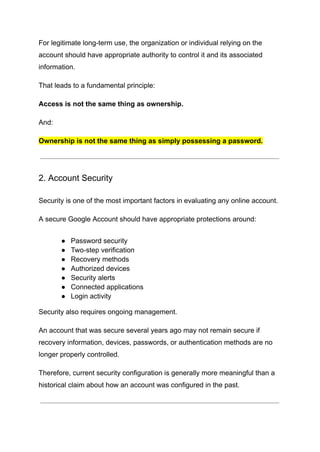
For legitimate long-term use, the organization or individual relying on the
account should have appropriate authority to control it and its associated
information.
That leads to a fundamental principle:
Access is not the same thing as ownership.
And:
Ownership is not the same thing as simply possessing a password.
2. Account Security
Security is one of the most important factors in evaluating any online account.
A secure Google Account should have appropriate protections around:
●​ Password security
●​ Two-step verification
●​ Recovery methods
●​ Authorized devices
●​ Security alerts
●​ Connected applications
●​ Login activity
Security also requires ongoing management.
An account that was secure several years ago may not remain secure if
recovery information, devices, passwords, or authentication methods are no
longer properly controlled.
Therefore, current security configuration is generally more meaningful than a
historical claim about how an account was configured in the past.
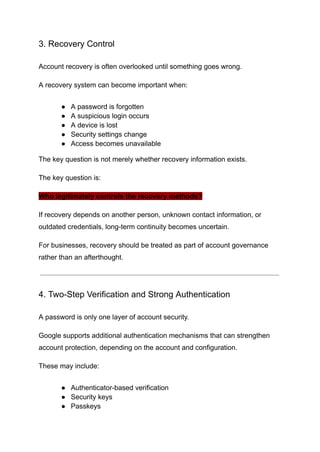
3. Recovery Control
Account recovery is often overlooked until something goes wrong.
A recovery system can become important when:
●​ A password is forgotten
●​ A suspicious login occurs
●​ A device is lost
●​ Security settings change
●​ Access becomes unavailable
The key question is not merely whether recovery information exists.
The key question is:
Who legitimately controls the recovery methods?
If recovery depends on another person, unknown contact information, or
outdated credentials, long-term continuity becomes uncertain.
For businesses, recovery should be treated as part of account governance
rather than an afterthought.
4. Two-Step Verification and Strong Authentication
A password is only one layer of account security.
Google supports additional authentication mechanisms that can strengthen
account protection, depending on the account and configuration.
These may include:
●​ Authenticator-based verification
●​ Security keys
●​ Passkeys
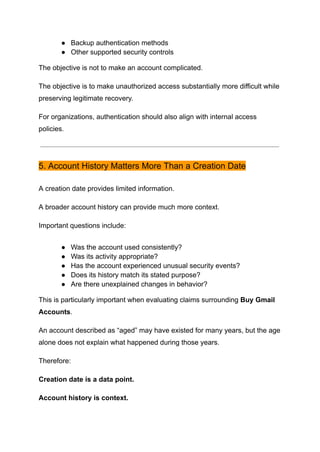
●​ Backup authentication methods
●​ Other supported security controls
The objective is not to make an account complicated.
The objective is to make unauthorized access substantially more difficult while
preserving legitimate recovery.
For organizations, authentication should also align with internal access
policies.
5. Account History Matters More Than a Creation Date
A creation date provides limited information.
A broader account history can provide much more context.
Important questions include:
●​ Was the account used consistently?
●​ Was its activity appropriate?
●​ Has the account experienced unusual security events?
●​ Does its history match its stated purpose?
●​ Are there unexplained changes in behavior?
This is particularly important when evaluating claims surrounding Buy Gmail
Accounts.
An account described as “aged” may have existed for many years, but the age
alone does not explain what happened during those years.
Therefore:
Creation date is a data point.
Account history is context.
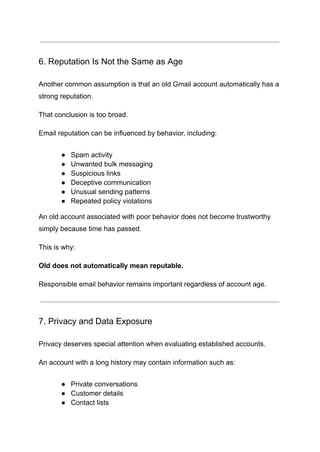
6. Reputation Is Not the Same as Age
Another common assumption is that an old Gmail account automatically has a
strong reputation.
That conclusion is too broad.
Email reputation can be influenced by behavior, including:
●​ Spam activity
●​ Unwanted bulk messaging
●​ Suspicious links
●​ Deceptive communication
●​ Unusual sending patterns
●​ Repeated policy violations
An old account associated with poor behavior does not become trustworthy
simply because time has passed.
This is why:
Old does not automatically mean reputable.
Responsible email behavior remains important regardless of account age.
7. Privacy and Data Exposure
Privacy deserves special attention when evaluating established accounts.
An account with a long history may contain information such as:
●​ Private conversations
●​ Customer details
●​ Contact lists
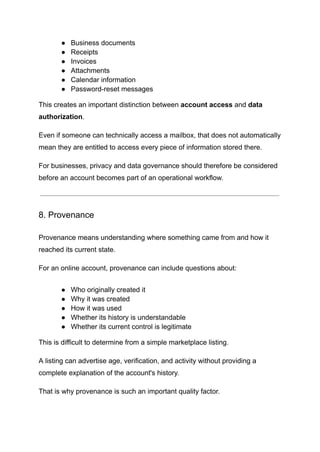
●​ Business documents
●​ Receipts
●​ Invoices
●​ Attachments
●​ Calendar information
●​ Password-reset messages
This creates an important distinction between account access and data
authorization.
Even if someone can technically access a mailbox, that does not automatically
mean they are entitled to access every piece of information stored there.
For businesses, privacy and data governance should therefore be considered
before an account becomes part of an operational workflow.
8. Provenance
Provenance means understanding where something came from and how it
reached its current state.
For an online account, provenance can include questions about:
●​ Who originally created it
●​ Why it was created
●​ How it was used
●​ Whether its history is understandable
●​ Whether its current control is legitimate
This is difficult to determine from a simple marketplace listing.
A listing can advertise age, verification, and activity without providing a
complete explanation of the account's history.
That is why provenance is such an important quality factor.
If the origin is unclear, confidence in the account should be limited.
9. Connected Applications and Devices
A Google Account may interact with many devices and third-party
applications.
Unknown or unnecessary connections can create security concerns.
A responsible account review should consider:
●​ Authorized devices
●​ Active sessions
●​ Connected applications
●​ Account permissions
●​ Recovery methods
●​ Security notifications
The more services connected to an account, the more important proper
access management becomes.
For business environments, unnecessary connections should be reviewed and
removed where appropriate.
10. Policy Compliance
Account value should always be considered alongside platform rules.
Google's policies can address areas such as:
●​ Account security
●​ Spam
●​ Abuse
●​ Deceptive activity
●​ Unauthorized access
●​ Misuse of services
An account may appear technically functional while still presenting
policy-related concerns.
Therefore, the intended use matters just as much as the account's technical
characteristics.
A sustainable email strategy should be based on activities that are consistent
with applicable Google policies.
Why “Verified” Does Not Automatically Mean “High Quality”
The word verified can create a strong impression.
But verification generally confirms something specific.
It does not necessarily answer:
●​ Who owns the account?
●​ Who controls recovery?
●​ What is the account's history?
●​ Has it been used responsibly?
●​ Is the stored information private?
●​ Is the intended use appropriate?
●​ Can the account support long-term business continuity?
This creates two important distinctions:
Verification is a signal, not a complete quality assessment.
Verification is not the same as legitimate ownership.
That distinction is particularly important when evaluating third-party account
listings.
Why “Phone-Verified” Should Be Interpreted Carefully
A phone number can play a role in account verification or security.
However, phone association does not automatically prove:
●​ Authenticity
●​ Ownership
●​ Reputation
●​ Clean history
●​ Long-term stability
●​ Business suitability
A phone-verified label therefore provides limited information by itself.
It should be evaluated alongside security, history, provenance, and legitimate
control.
The Problem With “100% Safe” Claims
Online marketplaces sometimes use absolute language.
Examples include:
●​ 100% safe
●​ Ban-proof
●​ Permanent
●​ Unlimited
●​ Zero risk
●​ Guaranteed recovery
●​ Never restricted
Such claims deserve skepticism.
No third party can responsibly guarantee that a Google Account will remain
permanently accessible regardless of future activity, security events, or
platform enforcement.
A more realistic approach is to evaluate risk factors rather than search for
impossible guarantees.
The Hidden Cost of Unclear Account Control
Price can be attractive when evaluating third-party account listings.
But initial price does not represent total cost.
Potential operational consequences can include:
●​ Loss of access
●​ Recovery difficulties
●​ Security incidents
●​ Privacy complications
●​ Communication disruption
●​ Replacement work
●​ Business continuity problems
This produces a more realistic concept of value:
Total Cost = Initial Expense + Security Risk + Recovery Risk + Privacy
Risk + Operational Risk
An account with a low upfront cost may therefore become expensive if it
creates a major continuity problem later.
Why Shared Credentials Create Business Risk
Credential sharing can make accountability difficult.
When several people use the same login, it can become harder to determine:
●​ Who accessed the account
●​ Who changed a setting
●​ Who sent a message
●​ Who connected an application
●​ Who modified recovery information
Shared access can also complicate employee changes and internal security
management.
For organizations, separate authorized accounts and appropriate
administrative controls generally provide clearer accountability than informal
credential sharing.
A Better Approach to Business Email
The legitimate business objective behind searches for Buy Gmail Accounts
is often straightforward.
Organizations may want:
●​ Reliable email
●​ Professional communication
●​ Better collaboration
●​ Organized workflows
●​ Secure authentication
●​ Scalable infrastructure
Those objectives do not require a business to build its critical communication
system around accounts with uncertain provenance or unclear ownership.
A stronger approach is to establish email infrastructure under legitimate
organizational control.
Use Properly Managed Google Accounts
Organizations can create and manage accounts through appropriate Google
services.
This makes it easier to establish:
●​ Clear ownership
●​ Controlled access
●​ Defined recovery
●​ Strong authentication
●​ Better employee management
●​ Business continuity
The central advantage is control.
Consider Google Workspace for Organizational Email
Businesses that need managed email can evaluate Google Workspace and its
administrative capabilities.
A properly managed business environment can support:
●​ Employee accounts
●​ Custom business email
●​ Administrative controls
●​ Security policies
●​ User management
●​ Organizational continuity
This is fundamentally different from depending on unrelated third-party
accounts.
Use Aliases and Shared Workflows Where Appropriate
A business does not necessarily need a separate personal mailbox for every
communication function.
Depending on its configuration, an organization can structure communication
around functions such as:
●​ Sales
●​ Support
●​ Billing
●​ Partnerships
●​ General inquiries
This can reduce unnecessary account proliferation and improve organizational
clarity.
A Practical Account-Quality Framework
When evaluating any Gmail account, consider these dimensions together:
Factor
Importance
Legitimate ownership
Very High
Security
Very High
Recovery control
Very High
Privacy
Very High
Policy compliance
Very High
Account history
High
Provenance
High
Reputation
High
Verification clarity
Medium-High
Activity history
Medium
Account age
Medium
Price
Context-dependent
This ranking highlights an important point:
The oldest account is not necessarily the best account.
Likewise:
The cheapest account is not necessarily the most economical account.
And:
The most heavily advertised account is not necessarily the most reliable
one.
A Simple Way to Think About Gmail Account Value
A useful conceptual model is:
Account Value = Control + Security + Recovery + History + Privacy +
Reputation + Compliance + Continuity
Each component addresses a different risk.
Control
Can the authorized owner manage the account?
Security
Are appropriate protections in place?
Recovery
Can legitimate access be restored when necessary?
History
Is the account's past understandable and appropriate?
Privacy
Is stored information protected and accessed appropriately?
Reputation
Does the account's behavior support responsible communication?
Compliance
Does its intended use align with applicable platform policies?
Continuity
Can the organization continue operating if the account becomes unavailable?
This model is more useful than judging an account from a single marketplace
label.
Due-Diligence Questions Worth Asking
Before an organization depends on any Gmail account, it should be able to
answer questions such as:
●​ Who legitimately controls the account?
●​ What exactly does the term “verified” mean?
●​ Who controls the recovery methods?
●​ Is strong authentication enabled?
●​ Is the account history understandable?
●​ Are there suspicious or unexplained security events?
●​ What information may already be stored in the account?
●​ Which applications or devices are connected?
●​ Does the intended use comply with applicable Google policies?
●​ What happens if access is lost?
●​ Is the organization unnecessarily dependent on one mailbox?
●​ Could the same business objective be achieved through a properly
managed Google Workspace environment?
If several important answers remain unknown, the account should not be
treated as a dependable foundation for critical business operations.
Frequently Asked Questions
What makes a Gmail account truly valuable?
A Gmail account's value is better determined by legitimate control, security,
recovery, privacy, history, reputation, provenance, and appropriate use than by
age or price alone.
Are older Gmail accounts automatically better?
No. Age provides historical context, but it does not guarantee security,
legitimate ownership, clean history, reputation, or long-term reliability.
Does phone verification prove account quality?
No. Phone verification can be one security or verification signal, but it does not
establish overall account quality.
Does a verified account guarantee permanent access?
No. Verification does not guarantee permanent access, uninterrupted
availability, or freedom from future security or policy issues.
Why is account provenance important?
Provenance helps explain where an account came from and how it was used.
Unclear provenance makes it harder to evaluate legitimacy and long-term
reliability.
Why does recovery control matter?
Recovery methods can determine who can legitimately regain access after a
password or security problem. Recovery controlled by someone else can
create serious continuity concerns.
Can an established Gmail account contain private information?
Yes. Depending on its history, an account can contain emails, contacts,
attachments, calendar information, Drive content, and other data. Appropriate
authorization is therefore essential.
Is account age a useful metric?
Yes, but only as one metric. Age can provide historical context, while security,
ownership, provenance, and current use provide a broader picture of quality.
Is a cheap Gmail account necessarily a good deal?
No. A low initial price may be outweighed by recovery, privacy, security, or
continuity risks.
What is a stronger long-term solution for businesses?
Organizations that need managed business email can consider properly
configured Google Workspace or other legitimate business email infrastructure
that provides clear ownership, administrative control, security, and continuity.
Final Verdict
The search phrase Buy Gmail Accounts reflects a real demand for reliable
digital communication and established email infrastructure. But the most
valuable account is not necessarily the oldest, cheapest, most active, or most
heavily advertised.
The stronger evaluation begins with legitimate ownership and control.
From there, businesses should consider:
Security
Recovery
Privacy
History
Provenance
Reputation
Policy compliance
Business continuity
These factors provide a much more realistic understanding of account value.
An aged account is not automatically trustworthy.
A verified account is not automatically high-quality.
A phone-verified account is not automatically secure.
A working login is not automatically legitimate ownership.
And a low price is not automatically a low total cost.
The most sustainable approach is to build email infrastructure around
accounts that the authorized individual or organization can properly control,
secure, recover, and manage.
That is what turns email from a simple login into dependable business
infrastructure.
Age provides history.
Verification provides a signal.
Security protects access.
Provenance provides context.
Legitimate ownership provides control.
And strong infrastructure creates long-term reliability.
For anyone researching Buy Gmail Accounts in 2026, that is the distinction
that matters most.