Buy aged Gmailaccounts 2026 — Guide
& Risks to know
The search term Buy Old Gmail Accounts is commonly associated with people researching
older or aged Gmail accounts and trying to understand how they differ from newly created
email accounts. An old Gmail account has simply existed for a longer period, which means it
may have accumulated a history of emails, contacts, settings, subscriptions, and other
account activity.
However, account age should never be confused with account quality.
A Gmail account that has existed for many years is not automatically more secure, more
trustworthy, or more reliable than a recently created account. In fact, an older account can
introduce additional questions about previous activity, privacy, recovery information, and
legitimate ownership.
For anyone researching old or aged Gmail accounts, understanding these issues is much
more valuable than focusing exclusively on age. This guide explores the topic from a
2.
security, privacy, business,and account-management perspective while highlighting safer
approaches for legitimate email needs.
What Does “Buy Old Gmail Accounts” Mean?
The phrase Buy Old Gmail Accounts generally refers to searches involving Gmail accounts
that were created in the past and have therefore accumulated account age.
An old account may have existed for months or years.
Its history could include:
● Emails
● Contacts
● Documents
● Notifications
● Subscriptions
● Account settings
● Connected services
However, the creation date does not reveal everything about the account.
It does not automatically tell you:
● Whether the account is secure
● Who legitimately controls it
● Whether recovery information is current
● Whether historical information remains inside it
● Whether the account is appropriate for a particular purpose
Therefore, account age should be considered only one characteristic.
Why People Search for Old Gmail
Accounts
There are many reasons someone might search for information about aged Gmail accounts.
Some people are researching the concept itself. Others may be comparing older and newer
email accounts for legitimate business or communication purposes.
Related searches include:
● Buy Old Gmail Accounts
● Buy Aged Gmail Accounts
● Old Gmail Accounts
● Aged Gmail Accounts
● Buy Gmail Accounts
3.
● Buy VerifiedGmail Accounts
● Gmail Account Security
● Gmail Account Recovery
● Gmail for Business
These keywords may represent very different intentions.
For that reason, it is important to separate understanding account age from assumptions
about what an old account can accomplish.
Account Age Is Not a Trust Score
One of the biggest misconceptions surrounding old Gmail accounts is that age automatically
creates trust.
It does not.
An account could be ten years old and still have poor security practices.
For example, it might have:
● Outdated recovery information
● Weak account-management practices
● Unknown historical activity
● Unnecessary connected services
● Old private information
Conversely, a newly created account can be securely configured by its legitimate owner.
Therefore:
Account age ≠ account security
Account age ≠ account ownership
Account age ≠ account trust
This distinction is essential when evaluating any email account.
Old Gmail Accounts vs New Gmail
Accounts
The most obvious difference is historical depth.
A New Gmail Account
4.
A new accountstarts with a relatively clean environment.
The legitimate owner can establish:
● A secure password
● Recovery options
● Security settings
● Account purpose
● Email organization
● Communication history
This provides greater clarity about the account's origin and management.
An Old Gmail Account
An existing account may contain years of accumulated information.
It may have:
● Previous emails
● Existing contacts
● Old notifications
● Files
● Subscriptions
● Connected services
This history can make the account more complicated.
Therefore, older does not necessarily mean preferable.
What Is an Aged Gmail Account?
An aged Gmail account generally means an account that has existed for a relatively long
time.
The word aged describes its historical age.
It does not automatically indicate:
● High quality
● Strong security
● Permanent access
● Clean history
● Better performance
The term should therefore be understood descriptively rather than as a guarantee.
5.
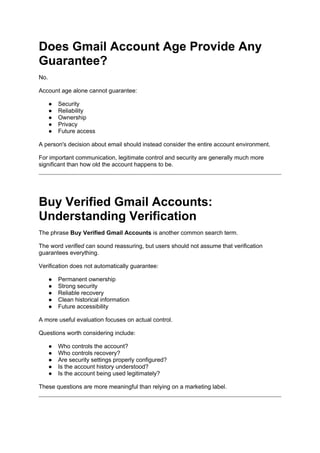
Does Gmail AccountAge Provide Any
Guarantee?
No.
Account age alone cannot guarantee:
● Security
● Reliability
● Ownership
● Privacy
● Future access
A person's decision about email should instead consider the entire account environment.
For important communication, legitimate control and security are generally much more
significant than how old the account happens to be.
Buy Verified Gmail Accounts:
Understanding Verification
The phrase Buy Verified Gmail Accounts is another common search term.
The word verified can sound reassuring, but users should not assume that verification
guarantees everything.
Verification does not automatically guarantee:
● Permanent ownership
● Strong security
● Reliable recovery
● Clean historical information
● Future accessibility
A more useful evaluation focuses on actual control.
Questions worth considering include:
● Who controls the account?
● Who controls recovery?
● Are security settings properly configured?
● Is the account history understood?
● Is the account being used legitimately?
These questions are more meaningful than relying on a marketing label.
6.
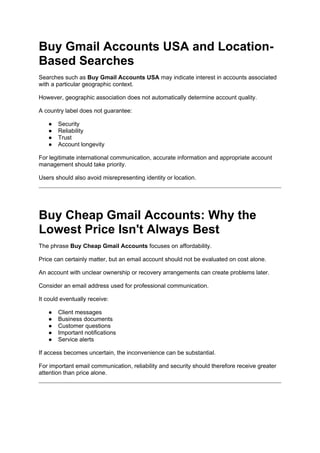
Buy Gmail AccountsUSA and Location-
Based Searches
Searches such as Buy Gmail Accounts USA may indicate interest in accounts associated
with a particular geographic context.
However, geographic association does not automatically determine account quality.
A country label does not guarantee:
● Security
● Reliability
● Trust
● Account longevity
For legitimate international communication, accurate information and appropriate account
management should take priority.
Users should also avoid misrepresenting identity or location.
Buy Cheap Gmail Accounts: Why the
Lowest Price Isn't Always Best
The phrase Buy Cheap Gmail Accounts focuses on affordability.
Price can certainly matter, but an email account should not be evaluated on cost alone.
An account with unclear ownership or recovery arrangements can create problems later.
Consider an email address used for professional communication.
It could eventually receive:
● Client messages
● Business documents
● Customer questions
● Important notifications
● Service alerts
If access becomes uncertain, the inconvenience can be substantial.
For important email communication, reliability and security should therefore receive greater
attention than price alone.
7.
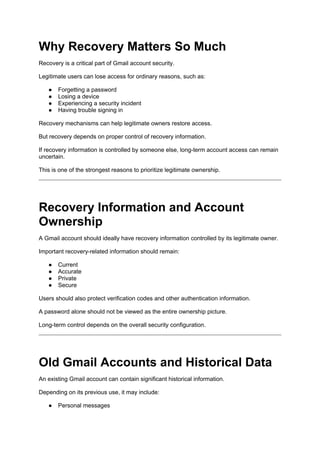
Why Recovery MattersSo Much
Recovery is a critical part of Gmail account security.
Legitimate users can lose access for ordinary reasons, such as:
● Forgetting a password
● Losing a device
● Experiencing a security incident
● Having trouble signing in
Recovery mechanisms can help legitimate owners restore access.
But recovery depends on proper control of recovery information.
If recovery information is controlled by someone else, long-term account access can remain
uncertain.
This is one of the strongest reasons to prioritize legitimate ownership.
Recovery Information and Account
Ownership
A Gmail account should ideally have recovery information controlled by its legitimate owner.
Important recovery-related information should remain:
● Current
● Accurate
● Private
● Secure
Users should also protect verification codes and other authentication information.
A password alone should not be viewed as the entire ownership picture.
Long-term control depends on the overall security configuration.
Old Gmail Accounts and Historical Data
An existing Gmail account can contain significant historical information.
Depending on its previous use, it may include:
● Personal messages
8.
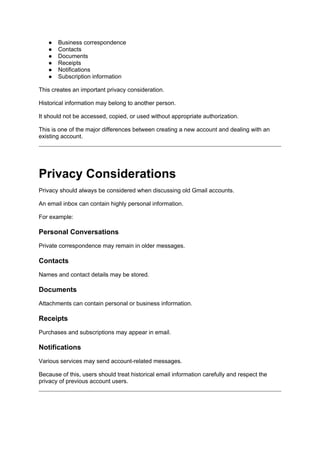
● Business correspondence
●Contacts
● Documents
● Receipts
● Notifications
● Subscription information
This creates an important privacy consideration.
Historical information may belong to another person.
It should not be accessed, copied, or used without appropriate authorization.
This is one of the major differences between creating a new account and dealing with an
existing account.
Privacy Considerations
Privacy should always be considered when discussing old Gmail accounts.
An email inbox can contain highly personal information.
For example:
Personal Conversations
Private correspondence may remain in older messages.
Contacts
Names and contact details may be stored.
Documents
Attachments can contain personal or business information.
Receipts
Purchases and subscriptions may appear in email.
Notifications
Various services may send account-related messages.
Because of this, users should treat historical email information carefully and respect the
privacy of previous account users.
9.
Old Gmail Accountsand Connected
Services
A Gmail account may be connected to more than email.
Depending on its history, it could be associated with:
● Files
● Contacts
● Subscriptions
● Other Google services
● Account notifications
This means an existing Gmail account may represent a broader digital environment.
Users should understand that changing the way an existing account is used can have
implications beyond the inbox itself.
Old Gmail Accounts for Business
Gmail can be useful for legitimate business communication.
Businesses commonly rely on email for:
● Customer inquiries
● Client communication
● Team discussions
● Project updates
● Document exchange
● Business notifications
For professional use, account ownership should be clear.
A business should know:
● Who manages the account
● Who has authorization
● Who controls recovery
● What information is stored
A professional email system should be built around continuity and security.
Old Gmail Accounts for Customer
Service
10.
A customer-service inboxmay receive messages about:
● Orders
● Products
● Services
● Technical problems
● Appointments
● General questions
These messages can contain personal information.
Therefore, businesses should ensure that only authorized personnel have access.
They should also maintain:
● Secure credentials
● Appropriate recovery controls
● Clear responsibility
● Organized communication
● Privacy-conscious data handling
Old Gmail Accounts for Freelancers
Freelancers may use Gmail for almost every part of their professional workflow.
Email can be used for:
● Client communication
● Project updates
● Scheduling
● Document exchange
● Invoices
● Notifications
A professional email address can become an important part of a freelancer's identity.
For that reason, legitimate control and reliable recovery are especially important.
Old Gmail Accounts for Remote Work
Remote professionals often depend on email to communicate with:
● Employers
● Clients
● Managers
● Colleagues
● Partners
11.
Important documents mayalso be delivered through email.
Security therefore becomes a major consideration.
Users should maintain secure credentials, protect recovery information, and avoid
unnecessary account sharing.
Old Gmail Accounts and Professional
Identity
An email address may eventually appear on:
● Business websites
● Contact pages
● Invoices
● Professional profiles
● Client documents
Once an address becomes associated with a professional identity, account continuity
matters.
Losing access can result in missed communication and administrative difficulties.
A professionally important email account should therefore be securely and legitimately
controlled.
Gmail and Responsible Marketing
Gmail can support legitimate marketing and customer communication.
Responsible email marketing should focus on:
● Relevance
● Transparency
● Honest sender information
● Useful content
● Appropriate frequency
Users should avoid spam, deceptive communication, and misleading messages.
An old account does not provide special permission to bypass responsible email practices.
12.
Gmail Security Checklist
Whetheran account is old or new, a basic security checklist can help.
Password
Use a strong, private password.
Recovery
Keep recovery information current and controlled.
Verification
Protect verification codes and authentication information.
Account Activity
Monitor unusual activity.
Connected Services
Review services associated with the account.
Privacy
Protect sensitive emails and documents.
Access
Limit access to authorized users.
These practices are valuable for everyday Gmail management.
Common Risks of Old Gmail Accounts
Old accounts can introduce several categories of risk.
Unknown History
Previous use may not be fully understood.
Recovery Risk
Someone else may retain recovery access.
13.
Privacy Risk
Historical personalinformation may remain.
Connected-Service Risk
Older services may still be linked.
Ownership Risk
Control may be unclear.
Organizational Risk
A large inbox can be difficult to manage.
Recognizing these risks helps users understand why account age alone is insufficient.
How to Evaluate an Existing Gmail
Account
A useful framework is to consider several dimensions.
1. Age
How long has the account existed?
2. Ownership
Who legitimately controls it?
3. Security
Are the security settings appropriate?
4. Recovery
Who controls recovery methods?
5. History
What information is already present?
14.
6. Privacy
Could historicaldata belong to another person?
7. Purpose
What legitimate purpose will the account serve?
This framework provides a more complete evaluation.
Why Legitimate Ownership Comes First
The most important principle is simple:
The legitimate owner should control the account.
That includes appropriate control of:
● Login credentials
● Recovery methods
● Security settings
● Account activity
Without legitimate control, an account's age becomes almost irrelevant.
An old account with uncertain ownership is not necessarily a dependable digital asset.
Why Security Matters More Than Age
Security determines how well an account can be protected.
Important security practices include:
● Strong credentials
● Protected recovery information
● Secure verification methods
● Regular security reviews
● Awareness of suspicious activity
These practices apply to every Gmail account.
A newly created account with strong security can be much safer than an old account with
poor security.
15.
Why Privacy MattersMore Than
Historical Age
Historical information can have significant value to the person who originally created it.
Private correspondence should remain private.
This means users should be cautious about accounts containing historical data.
The responsible approach is to respect privacy and avoid accessing information that is not
authorized for use.
Why Price Should Not Be the Main
Factor
A low price may seem attractive.
But email accounts can become important over time.
If an account is used for:
● Business
● Professional communication
● Customer service
● Important notifications
then security and continuity become much more important.
A cheap solution that creates access or privacy problems later may not be economical in the
long run.
Safer Alternative: Create and Manage
Your Own Account
For many legitimate users, creating a new Gmail account can be the simplest and safest
starting point.
The owner can establish:
● Account purpose
● Password
● Recovery options
● Security settings
16.
● Email organization
Thereis also less uncertainty about historical information.
For organizations, business-focused email solutions can provide additional administration
and account-management capabilities.
Building a Secure Gmail Workflow
A secure email workflow can include:
1. Establishing clear ownership
2. Protecting login credentials
3. Maintaining recovery information
4. Reviewing security settings
5. Organizing messages
6. Protecting private information
7. Monitoring account activity
8. Limiting unauthorized access
These practices help create a stable long-term email environment.
Common Mistakes to Avoid
Mistake 1: Assuming Old Means Trusted
Age alone does not establish trust.
Mistake 2: Ignoring Recovery
Recovery is essential to long-term access.
Mistake 3: Ignoring Historical Privacy
Old messages may contain sensitive information.
Mistake 4: Sharing Security Information
Passwords and verification codes should remain private.
Mistake 5: Choosing Based Only on Price
Low cost does not guarantee reliability.
Mistake 6: Ignoring Account Security
17.
Security settings shouldbe reviewed regularly.
Mistake 7: Using Email Irresponsibly
Spam and deceptive communication can create problems.
Frequently Asked Questions
What does Buy Old Gmail Accounts mean?
It generally refers to searches concerning Gmail accounts that have existed for a longer
period.
What is an aged Gmail account?
It is generally an account with an older creation history.
Does an old Gmail account automatically have higher
trust?
No. Account age alone does not establish trust.
Does verification guarantee permanent access?
No. Verification does not guarantee permanent ownership or future access.
Why is recovery important?
Recovery helps the legitimate owner regain access when normal sign-in becomes
unavailable.
Can old Gmail accounts contain private information?
Yes. Existing accounts can contain historical emails, contacts, documents, receipts, and
other information.
Is a cheap Gmail account automatically a good choice?
No. Security, ownership, recovery, privacy, and intended use are also important.
Can Gmail be used for business?
18.
Yes. Gmail cansupport legitimate business communication, customer service, professional
correspondence, and project work.
Does a country-specific Gmail account guarantee
better quality?
No. Geographic association does not automatically determine security or reliability.
What is more important than account age?
Legitimate ownership, security, recovery control, privacy, account history, and responsible
use are generally more important than age.
Final Thoughts
The subject of Buy Old Gmail Accounts should be approached with a clear understanding
of what account age actually means.
An old Gmail account is simply an account with a longer history. That history may include
useful organizational information, but it can also contain private messages, old contacts,
documents, subscriptions, and connected services.
Therefore, an old account is not automatically safer, more trustworthy, or more reliable.
The most important considerations are legitimate ownership, strong security, reliable
recovery, privacy protection, understandable account history, and responsible use.
For individuals, freelancers, businesses, and professionals, these factors can matter far
more than the number of years an account has existed.
If an email account is going to become important, the best long-term strategy is to ensure
that it is securely controlled, properly recoverable, responsibly managed, and appropriate for
its intended purpose.
Account age may describe history, but responsible ownership determines reliability.