2
What is Research
Research is the systematic investigation into and
study of materials, sources in order to establish facts
and reach new conclusions.
An endeavour to discover new or collate old facts by
the scientific study of a subject or by a course of
critical investigation.
Research is what we do when we have a question or a
problem we want to resolve.
A combination of investigation of past work and effort
in the present that will help others in the future”
3.
3
Research is…
Acombination of investigation of past work and effort in the present
that will help others in the future”.
Finding or developing something new that changes the world
Research describes what or explains why
It is a method for finding answers to questions or a strategy for
explanation
A systematized effort to gain new knowledge; A movement from
the known to the unknown
Search for (new) knowledge/facts through objective, systematic
and scientific method of finding solution to a problem
4.
4
Research…
An activitycaused by instinct of inquisitiveness (curiosity
and questioning) to:
acquire knowledge
gain fresh insight
find answers to questions.
An art of scientific investigation, which means
systematic search for pertinent information on a specific
topic
Process of arriving at dependable solutions to problems
through the planned & systematic collection, analysis &
interpretation of data
Research is an academic activity
Search for knowledge
5.
5
..
Research isan academic activity and as such the term
should be used in a technical sense.
According to Clifford Woody research comprises
defining and redefining problems, formulating
hypothesis or suggested solutions; collecting,
organizing and evaluating data; making deductions
and reaching conclusions
Research is, thus, an original contribution to the
existing stock of knowledge making for its
advancement
6.
6
…
Research oftenmakes use of various sources of
knowledge.
Intuitive (when coming up with an initial idea for
research.
Authoritative (when reviewing professional literature
Logical (when reasoning from findings to conclusion
Empirical (when engaging in procedures that lead to
these findings by performing experiments.
7.
7
Research …..
Asystematic means of problem solving (Tuckman
1978)
5 key characteristics of research
1. Systematic – research process
2. Logical – induction/deduction
3. Empirical – evidence based
4. Reductive – generalisation
5. Replicable – methodology.
8.
8
Research is Not
Research isn’t information gathering:
Gathering information from resources such as books or
magazines isn’t research.
No contribution to new knowledge.
Research isn’t the transportation of facts:
Merely transporting facts from one resource to another
doesn’t constitute research.
No contribution to new knowledge although this might
make existing knowledge more accessible.
Missed the essence of research: the interpretation of data.
Doing what others have already done
9.
9
Why Research
Researchallows you to learn something new, to perfect
your problem-solving skills, to challenge yourself in
new ways and to pursue your interests.
To learn to read and think critically.
To face a challenge
To solve a problem
To get a degree
To get intellectual joy
To bring advancement of wealth of human knowledge
10.
10
Conti. ..
To servesociety
by increasing standard of living in case of
Science & Technology, and
by showing the right path in case of Social and
behavioral Sciences.
11.
11
Objective of Research
The purpose of research is to discover answers to
questions through the application of scientific procedures.
The main aim of research is to find out the truth which is
hidden and which has not been discovered as yet.
Though each research study has its own specific purpose,
Research objectives as falling into a number of the
following broad groupings:
To gain familiarity with a phenomenon or to achieve new
insights into it (studies with this object in view are termed
as exploratory or formulative research studies).
12.
12
..
To portrayaccurately the characteristics of a
particular individual, situation or a group(studies with
this object in view are known as descriptive research
studies)
To determine the frequency with which something
occurs or with which it is associated with something
else (studies with this object in view are known as
diagnostic research studies);
To test a hypothesis of a causal relationship
13.
13
Research Characteristics
Originateswith a question or problem.
Requires clear expression of a goal.
Follows a specific plan or procedure.
Often divides main problem into sub problems.
Tentatively guided by a research problem, question, or
hypothesis.
Accepts certain critical assumptions.
By its nature it is more circular and iterative.
Requires collection and interpretation of data.
Requires design, testing, and verification of algorithm
14.
14
Motivation in Research
What makes people undertake research?
Desire to get a research degree along with its
consequential benefits.
Desire to face the challenge in solving the unsolved
problems, i.e., concern over practical problems
initiates research
Desire to get intellectual joy of doing some creative
work.
Desire to be of service to society
Desire to get respectability.
15.
15
Who Does Research
GraduateStudents
Masters Degree
Ph.D. Degree
Researchers at universities
Post-Doctoral students
Faculty members
Researchers in industry
Research scientists
Many other technical workers
Undergraduate students
16.
16
Qualities of GoodResearch
Research is:
Empirical, because it is based on evidence or data
-It provides a basis for external validity to results
(validation)
Systematic, because it uses a method
-It rejects the use of guessing & intuition, but
does not rule out creative thinking
Objective, because it is presumably conducted and
interpreted by the researcher without any bias
Controlled – Variables are identified & controlled,
wherever possible
17.
17
Cont.…
Logical -Guided by rules of logical reasoning &
logical process of induction & deduction
Replicable – produce the same results if repeated
exactly. So replicability will help to verify and
confirm the study
Self Correcting - Built in mechanism & open to
public scrutiny (examination) by fellow
professionals.
18.
18
Is Research thesame as Project
A project is where you apply the theories that you
have learned to practice, where as a research goes a
little beyond that.
you apply existing theories (you have learned) but
will be coming up with new theories or concepts of
your own.
you will have to experiment new scenario, interpret
it and come up with findings in your study.
you cannot be certain of the result till you are done
with your research.
19.
19
How to doResearch
Research is all about addressing an issue or asking and
answering a question or solving a problem
Select topic: identify an issue, question, or problem.
Talk with people who want or need your study.
Review literature: find out what's already known
about it.
Talk with experts and/or read their reviews and the
original research on the topic.
Develop research proposal: plan, cost, and do your
study accordingly.
Write research report and submit it for evaluation.
Better still, do a good job on it and submit it for
publication.
20.
20
Major Research Paradigms
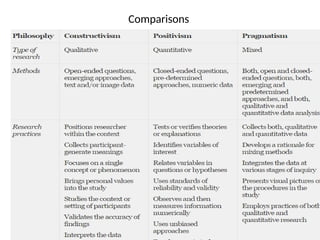
A research paradigm is an approach or a research model
to conducting a research that has been verified by
the research community for long and that has been in
practice for hundreds of years.
A research paradigm is “the set of common beliefs
and agreements shared between scientists about how
problems should be understood and addressed”
(Kuhn, 1962)
A paradigm is a set of shared beliefs among members of
a specialty area and, a paradigm as a model example
of research (Morgan, 2007)
Research paradigms are (Positivists, Constructivist,
Emancipator /pragmatist).
21.
21
Positivists
Most ofthe scientific or quantitative research use
positivism as a conceptual framework for research.
Quantitative research always follows positivist approach
because positivists believe in the empirical hypothesis
testing.
In pure sciences, positivism is preferred because of its
empirical nature to study facts. In quantitative research,
the research follows a probabilistic model that is
determined by previous research.
Positivists believe that the findings of one study can be
generalized to another study of a similar kind regardless of
it is conducted in a different environment and situation
22.
22
..
The positivistparadigm of exploring social reality is
based on the idea that one can best gain an
understanding of human behavior through
observation and reason.
Stated differently, only objective, observable facts
can be the basis for science.
23.
23
Constructivist
Honebein (1996)describesconstructivism paradigm
as an approach that asserts that people construct their own
understanding and knowledge of the world through experiencing
things and reflecting on those experiences.
“Constructivism is the recognition that reality is a product of
human intelligence interacting with experience in the real world. As
soon as you include human mental activity in the process of
knowing reality” Davis Elkind.
It is based on the analogy or basis that people form or construct
much of what they learn through experience (Cashman et al., 2008;
Hein, 1991).
Constructivism philosophy is based on cognitive psychology
and its background relates to Socratic method, ancient Greece.
24.
24
….
The maindistinction between constructivism
philosophy and positivism relates to the fact that
while positivism argues that knowledge is generated
in a scientific method,
Constructivism maintains that knowledge is
constructed by scientists and it opposes the idea that
there is a single methodology to generate knowledge
25.
25
Emancipator /Pragmatist/
Pragmatismresearch philosophy accepts concepts to be relevant
only if they support action.
Pragmatics “recognise that there are many different ways of
interpreting the world and undertaking research, that no single
point of view can ever give the entire picture and that there may be
multiple realities.
According to pragmatism research philosophy, research question
is the most important determinant of the research philosophy.
Pragmatist management researchers can be compared to architects.
In the same way architects use whatever materials and methods
needed to build the building they schemed in paper, pragmatists
use whatever combination of methods necessary to find answers to
research questions.
27
Research Types
GeneralClassification of Types of Research Methods
Types of research methods can be broadly divided into
two quantitative and qualitative categories.
Quantitative Research “describes, infers, and resolves
problems using numbers.
Emphasis is placed on the collection of numerical data,
the summary of those data and the drawing of inferences
from the data”
A research which is based on the measurement of quantity
or amount.
It is applicable to phenomena that can be expressed in
terms of quantity
28.
28
Qualitative research
Qualitativeresearch, is based on words, feelings, emotions,
sounds and other non-numerical and unquantifiable
elements.
It has been noted that “information is considered qualitative
in nature if it cannot be analyzed
by means of mathematical techniques. This characteristic
may also mean that an incident does not take place often
enough to allow reliable data to be collected
Qualitative research is specially important in the behavioral
sciences where the aim is to discover the underlying
motives of human behavior
29.
29
Types of Researchbased purpose
Two categories applied research and fundamental research.
Applied research is also referred to as an action research, and
the fundamental research is sometimes called basic or pure
research.
Applied Research
The purpose of applied research is to solve an
immediate, practical problem.
Applied research aims at finding a solution for an
immediate problem facing a society or an
industrial/business organization
The central aim of applied research is to discover a
solution for some pressing practical problem
30.
30
…
Basic Research(Pure Research, Fundamental Research)
Basic Research adds to the existing body of knowledge.
It doesn't necessarily provide results of immediate,
practical use.
It is mainly concerned with generalizations and with the
formulation of a theory.
“Gathering knowledge for knowledge’s sake is termed
‘pure’ or ‘basic’ research.”
Research concerning some natural phenomenon or relating
to pure mathematics are examples of fundamental research
31.
31
Types of researchbased on nature
Types of the research methods according to the nature of
research can be divided into two groups: descriptive and
analytical.
Descriptive research usually involves surveys and studies
that aim to identify the facts.
In other words, descriptive research mainly deals with the
“description of the state of affairs as it is at present "and there
is no control over variables in descriptive research.
Analytical research, is fundamentally different in a way that
“the researcher has to use facts or information already
available and analyze these in order to make a critical
evaluation of the material
32.
32
Research type
ConceptualResearch
Conceptual research is that related to some abstract idea(s)
or theory. It is generally used by philosophers and thinkers
to develop new concepts or to reinterpret existing ones.
Empirical Research
Empirical research relies on experience or observation
alone, often without due regard for system and theory. It is
data-based research, coming up with conclusions which are
capable of being verified by observation or experiment.
We can also call it as experimental type of research. In such
a research it is necessary to get at facts firsthand, at their
source, and actively to go about doing certain things to
stimulate the production of desired information.
33.
33
Empirical Research
Iscommonly used in sciences such as computer
science and engineering, physics, chemistry, biology…
Such research is thus characterized by the
experimenter’s control over the variables under study
and his deliberate manipulation of one of them to
study its effects.
Empirical research is appropriate when proof is
sought that certain variables affect other variables in
some way.
Evidence gathered through experiments or empirical
studies is today considered to be the most powerful
support possible for a given hypothesis.
34.
34
Types of research…
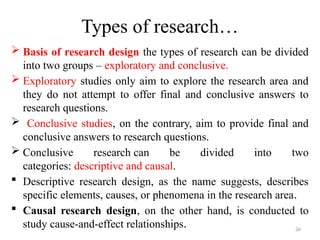
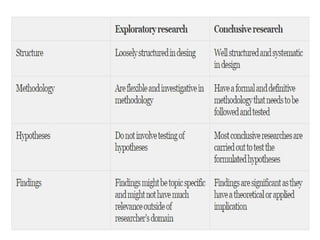
Basis of research design the types of research can be divided
into two groups – exploratory and conclusive.
Exploratory studies only aim to explore the research area and
they do not attempt to offer final and conclusive answers to
research questions.
Conclusive studies, on the contrary, aim to provide final and
conclusive answers to research questions.
Conclusive research can be divided into two
categories: descriptive and causal.
Descriptive research design, as the name suggests, describes
specific elements, causes, or phenomena in the research area.
Causal research design, on the other hand, is conducted to
study cause-and-effect relationships.
36
Other Types ofResearch
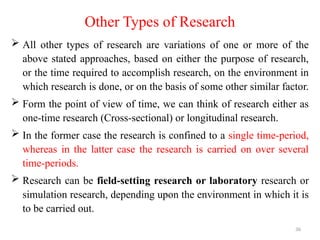
All other types of research are variations of one or more of the
above stated approaches, based on either the purpose of research,
or the time required to accomplish research, on the environment in
which research is done, or on the basis of some other similar factor.
Form the point of view of time, we can think of research either as
one-time research (Cross-sectional) or longitudinal research.
In the former case the research is confined to a single time-period,
whereas in the latter case the research is carried on over several
time-periods.
Research can be field-setting research or laboratory research or
simulation research, depending upon the environment in which it is
to be carried out.
37.
37
Research Questions
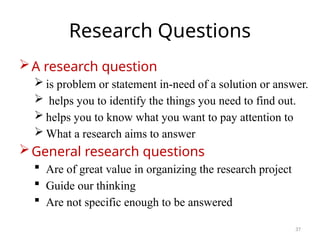
A researchquestion
is problem or statement in-need of a solution or answer.
helps you to identify the things you need to find out.
helps you to know what you want to pay attention to
What a research aims to answer
General research questions
Are of great value in organizing the research project
Guide our thinking
Are not specific enough to be answered
38.
38
..
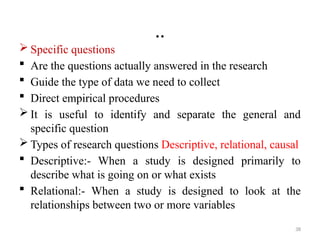
Specific questions
Are the questions actually answered in the research
Guide the type of data we need to collect
Direct empirical procedures
It is useful to identify and separate the general and
specific question
Types of research questions Descriptive, relational, causal
Descriptive:- When a study is designed primarily to
describe what is going on or what exists
Relational:- When a study is designed to look at the
relationships between two or more variables
39.
39
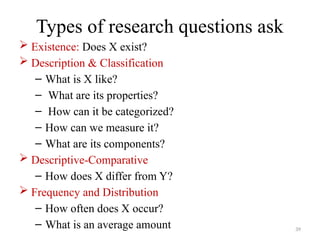
Types of researchquestions ask
Existence: Does X exist?
Description & Classification
– What is X like?
– What are its properties?
– How can it be categorized?
– How can we measure it?
– What are its components?
Descriptive-Comparative
– How does X differ from Y?
Frequency and Distribution
– How often does X occur?
– What is an average amount
40.
40
………
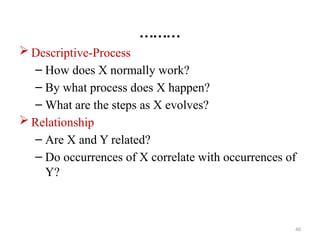
Descriptive-Process
– Howdoes X normally work?
– By what process does X happen?
– What are the steps as X evolves?
Relationship
– Are X and Y related?
– Do occurrences of X correlate with occurrences of
Y?
41.
41
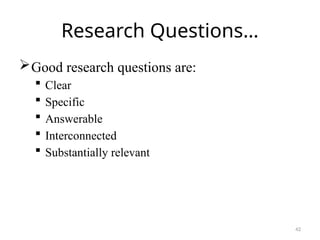
Research Questions..
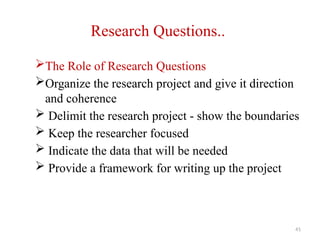
The Roleof Research Questions
Organize the research project and give it direction
and coherence
Delimit the research project - show the boundaries
Keep the researcher focused
Indicate the data that will be needed
Provide a framework for writing up the project
43
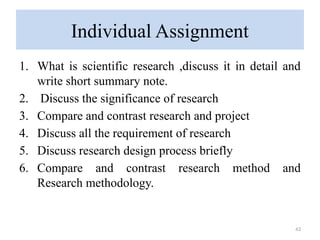
Individual Assignment
1. Whatis scientific research ,discuss it in detail and
write short summary note.
2. Discuss the significance of research
3. Compare and contrast research and project
4. Discuss all the requirement of research
5. Discuss research design process briefly
6. Compare and contrast research method and
Research methodology.