Business Analytics & Text Mining
Modeling Using Python
Introduction to Python
Dr. GAURAV DIXIT
DEPARTMENT OF MANAGEMENT STUDIES
1
Introduction to Python
• Installing Python and Jupyter using the Anaconda Distribution
– Includes Python
– Jupyter Notebook
– Other commonly used packages for scientific computing and data
science
– Download Link (Windows PC or Laptop):
https://www.anaconda.com/download/#windows
2
Introduction to Python
• Once Installation is complete
– Launch Jupyter Notebook
– A new browser window (or a new tab) showing the Notebook
Dashboard will get launched
• Jupyter Notebook
– About Programming (coding and execution) in a Web browser
– Code (instructions) and execution output are displayed “in-line”
– Can be used for other programming languages like R and JAVA
3
Introduction to Python
• Alternatives to Run Python code
– Python interpreter
• Standard >>> prompt
– Ipython
• An enhanced Python interpreter
• Numbered In [1]: style prompt
– Jupyter notebooks
• Web-based code notebooks
• Numbered In [1]: style prompt
4
Introduction to Python
• Jupyter Notebook
– Typically used as a local computing environment
– Can be deployed on servers and accessed remotely
– Creating a notebook file
• A file with the extension .ipynb
• A self-contained file format
• Contains all of the content (including any evaluated code output)
• Python Basics
– Open Jupyter Notebook
5
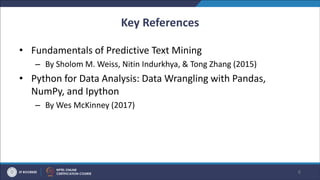
Key References
• Fundamentals of Predictive Text Mining
– By Sholom M. Weiss, Nitin Indurkhya, & Tong Zhang (2015)
• Python for Data Analysis: Data Wrangling with Pandas,
NumPy, and Ipython
– By Wes McKinney (2017)
6
Thanks…
7