BSBINN301
Promote innovation in
a team environment
YEE SIN MUN ID: MEI 2385
Evaluate
 Know your business/organisation
 Who your customers are- What are their needs
 Are the customers’ needs are being met
 Look at your team and their work performance
 Evaluate the current working practices
 What does the team need
 Include your team- will validate their input and be
more positive towards any change
Information on your team
members
Information about current or potential team
members’ work may relate to:
 Interests
 Lifestyle preferences
 Past jobs
 Technical strengths
 Work preferences
 Working styles.
Cross-fertilising ideas
The cross-fertilisation of ideas refers to the process of
bringing together ideas from different sources.
Selecting a diverse set of team members within a team
can help to facilitate the cross-fertilisation of ideas and
inspire innovation.
Different ways that people may
contribute
Others may bring:
 Positive energy within the team
 Literacy strengths
 Ideas
 Problem-solving capacities
 Specific technical skills and knowledge.
Networks and spheres of influence can also have a
positive effect of promoting innovation in your team.
Establish rules
 Roles and responsibilities
 Timelines
 Confidentiality
 Copyright, moral rights or intellectual property
 Communication.
Process for establishing ground rules
 Clarify the roles and responsibilities of each team
member
 Outline any legislative or organisational policies,
procedures or other requirements
 Lay out expectations
 Explain proper procedures for expressing grievances
or concerns and reporting structures
 Outline modes and means of communication
between the team.
Process for establishing ground rules
 Assign work allocations
 Set out any other expectations or obligations
 Allow team members to ask questions and clarify any
issues.
Planning and scheduling activities
 Identify objectives – what
needs to be done?
 Establish priorities – what
needs to be done first?
What is the most important
task(s)?
 Establish sequence – in
what order should tasks be
carried out?
 Determine who is needed
to complete the task.
Reward and recognition
 Consistently acknowledge those who contribute
ideas, knowledge, and time
 Provide special recognition to volunteers, change
agents, and model innovators
 Keep names associated with contributions.
 Disseminate success stories concerning invention of
a successful new product or approach.
Sources of stimuli may include:
 Australia or overseas
 Colleagues outside of the team
 Family and friends
 Internet
 Journals
 Networks or technical experts
 Other organisations.
Acknowledge the input of others
 You and your team should be respectful of all
contributions gathered from other departments
 Keep a record of all comments received as it may be
that an idea not used now can be used at a later time.
Challenge and test ideas
Your team should challenge and test their ideas; this is
part of the developmental phase of creating new work.
Ask questions to challenge the norm
 Does it add value to our overall goal?
 Could the way we do things be improved?
Discussing ideas with your team will make sure you are
on track and will help to flush out any issues or
problems.
Discuss and explore ideas
 Regularly discuss and explore your
work ideas within your team
 Team members will value the
interaction and it will help break
through on sticking points and
difficult issues
 Frequent communications can be
used to explore a variety of
opportunities which could be
catalogued into a central
resource area.
Debrief
Debriefing may include:
 Explaining the activities
 How the activities were performed
 The outcome
 The results of this.
Methods of gathering feedback
These may include:
 One-on-one interviews
 A team meeting or feedback session
 Written questionnaires
 Self-assessments.
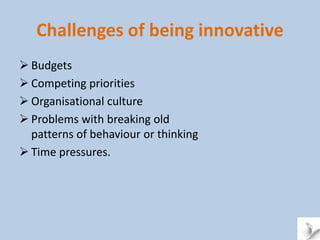
Challenges of being innovative
 Budgets
 Competing priorities
 Organisational culture
 Problems with breaking old
patterns of behaviour or thinking
 Time pressures.