Bridging forest restoration, climate resilience, and finance through the Philippines’ Green Assessment and Recovery Framework (GARF)
Presented by Noralene M. Uy (Department of Environment and Natural Resources) at "Forests, finance, synergies: Advancing integrated climate action towards 2030" UNFCCC SB64 side event on 15 June 2026.
Bridging forest restoration, climate resilience, and finance through the Philippines’ Green Assessment and Recovery Framework (GARF)
1.
Bridging forest restoration,climate resilience,
and finance through the Philippines’ Green
Assessment and Recovery Framework (GARF)
NORALENE M. UY, PhD
Assistant Secretary for Policy, Planning, International Affairs and Climate
Change
Department of Environment and Natural Resources
2.
Non-economic Loss andDamage is often
underrepresented in policy and disaster
assessments because there are limited tools to
measure these impacts compared to economic
losses.
Hazard Context:
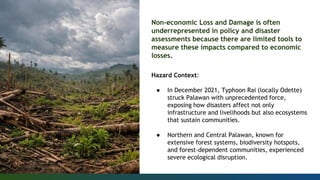
● In December 2021, Typhoon Rai (locally Odette)
struck Palawan with unprecedented force,
exposing how disasters affect not only
infrastructure and livelihoods but also ecosystems
that sustain communities.
● Northern and Central Palawan, known for
extensive forest systems, biodiversity hotspots,
and forest-dependent communities, experienced
severe ecological disruption.
3.
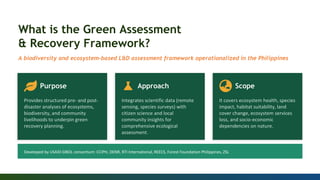
What is theGreen Assessment
& Recovery Framework?
A biodiversity and ecosystem-based L&D assessment framework operationalized in the Philippines
Purpose
Provides structured pre- and post-
disaster analyses of ecosystems,
biodiversity, and community
livelihoods to underpin green
recovery planning.
Approach
Integrates scientific data (remote
sensing, species surveys) with
citizen science and local
community insights for
comprehensive ecological
assessment.
Scope
It covers ecosystem health, species
impact, habitat suitability, land
cover change, ecosystem services
loss, and socio-economic
dependencies on nature.
Developed by USAID-SIBOL consortium: CCIPH, DENR, RTI International, REECS, Forest Foundation Philippines, ZSL
5.
The Green AssessmentFramework
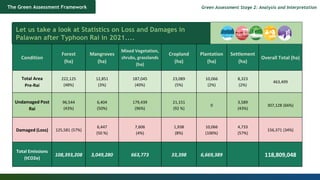
Let us take a look at Statistics on Loss and Damages in
Palawan after Typhoon Rai in 2021....
Green Assessment Stage 2: Analysis and Interpretation
Condition
Forest
(ha)
Mangroves
(ha)
Mixed Vegetation,
shrubs, grasslands
(ha)
Cropland
(ha)
Plantation
(ha)
Settlement
(ha)
Overall Total (ha)
Total Area
Pre-Rai
222,125
(48%)
12,851
(3%)
187,045
(40%)
23,089
(5%)
10,066
(2%)
8,323
(2%)
463,499
Undamaged Post
Rai
96,544
(43%)
6,404
(50%)
179,439
(96%)
21,151
(92 %)
0
3,589
(43%)
307,128 (66%)
Damaged (Loss) 125,581 (57%)
6,447
(50 %)
7,606
(4%)
1,938
(8%)
10,066
(100%)
4,733
(57%)
156,371 (34%)
Total Emissions
(tCO2e)
108,393,208 3,049,280 663,773 33,398 6,669,389 118,809,048
6.
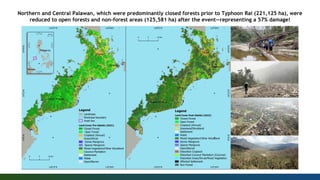
Northern and CentralPalawan, which were predominantly closed forests prior to Typhoon Rai (221,125 ha), were
reduced to open forests and non-forest areas (125,581 ha) after the event—representing a 57% damage!
7.
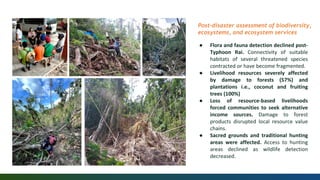
● Flora andfauna detection declined post-
Typhoon Rai. Connectivity of suitable
habitats of several threatened species
contracted or have become fragmented.
● Livelihood resources severely affected
by damage to forests (57%) and
plantations i.e., coconut and fruiting
trees (100%)
● Loss of resource-based livelihoods
forced communities to seek alternative
income sources. Damage to forest
products disrupted local resource value
chains.
● Sacred grounds and traditional hunting
areas were affected. Access to hunting
areas declined as wildlife detection
decreased.
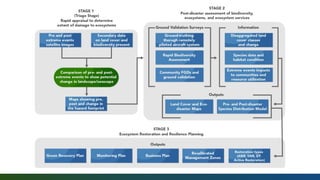
Post-disaster assessment of biodiversity,
ecosystems, and ecosystem services
8.
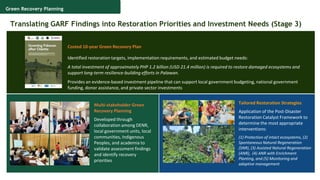
Translating GARF Findingsinto Restoration Priorities and Investment Needs (Stage 3)
Green Recovery Planning
Costed 10-year Green Recovery Plan
Identified restoration targets, implementation requirements, and estimated budget needs:
A total investment of approximately PHP 1.2 billion (USD 21.4 million) is required to restore damaged ecosystems and
support long-term resilience-building efforts in Palawan.
Provides an evidence-based investment pipeline that can support local government budgeting, national government
funding, donor assistance, and private sector investments
Multi-stakeholder Green
Recovery Planning
Developed through
collaboration among DENR,
local government units, local
communities, Indigenous
Peoples, and academia to
validate assessment findings
and identify recovery
priorities
Tailored Restoration Strategies
Application of the Post-Disaster
Restoration Catalyst Framework to
determine the most appropriate
interventions:
(1) Protection of intact ecosystems, (2)
Spontaneous Natural Regeneration
(SNR), (3) Assisted Natural Regeneration
(ANR), (4) ANR with Enrichment
Planting, and (5) Monitoring and
adaptive management
9.
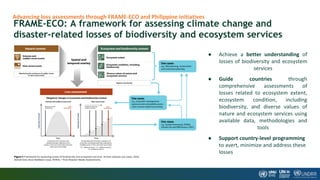
FRAME-ECO: A frameworkfor assessing climate change and
disaster-related losses of biodiversity and ecosystem services
Advancing loss assessments through FRAME-ECO and Philippine initiatives
● Achieve a better understanding of
losses of biodiversity and ecosystem
services
● Guide countries through
comprehensive assessments of
losses related to ecosystem extent,
ecosystem condition, including
biodiversity, and diverse values of
nature and ecosystem services using
available data, methodologies and
tools
● Support country-level programming
to avert, minimize and address these
losses
10.
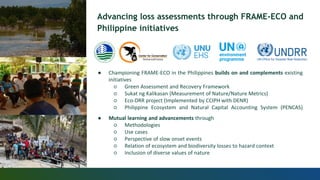
Advancing loss assessmentsthrough FRAME-ECO and
Philippine initiatives
● Championing FRAME-ECO in the Philippines builds on and complements existing
initiatives
○ Green Assessment and Recovery Framework
○ Sukat ng Kalikasan (Measurement of Nature/Nature Metrics)
○ Eco-DRR project (Implemented by CCIPH with DENR)
○ Philippine Ecosystem and Natural Capital Accounting System (PENCAS)
● Mutual learning and advancements through
○ Methodologies
○ Use cases
○ Perspective of slow onset events
○ Relation of ecosystem and biodiversity losses to hazard context
○ Inclusion of diverse values of nature
11.
Key Takeaways
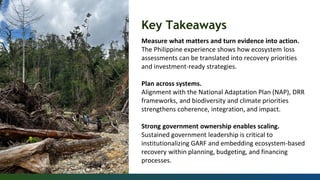
Measure whatmatters and turn evidence into action.
The Philippine experience shows how ecosystem loss
assessments can be translated into recovery priorities
and investment-ready strategies.
Plan across systems.
Alignment with the National Adaptation Plan (NAP), DRR
frameworks, and biodiversity and climate priorities
strengthens coherence, integration, and impact.
Strong government ownership enables scaling.
Sustained government leadership is critical to
institutionalizing GARF and embedding ecosystem-based
recovery within planning, budgeting, and financing
processes.
12.
Salamat. Danke. Merci.Gracias. Kia ora. Cảm ơn. Misaotra. Kadrin Chhe. Shukran
Jazilan. Xièxiè. Terima Kasih. Gamsahabnida. Obrigado. Gamsahamnida.
Dhanyavaad. Bayarlalaa. Khop Chai. Som Arkoun. Shukriya. Shukuriyyaa. Rahmat.
Рақмет. Gmadlobt. Manana. Sağ olun. Спасибо. Arigatō. Dziękuję. Maturnuwun.
Mahalo. Nagode. Vinaka. Henna
Thank you!
denr.gov.ph | @DENROfficial
conservation-innovations.org | @conservationph
ccs@denr.gov.ph
info@conservation-innovations.org
Scan to see GARF in action and explore our
impact across the Philippines or visit
tinyurl.com/GARFModules