BP105T Comprehensive Introduction to Pharmacognosy: History, Scope, and Applications in Natural Drug Discovery
Explore the fundamentals of pharmacognosy including its history, sources of natural drugs, traditional medicine systems, quality control, and modern advancements in drug discovery and development from natural sources.
BP105T Comprehensive Introduction to Pharmacognosy: History, Scope, and Applications in Natural Drug Discovery
1.
SCHOOL OF PHARMACY
(Approvedby PCI, New Delhi)
SBV Chennai Campus
B. PHARMACY- I SEMESTER
BP105T. INTRODUCTION TO PHARMACOGNOSY
UNIT – I (A)
FUNDAMENTALS OF PHARMACOGNOSY
Mr. R. SAIRAM M. Pharm.,
Assistant Professor
2.
COURSE OBJECTIVES
1. Explainthe origin, history, and classification of natural drugs.
2. Understand cultivation and conservation methods for medicinal
plants.
3. Study quality control and evaluation of crude drugs.
4. Study primary and secondary metabolites with their therapeutic
relevance
5. Introduce traditional systems of medicine and phyto-therapeutic
agents.
3.
COURSE OUTCOMES
Upon successfulcompletion of this course, the students will be able to:
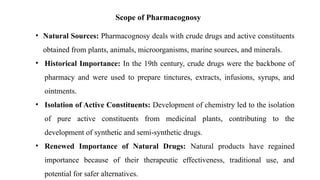
1. Describe the historical development, classification, and scope of
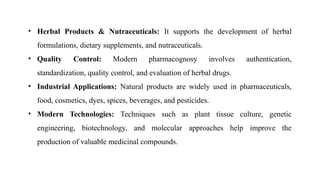
Pharmacognosy.
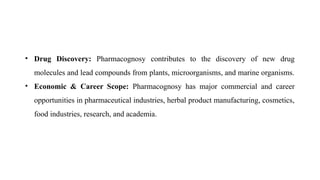
2. Explain cultivation, processing, and conservation techniques for
medicinal plants.
3. Apply quality evaluation methods to crude drugs using
organoleptic, microscopic, and chemical parameters.
4. Identify primary and secondary metabolites with their therapeutic
relevance.
5. Recognize traditional systems of medicine and commonly used
phyto-therapeutic agents.
4.
UNIT-1
Fundamentals of Pharmacognosy
(a)Definition, history, present status, scope and development of pharmacognosy.
(b) Sources of drugs: Plants, animals, microbial, marine, mineral and plant tissue culture.
(c) Historical milestones in drug discovery: Morphine, quinine, aspirin, warfarin, penicillin,
cephalosporin, taxol and artemisinin.
(d) Introduction to different herbal / traditional pharmacopoeias: Indian Pharmacopoeia, British
Herbal Pharmacopoeia, United States Pharmacopeia – Herbal Medicines and Dietary Supplements,
Ayurvedic Pharmacopoeia of India, Unani Pharmacopoeia of India and American Herbal
Pharmacopoeia.
(e) Official and non-official; codified and non-codified drugs. Classification of crude drugs:
alphabetical, morphological, taxonomical, chemical, pharmacological and chemotaxonomic
classification along with their merits and limitations.
10 hours
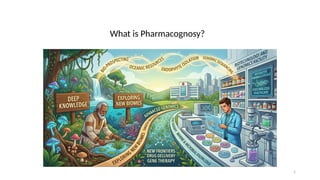
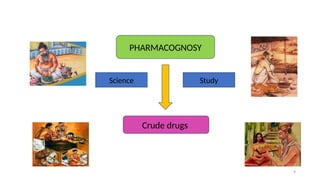
• Pharmacognosy isderived from Greek words,
Pharmakon – means “Drug”
Gnosis – means “Knowledge”
• In brief, Pharmacognosy means “Knowledge of drugs”
• It is the study of drug that originate in the plant & animal kingdoms.
• Pharmacognosy is the branch of science that deals with the study of
crude drugs obtained from natural sources.
10
11.
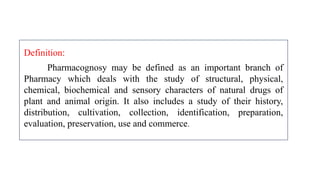
Pharmacognosy may bedefined as an important branch of
Pharmacy which deals with the study of structural, physical,
chemical, biochemical and sensory characters of natural drugs of
plant and animal origin. It also includes a study of their history,
distribution, cultivation, collection, identification, preparation,
evaluation, preservation, use and commerce.
Definition:
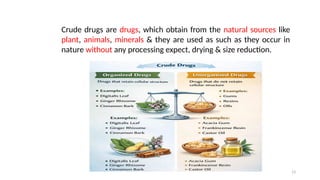
Crude drugs aredrugs, which obtain from the natural sources like
plant, animals, minerals & they are used as such as they occur in
nature without any processing expect, drying & size reduction.
13
14.
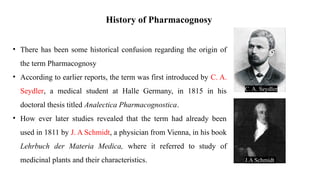
• There hasbeen some historical confusion regarding the origin of
the term Pharmacognosy
• According to earlier reports, the term was first introduced by C. A.
Seydler, a medical student at Halle Germany, in 1815 in his
doctoral thesis titled Analectica Pharmacognostica.
• How ever later studies revealed that the term had already been
used in 1811 by J. A Schmidt, a physician from Vienna, in his book
Lehrbuch der Materia Medica, where it referred to study of
medicinal plants and their characteristics. J.A Schmidt
C. A. Seydler
History of Pharmacognosy
15.
Pre-History
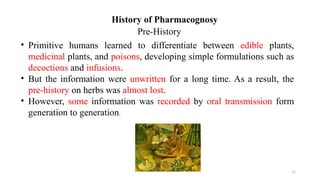
• Primitive humanslearned to differentiate between edible plants,
medicinal plants, and poisons, developing simple formulations such as
decoctions and infusions.
• But the information were unwritten for a long time. As a result, the
pre-history on herbs was almost lost.
• However, some information was recorded by oral transmission form
generation to generation.
15
History of Pharmacognosy
16.
Written-History
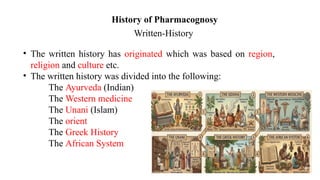
• The writtenhistory has originated which was based on region,
religion and culture etc.
• The written history was divided into the following:
The Ayurveda (Indian)
The Western medicine
The Unani (Islam)
The orient
The Greek History
The African System
History of Pharmacognosy
17.
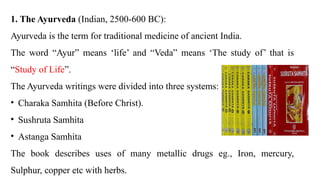
1. The Ayurveda(Indian, 2500-600 BC):
Ayurveda is the term for traditional medicine of ancient India.
The word “Ayur” means ‘life’ and “Veda” means ‘The study of’ that is
“Study of Life”.
The Ayurveda writings were divided into three systems:
• Charaka Samhita (Before Christ).
• Sushruta Samhita
• Astanga Samhita
The book describes uses of many metallic drugs eg., Iron, mercury,
Sulphur, copper etc with herbs.
18.
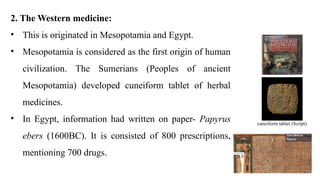
2. The Westernmedicine:
• This is originated in Mesopotamia and Egypt.
• Mesopotamia is considered as the first origin of human
civilization. The Sumerians (Peoples of ancient
Mesopotamia) developed cuneiform tablet of herbal
medicines.
• In Egypt, information had written on paper- Papyrus
ebers (1600BC). It is consisted of 800 prescriptions,
mentioning 700 drugs.
cuneiform tablet (Script)
19.
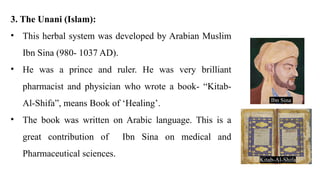
3. The Unani(Islam):
• This herbal system was developed by Arabian Muslim
Ibn Sina (980- 1037 AD).
• He was a prince and ruler. He was very brilliant
pharmacist and physician who wrote a book- “Kitab-
Al-Shifa”, means Book of ‘Healing’.
• The book was written on Arabic language. This is a
great contribution of Ibn Sina on medical and
Pharmaceutical sciences.
Ibn Sina
Kitab-Al-Shifa
Ibn Sina
20.
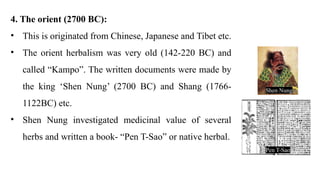
4. The orient(2700 BC):
• This is originated from Chinese, Japanese and Tibet etc.
• The orient herbalism was very old (142-220 BC) and
called “Kampo”. The written documents were made by
the king ‘Shen Nung’ (2700 BC) and Shang (1766-
1122BC) etc.
• Shen Nung investigated medicinal value of several
herbs and written a book- “Pen T-Sao” or native herbal.
Shen Nung
Pen T-Sao
21.
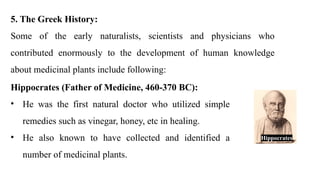
5. The GreekHistory:
Some of the early naturalists, scientists and physicians who
contributed enormously to the development of human knowledge
about medicinal plants include following:
Hippocrates (Father of Medicine, 460-370 BC):
• He was the first natural doctor who utilized simple
remedies such as vinegar, honey, etc in healing.
• He also known to have collected and identified a
number of medicinal plants.
Hippocrates
22.
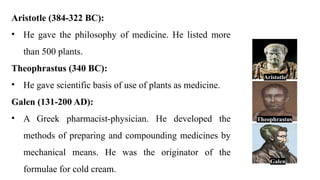
Aristotle (384-322 BC):
•He gave the philosophy of medicine. He listed more
than 500 plants.
Theophrastus (340 BC):
• He gave scientific basis of use of plants as medicine.
Galen (131-200 AD):
• A Greek pharmacist-physician. He developed the
methods of preparing and compounding medicines by
mechanical means. He was the originator of the
formulae for cold cream.
Aristotle
Theophrastus
Galen
23.
4. The AfricanSystem (Tropical Africa, North and South America):
• They keep information in their groups or tribes. The information
transmitted from one generation to another.
• These regions are richest sources of medicinal plants and needs to
explore for new drug discovery..
24.
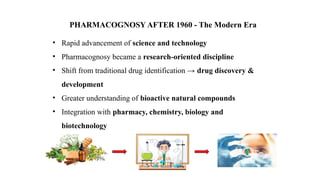
PHARMACOGNOSY AFTER 1960- The Modern Era
• Rapid advancement of science and technology
• Pharmacognosy became a research-oriented discipline
• Shift from traditional drug identification → drug discovery &
development
• Greater understanding of bioactive natural compounds
• Integration with pharmacy, chemistry, biology and
biotechnology
25.
Present Status
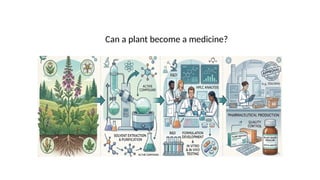
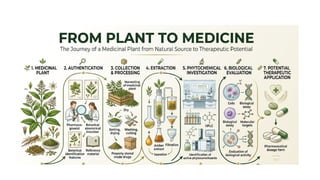
• Pharmacognosyhas evolved from the study of crude drugs to a
modern scientific discipline integrating botany, chemistry,
biotechnology, and pharmacology.
• It plays a vital role in drug discovery and development from natural
sources, especially plant-based medicines.
• Pharmacognosy supports traditional systems of medicine like
Ayurveda, Siddha, and Unani with scientific evidence.
• It contributes to the development of nutraceuticals, herbal cosmetics,
and phytopharmaceuticals.
26.
• Natural Sources:Pharmacognosy deals with crude drugs and active constituents
obtained from plants, animals, microorganisms, marine sources, and minerals.
• Historical Importance: In the 19th century, crude drugs were the backbone of
pharmacy and were used to prepare tinctures, extracts, infusions, syrups, and
ointments.
• Isolation of Active Constituents: Development of chemistry led to the isolation
of pure active constituents from medicinal plants, contributing to the
development of synthetic and semi-synthetic drugs.
• Renewed Importance of Natural Drugs: Natural products have regained
importance because of their therapeutic effectiveness, traditional use, and
potential for safer alternatives.
Scope of Pharmacognosy
27.
• Herbal Products& Nutraceuticals: It supports the development of herbal
formulations, dietary supplements, and nutraceuticals.
• Quality Control: Modern pharmacognosy involves authentication,
standardization, quality control, and evaluation of herbal drugs.
• Industrial Applications: Natural products are widely used in pharmaceuticals,
food, cosmetics, dyes, spices, beverages, and pesticides.
• Modern Technologies: Techniques such as plant tissue culture, genetic
engineering, biotechnology, and molecular approaches help improve the
production of valuable medicinal compounds.
28.
• Drug Discovery:Pharmacognosy contributes to the discovery of new drug
molecules and lead compounds from plants, microorganisms, and marine organisms.
• Economic & Career Scope: Pharmacognosy has major commercial and career
opportunities in pharmaceutical industries, herbal product manufacturing, cosmetics,
food industries, research, and academia.
• Evolution ofPharmacognosy – Developed from simple identification of crude
drugs into an advanced scientific discipline.
• Isolation of Active Constituents – Chemistry led to the isolation of alkaloids,
glycosides, essential oils, and other active compounds.
• Discovery of Important Drugs – Natural products contributed to drugs such as
quinine, morphine, penicillin, reserpine, and vinca alkaloids.
• Advanced Analytical Techniques – Chromatography and spectroscopy enabled
identification and structural elucidation of natural compounds.
• Understanding Structure–Activity Relationship – Research helped establish the
relationship between chemical structure and biological activity.
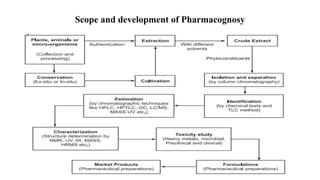
DEVELOPMENT & FUTURE OF PHARMACOGNOSY
31.
• Biotechnology &Plant Tissue Culture – Modern biotechnology is used to produce
valuable secondary metabolites under controlled conditions, such as taxol.
• Role in Modern Drug Discovery – Pharmacognosy contributes to drug discovery,
quality control, and standardization of herbal medicines.
• Important Natural Products – Examples include artemisinin, paclitaxel (Taxol),
forskolin, and piperine, demonstrating the therapeutic potential of natural products.
• Future Research Areas – Focus includes marker compounds, standardization,
biodiversity, biotechnology, genomics, metabolomics, and sustainable use of medicinal
plants.
• Vast Drug-Discovery Potential – Only a small proportion of the approximately
250,000 plant species have been scientifically evaluated, indicating enormous potential
for future drug discovery.
32.
1. Pharmacognosy isderived from which
Greek words?
a. Pharmakon and Gnosis
b. Pharma and Logos
c. Phyto and Gnosis
d. Pharmakon and Logos
Quiz
2. What does “Pharmakon” mean?
a. Plant
b. Drug
c. Knowledge
d. Medicine
33.
3. What ismeant by “Gnosis”?
a. Drug
b. Plant
c. Knowledge
d. Treatment
Quiz
4. Which of the following best describes a crude
drug?
a. A completely synthetic drug
b. A natural drug used essentially as it occurs in nature
c. A purified chemical compound
d. A chemically synthesized medicine
34.
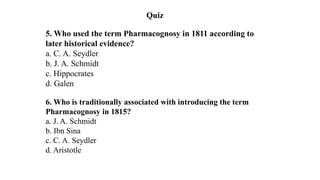
5. Who usedthe term Pharmacognosy in 1811 according to
later historical evidence?
a. C. A. Seydler
b. J. A. Schmidt
c. Hippocrates
d. Galen
Quiz
6. Who is traditionally associated with introducing the term
Pharmacognosy in 1815?
a. J. A. Schmidt
b. Ibn Sina
c. C. A. Seydler
d. Aristotle
35.
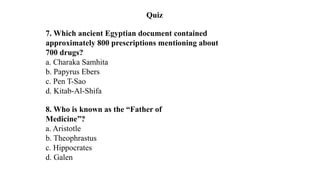
7. Which ancientEgyptian document contained
approximately 800 prescriptions mentioning about
700 drugs?
a. Charaka Samhita
b. Papyrus Ebers
c. Pen T-Sao
d. Kitab-Al-Shifa
Quiz
8. Who is known as the “Father of
Medicine”?
a. Aristotle
b. Theophrastus
c. Hippocrates
d. Galen
36.
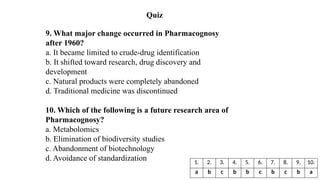
9. What majorchange occurred in Pharmacognosy
after 1960?
a. It became limited to crude-drug identification
b. It shifted toward research, drug discovery and
development
c. Natural products were completely abandoned
d. Traditional medicine was discontinued
Quiz
10. Which of the following is a future research area of
Pharmacognosy?
a. Metabolomics
b. Elimination of biodiversity studies
c. Abandonment of biotechnology
d. Avoidance of standardization 1. 2. 3. 4. 5. 6. 7. 8. 9. 10.
a b c b b c b c b a
37.
References
1.Evans, W.C., Treaseand Evans Pharmacognosy. 16th ed. London: W.B.
Saunders & Co., 2009.
2.Tyler, V.E., Brady, L.R. and Robbers, J.E., Pharmacognosy. 9th ed.
Philadelphia: Lea & Febiger, 1988.
3.Wallis, T.E., Textbook of Pharmacognosy. London: J. & A. Churchill Ltd.
4.World Health Organization (2002) WHO traditional medicine strategy
2002–2005. Geneva: World Health Organization
 Most read
 Most read