BIOLOGY & HEALTH SCIENCES
Blood: The Body’s Living
Transport System
What blood is ?, what it contains ?, and why it matters ?
Prepared by : Rangin A. Ghafwr
Outline
A guided tour of blood—from composition to clinical meaning.
01 Blood : structure and composition
02 Plasma and formed elements
03 Red cells, white cells, and platelets
04 Hematopoiesis: making blood cells
05 Blood, homeostasis, and protection
06 Blood as a diagnostic window
1
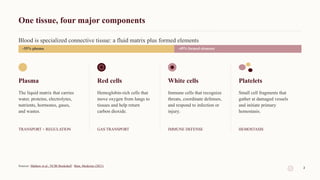
One tissue, four major components
Blood is specialized connective tissue: a fluid matrix plus formed elements
~55% plasma ~45% formed elements
Plasma
The liquid matrix that carries
water, proteins, electrolytes,
nutrients, hormones, gases,
and wastes.
TRANSPORT + REGULATION
Red cells
Hemoglobin-rich cells that
move oxygen from lungs to
tissues and help return
carbon dioxide.
GAS TRANSPORT
White cells
Immune cells that recognize
threats, coordinate defenses,
and respond to infection or
injury.
IMMUNE DEFENSE
Platelets
Small cell fragments that
gather at damaged vessels
and initiate primary
hemostasis.
HEMOSTASIS
Sources: Mathew et al., NCBI Bookshelf · Bain, Medicine (2021)
2
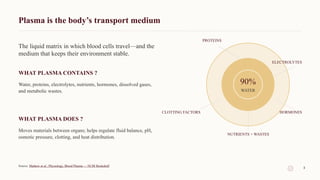
Plasma is the body’s transport medium
The liquid matrix in which blood cells travel—and the
medium that keeps their environment stable.
WHAT PLASMA CONTAINS ?
Water, proteins, electrolytes, nutrients, hormones, dissolved gases,
and metabolic wastes.
WHAT PLASMA DOES ?
Moves materials between organs; helps regulate fluid balance, pH,
osmotic pressure, clotting, and heat distribution.
90%
WATER
PROTEINS
ELECTROLYTES
HORMONES
NUTRIENTS + WASTES
CLOTTING FACTORS
Source: Mathew et al., Physiology, Blood Plasma — NCBI Bookshelf
3
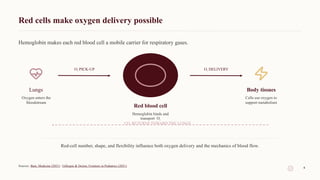
Red cells make oxygen delivery possible
Hemoglobin makes each red blood cell a mobile carrier for respiratory gases.
Lungs
Oxygen enters the
bloodstream
O2 PICK-UP
Red blood cell
Hemoglobin binds and
transport O2
O2 DELIVERY
Body tissues
Cells use oxygen to
support metabolism
CO2 RETURNS TOWARD THE LUNGS
Red-cell number, shape, and flexibility influence both oxygen delivery and the mechanics of blood flow.
Sources: Bain, Medicine (2021) · Gillespie & Doctor, Frontiers in Pediatrics (2021)
4
White cells defend and coordinate immunity
White blood cells circulate, enter tissues, and coordinate
responses to infection, foreign material, and cellular stress.
Rapid response
Neutrophils and monocytes are major phagocytic cells that help
contain threats early.
Precise defense
B cells, T cells, and natural killer cells support antibody-
mediated and cellular responses.
Continuous surveillance
Movement between blood and tissues lets immune cells monitor
the body as conditions change.
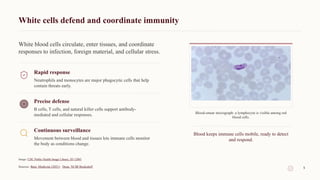
Blood-smear micrograph: a lymphocyte is visible among red
blood cells.
Blood keeps immune cells mobile, ready to detect
and respond.
Image: CDC Public Health Image Library, ID 12085
Sources: Bain, Medicine (2021) · Dean, NCBI Bookshelf 5
Platelets stop bleeding fast
Small cell fragments act within seconds when a blood vessel is
damaged.
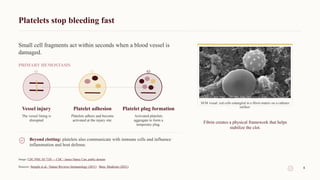
PRIMARY HEMOSTASIS
01
Vessel injury
The vessel lining is
disrupted
02
Platelet adhesion
Platelets adhere and become
activated at the injury site.
03
Platelet plug formation
Activated platelets
aggregate to form a
temporary plug.
Beyond clotting: platelets also communicate with immune cells and influence
inflammation and host defense.
SEM visual: red cells entangled in a fibrin matrix on a catheter
surface.
Fibrin creates a physical framework that helps
stabilize the clot.
Image: CDC PHIL ID 7320 — CDC / Janice Haney Carr, public domain
Sources: Semple et al., Nature Reviews Immunology (2011) · Bain, Medicine (2021) 6
Hematopoiesis: How blood cells are made ?
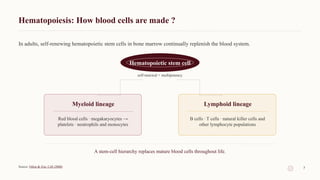
In adults, self-renewing hematopoietic stem cells in bone marrow continually replenish the blood system.
Hematopoietic stem cell
self-renewal + multipotency
Myeloid lineage
Red blood cells · megakaryocytes →
platelets · neutrophils and monocytes
Lymphoid lineage
B cells · T cells · natural killer cells and
other lymphocyte populations
A stem-cell hierarchy replaces mature blood cells throughout life.
Source: Orkin & Zon, Cell (2008) 7
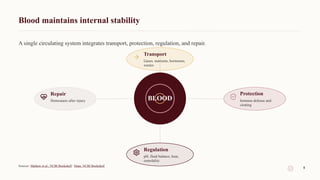
Blood maintains internal stability
A single circulating system integrates transport, protection, regulation, and repair.
BLOOD
Transport
Gases, nutrients, hormones,
wastes
Protection
Immune defense and
clotting
Regulation
pH, fluid balance, heat,
osmolality
Repair
Hemostasis after injury
Sources: Mathew et al., NCBI Bookshelf · Dean, NCBI Bookshelf
8
Blood is a diagnostic window
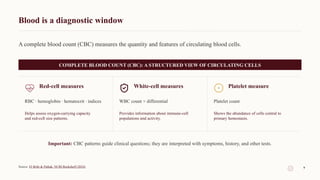
A complete blood count (CBC) measures the quantity and features of circulating blood cells.
COMPLETE BLOOD COUNT (CBC): A STRUCTURED VIEW OF CIRCULATING CELLS
Red-cell measures
RBC · hemoglobin · hematocrit · indices
Helps assess oxygen-carrying capacity
and red-cell size patterns.
White-cell measures
WBC count + differential
Provides information about immune-cell
populations and activity.
Platelet measure
Platelet count
Shows the abundance of cells central to
primary hemostasis.
Important: CBC patterns guide clinical questions; they are interpreted with symptoms, history, and other tests.
Source: El Brihi & Pathak, NCBI Bookshelf (2024) 9
Why blood matters in real life
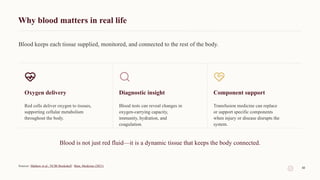
Blood keeps each tissue supplied, monitored, and connected to the rest of the body.
Oxygen delivery
Red cells deliver oxygen to tissues,
supporting cellular metabolism
throughout the body.
Diagnostic insight
Blood tests can reveal changes in
oxygen-carrying capacity,
immunity, hydration, and
coagulation.
Component support
Transfusion medicine can replace
or support specific components
when injury or disease disrupts the
system.
Blood is not just red fluid—it is a dynamic tissue that keeps the body connected.
Sources: Mathew et al., NCBI Bookshelf · Bain, Medicine (2021)
10
References
1. Mathew J, et al. Physiology, Blood Plasma. StatPearls. NCBI Bookshelf.
2. Dean L. Blood and the cells it contains. In: Blood Groups and Red Cell Antigens.
NCBI Bookshelf.
3. Bain BJ. Structure and function of red and white blood cells and platelets.
Medicine. 2021;49(4):183–188.
4. Gillespie AH, Doctor A. Red Blood Cell Contribution to Hemostasis. Frontiers in
Pediatrics. 2021;9:629824.
5. Semple JW, Italiano JE Jr, Freedman J. Platelets and the immune continuum. Nature
Reviews Immunology. 2011;11:264–274.
6. Weisel JW, Litvinov RI.
Red blood cells: the forgotten player in hemostasis and thrombosis. Journal of
Thrombosis and Haemostasis. 2019;17(2):271–282.
7. Orkin SH, Zon LI. Hematopoiesis: An Evolving Paradigm for Stem Cell Biology.
Cell. 2008;132(4):631–644.
8. El Brihi J, Pathak S. Normal and Abnormal Complete Blood Count With Differential
. StatPearls. NCBI Bookshelf.
11