Introduction to Biogas
•Biogas is a renewable fuel produced from
organic material in the absence of oxygen. It
mainly contains Methane (50-70%), CO₂ (25-
45%), H₂S, and water vapor.
3.
Plant Waste asFeedstock
• Includes straw, husks, peels, leaves, and
bagasse. Rich in cellulose and lignin, ideal for
microbial decomposition.
4.
Principle of BiogasProduction
• Biogas is formed through anaerobic digestion
—microbial breakdown of biomass in absence
of oxygen in 4 stages.
5.
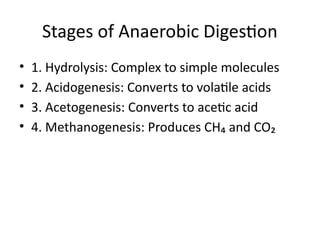
Stages of AnaerobicDigestion
• 1. Hydrolysis: Complex to simple molecules
• 2. Acidogenesis: Converts to volatile acids
• 3. Acetogenesis: Converts to acetic acid
• 4. Methanogenesis: Produces CH₄ and CO₂
6.
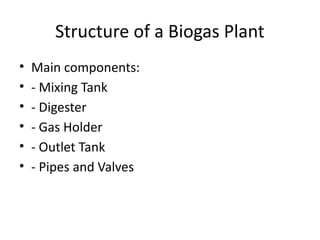
Structure of aBiogas Plant
• Main components:
• - Mixing Tank
• - Digester
• - Gas Holder
• - Outlet Tank
• - Pipes and Valves
7.
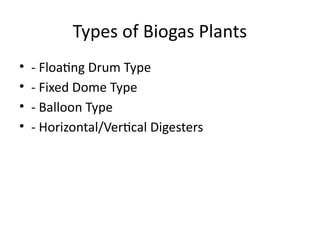
Types of BiogasPlants
• - Floating Drum Type
• - Fixed Dome Type
• - Balloon Type
• - Horizontal/Vertical Digesters
8.
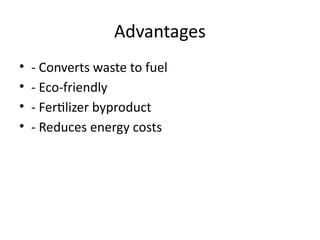
Advantages
• - Convertswaste to fuel
• - Eco-friendly
• - Fertilizer byproduct
• - Reduces energy costs
9.
Challenges
• - Hardlignin decomposes slowly
• - Requires regular input
• - High setup cost
• - Temperature sensitivity