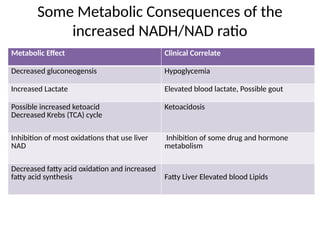
Biochemical effects of alcohol abuse include increased NADH/NAD⁺ ratio, impaired gluconeogenesis, fatty liver from triglyceride accumulation, lactic acidosis, hypoglycemia, hyperuricemia, and altered lipid metabolism due to excessive ethanol metabolism in the liver.
Introduction
• Fermentation tomake alcohol dates back to 4200 BC
• Second most used drug in the world (after Caffeine )
• Whites have highest alcohol consumption rates
• Requires no digestion
• Crosses placenta and BBB
• Alcohol consumption has multiple biochemical consequences.
• Average consumption of 2 to 4 drinks per day is associated with
lower overall or cardiovascular mortality risk than either lower
or higher intake.
– 65% of Americans consume alcohol
– 10% are heavy drinkers
3.
Chemistry
• Ethanol iscompletely miscible with water due to its
hydroxyl group (-OH) which forms inter molecular bonds to
water and fat
• This means alcohol is absorbed though the gastrointestinal
tract and through the Blood Brain barrier
• it is readily distributed through out the body and readily
crosses biological membranes (simple passive diffusion
along concentration gradients)
• 20% is absorbed through the stomach the other 80%
through the upper intestine
• Alcohol is exposed to first-pass metabolism
• 5% is excreted via the lungs
• Alcohol metabolism is zero order
4.
Synthesis of Alcohol
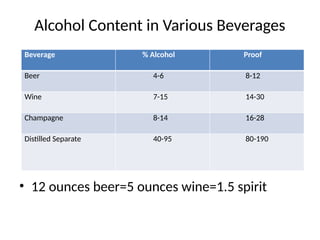
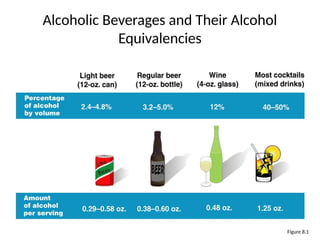
•The Initial fermentation mixture contains ~ 3-5 %
ethanol (Beer) up to 12-15 % (wine)
• Higher concentration (yeast is inactivated) so
distillation is required
• Using differences in boiling points to separate
compounds (water 100 C, Ethanol 78.3C)
• e.g. gin, scotch, bourbon, vodka, liqueurs,
cordials, and bitters
5.
Proof of Beverage
•Measure of the percent alcohol: Amount of
alcohol/volume of water
• 100% Ethanol /0% water =zero proof (only exists in
airless environment)
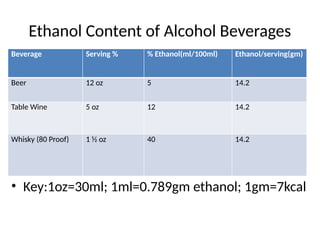
• One Proof=0.5% ethanol by volume
• 50% Ethanol /50% water=100proof
• 40% Ethanol/60% water=80proof
• 80 proof whiskey = 40% alcohol
• The greater the proof, the faster the entry into the blood
stream
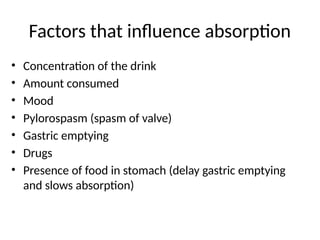
Factors that influenceabsorption
• Concentration of the drink
• Amount consumed
• Mood
• Pylorospasm (spasm of valve)
• Gastric emptying
• Drugs
• Presence of food in stomach (delay gastric emptying
and slows absorption)
10.
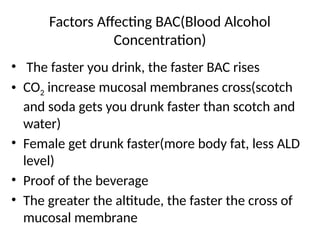
Factors Affecting BAC(BloodAlcohol
Concentration)
• The faster you drink, the faster BAC rises
• CO2 increase mucosal membranes cross(scotch
and soda gets you drunk faster than scotch and
water)
• Female get drunk faster(more body fat, less ALD
level)
• Proof of the beverage
• The greater the altitude, the faster the cross of
mucosal membrane
11.
Metabolism of Alcohol
•Alcohol is eliminated from the body by various metabolic
mechanisms.
• Oxidative and Nonoxidative Pathways
• The primary enzymes involved are aldehyde
dehydrogenase, alcohol dehydrogenase, cytochrome
P450, and catalase.
• 90% Ethanol---- Acetic Acid(Liver)
• 10% (sweat, urine or breath)
• ADH (Alcohol dehydrogenase )
• MEOS (Microsomal ethyl oxidizing system )
• Catalaze dependent oxidation
• Interacting with fatty acids------ F.A ethyl esters (FAEEs)
12.
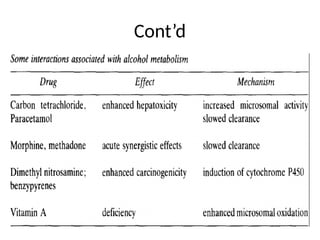
Cont’d
• Variations inthe genes for these enzymes have been found to
influence alcohol consumption, alcohol-related tissue damage,
and alcohol dependence.
• The consequences of alcohol metabolism include
• Oxygen deficits in the liver
• interaction between alcohol metabolism byproducts and other
cell components, resulting in the formation of harmful
compounds
• formation of highly reactive oxygen-containing molecules (i.e.,
reactive oxygen species ) that can damage other cell components
• changes in the ratio of NADH to NAD+ (cell’s redox state);
• tissue damage; fetal damage;
• impairment of other metabolic processes;
• cancer; and medication interactions.
13.
Alcohol Distribution InThe Body
• It is proportional to the water content in the
particular tissue and rate of blood flow
• The body can metabolize a certain amount of alcohol
every hour (many factors including liver size , body
mass, variations in enzymes ,etc)
• The estimated maximal rate of ethanol metabolism is
200-240 gm/day for a 70 kg male causal drinker (1.5
pint whiskey),and up to 370 gm/day for an alcoholic
• There is swift increase in metabolism a few hours
after alcohol intake (up to 50% in oxidation)
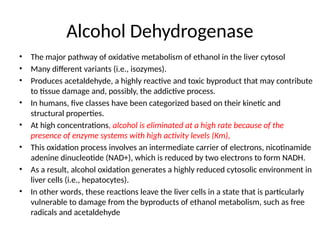
Alcohol Dehydrogenase
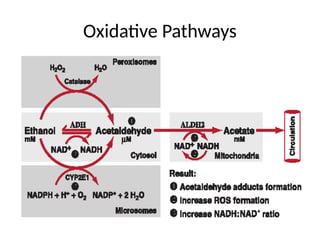
• Themajor pathway of oxidative metabolism of ethanol in the liver cytosol
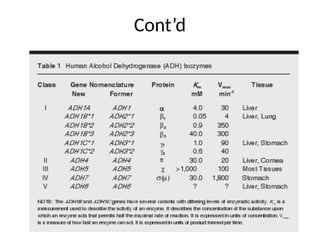
• Many different variants (i.e., isozymes).
• Produces acetaldehyde, a highly reactive and toxic byproduct that may contribute
to tissue damage and, possibly, the addictive process.
• In humans, five classes have been categorized based on their kinetic and
structural properties.
• At high concentrations, alcohol is eliminated at a high rate because of the
presence of enzyme systems with high activity levels (Km),
• This oxidation process involves an intermediate carrier of electrons, nicotinamide
adenine dinucleotide (NAD+), which is reduced by two electrons to form NADH.
• As a result, alcohol oxidation generates a highly reduced cytosolic environment in
liver cells (i.e., hepatocytes).
• In other words, these reactions leave the liver cells in a state that is particularly
vulnerable to damage from the byproducts of ethanol metabolism, such as free
radicals and acetaldehyde
Genetics Behind Metabolism
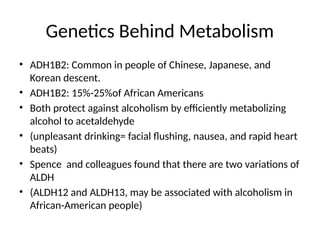
•ADH1B2: Common in people of Chinese, Japanese, and
Korean descent.
• ADH1B2: 15%-25%of African Americans
• Both protect against alcoholism by efficiently metabolizing
alcohol to acetaldehyde
• (unpleasant drinking= facial flushing, nausea, and rapid heart
beats)
• Spence and colleagues found that there are two variations of
ALDH
• (ALDH12 and ALDH13, may be associated with alcoholism in
African-American people)
18.
Cytochrome P450
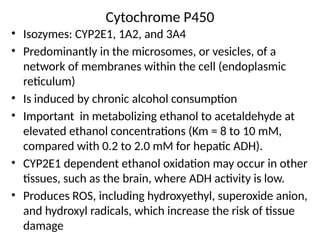
• Isozymes:CYP2E1, 1A2, and 3A4
• Predominantly in the microsomes, or vesicles, of a
network of membranes within the cell (endoplasmic
reticulum)
• Is induced by chronic alcohol consumption
• Important in metabolizing ethanol to acetaldehyde at
elevated ethanol concentrations (Km = 8 to 10 mM,
compared with 0.2 to 2.0 mM for hepatic ADH).
• CYP2E1 dependent ethanol oxidation may occur in other
tissues, such as the brain, where ADH activity is low.
• Produces ROS, including hydroxyethyl, superoxide anion,
and hydroxyl radicals, which increase the risk of tissue
damage
19.
Catalase
• Another enzyme,catalase, located in cell bodies called
peroxisomes, is capable of oxidizing ethanol in vitro in
the presence of a hydrogen peroxide (H2O2)-generating
system, such as the enzyme complex NADPH oxidase or
the enzyme xanthine oxidase.
• Quantitatively, however, this is considered a minor
pathway of alcohol oxidation, except in the fasted state.
• Chronic alcohol consumption by rats has been shown to
result in increased H2O2 production in pericentral regions
of the liver and increased catalase activity.
20.
Products of OxidativeMetabolism of Alcohol
1. Acetaldehyde
2. Acetate
3. Reactive oxygen species (ROS)
• Contribute to cell and tissue damage in
various ways
21.
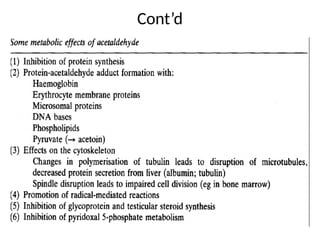
Acetaldehyde
• Produced byalcohol oxidation pathways
• Is rapidly metabolized to acetate
• Mainly by ALDH2 in mitochondria to form acetate and NADH.
• NADH then is oxidized by a series of chemical reactions in the
mitochondria (the mitochondrial electron transport chain).
• Acetaldehyde has the capacity to bind to proteins such as
enzymes, microsomal proteins, and microtubules.
• It also forms adducts with the brain signaling chemical,dopamine
to form salsolinol, which may contribute to alcohol dependence,
and with DNA to form carcinogenic DNA adducts such as 1,N2-
propanodeoxyguanosine
• Formation of protein adducts in hepatocytes impairs protein
secretion, which has been proposed to play a role in enlargement
of the liver
Acetate
• Produced fromthe oxidation of acetaldehyde, is oxidized to
carbon dioxide (CO2).
• Most of the acetate resulting from alcohol metabolism escapes
the liver to the blood and is eventually metabolized to CO2 in
heart, skeletal muscle, and brain cells.
• it increases blood flow into the liver and depresses the central
nervous system, as well as affects various metabolic processes.
• Metabolized to acetyl CoA, which is involved in lipid and
cholesterol biosynthesis in the mitochondria of peripheral and
brain tissues.
• It is hypothesized that upon chronic alcohol intake the brain
starts using acetate rather than glucose as a source of energy
24.
Non-oxidative metabolism ofalcohol
• Is minimal, but its products may have pathological and diagnostic
relevance.
• At least two pathways.
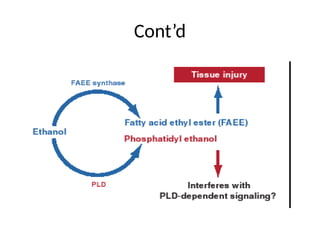
• One leads to the formation of molecules called fatty acid ethyl esters
(FAEEs) from the reaction of alcohol with fatty acids––weak organic
acids that play functional roles in human cells.
• The other nonoxidative pathway results in the formation of a type of
fat molecule, phosphatidyl ethanol .
• FAEEs are detectable in serum and other tissues after alcohol
ingestion and persist long after alcohol is eliminated.
• The role of FAEEs in alcohol-induced tissue damage remains to be
further evaluated.
25.
Cont’d
• The secondnonoxidative pathway requires the enzyme phospholipase D (PLD),
which breaks down phospholipids (primarily phosphatidylcholine) to generate
phosphatidic acid (PA).
• This pathway is a critical component in cellular communication
• PLD has a high Km for ethanol, and the enzymatic reaction does occur
predominantly at high circulating alcohol concentrations.
• The product of this reaction, phosphatidyl ethanol, is poorly metabolized and
may accumulate to detectable levels following chronic consumption of large
amounts of alcohol, but its effects on the cell remain to be established.
• However, the formation of phosphatidyl ethanol occurs at the expense of the
normal function of PLD, namely to produce PA, resulting in inhibited PA
formation and disruption of cell signaling.
• Oxidative and nonoxidative pathways of alcohol metabolism are interrelated.
• Inhibition of ethanol oxidation by compounds that inhibit ADH, CYP2E1, and
catalase results in an increase in the nonoxidative metabolism of alcohol and
increased production of FAEEs in the liver and pancreas
Some Metabolic Consequencesof the
increased NADH/NAD ratio
Metabolic Effect Clinical Correlate
Decreased gluconeogensis Hypoglycemia
Increased Lactate Elevated blood lactate, Possible gout
Possible increased ketoacid
Decreased Krebs (TCA) cycle
Ketoacidosis
Inhibition of most oxidations that use liver
NAD
Inhibition of some drug and hormone
metabolism
Decreased fatty acid oxidation and increased
fatty acid synthesis Fatty Liver Elevated blood Lipids
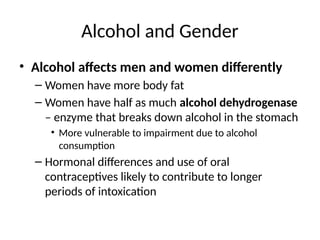
Alcohol and Gender
•Alcohol affects men and women differently
– Women have more body fat
– Women have half as much alcohol dehydrogenase
– enzyme that breaks down alcohol in the stomach
• More vulnerable to impairment due to alcohol
consumption
– Hormonal differences and use of oral
contraceptives likely to contribute to longer
periods of intoxication
30.
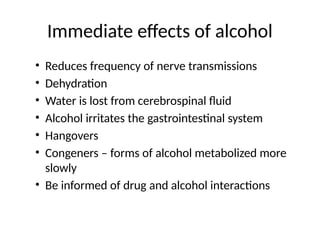
Immediate effects ofalcohol
• Reduces frequency of nerve transmissions
• Dehydration
• Water is lost from cerebrospinal fluid
• Alcohol irritates the gastrointestinal system
• Hangovers
• Congeners – forms of alcohol metabolized more
slowly
• Be informed of drug and alcohol interactions
31.
Long-term effects ofalcohol
• Effects on the Nervous System
• Cardiovascular Effects
• Liver disease
• Cirrhosis
• Alcoholic hepatitis
• Cancer
• Chronic inflammation of pancreas
• Impairs ability to recognize and fight bacteria and
viruses
32.
Alcohol and Pregnancy
•Risks
– Alcohol can harm fetal development
– Even a single exposure to high levels can cause
damage
– Fetal Alcohol Syndrome (FAS)
• Mental retardation, small head, tremors, and
abnormalities of face, limbs, heart, and brain
• FAS is the 3rd most common birth defect in the United
States
33.
Cont’d
• FAS behaviorsinclude
– Impaired learning
– Poor memory
– Impulsive behaviors
– Reduced attention span
– Poor problem solving
– Some have Fetal Alcohol Effects (less severe)
34.
Alcohol And liver
•The risk of cirrhosis is probably small-below 80gm of ethanol per day
but some persons get
• liver disease at modest consumption
• Only 20% will develop alcoholic liver disease and cirrhosis
>90% of heavy drinkers develops fatty liver
It is the first stage in alcoholic liver disease
Causes:
1. Impaired fatty acid oxidation
2. Increased lipogenesis (change in NADH/NAD redox potential)
3. NADH competes with reducing equivalents including fatty acids for
the respiratory chain, inhibiting their oxidation leading to
increased esterifications of fatty acid to form triglycerol fatty liver
35.
Alcohol And Pancreas
•<10% of heavy alcoholic users develop
alcoholic pancreatitis
• Environmental factors, smoking, amount and
patterns of drinking ,dietary habits and genetic
deference (not definitively linked
36.
Alcohol Metabolism andCancer
• Liver, Colon, rectum, breast and upper
respiratory tract
• Genetic Predisposition
• Acetaldehyde as carcinogen
• ROS
 Most read
 Most read