Best Websites to Buy Verified DogPay Accounts Online_ Myth vs. Legal Reality
An in-depth analysis of DogPay account fraud, gray market risks, security detection methods, enforcement lifecycle, and legal implications for Web3 payment gateways and crypto-to-fiat services.
Best Websites to Buy Verified DogPay Accounts Online_ Myth vs. Legal Reality
1.
Top Trusted Placesto Buy Verified
DogPay Accounts …
The global expansion of Web3 payment gateways, crypto-to-fiat debit cards, and multi-
currency international bank accounts has created widespread interest in modern financial
service providers such as DogPay. With its FinCEN Money Services Business (MSB) registration,
Visa Third-Party Agent certification, and PCI-DSS Level 1 infrastructure, DogPay enables users
to issue virtual USD cards, manage multi-currency bank accounts (USD, EUR, HKD), and
process cross-border merchant payments.
2.
DogPay
However, as demandfor non-custodial and fiat-gateway accounts grows, a dangerous gray
market has emerged online. Unregulated forums, social media channels, and dark-web vendors
frequently market "fully verified," "pre-activated," or "turnkey" DogPay accounts. These sellers
promise instant access to USD virtual cards, high transaction limits, and bypassed identity
verification.
There are no trusted or legitimate places to buy verified DogPay accounts online. Selling,
leasing, purchasing, or sharing verified payment accounts strictly violates international Anti-
Money Laundering (AML) standards, Know Your Customer (KYC) regulations, and DogPay’s
terms of service. Purchasing pre-verified financial accounts from unauthorized third-party
vendors leads to immediate account freezes, permanent capital forfeiture, vendor scams, and
severe legal liability.
To navigate global payment compliance securely, this detailed analysis breaks down the
technical mechanisms behind financial fraud monitoring, dismantles grey-market vendor
claims, outlines the account enforcement lifecycle, details the official DogPay KYC verification
procedure, and provides compliant enterprise alternatives for global merchants and Web3
developers.
The Gray Market Reality Behind Third-Party Account
Vendors
Promotional listings across messaging apps and online forums frequently advertise verified
DogPay accounts with promises of instant activation, attached virtual cards, and pre-completed
Sumsub identity checks. Examining how these accounts are constructed reveals why purchasing
them invariably results in financial loss.
Synthetic Identity Generation and Stolen Data
A significant percentage of pre-verified financial accounts sold on the internet are generated
using stolen personal identifiable information (PII). Online fraud networks acquire leaked
passports, national identity cards, utility bills, and tax identification numbers from dark-web
repositories and data breaches. Vendors feed these compromised documents into automated
registration pipelines to pass initial electronic KYC checks. Operating a payment account
linked to stolen identity documents directly entangles the buyer in identity theft and financial
fraud investigations.
The Account Mule Network Model
In alternative gray-market models, vendors recruit individuals—known as account mules—who
agree to register DogPay accounts using their own genuine identity documents and personal
details in exchange for a small fee. Once the account passes verification, the vendor changes
the primary login credentials and sells access to an international buyer.
3.
Because the accountmule retains physical possession of their original government documents,
official bank accounts, and registered phone numbers, they maintain permanent recovery rights
over the profile. At any time, the original creator can contact support, submit biometric photo
verification, reset the security parameters, and seize all deposited balances, virtual cards, and
active crypto-to-fiat conversions.
Fabricated Trust Signals and Fake Escrow Services
Unauthorized vendors build an illusion of legitimacy by displaying curated customer review
screenshots, forum trust badges, and seller guarantees. Many operate fake escrow services
designed to give buyers a false sense of security. Because purchasing or leasing financial
payment accounts violates federal laws and platform terms, buyers have no legal recourse or
consumer protection when a vendor delivers a compromised account, alters recovery settings,
or reclaims the balance post-sale.
Technical Security: How Fraud Engines Detect Purchased
Accounts
Modern payment platforms deploy real-time threat intelligence engines, behavioral analytics,
and device fingerprinting to monitor user sessions, payment routing, and account access
patterns continuously.
Biometric and Device Telemetry
When a user accesses the DogPay application or web panel, client-side security modules
construct a dynamic device fingerprint:
● Hardware Component Hashes: WebGL signatures, GPU rendering patterns, and screen
resolution matrices that uniquely identify local physical hardware.
● System Environment Metrics: Operating system build versions, system language sets,
installed font lists, and browser extension environments.
● Session Security Telemetry: Real-time analysis of touch inputs, mouse trajectories, and
navigation speeds.
When an account created under one hardware signature is suddenly accessed from a distinct
device environment, security systems flag the account for identity re-verification.
Network Topology and Geolocation Signatures
Vendors often instruct buyers to access purchased accounts through Virtual Private Networks
(VPNs) or residential proxies to mimic the original registration location. Risk engines identify
and counter these methods:
4.
● Autonomous SystemNumber (ASN) Tracking: IP addresses are categorized
automatically. Connections originating from commercial data centers or VPN
infrastructure trigger instant risk elevation.
● Latency and WebRTC Inspection: Network inspection scripts evaluate packet latency
anomalies and DNS query paths to detect proxy layers.
● Impossible Travel Algorithms: If an account authenticates from an IP subnet in one
region and executes card transactions or payouts from a distant location shortly after,
automated security holds activate immediately.
Payment Profile and Name Matching Controls
Under global regulatory mandates, payment gateways strictly enforce matching-name
protocols for deposits, withdrawals, and bank transfers:
● Direct Name Alignment: The name listed on incoming or outgoing bank wires (ACH,
SWIFT, Fedwire) must match the legal verified name on the DogPay account.
● Financial Source Screening: Deposits from third-party bank accounts or payment
sources that do not match the account holder's verified records are automatically
rejected and flagged.
● Crypto Wallet Telemetry: Incoming digital asset transfers are audited via Know Your
Transaction (KYT) tools to detect interactions with mixers, high-risk smart contracts, or
sanctioned addresses.
Technical Fallacies in Vendor "Protection" Guides
Sellers often supply buyers with instruction manuals claiming that specific browser
configurations or proxy tools render bought accounts immune to detection. From a
cybersecurity perspective, these claim fallacies do not hold up.
The Anti-Detect Browser Misconception
Vendors recommend running bought accounts inside anti-detect browsers to spoof hardware
hashes and WebGL details. While anti-detect browsers separate local session cookies,
generating synthetic parameter combinations creates abnormal signatures that trigger fraud
detection systems.
The Static Residential Proxy Fallacy
Sellers claim that static residential proxies conceal ownership changes by maintaining a
consistent IP address in the original city of registration. In reality, security engines evaluate
session behavior, transaction patterns, and payment profile updates independently of IP
consistency.
The Micro-Transaction Warming Fallacy
5.
Vendor guides instructbuyers to process small initial payments to "warm up" the account trust
score. While transaction velocity influences automated limit systems, any substantial
withdrawal, card creation request, or security parameter update triggers a mandatory
compliance audit, rendering previous warming efforts ineffective.
The Account Freeze and Asset Forfeiture Lifecycle
When risk engines detect policy violations, security discrepancies, or unauthorized account
transfers, platforms enforce a multi-stage enforcement protocol.
Stage 1: Temporary Account Hold and Card Suspension
Upon triggering a risk flag, the platform restricts operational capabilities:
● Active virtual and physical cards are frozen immediately.
● Pending bank transfers, crypto-to-fiat conversions, and merchant payouts are paused.
● The account dashboard displays a mandatory compliance notification requiring formal
document re-verification.
Stage 2: Mandatory Identity Re-Verification
To lift operational holds, the operator must provide unedited verification documents:
● Proof of Identity (POI): Official government-issued photo ID matching the registration
records exactly.
● Proof of Address (POA): Recent utility bills, bank statements, or official government
correspondence issued within the last three to six months.
● Biometric Facial Liveness Checks: Real-time facial scans or video verifications to
confirm that the person operating the device matches the original identity photo.
● Source of Wealth Declarations: Financial records detailing the origin of funds moved
through the platform.
Because purchasers operate under third-party or synthetic identities, fulfilling these live
verification checks is impossible.
Stage 3: Permanent Termination and Blacklisting
Failing identity re-verification or submitting altered documentation leads to permanent
enforcement actions:
● The account and associated services are terminated permanently.
● Remaining balances and active funds are locked subject to Anti-Money Laundering
regulatory reviews.
● Device hashes, network details, phone numbers, and payment details are permanently
blacklisted across security databases.
6.
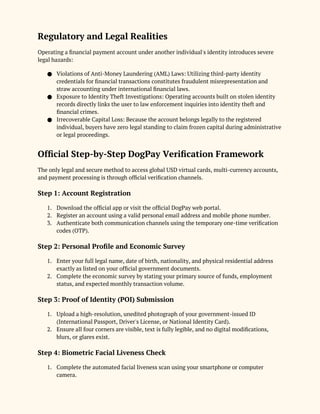
Regulatory and LegalRealities
Operating a financial payment account under another individual's identity introduces severe
legal hazards:
● Violations of Anti-Money Laundering (AML) Laws: Utilizing third-party identity
credentials for financial transactions constitutes fraudulent misrepresentation and
straw accounting under international financial laws.
● Exposure to Identity Theft Investigations: Operating accounts built on stolen identity
records directly links the user to law enforcement inquiries into identity theft and
financial crimes.
● Irrecoverable Capital Loss: Because the account belongs legally to the registered
individual, buyers have zero legal standing to claim frozen capital during administrative
or legal proceedings.
Official Step-by-Step DogPay Verification Framework
The only legal and secure method to access global USD virtual cards, multi-currency accounts,
and payment processing is through official verification channels.
Step 1: Account Registration
1. Download the official app or visit the official DogPay web portal.
2. Register an account using a valid personal email address and mobile phone number.
3. Authenticate both communication channels using the temporary one-time verification
codes (OTP).
Step 2: Personal Profile and Economic Survey
1. Enter your full legal name, date of birth, nationality, and physical residential address
exactly as listed on your official government documents.
2. Complete the economic survey by stating your primary source of funds, employment
status, and expected monthly transaction volume.
Step 3: Proof of Identity (POI) Submission
1. Upload a high-resolution, unedited photograph of your government-issued ID
(International Passport, Driver's License, or National Identity Card).
2. Ensure all four corners are visible, text is fully legible, and no digital modifications,
blurs, or glares exist.
Step 4: Biometric Facial Liveness Check
1. Complete the automated facial liveness scan using your smartphone or computer
camera.
7.
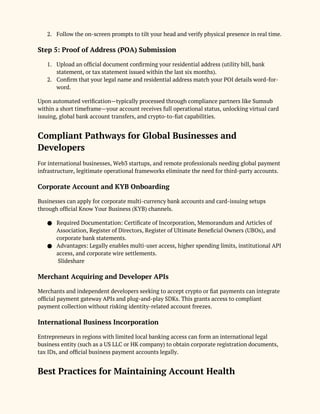
2. Follow theon-screen prompts to tilt your head and verify physical presence in real time.
Step 5: Proof of Address (POA) Submission
1. Upload an official document confirming your residential address (utility bill, bank
statement, or tax statement issued within the last six months).
2. Confirm that your legal name and residential address match your POI details word-for-
word.
Upon automated verification—typically processed through compliance partners like Sumsub
within a short timeframe—your account receives full operational status, unlocking virtual card
issuing, global bank account transfers, and crypto-to-fiat capabilities.
Compliant Pathways for Global Businesses and
Developers
For international businesses, Web3 startups, and remote professionals needing global payment
infrastructure, legitimate operational frameworks eliminate the need for third-party accounts.
Corporate Account and KYB Onboarding
Businesses can apply for corporate multi-currency bank accounts and card-issuing setups
through official Know Your Business (KYB) channels.
● Required Documentation: Certificate of Incorporation, Memorandum and Articles of
Association, Register of Directors, Register of Ultimate Beneficial Owners (UBOs), and
corporate bank statements.
● Advantages: Legally enables multi-user access, higher spending limits, institutional API
access, and corporate wire settlements.
Slideshare
Merchant Acquiring and Developer APIs
Merchants and independent developers seeking to accept crypto or fiat payments can integrate
official payment gateway APIs and plug-and-play SDKs. This grants access to compliant
payment collection without risking identity-related account freezes.
International Business Incorporation
Entrepreneurs in regions with limited local banking access can form an international legal
business entity (such as a US LLC or HK company) to obtain corporate registration documents,
tax IDs, and official business payment accounts legally.
Best Practices for Maintaining Account Health
8.
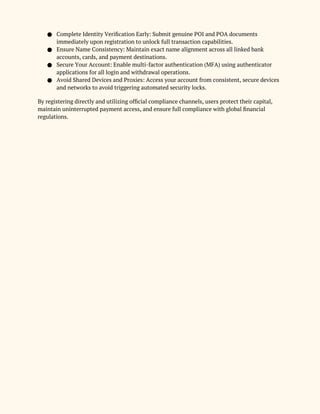
● Complete IdentityVerification Early: Submit genuine POI and POA documents
immediately upon registration to unlock full transaction capabilities.
● Ensure Name Consistency: Maintain exact name alignment across all linked bank
accounts, cards, and payment destinations.
● Secure Your Account: Enable multi-factor authentication (MFA) using authenticator
applications for all login and withdrawal operations.
● Avoid Shared Devices and Proxies: Access your account from consistent, secure devices
and networks to avoid triggering automated security locks.
By registering directly and utilizing official compliance channels, users protect their capital,
maintain uninterrupted payment access, and ensure full compliance with global financial
regulations.