Bertrand Russell’s &Ludwig Wittgenstien
& Moore Philosophy of Education
Bertrand Russell
• Bertrand Russell shaped analytic philosophy by using mathematical logic to solve
traditional metaphysical and epistemological problems. His core approach replaced vague
philosophical prose with rigorous logical analysis, establishing a new standard of clarity
and precision in the English-speaking philosophical tradition.
• Bertrand Russell’s philosophy of education focuses on individual empowerment, critical
thinking, and the rejection of dogma. Detailed primarily in his books On
Education (1926) and Education and the Social Order (1932), he argued that education
should cultivate free, rational minds rather than enforce blind obedience to the state,
church, or tradition.
• Bertrand Russell's most famous academic work is Principia Mathematica (1910–1913),
co-authored with Alfred North Whitehead, while his most famous general audience book
is A History of Western Philosophy (1945), and his most famous technical paper is "On
Denoting" (1905). who helped start analytic philosophy. His main ideas focused on
showing that mathematics is part of logic, using logical analysis to fix language confusion,
breaking down reality into basic logical facts, and promoting free thought and peace.
Core Ideas of Analytical Philosophy of Russell
Philosophy should make unclear ideas clear
• Russell believed that philosophers should not simply speculate about big questions. They should first
ask:
• “What exactly do we mean by this statement?”
• For example, if someone says: “The mind controls the body.”
• Russell would ask: What do we mean by “mind,” “controls,” and “body”?
• By analysing the meaning of the statement, we may discover whether the problem is genuine or simply
created by confusing language.
Logic is the main tool of philosophy
• Russell gave great importance to formal logic.
• He believed that logic helps us determine whether an argument is properly constructed.
• For example: All humans are mortal.-Socrates is a human. -Therefore, Socrates is mortal.
• The conclusion follows logically from the first two statements.
• Thus, philosophy should use logical reasoning rather than vague speculation.
Analyse complex ideas into simpler parts
• One of Russell's central approaches was logical analysis. Think of it like taking apart a
complicated machine to understand how it works.
• For example: “The university is successful.”
• Russell would ask: What does “university” refer to?, What does “successful” mean?, What
evidence shows that it is successful?
• Is the statement about research, teaching, employment, reputation, or something else?
• Breaking a complicated statement into its simpler components helps us understand it accurately.
Language can create philosophical confusion
• Russell believed that ordinary language sometimes hides the logical structure of reality.
• For example: “The present King of France is bald.”
• The sentence looks grammatically correct. But Russell asked: Does France currently have a
King?
• If there is no present King of France, the statement creates a philosophical puzzle.
• Russell's theory of descriptions attempted to show how such statements can be logically
analysed instead of treating every grammatical expression as referring to an actual object.
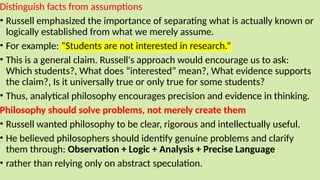
Distinguish facts from assumptions
• Russell emphasized the importance of separating what is actually known or
logically established from what we merely assume.
• For example: “Students are not interested in research.”
• This is a general claim. Russell's approach would encourage us to ask:
Which students?, What does “interested” mean?, What evidence supports
the claim?, Is it universally true or only true for some students?
• Thus, analytical philosophy encourages precision and evidence in thinking.
Philosophy should solve problems, not merely create them
• Russell wanted philosophy to be clear, rigorous and intellectually useful.
• He believed philosophers should identify genuine problems and clarify
them through: Observation + Logic + Analysis + Precise Language
• rather than relying only on abstract speculation.
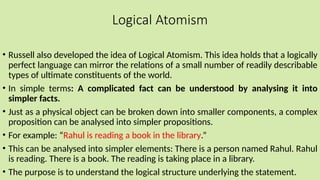
Logical Atomism
• Russell also developed the idea of Logical Atomism. This idea holds that a logically
perfect language can mirror the relations of a small number of readily describable
types of ultimate constituents of the world.
• In simple terms: A complicated fact can be understood by analysing it into
simpler facts.
• Just as a physical object can be broken down into smaller components, a complex
proposition can be analysed into simpler propositions.
• For example: “Rahul is reading a book in the library.”
• This can be analysed into simpler elements: There is a person named Rahul. Rahul
is reading. There is a book. The reading is taking place in a library.
• The purpose is to understand the logical structure underlying the statement.
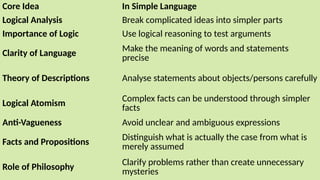
Core Idea In Simple Language
Logical Analysis Break complicated ideas into simpler parts
Importance of Logic Use logical reasoning to test arguments
Clarity of Language
Make the meaning of words and statements
precise
Theory of Descriptions Analyse statements about objects/persons carefully
Logical Atomism Complex facts can be understood through simpler
facts
Anti-Vagueness Avoid unclear and ambiguous expressions
Facts and Propositions Distinguish what is actually the case from what is
merely assumed
Role of Philosophy Clarify problems rather than create unnecessary
mysteries
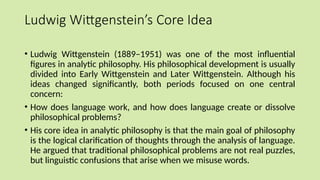
Ludwig Wittgenstein’s Core Idea
• Ludwig Wittgenstein (1889–1951) was one of the most influential
figures in analytic philosophy. His philosophical development is usually
divided into Early Wittgenstein and Later Wittgenstein. Although his
ideas changed significantly, both periods focused on one central
concern:
• How does language work, and how does language create or dissolve
philosophical problems?
• His core idea in analytic philosophy is that the main goal of philosophy
is the logical clarification of thoughts through the analysis of language.
He argued that traditional philosophical problems are not real puzzles,
but linguistic confusions that arise when we misuse words.
Early Wittgenstein: Language as a Picture of Reality
• Ludwig Wittgenstein’s picture theory of meaning proposes that language functions
like a picture or a map. A meaningful sentence represents reality because its elements
mirror the structure of a possible state of affairs in the world, sharing the same logical
form.
• His early philosophy is mainly expressed in Tractatus Logico-Philosophicus (1921).
• His basic idea was: A meaningful proposition represents or “pictures” a possible fact
about the world.
• Simple example: Consider: “The book is on the table.”
• This sentence describes a possible arrangement of things: Book → on → Table
• If the book really is on the table, the proposition is true. If it is not, the proposition is
false.
• Thus, language can represent the structure of reality.
• A statement like "The cat is on the mat" is a logical picture.
The World Consists of Facts
•Wittgenstein famously wrote: “The world is everything
that is the case.”
•In simple language, the world is not merely a collection
of objects; it consists of facts or states of affairs.
•For example: A chair exists → an object.
•The chair is in the classroom → a fact.
•The teacher is teaching → a fact.
•Philosophy should therefore examine how language
represents facts.
Logical Structure of Language
• Wittgenstein believed that meaningful language has an underlying
logical structure.
• The structure of a meaningful proposition corresponds to the
possible structure of reality.
• For example: “A is next to B.”
• The proposition contains a relationship between A and B, and the
logical structure of the proposition represents that relationship.
• Therefore: Logical structure of language ↔ Logical structure of
reality
• This was one of the central ideas of his early philosophy.
The Limits of Language
• One of Wittgenstein's most famous ideas is: “The limits of my language
mean the limits of my world.”
• In simple terms: What we can clearly express in language determines
what we can meaningfully discuss.
• For example, if a concept is completely unclear, we may create a
philosophical problem simply by using words without knowing precisely
what they mean.
• This led Wittgenstein to his famous conclusion: “Whereof one cannot
speak, thereof one must be silent.”
• In simple language we can say: If something cannot be meaningfully
expressed in language, we should not pretend that we can make clear
philosophical statements about it.
Philosophy Is Not a Scientific Theory
•Wittgenstein did not think philosophy should provide
scientific theories about the world.
•Philosophy should clarify our thoughts and language.
•Science asks: “What happens?”
•Philosophy asks: “What exactly do we mean when we
say this?”
•Therefore, philosophy is primarily a clarifying activity.
Later Wittgenstein: Meaning as Use
• Wittgenstein later changed his position considerably.
• His later philosophy is mainly found in Philosophical Investigations.
• His famous principle became: “The meaning of a word is its use in the
language.”
• This is a major shift from his early picture theory.
• Simple example: “Game”
• What does the word “game” mean?
• It can refer to: cricket, chess, football, children's games, computer games.
• There is not necessarily one single characteristic common to every game.
• We understand the meaning of “game” by looking at how the word is actually
used.
Language Games
• Wittgenstein introduced the concept of Language Games.
• A language game is a particular way in which language is used within a specific activity or
social context.
• For example: In a classroom someone said that “Open your book.”
• This is an instruction.
• In a laboratory: “The temperature is 30°C.”
• This is a report or measurement.
• In a courtroom: “I swear to tell the truth.”
• This is a formal declaration.
• The words have meaning partly because of the activity and context in which they are used.
• Therefore: Language does not have meaning in isolation; its meaning depends on how and
where it is used.
Family Resemblance
•Wittgenstein used the idea of family resemblance to explain
why some concepts do not have one strict definition.
•Consider a family. Different family members may share:
similar eyes, similar facial features, similar habits, similar
voice,
•but there may be no single feature shared by everyone.
•Similarly, different activities called “games” may resemble
each other in different ways without sharing one essential
characteristic.
•This is called: Family Resemblance
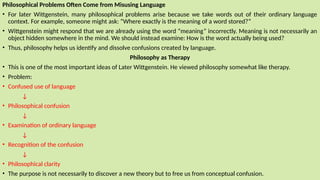
Philosophical Problems Often Come from Misusing Language
• For later Wittgenstein, many philosophical problems arise because we take words out of their ordinary language
context. For example, someone might ask: “Where exactly is the meaning of a word stored?”
• Wittgenstein might respond that we are already using the word “meaning” incorrectly. Meaning is not necessarily an
object hidden somewhere in the mind. We should instead examine: How is the word actually being used?
• Thus, philosophy helps us identify and dissolve confusions created by language.
Philosophy as Therapy
• This is one of the most important ideas of Later Wittgenstein. He viewed philosophy somewhat like therapy.
• Problem:
• Confused use of language
↓
• Philosophical confusion
↓
• Examination of ordinary language
↓
• Recognition of the confusion
↓
• Philosophical clarity
• The purpose is not necessarily to discover a new theory but to free us from conceptual confusion.
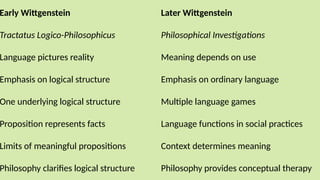
Early Wittgenstein Later Wittgenstein
Tractatus Logico-Philosophicus Philosophical Investigations
Language pictures reality Meaning depends on use
Emphasis on logical structure Emphasis on ordinary language
One underlying logical structure Multiple language games
Proposition represents facts Language functions in social practices
Limits of meaningful propositions Context determines meaning
Philosophy clarifies logical structure Philosophy provides conceptual therapy
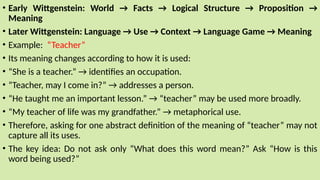
• Early Wittgenstein: World → Facts → Logical Structure → Proposition →
Meaning
• Later Wittgenstein: Language → Use → Context → Language Game → Meaning
• Example: “Teacher”
• Its meaning changes according to how it is used:
• “She is a teacher.” → identifies an occupation.
• “Teacher, may I come in?” → addresses a person.
• “He taught me an important lesson.” → “teacher” may be used more broadly.
• “My teacher of life was my grandfather.” → metaphorical use.
• Therefore, asking for one abstract definition of the meaning of “teacher” may not
capture all its uses.
• The key idea: Do not ask only “What does this word mean?” Ask “How is this
word being used?”
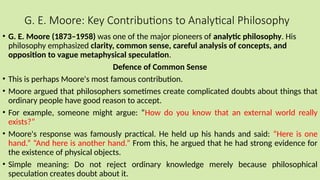
G. E. Moore: Key Contributions to Analytical Philosophy
• G. E. Moore (1873–1958) was one of the major pioneers of analytic philosophy. His
philosophy emphasized clarity, common sense, careful analysis of concepts, and
opposition to vague metaphysical speculation.
Defence of Common Sense
• This is perhaps Moore's most famous contribution.
• Moore argued that philosophers sometimes create complicated doubts about things that
ordinary people have good reason to accept.
• For example, someone might argue: “How do you know that an external world really
exists?”
• Moore's response was famously practical. He held up his hands and said: “Here is one
hand.” “And here is another hand.” From this, he argued that he had strong evidence for
the existence of physical objects.
• Simple meaning: Do not reject ordinary knowledge merely because philosophical
speculation creates doubt about it.
Analysis of Concepts
• Moore believed that philosophers should carefully analyse the meaning of concepts rather than
simply make broad claims.
• For example: What is “good”?
• Instead of immediately saying: “Good means pleasure.”
• Moore asks whether goodness and pleasure are really the same thing.
• This emphasis on conceptual clarification became an important feature of analytic philosophy.
Naturalistic Fallacy
• Moore's discussion of the naturalistic fallacy is central to his ethical philosophy, especially in Principia
Ethica (1903).
• He argued that “good” cannot simply be identified with a natural property, such as pleasure, desire,
evolutionary fitness or survival.
• For example: “Pleasure is good.”
• Moore would distinguish: Pleasure = a particular natural/psychological experience.
• Good = a basic evaluative concept.
• Therefore, saying: Good = Pleasure
• does not adequately explain what “good” means.
Open Question Argument
• Moore supported his position through the Open Question Argument.
• Suppose someone says: “Good means pleasurable.” We can still ask: “Is everything
pleasurable necessarily good?”
• The question makes sense. Therefore, according to Moore, “good” cannot simply be
identical in meaning to “pleasurable.”
• Formula: If X = Good, then asking “Is X good?” should be meaningless. But: “Is pleasure
good?” is still a meaningful question.
• Therefore: Goodness cannot simply be reduced to pleasure or another natural property.
Good as a Simple and Non-Natural Property
• Moore considered goodness to be a simple, indefinable property.
• Think of the colour yellow. We can recognise yellow, but trying to define yellow entirely in
terms of other simpler colours does not really capture what yellow is.
• Similarly, Moore argued that: “Good” can be understood, but it cannot be reduced to a
simpler definition.
• This is called ethical non-naturalism.
Intrinsic Goodness
• Moore distinguished between things that are good in themselves and things that
are good because they lead to something else.
• Example: Suppose education produces employment. Employment may be
valuable partly because it produces other benefits. But Moore argued that some
experiences, such as: friendship, appreciation of beauty, knowledge, and
aesthetic experience may possess intrinsic value—they are valuable in
themselves.
Objective Moral Values
• Moore rejected the idea that moral value is simply a matter of personal
preference.
• For example: “I like honesty.” is a statement about personal preference. But
• “Honesty is morally good.” makes an objective evaluative claim.
• Moore's ethical theory therefore supports the idea that moral values have an
objective character.
Moore's Contribution to Analytic Philosophy
• Moore helped establish an important methodological principle: Before
attempting to solve a philosophical problem, first clarify the concepts involved.
• His work shifted philosophical attention towards: Ordinary Language →
Conceptual Analysis → Logical Clarity → Philosophical Argument
• This became an important foundation for the development of British analytic
philosophy.
• G. E. Moore's major contribution to analytic philosophy was his emphasis on
precise conceptual analysis and common-sense knowledge, together with his
influential ethical theory that “good” is an indefinable, non-natural property and
cannot simply be reduced to pleasure or other natural facts.
• Moore = Common Sense + Conceptual Analysis + Ethics
• And in ethics: Good ≠ Pleasure : Good is simple, non-natural and intrinsically
valuable things can exist.
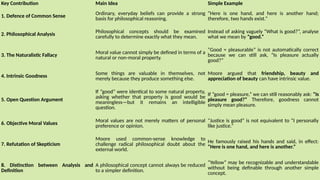
Key Contribution Main Idea Simple Example
1. Defence of Common Sense Ordinary, everyday beliefs can provide a strong
basis for philosophical reasoning.
“Here is one hand, and here is another hand;
therefore, two hands exist.”
2. Philosophical Analysis Philosophical concepts should be examined
carefully to determine exactly what they mean.
Instead of asking vaguely “What is good?”, analyse
what we mean by “good.”
3. The Naturalistic Fallacy
Moral value cannot simply be defined in terms of a
natural or non-moral property.
“Good = pleasurable” is not automatically correct
because we can still ask, “Is pleasure actually
good?”
4. Intrinsic Goodness Some things are valuable in themselves, not
merely because they produce something else.
Moore argued that friendship, beauty and
appreciation of beauty can have intrinsic value.
5. Open Question Argument
If “good” were identical to some natural property,
asking whether that property is good would be
meaningless—but it remains an intelligible
question.
If “good = pleasure,” we can still reasonably ask: “Is
pleasure good?” Therefore, goodness cannot
simply mean pleasure.
6. Objective Moral Values Moral values are not merely matters of personal
preference or opinion.
“Justice is good” is not equivalent to “I personally
like justice.”
7. Refutation of Skepticism
Moore used common-sense knowledge to
challenge radical philosophical doubt about the
external world.
He famously raised his hands and said, in effect:
“Here is one hand, and here is another.”
8. Distinction between Analysis and
Definition
A philosophical concept cannot always be reduced
to a simpler definition.
“Yellow” may be recognizable and understandable
without being definable through another simple
concept.
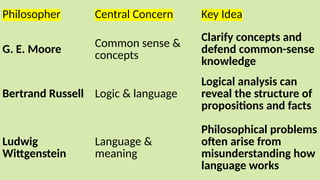
Philosopher Central Concern Key Idea
G. E. Moore
Common sense &
concepts
Clarify concepts and
defend common-sense
knowledge
Bertrand Russell Logic & language
Logical analysis can
reveal the structure of
propositions and facts
Ludwig
Wittgenstein
Language &
meaning
Philosophical problems
often arise from
misunderstanding how
language works