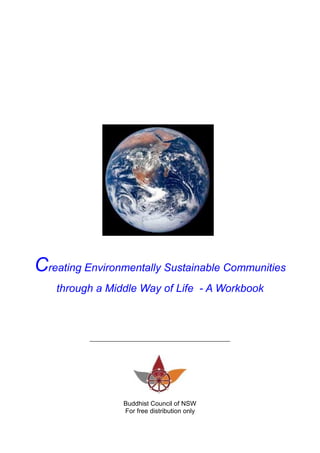
Creating Environmentally Sustainable Communities
through a Middle Way of Life - A Workbook
Buddhist Council of NSW
For free distribution only
2
“We have a brief window of opportunity to take action, to preserve humanity from imminent disaster
and to assist the survival of the many diverse and beautiful forms of life on Earth.
Future generations, and the other species that share the biosphere with us, have no voice to ask for
our compassion, wisdom, and leadership. We must listen to their silence. We must be their voice,
too, and act on their behalf.”
From “A Buddhist Declaration on Climate Change” [1]
Dietrich Bonhoeffer: “The ultimate test of a moral society is the kind of world that it leaves to its
children.”
Prof Ian Lowe: “It would be much easier to ignore these difficult issues, to enjoy our material comforts
and our wonderful lifestyle - but sustainable future is clearly a better future. Working for it is our moral
duty to the countless millions of other species that we share this planet with, and the future
generations for whom we hold it in trusts.”
Dalai Lama: “It is our collective and individual responsibility to preserve and tend to the environment
in which we all live.”
St Francis of Assisi: “It is no use walking anywhere to preach, unless our walking is our preaching.”
M.K. Ghandi: “Whatever you do may seem insignificant but it is most important that you do it.”
Thomas Berry: “The natural world is the larger sacred community to which we belong.” [2]
3
CONTENTS
Introduction 3
Eco-Footprint Records 4
Worksheets
1. Eco-Footprint and First Steps 5
2. Home - Energy and Water 6
3. Home - Waste and Recycling 7
4. Home - Air and Chemicals 8
5. Garden - Plants, Pets and Wildlife 9
6. Food 10
7. Personal Products - Medicines, Toiletries, Clothing 12
8. Education and Work Resources 13
9. Transport 13
10. Helping Others 14
11. Contemplation on our Lifestyle 15
References 16
INTRODUCTION
It is an unavoidable truth that we are living during a global environmental crisis of which large-scale
pollution, global warming, poverty of many millions of people and extinction of many species are clear
signs. While the deep causes of this crisis are indeed human selfishness and ignorance of the natural
laws of cause and effect, it is vital, like during any medical or humanitarian crisis, that we deal with
the immediate dangers first and then focus on alleviating the deeper causes, and establishing a
preventive or environmentally sustainable lifestyle. [3]
Just as ethical rules of conduct, so simplifying and purifying our basic life requisites is essential to
establishing an environmentally sustainable way of life - a Middle Way between the two extremes of
self-indulgence and self-injury. This way of life was taught by the Buddha 2500 years ago, but unlike
then our basic life requisites are not naturally pure and environmentally sustainable, so we now need
to address these much more than it was necessary then. To achieve an environmentally sustainable
lifestyle does not require much time or money, but a general understanding of what a modern
sustainable lifestyle means, a standard to measure our lifestyle by and an effective method to
achieve such lifestyle.
This workbook has been designed to help you establish an environmentally sustainable lifestyle that
is relevant to the modern world now, and so contribute towards achieving national and international
CO2 emission targets and environmental sustainability. The workbook is suitable for both individuals
and community groups, to systematically examine and improve their personal and community
lifestyle. It utilises free online eco-footprint calculators and other sustainable lifestyle resources.
Measuring your eco-footprint will enable you to evaluate your lifestyle against your current national
average and against the current globally sustainable lifestyle. It will also give you some insight into
what you need to improve. The following worksheets will help you develop a general understanding
of what an environmentally sustainable lifestyle means, examine your way of life, plan improvements
and take action. Finally, the contemplation on the impacts of our lifestyle on the environment,
described at the end of this workbook, will help you develop a holistic understanding of the global
interdependence and hence of the significance of each individual’s way of life in alleviating the
environmental crisis.
Dr Danuse Murty
Sydney 2012
4
ECO-FOOTPRINT RECORDS
DATE CALCULATOR VALUE NOTES
My Footprint
EPA
My Footprint
EPA
My Footprint
EPA
Eco-footprint calculators:
My Footprint - www.myfootprint.org
EPA Ecological Footprint Calculators - www.epa.vic.gov.au/ecologicalfootprint
“The small things you do now make a big difference. Your everyday actions at home, work and play
will reward both the environment and you. Live in a sustainable way and feel good about your
contribution. Check your current behaviours - see how many of the priority actions you already do
and then take the next step.” (Our Environment - It’s a Living Thing) [4]
5
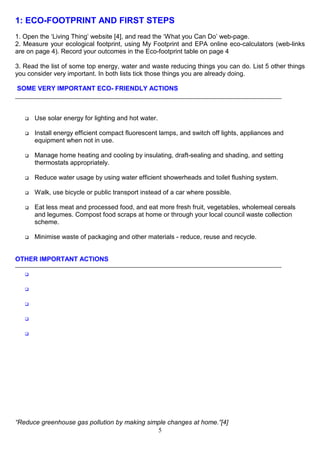
1: ECO-FOOTPRINT AND FIRST STEPS
1. Open the ‘Living Thing’ website [4], and read the ‘What you Can Do’ web-page.
2. Measure your ecological footprint, using My Footprint and EPA online eco-calculators (web-links
are on page 4). Record your outcomes in the Eco-footprint table on page 4
3. Read the list of some top energy, water and waste reducing things you can do. List 5 other things
you consider very important. In both lists tick those things you are already doing.
SOME VERY IMPORTANT ECO- FRIENDLY ACTIONS
! Use solar energy for lighting and hot water.
! Install energy efficient compact fluorescent lamps, and switch off lights, appliances and
equipment when not in use.
! Manage home heating and cooling by insulating, draft-sealing and shading, and setting
thermostats appropriately.
! Reduce water usage by using water efficient showerheads and toilet flushing system.
! Walk, use bicycle or public transport instead of a car where possible.
! Eat less meat and processed food, and eat more fresh fruit, vegetables, wholemeal cereals
and legumes. Compost food scraps at home or through your local council waste collection
scheme.
! Minimise waste of packaging and other materials - reduce, reuse and recycle.
OTHER IMPORTANT ACTIONS
!
!
!
!
!
“Reduce greenhouse gas pollution by making simple changes at home.”[4]
6
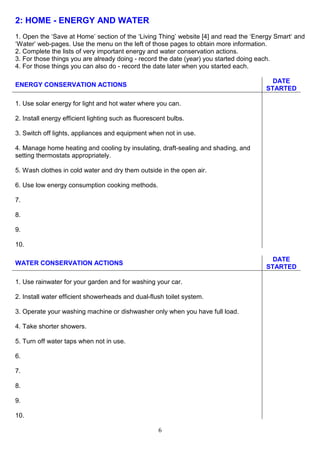
2: HOME - ENERGY AND WATER
1. Open the ‘Save at Home’ section of the ‘Living Thing’ website [4] and read the ‘Energy Smart‘ and
‘Water’ web-pages. Use the menu on the left of those pages to obtain more information.
2. Complete the lists of very important energy and water conservation actions.
3. For those things you are already doing - record the date (year) you started doing each.
4. For those things you can also do - record the date later when you started each.
ENERGY CONSERVATION ACTIONS
DATE
STARTED
1. Use solar energy for light and hot water where you can.
2. Install energy efficient lighting such as fluorescent bulbs.
3. Switch off lights, appliances and equipment when not in use.
4. Manage home heating and cooling by insulating, draft-sealing and shading, and
setting thermostats appropriately.
5. Wash clothes in cold water and dry them outside in the open air.
6. Use low energy consumption cooking methods.
7.
8.
9.
10.
WATER CONSERVATION ACTIONS
DATE
STARTED
1. Use rainwater for your garden and for washing your car.
2. Install water efficient showerheads and dual-flush toilet system.
3. Operate your washing machine or dishwasher only when you have full load.
4. Take shorter showers.
5. Turn off water taps when not in use.
6.
7.
8.
9.
10.
7
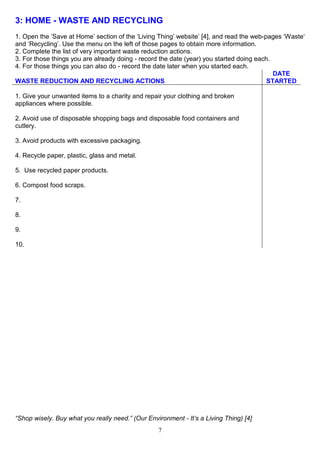
3: HOME - WASTE AND RECYCLING
1. Open the ‘Save at Home’ section of the ‘Living Thing’ website’ [4], and read the web-pages ‘Waste‘
and ‘Recycling’. Use the menu on the left of those pages to obtain more information.
2. Complete the list of very important waste reduction actions.
3. For those things you are already doing - record the date (year) you started doing each.
4. For those things you can also do - record the date later when you started each.
WASTE REDUCTION AND RECYCLING ACTIONS
DATE
STARTED
1. Give your unwanted items to a charity and repair your clothing and broken
appliances where possible.
2. Avoid use of disposable shopping bags and disposable food containers and
cutlery.
3. Avoid products with excessive packaging.
4. Recycle paper, plastic, glass and metal.
5. Use recycled paper products.
6. Compost food scraps.
7.
8.
9.
10.
“Shop wisely. Buy what you really need.” (Our Environment - It’s a Living Thing) [4]
8
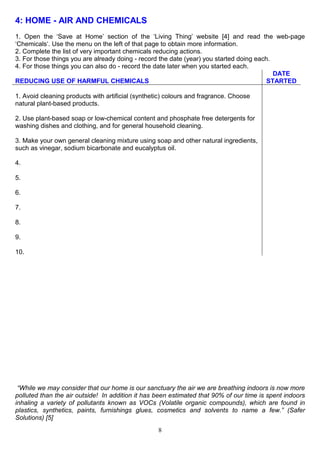
4: HOME - AIR AND CHEMICALS
1. Open the ‘Save at Home’ section of the ‘Living Thing’ website [4] and read the web-page
‘Chemicals‘. Use the menu on the left of that page to obtain more information.
2. Complete the list of very important chemicals reducing actions.
3. For those things you are already doing - record the date (year) you started doing each.
4. For those things you can also do - record the date later when you started each.
REDUCING USE OF HARMFUL CHEMICALS
DATE
STARTED
1. Avoid cleaning products with artificial (synthetic) colours and fragrance. Choose
natural plant-based products.
2. Use plant-based soap or low-chemical content and phosphate free detergents for
washing dishes and clothing, and for general household cleaning.
3. Make your own general cleaning mixture using soap and other natural ingredients,
such as vinegar, sodium bicarbonate and eucalyptus oil.
4.
5.
6.
7.
8.
9.
10.
“While we may consider that our home is our sanctuary the air we are breathing indoors is now more
polluted than the air outside! In addition it has been estimated that 90% of our time is spent indoors
inhaling a variety of pollutants known as VOCs (Volatile organic compounds), which are found in
plastics, synthetics, paints, furnishings glues, cosmetics and solvents to name a few.” (Safer
Solutions) [5]
9
5: GARDEN - PLANTS, PETS AND WILDLIFE
1. Open the ‘Safer Solutions’ website [5]. Read the web-page ‘In Your Garden’ to learn how you can
make your garden more eco-sustainable.
2. Complete the list of very important garden care actions.
3. For those things you are already doing - record the date (year) you started doing each.
4. For those things you can also do - record the date later when you started each.
ECO-FRIEDLY GARDEN CARE
DATE
STARTED
1. Avoid use of synthetic herbicides or pesticides. Use natural weed and pest control.
2. Remove noxious and environmental weeds from your garden.
3. Plant native plants to encourage native wildlife.
4. Put bells on your cats and keep them caged or indoors at night.
5. Join a bush-care or other wildlife conservation group.
6.
7.
8.
9.
10.
“The average domestic cat brings home 16 mammals, 8 birds and 8 reptiles each year. There are
more than 2.5 million domestic cats in Australia. Feral cats feed on wildlife. There are now more than
12 million feral cats across Australia, many of which were once someone’s pet until they were
forgotten or run away.” (WIRES) [6]
10
6: FOOD
1.Open the ‘Save at Home’ section of the ‘Living Thing’ website’] and read web-page ‘Chemicals‘.[4]
Use the menu on the left of that page to learn more about how to make your food freer of harmful
chemicals. Open the Why Veg website learn why it is important to eat less of animal products. [7]
2. Complete the list of very important food choices.
3. For those things you are already doing - record the date (year) you started doing each.
4. For those things you can also do - record the date later when you started each.
ECO-FRIENDLY FOOD CHOICES
DATE
STARTED
1. Eat less meat and don’t eat meat at least one day each week.
2. Avoid factory-farmed animal products. Chose free range instead.
3. Eat less processed food and more fresh fruit and vegetables, unrefined cereals
and legumes.
4. Eat more organic food.
5.
6.
7.
8.
9.
10.
“Eating less meat is is one of the most effective things you can do to reduce your impact on the
environment.” (Australian Religious Response to Climate Change) [8]
11
FOOD FOR THOUGHT
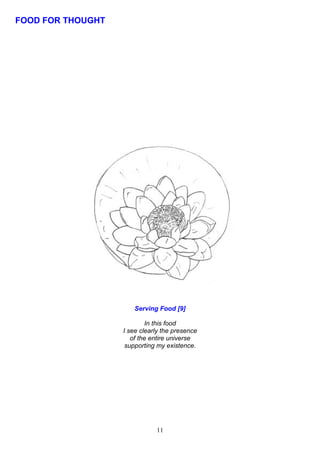
Serving Food [9]
In this food
I see clearly the presence
of the entire universe
supporting my existence.
12
7: PERSONAL PRODUCTS - MEDICINES, TOILETRIES, CLOTHING
1. Open the ‘Save at Home’ section of the ‘Living Thing’ website’ and read the web-page ‘Chemicals’.
[4] Use the menu on the left of that page to learn about chemicals in personal products.
2. Complete the list of very important personal care actions.
3. For those things you are already doing - record the date (year) you started doing each.
4. For those things you can also do - record the date later when you started each.
ECO-FRIENDLY PERSONAL CARE
DATE
STARTED
1. Avoid synthetic medicines where possible. Use natural medicines and treatments
instead.
2. Avoid soaps, shampoos, lotions and other toiletries that were tested on animals.
Choose products labelled ‘Not tested on animals’ or ‘Cruelty free”.
3. Avoid artificially coloured and scented toiletries. Use only unscented or naturally
scented soaps, shampoos and creams.
4. Avoid coloured and perfumed toilet paper. Buy only plain paper and made from
recycled paper.
5. Avoid clothing made by child labour. Choose fair-trade clothing.
6.
7.
8.
9.
10.
“Compassionate living: The humble act of shopping provides the single greatest opportunity to vote
against animal cruelty.” (Animals Australia) [10]
13
8: EDUCATION AND WORK RESOURCES
1. Read the ‘Waste’ pages in the ‘Save at Home’ and ‘Save at Work’ sections of the ‘Living Thing’
website [4]. Use the menu on the left of those pages to learn more how to make your education and
work more eco-sustainable.
2. Complete the lists of very important resource conservation actions.
3. For those things you are already doing - record the date (year) you started doing each. For those
things you can also do - record the date later when you started each.
EDUCATION & WORK RESOURCES CONSERVATION
DATE
STARTED
1. Print only what is really necessary and on both sides of paper.
2. Reuse paper printed on one side for notes and drafts.
3. Borrow books and other resources from the libraries.
4.
5.
9: TRANSPORT
1. Read the ‘Transport’ in the ‘Save at Home’ and ‘Save at Work’ sections of the ‘Living Thing’
website [4]. Use the menu on the left of those pages to learn more how to make your transport more
eco-sustainable.
2. Complete the lists of very important eco-sustainable transport actions.
3. For those things you are already doing - record the date (year) you started doing each. For those
things you can also do - record the date later when you started each.
ECO-SUSTINABLE TRANSPORT ACTIONS
DATE
STARTED
1. Walk or use bicycle where practically possible. .
2. Use public transport to go to place of learning or work.
3. Fly only if necessary.
4.
5.
“By using cars less we can improve our health, reduce air pollution and improve quality of life for the
whole community.” (Our Environment - It’s a Living Thing) [4]
14
10: HELPING OTHERS
1. Reflect on simple ways to help others.
2. Complete the lists of some important ways to help others towards more eco-sustainable living.
3. For those things you are already doing - record the date (year) you started doing each.
4. For those things you can also do - record the date later when you started each.
HELPING OTHERS – ECO-FRIENDLY ACTIONS
DATE
STARTED
1. Give only eco-friendly products for birthdays, Christmas and other special
occasions.
2. Give your presents unwrapped or wrapped in recyclable packaging.
3. Give gifts to UNICEF, WWF or other charity on your friends’ behalf.
4.
5.
6.
7.
8.
9.
10.
“An important and easy way of helping our families, friends and work associates, is through offering
them healthy food and other environmentally friendly gifts.” [3]
15
CONTEMPLATION ON OUR LIFESTYLE
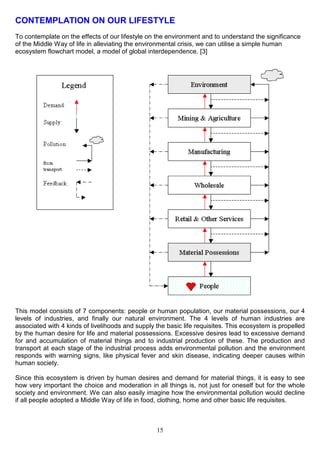
To contemplate on the effects of our lifestyle on the environment and to understand the significance
of the Middle Way of life in alleviating the environmental crisis, we can utilise a simple human
ecosystem flowchart model, a model of global interdependence. [3]
This model consists of 7 components: people or human population, our material possessions, our 4
levels of industries, and finally our natural environment. The 4 levels of human industries are
associated with 4 kinds of livelihoods and supply the basic life requisites. This ecosystem is propelled
by the human desire for life and material possessions. Excessive desires lead to excessive demand
for and accumulation of material things and to industrial production of these. The production and
transport at each stage of the industrial process adds environmental pollution and the environment
responds with warning signs, like physical fever and skin disease, indicating deeper causes within
human society.
Since this ecosystem is driven by human desires and demand for material things, it is easy to see
how very important the choice and moderation in all things is, not just for oneself but for the whole
society and environment. We can also easily imagine how the environmental pollution would decline
if all people adopted a Middle Way of life in food, clothing, home and other basic life requisites.
16
REFERENCES
1. Ecological Buddhism. www.ecobuddhism.org
2. The Hunger Site. www.thehungersite.com
3. Murty D, 2009. Alleviating the Climate Change Crisis through a Middle Way of Life.
The International Journal of Climate Change - Impacts and Responses. Common Ground Publishing,
Melbourne. Volume 1, Number 1, pp. 7-16.
4. NSW Environmental Trust. Our Environment - It’s a Living Thing. www.livingthing.net.au
5. Safer Solutions. www.safersolutions.org.au
6. WIRES, 2008. www.wires.org.au
7. WhyVeg? www.whyveg.org
8. Australian Religious Response to Climate Change. www.arrcc.org.au/eat-less-meat
9. Hanh TN, 1997. Present Moment Wonderful Moment - Mindfulness Verses for Daily Living.
Published by Full Circle, Delhi, India. Printed for Free Distribution by The Corporate Body of the
Buddha Educational Foundation. Taipei, Taiwan.
10. Animals Australia. www.animalsaustralia.org.au
Buddhist Council of NSW
Eco-living Project
www.buddhistcouncil.org