Bayesian Causal Models: Reasoning Under Uncertainty in Complex Systems
An accessible introduction to Bayesian causal modeling, its application in biology and complex systems, and practical tools for decision-making under uncertainty. Presented at the Innovators Circle, June 2026
Bayesian Causal Models: Reasoning Under Uncertainty in Complex Systems
1.
Paul Agapow (Bayezian/ Skipping Girl Bio)
paul@agapow.net
Reasoning Under
Uncertainty
Bayesian Causal Models: a very non-technical introduction
15 min · Technical audience
2.
About me anddisclaimer
Portrait via ChatGPT
• Have been a immunologist, molecular evolutionist,
bioinformatician, database manager, analyst, data
scientist, epi-informatician, “computer guy” ...
• More recently, using AIML, stats & computation in drug
development & life sciences
• Nothing in this presentation implies the existence of any
project or policy at any company
3.
I N TR O D U C T I O N
Aims
1
How can we model and predict in the real world?
In theory, it’s practical. But practically, it’s all theoretical.
2
What’s Bayesian Causal Modelling?
How we can talk about uncertain beliefs and multiple paths to the same end.
3
Can we mobilize these models in a democratized way?
If you don’t have a statistician and 3 months, what do you do?
4.
T H EM E S S Y N A T U R E O F R E A L I T Y
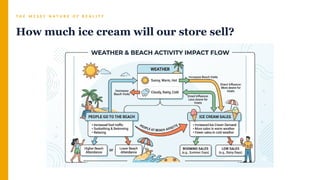
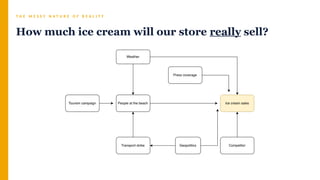
How much ice cream will our store sell?
5.
T H EM E S S Y N A T U R E O F R E A L I T Y
How much ice cream will our store really sell?
6.
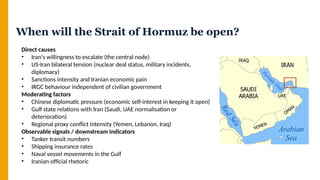
When will theStrait of Hormuz be open?
Direct causes
• Iran's willingness to escalate (the central node)
• US-Iran bilateral tension (nuclear deal status, military incidents,
diplomacy)
• Sanctions intensity and Iranian economic pain
• IRGC behaviour independent of civilian government
Moderating factors
• Chinese diplomatic pressure (economic self-interest in keeping it open)
• Gulf state relations with Iran (Saudi, UAE normalisation or
deterioration)
• Regional proxy conflict intensity (Yemen, Lebanon, Iraq)
Observable signals / downstream indicators
• Tanker transit numbers
• Shipping insurance rates
• Naval vessel movements in the Gulf
• Iranian official rhetoric
7.
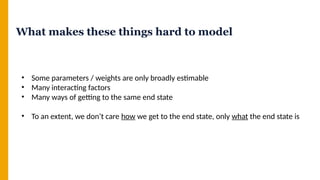
What makes thesethings hard to model
• Some parameters / weights are only broadly estimable
• Many interacting factors
• Many ways of getting to the same end state
• To an extent, we don’t care how we get to the end state, only what the end state is
8.
C L AS S I C A L V S B A Y E S I A N
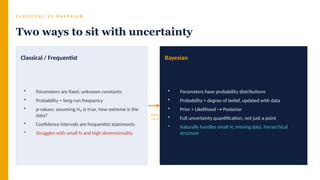
Two ways to sit with uncertainty
Classical / Frequentist
• Parameters are fixed, unknown constants
• Probability = long-run frequency
• p-values: assuming H₀ is true, how extreme is the
data?
• Confidence intervals are frequentist statements
• Struggles with small N and high dimensionality
Bayesian
• Parameters have probability distributions
• Probability = degree of belief, updated with data
• Prior + Likelihood → Posterior
• Full uncertainty quantification, not just a point
• Naturally handles small N, missing data, hierarchical
structure
better
for us
9.
T H EM E C H A N I C S
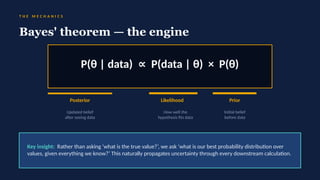
Bayes' theorem — the engine
P(θ | data) P(data | θ) × P(θ)
∝
Posterior
Updated belief
after seeing data
Likelihood
How well the
hypothesis fits data
Prior
Initial belief
before data
Key insight: Rather than asking ‘what is the true value?’, we ask ‘what is our best probability distribution over
values, given everything we know?’ This naturally propagates uncertainty through every downstream calculation.
10.
B I OL O G Y A S A ( W O R S E P O S S I B L E ) U S E C A S E
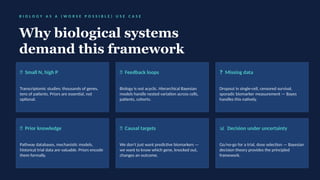
Why biological systems
demand this framework
🔬 Small N, high P
Transcriptomic studies: thousands of genes,
tens of patients. Priors are essential, not
optional.
🔀 Feedback loops
Biology is not acyclic. Hierarchical Bayesian
models handle nested variation across cells,
patients, cohorts.
❓ Missing data
Dropout in single-cell, censored survival,
sporadic biomarker measurement — Bayes
handles this natively.
🧪 Prior knowledge
Pathway databases, mechanistic models,
historical trial data are valuable. Priors encode
them formally.
🎯 Causal targets
We don't just want predictive biomarkers —
we want to know which gene, knocked out,
changes an outcome.
📊 Decision under uncertainty
Go/no-go for a trial, dose selection — Bayesian
decision theory provides the principled
framework.
11.
G E NE R A L A P P L I C A B I L I T Y
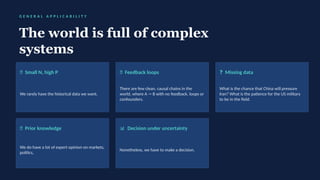
The world is full of complex
systems
🔬 Small N, high P
We rarely have the historical data we want.
🔀 Feedback loops
There are few clean, causal chains in the
world, where A -> B with no feedback, loops or
confounders.
❓ Missing data
What is the chance that China will pressure
Iran? What is the patience for the US military
to be in the field.
🧪 Prior knowledge
We do have a lot of expert opinion on markets,
politics,
📊 Decision under uncertainty
Nonetheless, we have to make a decision.
12.
C A US A L S T R U C T U R E
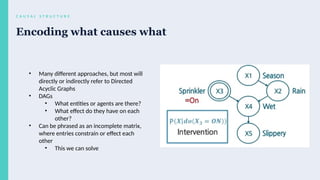
Encoding what causes what
• Many different approaches, but most will
directly or indirectly refer to Directed
Acyclic Graphs
• DAGs
• What entities or agents are there?
• What effect do they have on each
other?
• Can be phrased as an incomplete matrix,
where entries constrain or effect each
other
• This we can solve
13.
C A US A L S T R U C T U R E
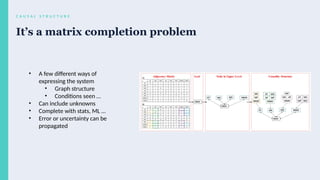
It’s a matrix completion problem
• A few different ways of
expressing the system
• Graph structure
• Conditions seen …
• Can include unknowns
• Complete with stats, ML …
• Error or uncertainty can be
propagated
14.
T H ET O O L K I T
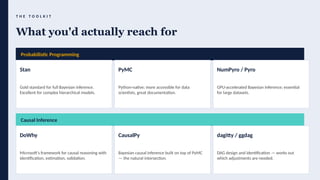
What you'd actually reach for
Probabilistic Programming
Stan
Gold standard for full Bayesian inference.
Excellent for complex hierarchical models.
PyMC
Python-native; more accessible for data
scientists, great documentation.
NumPyro / Pyro
GPU-accelerated Bayesian inference; essential
for large datasets.
Causal Inference
DoWhy
Microsoft's framework for causal reasoning with
identification, estimation, validation.
CausalPy
Bayesian causal inference built on top of PyMC
— the natural intersection.
dagitty / ggdag
DAG design and identification — works out
which adjustments are needed.
15.
But how dowe actually get it done, on time?
Need quicker building of these models
• “Will the strait be open by next month?”
• “Give me 3 months, I’ll get back to
you …”
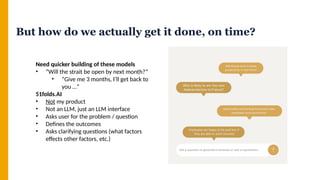
51folds.AI
• Not my product
• Not an LLM, just an LLM interface
• Asks user for the problem / question
• Defines the outcomes
• Asks clarifying questions (what factors
effects other factors, etc.)
16.
Making a “goodenough” model
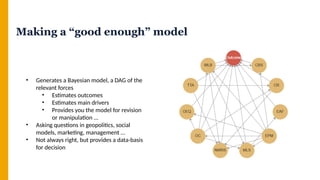
• Generates a Bayesian model, a DAG of the
relevant forces
• Estimates outcomes
• Estimates main drivers
• Provides you the model for revision
or manipulation …
• Asking questions in geopolitics, social
models, marketing, management …
• Not always right, but provides a data-basis
for decision
17.
T A KE A W A Y S
What’s the point?
1
Uncertainty is real information, not a nuisance
Bayesian methods don't eliminate uncertainty — they quantify it and carry it through every step. A posterior distribution is more
honest than a p-value.
2
Put structure where you have knowledge
Causal DAGs let you encode what you believe about mechanisms. Model comparison lets you formalise the competition between
rival theories rather than picking one arbitrarily.
3
Biology and other complex systems made these tools necessary
Small samples, confounders, feedback loops, missing data, expert priors — living systems have all of them. The world has lots of
these. Bayesian causal inference was built for exactly this. And we need a timely way to deploy these tools.