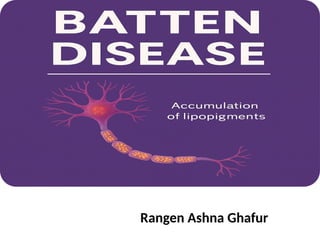
Batten disease : A window into pediatric neurodegenaration
A rare condition that touches childhood in the quietest, deepest ways.
Behind its silence, there’s a journey of science, struggle, and hope.
Let’s discover it together.
Introduction
• Imagine achild growing normally—then slowly losing their
vision, movement, and words.
• Batten disease is a rare condition that turns that heartbreaking
story into reality.
• It begins quietly, but its effects grow over time.
• For families, it brings more questions than answers.
• What causes this silent thief of childhood? 🔍
• Let’s take a closer look...
4.
What is BattenDisease ?
• A rare, genetic disorder that causes waste to build up in brain
cells.
• Caused by mutation CLN genes & leads to brain damage &
nerve cell death.
• They are also known as neuronal ceroid lipofuscinoses (NCLs).
• It usually begins in childhood & worsens over time.
• Sadly, it is fatal disease with no known cure.
5.
Classification & Terminology
•It is classified into five main types based on age of onset:
• 1. Congenital (present at birth; CLN10)
• 2. Infantile (appears by ~2 years; CLN1)
• 3. Late-infantile (ages 2–4; CLN2 and variants)
• 4. Juvenile (ages 4–10; CLN3 – the classic “Batten disease”)
• 5. Adult (after age 20–30; CLN1/6/4/13 etc.)
• Over 13 CLN genes (CLN1–CLN14) are linked to different NCL types; each subtype is
named after its gene.
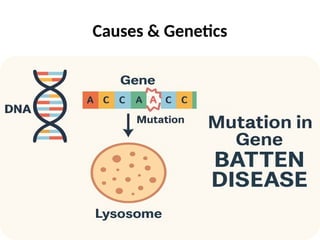
• Batten diseaseis genetic – it’s caused by changes (mutations) in certain
genes.
• These genes are called CLN genes (like CLN1, CLN2, CLN3... up to CLN14).
• Each gene gives instructions to make proteins that help cells break down
waste.
• When a CLN gene is mutated, the cell can’t clear waste properly,
especially in brain cells.
• This causes a toxic buildup of substances (like lipofuscins) in lysosomes.
• The buildup damages and kills nerve cells, leading to the symptoms of
Batten disease.
• It is inherited in an autosomal recessive pattern – a child must inherit the
faulty gene from both parents.
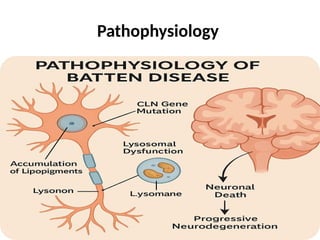
• Batten diseaseaffects the lysosomes, which are the “recycling
centers” of the cell.
• Mutations in CLN genes cause a deficiency or dysfunction of
lysosomal enzymes or proteins.
• This leads to the buildup of lipopigments (mainly ceroid and
lipofuscin) inside neurons.
• The accumulated waste interferes with normal cell function,
especially in brain and retinal cells.
• As waste builds up, nerve cells are damaged and eventually
die.
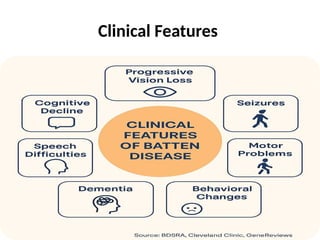
• Progressive visionloss — often one of the earliest signs.
• Seizures — commonly develop in early stages.
• Cognitive decline — memory, thinking, and learning skills worsen over
time.
• Speech difficulties — slow, slurred, or lost speech ability.
• Motor problems — clumsiness, unsteady walking, and eventually loss of
mobility.
• Behavioral changes — irritability, anxiety, or personality shifts.
• Dementia — occurs in later stages.
• Progressive and fatal — symptoms worsen with age and can lead to early
12.
Diagnosis
• Genetic testing→ Confirms mutations in CLN genes (most
accurate).
• Blood/urine tests → Detect abnormal enzyme activity or
waste buildup.
• Skin biopsy → Shows storage material (lipofuscin) in cells.
• MRI/EEG → Detects brain changes and seizure activity.
• Eye exam → Identifies retinal degeneration.
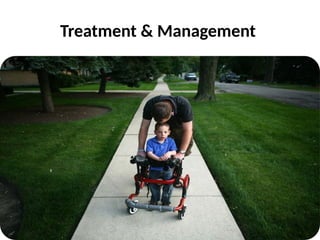
• No cureyet — treatment focuses on slowing symptoms and improving quality of
life.
• Enzyme replacement therapy (ERT)
Example: Cerliponase alfa (Brineura) for CLN2 type — slows motor and language
decline.
• Anti-seizure medications — help control epileptic seizures.
• Physical, speech, and occupational therapy — maintain skills and independence
longer.
• Vision support & mobility aids — for progressive vision loss and motor decline.
• Supportive care — includes nutrition, communication tools, and family
counseling.
• Ongoing research — gene therapy and other clinical trials are in development.
15.
Prognosis of BattenDisease
• Progressive and fatal — the disease worsens over time.
• Onset and progression depend on the type (CLN gene) and age of
symptoms.
• Children gradually lose vision, motor skills, and cognitive function.
• Most forms lead to shortened life expectancy — often into late childhood
or teens.
• Some adult forms progress more slowly and may allow longer survival.
• Early diagnosis & supportive care can improve quality of life, but not change
the outcome (yet).
16.
Recent Research &Hope
• Gene therapy: Promising trials aim to fix CLN gene mutations.
• New enzyme treatments: Like Brineura and more in development.
• Drug testing: Existing drugs being studied to slow the disease.
• Stem cell research: Exploring brain cell repair.
• Global efforts: Scientists & families worldwide are pushing for a cure.
• Hope is real: Science is closer than ever to better treatments—and one
day, a cure.
17.
conclusion
• Batten Diseaseis a rare, inherited neurological disorder.
• It mostly affects children and worsens over time.
• Causes include mutations in CLN genes, leading to brain cell damage.
• There’s no cure yet, but treatments like enzyme therapy can slow symptoms.
• Research in gene therapy and stem cells brings real hope.
• Awareness, early diagnosis, and continued research are key to changing the
future.
 Most read
 Most read