Topic:- Basic Of Fish Health And Management
ZL-304
Submitted by:-
Praveen kumar
M.sc Zoology 3rd Sem
Roll No. :- 235532
{2023-2025}
SubmittedtTo:-
Dr. Sandhya Ma'am
Basic Of Fish Health And
Management
Maintaining optimal fish health is essential for successful
aquaculture and responsible fishkeeping.
Understanding fish anatomy, physiology, and common
diseases allows for proactive disease prevention and
effective treatment.
This presentation will delve into key aspects of fish health
management, providing valuable insights for aquarists, fish
farmers, and anyone interested in the well-being of these
fascinating creatures.
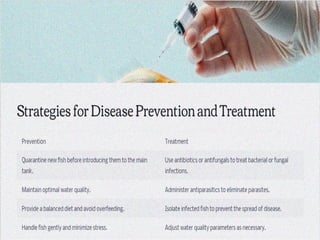
 Fish health management is a term used in aquaculture to
describe management practices which are designed to
prevent fish diseases.
 Successful fish health management begins with
prevention of disease rather than treatment.
 Management practices directed at limiting stress are
likely to be most effective in preventing disease
outbreaks
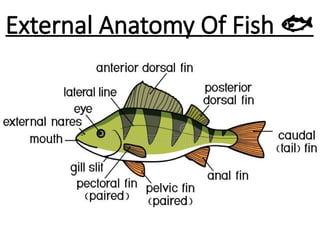
External Anatomy Of Fish 🐟
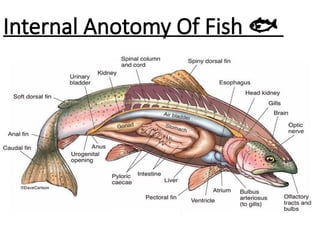
Internal Anotomy Of Fish 🐟
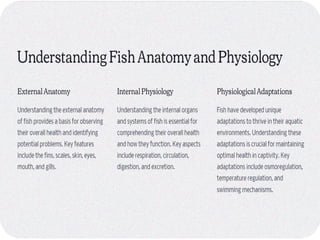
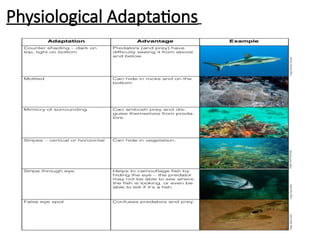
Physiological Adaptations
FACTORS AFFECTING FISH
HEALTH
The extrinsic or environmental factors which are known to
compromise the health status of fish individually or
collectively can be grouped into the following categories
according to their location within the system:
(1) water-associated;
(2) pond-associated;
(3) nutrition-associated;
(4) management-associated.
1.Water-associated factors:
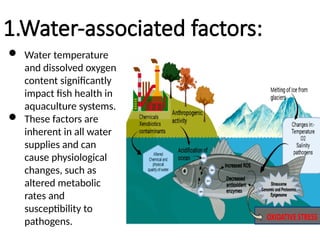
 Water temperature
and dissolved oxygen
content significantly
impact fish health in
aquaculture systems.
 These factors are
inherent in all water
supplies and can
cause physiological
changes, such as
altered metabolic
rates and
susceptibility to
pathogens.
2.Pond-associated factors:
The primary effect here is requiring a particular fish to live in
a pond configuration which does not meet its behavioral
requirements.
3.Management-associated
factors:
The primary health-threatening factors in this category
emanate from exceeding one or more of the pond carrying
capacities, inadequate housekeeping practices, inadequate
record-keeping practices, and undue physical stressors.
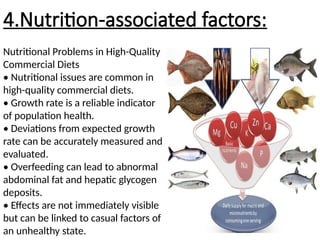
4.Nutrition-associated factors:
Nutritional Problems in High-Quality
Commercial Diets
• Nutritional issues are common in
high-quality commercial diets.
• Growth rate is a reliable indicator
of population health.
• Deviations from expected growth
rate can be accurately measured and
evaluated.
• Overfeeding can lead to abnormal
abdominal fat and hepatic glycogen
deposits.
• Effects are not immediately visible
but can be linked to casual factors of
an unhealthy state.
INTRINSIC FACTORS AFFECTING
FISH HEALTH:-
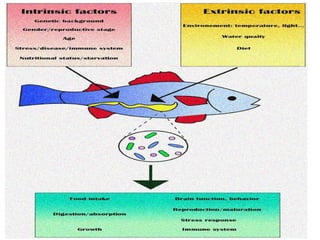
The intrinsic or somatic factors originate within the fish
itself. They are largely governed by the genetic make-up
which by and large dictates the physiological and
psychological responses of the fish to the extrinsic factors.
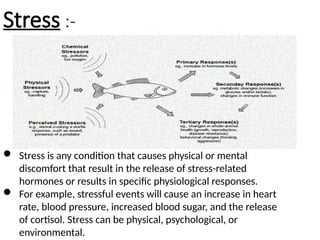
Stress :-
 Stress is any condition that causes physical or mental
discomfort that result in the release of stress-related
hormones or results in specific physiological responses.
 For example, stressful events will cause an increase in heart
rate, blood pressure, increased blood sugar, and the release
of cortisol. Stress can be physical, psychological, or
environmental.
The causes of stress:-
•Elevated ammonia
•Elevated nitrate
•Improper pH level
•Fluctuations in temperature
•Improper salinity
•Low oxygen levels
•Harassment from other fish
•Lack of hiding places
•Inadequate tank size
•Overstocking of tank
•Medications and water treatments
•Improper nutrition
•Disturbance of the tank
•Harvesting and shipping of fish
•Lack of enough fish to provide schooling
Common symptoms of stress include:
•Fish stays near the surface gasping for breath, indicating that it has
trouble getting enough oxygen. Possible causes include low oxygen
concentration due to poor water circulation, toxins that have damaged
its gills, high ammonia or nitrite levels, etc.
•Fish won't eat, or doesn't eat as aggressively as in past.
•Fish stays hidden continuously and won't come out where it can be
seen. Possible causes: aggressive fish, insufficient cover (e.g., plants,
wood, etc.) to make fish feel ``safe'' while swimming about.
•Fish has disease (parasites, fungus, etc.) Of course, the disease itself
is a major problem. But in most cases, a healthy fish's immune system
keeps it from getting sick in the first place. Thus, getting sick is a sign
that the fish is in a stressed state (or had been until recently).
Identifying and Diagnosing Fish Health Issues
1.Observing Behavior
Changes in behavior are often the first sign of illness in fish. bserve for lethargy, loss of
appetite, hiding, erratic swimming, andother unusual behaviors.
2.Examining Physical Appearance
Inspect the fish for any visible abnormalities, such as fin rot, skin lesions, cloudy eyes,
excessive mucus production, or
discoloration. These signs can indicate infections or other health problems
3.Water Quality Testing
Water quality plays a crucial role in fish health. Test the water for parameters like pH,
ammonia, nitrite, and nitrate levels.
Imbalances in these parameters can contribute to disease development
4.Diagnostic Procedures
If necessary, a veterinarian can conduct more advanced diagnostic procedures,
including blood tests, biopsies, and parasite
examinations, to confirm a diagnosis and recommend appropriate treatment.
Pathogen Transmission
Pathogens can be transmitted several ways in a recirculating system:
•in the water
•fish to fish
•by vectors and fomites
•in the food
Introduction of water used to ship fish can be a key source of
pathogens. Shipping water often contains high numbers of bacteria and
may also contain parasites or other pathogens.
Vectors
Vectors are organisms that can transmit disease-causing organisms from one animal to
another.Leeches are another vector that can transmit blood-borne parasites and
bacteria between fish.Additionally, people can act as vectors by transmitting water
and pathogens from one tank to another via their hands or arms.
Fomites
Fomites are inanimate objects that can transmit diseases. Examples of fomites in
aquaculture systems include equipment, such as nets and siphon hoses that are not
properly disinfected before being used in other tanks or vats.
Food
Food can also be a source of disease. Frozen and live foods can transmit bacteria,
parasites, viruses, and fungi. In addition, feeds that have been improperly stored can
contain pathogenic bacteria or mycotoxins, dangerous chemicals produced by the
growth of certain types of fungi in the feed.
Preventative Medicine Principles
The principles include understanding and attending to:
1) Species biology, including all known and important
genetic considerations;
2) Nutrition;
3) Water quality;
4) Quarantine;
5) Sanitation; and
6) Disinfection.
A basic knowledge of the anatomy, physiology, behavior, genetics, social interactions
and environmental needs of cultured species is critical to proper management.
1. Species biology
2. Nutrition
Nutritional considerations include size, palatability (“attractiveness by taste”) and
quantity of pellets, granules or live foods; frequency of feeding, lighting (some species
may prefer to eat during the day, at night, or at “dusk”), optimal as well as the
bioavailability, quality and quantity of micronutrients (vitamins, minerals) and
macronutrients (protein, fat, carbohydrate) in the diet.
3. Water quality
First and foremost, water quality must be compatible with the requirements of the
fish .Although initial water quality in a system will be determined by water source and
water treatment regimes.The most common water quality problems in aquaculture
systems are toxic levels of ammonia or nitrite caused by imbalances between the
capacity of the biofilter and the fish load and feeding rates.
4. Quarantine
Quarantine is voluntary or compulsory isolation, typically to prevent the spread of
something considered dangerous, often but not always disease. Quarantine is a
standard procedure in public aquaria because pathogens can be introduced with new
specimens.
Observation and diet adjustment
Observations of normal and abnormal behaviors can provide information on the
status of the fish. Diet adjustment means gradual increase over time in the
percentage of the final diet fed until fish are readily taking 100% of the final diet.
Preventative treatments (“prophylactic” treatments), such as freshwater dips for
marine fish or salt water dips for freshwater fish, can be helpful in removing initial
loads of external parasites. Use of external parasite treatments, such as formalin or
copper may be necessary if sampling demonstrates the presence of parasites
susceptible to those treatments.
Reduction or elimination of infectious pathogens
5. Sanitation
Good sanitation practices will help reduce the load of potential pathogens. Such
practices include proper system maintenance by removing excess suspended
particulate.
Elimination of pathogens from nets, siphons and tanks through the use of chemicals
(such as chlorine, benzalkonium chloride or iodine-containing compounds), ultraviolet
radiation, or ozone will help reduce the potential spread of disease.
6. Disinfection
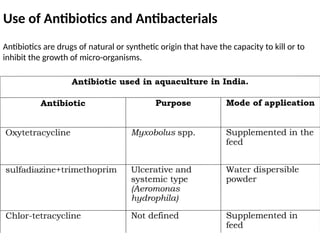
Use of Antibiotics and Antibacterials
Antibiotics are drugs of natural or synthetic origin that have the capacity to kill or to
inhibit the growth of micro-organisms.
Use of Other Chemicals
1.Copper Sulfate
Copper sulfate (CuSO4) is used to treat a variety of external parasites of fish. It is also
an effective algicide and piscicide, it can kill aquatic plants and fish and is approved
for use as an algicide. copper sulfate can be toxic to fish and it should not be used
unless a bioassay has been run in the water first with a limited number of the fish to
be treated
2.Formalin(F) - is approved for use in the treatment for a number of external
parasites. It is commonly used as an indefinite pond treatment at 15 milligrams per
liter (mg/L).
3.Potassium Permanganate
Potassium permanganate (KMnO4) is approved for use in aquaculture as an oxidizer
and detoxifier and has been used effectively against a number of external disease
organisms of fish.
4.Malachite green (again, illegal for use in food fish) has
been shown to have no effect on the biofilter at 0.1 mg/L,
combined with or without formalin at 25 mg/L. Copper
sulfate at 1 and 5 mg/L likewise had no effect on biofiltration.
5.Salt (sodium chloride)
Another chemical commonly used in aquaculture systems is
salt (sodium chloride). Salt can be useful in reducing certain
parasite infections in a system. Salt also helps reduce
osmolarity stresses by increasing the salt concentration in the
water relative to the normal concentration in the fish's body.
Use of Antibiotics
 The use of probiotics for aquatic animals is growing due to the need for eco-
friendly aquaculture. Probiotics, beneficial bacteria that control pathogens, are
seen as an alternative to antibiotics. Probiotics are live microorganisms that,
when consumed in adequate amounts, provide health benefits to the host. The
Joint Food and Agriculture Organization of the United Nations/World Health
Organization (FAO/WHO) supports this research.
 Bacterial mixtures are now commercially available for fish farming as feed
additives or incorporated into live fish feed to improve performance. Lactic
acid bacteria (LAB) are widely used for human and terrestrial animal purposes,
and are present in the intestine of healthy fish. Other probiotics include spore-
forming Bacillus spp. and yeasts. Probiotics can be beneficial in various ways,
such as inhibiting pathogens, competing for attachment sites and nutrients,
altering enzymatic activity, immunostimulating functions, and improving feed
digestibility and utilization. Commercial probiotics used in aquaculture include
GROVIMIN TM, GROWLIFE TM, BIOLIFETM, and PROLIQTM.
INHIBITION OF DEVELOPMENT OF FISH
DISEASES BY IMMUNIZATION VACCINES
Mass immunization of fishes may be performed with three types of
vaccines, i.e., oral vaccine, immersion vaccine (bath immunization)
and spray vaccine. On the basis of these vaccines, studies to develop
new immunization vaccines suitable for various fish diseases should
be made. Since the effectiveness of immunization vaccines depends
on the kinds of fishes and the types of fish diseases, an immunization
vaccine should be studied for each kind of fish and for each type of
each disease.
INHIBITION OF DEVELOPMENT OF FISH DISEASES BY
IMPROVEMENT OF MEANS OF FISH CULTURE TECHNIQUES
To make studies on optimum nutrition contained in feed for cultured fishes and on
the optimum amount of feed to be given to cultured fishes.

 To make studies on environmental conditions suitable for cultured fishes and
establish a feeding procedure which does cause any trauma in cultured fishes.

 To treat cultured fishes in a manner which does not cause any trauma in fishes,
since indigenous pathogens invade the body of fish via such trauma.

 To make studies on a method to culture fishes which are healthy and highly
resistant to pathogenic bacteria so as to inhibit development in fish
TREATMENT OF DISEASED FISH
a. Know your fish
b. Know your water
c. Know your chemical
d. Know your disease
Thank You