The difference insmall and large scale business is
that the large scale business has full time
employees dedicated to sales and marketing. In
small business the manager and perhaps even the
chef performs some function like marketing,
purchasing and accounting.
3.
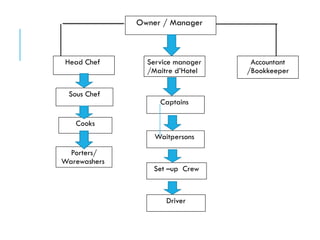
Owner / Manager
HeadChef Service manager
/Maitre d’Hotel
Accountant
/Bookkeeper
Sous Chef
Cooks
Porters/
Warewashers
Captains
Waitpersons
Set –up Crew
Driver
4.
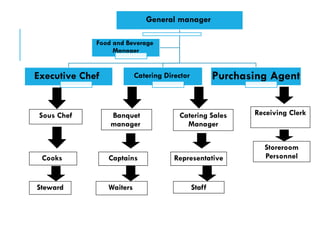
General manager
Executive ChefCatering Director Purchasing Agent
Food and Beverage
Manager
Sous Chef
Cooks
Banquet
manager
Captains
Waiters
Catering Sales
Manager
Representative
Staff
Receiving Clerk
Storeroom
Personnel
Steward
5.
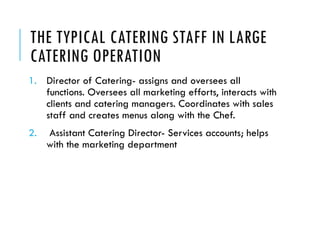
THE TYPICAL CATERINGSTAFF IN LARGE
CATERING OPERATION
1. Director of Catering- assigns and oversees all
functions. Oversees all marketing efforts, interacts with
clients and catering managers. Coordinates with sales
staff and creates menus along with the Chef.
2. Assistant Catering Director- Services accounts; helps
with the marketing department
6.
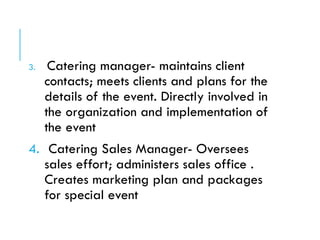
3. Catering manager-maintains client
contacts; meets clients and plans for the
details of the event. Directly involved in
the organization and implementation of
the event
4. Catering Sales Manager- Oversees
sales effort; administers sales office .
Creates marketing plan and packages
for special event
7.
5. Catering SalesRepresentative- Involved in selling
banquet and catering functions. Facilitates the event from
booking, payments, kitchen menu, function room, and
room arrangements.
6. Convention Conference Service Manager- handles
room set-up in hotels, conference centers, and convention
center. Sometimes handles catering for meetings and
conventions.
7. Food Handler- a person who handles food for a
banquet or other similar event. He or she prepares and
finishes food products noted on the event order form.
Making sure they are ready according to schedule.
8. Waiters- are persons employed to deliver or bring
food and beverage to guest in restaurants or banquet
halls
8.
9. Bartender- Concentrateson drinks specifically
alcoholic.
10. Sommelier- Wine steward or expert; usually used on
extravagant event or fine dine restaurants
11. Housemen- Sometimes referred to as a porter or
convention porter. Physically set-up and tear down rooms
with risers, hardware, tables, chairs, and other equipment.
12. Clerical Person- Types contracts and banquet event
order form. Handles and routes messages and documents
to other relevant departments.
13. Cashiers- Collects payments from all banquets and
catering events.
14. Security- provides crowed control and safety of all
attendees
9.
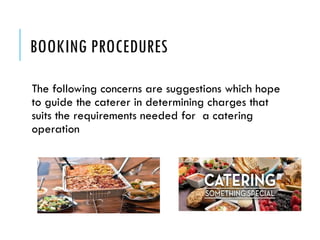
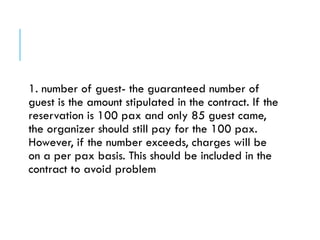
BOOKING PROCEDURES
The followingconcerns are suggestions which hope
to guide the caterer in determining charges that
suits the requirements needed for a catering
operation
10.
1. number ofguest- the guaranteed number of
guest is the amount stipulated in the contract. If the
reservation is 100 pax and only 85 guest came,
the organizer should still pay for the 100 pax.
However, if the number exceeds, charges will be
on a per pax basis. This should be included in the
contract to avoid problem
11.
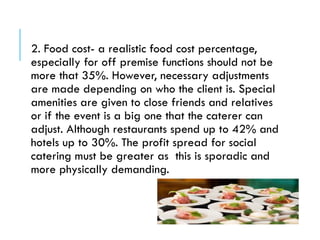
2. Food cost-a realistic food cost percentage,
especially for off premise functions should not be
more that 35%. However, necessary adjustments
are made depending on who the client is. Special
amenities are given to close friends and relatives
or if the event is a big one that the caterer can
adjust. Although restaurants spend up to 42% and
hotels up to 30%. The profit spread for social
catering must be greater as this is sporadic and
more physically demanding.
12.
3. Labor charges-you must determine the
personnel requirement of each function.
Project the determine number of persons
needed for production, for preparation of
materials, set-up, and service. With these
considerations a 38% labor cost is realistic
4. Distance- of the event from your
commissary should also be considered. This
will affect transportation facilities like
gasoline expenses, maintenance and repair,
driver and food safety.
13.
5 Personal Services-majority of caterers
overlook charges for personal services.
Skills and abilities must be compensated
for its value.
6. Cost of tools and equipment's - a
certain budget must be allotted for use,
rental and loos of tools and equipment's.
14.
7. Delivery- considerthe manpower involved
and the time needed to deliver food
materials to the venue of the function
8. Time- duration of the function. The
number of hours your employee will stay
from the start to the end of the function must
be stated in the contract.
15.
CATERING CONTRACT
Contract isa binding agreement between two
or more parties. It is an agreement that creates
obligation. This obliges the caterer to supply
the food and service needed as agreed upon
in the contract. The client on the other hand is
obliged to pay for the cost stipulated in the
contract. If they fail to fulfill, either way the
parties can take legal actions.
16.
Things to rememberin making a contract
1. One must have a written contract even your
client are your friends or relatives
2. Upon signing a contract a deposit of no less
than 50% of the total value must be paid.
Days before the event the client must be able
to pay the full amount.
3. Cancellations must be another part of the
contract. Moreover the cancellation fee must
be indicated.

 Most read