Regional Referee Training
Introduction
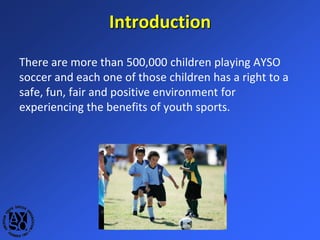
There are more than 500,000 children playing AYSO
soccer and each one of those children has a right to a
safe, fun, fair and positive environment for
experiencing the benefits of youth sports.
Why AYSO?
The Vision of AYSO is to provide
world class youth soccer programs
that enrich children’s lives.
What makes AYSO unique?
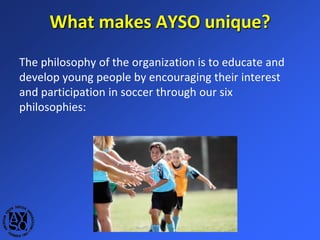
The philosophy of the organization is to educate and
develop young people by encouraging their interest
and participation in soccer through our six
philosophies:
Everyone Plays®

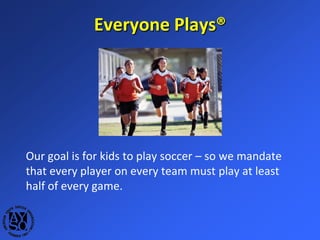
Our goal is for kids to play soccer – so we mandate
that every player on every team must play at least
half of every game.
Everyone Plays®

This includes our VIP -Very Important Players
Balanced Teams

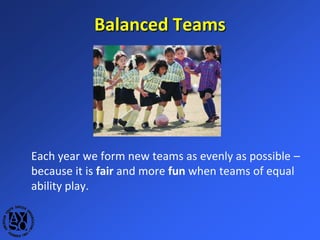
Each year we form new teams as evenly as possible –
because it is fair and more fun when teams of equal
ability play.
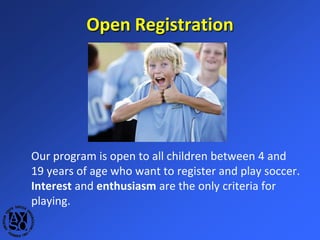
Open Registration

Our program is open to all children between 4 and
19 years of age who want to register and play soccer.
Interest and enthusiasm are the only criteria for
playing.
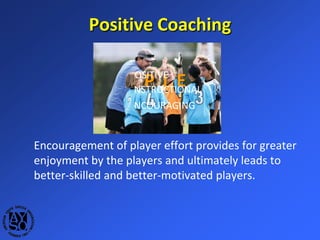
Positive Coaching
OSITIVE
NSTRUCTIONAL

P I E

NCOURAGING

Encouragement of player effort provides for greater
enjoyment by the players and ultimately leads to
better-skilled and better-motivated players.
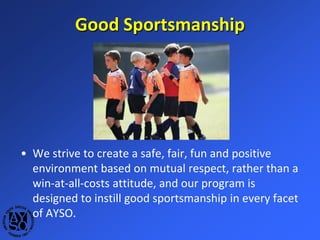
Good Sportsmanship

• We strive to create a safe, fair, fun and positive
environment based on mutual respect, rather than a
win-at-all-costs attitude, and our program is
designed to instill good sportsmanship in every facet
of AYSO.
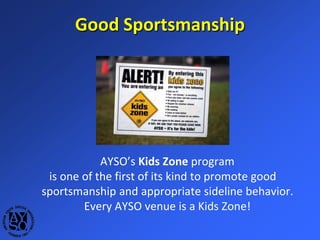
Good Sportsmanship

AYSO’s Kids Zone program
is one of the first of its kind to promote good
sportsmanship and appropriate sideline behavior.
Every AYSO venue is a Kids Zone!
Player Development

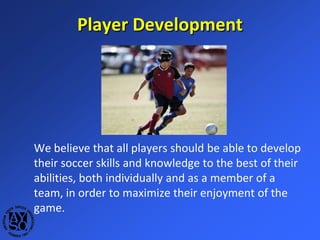
We believe that all players should be able to develop
their soccer skills and knowledge to the best of their
abilities, both individually and as a member of a
team, in order to maximize their enjoyment of the
game.
Player Development

AYSO provides a number of programs that support
player development including EXTRA and AYSO Soccer
Camps.
Volunteer Philosophies?

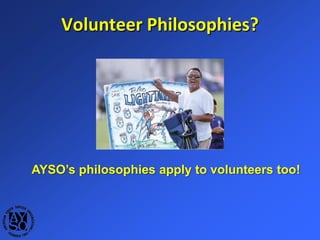
AYSO’s philosophies apply to volunteers too!
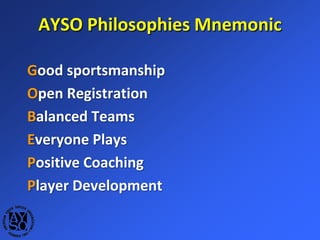
AYSO Philosophies Mnemonic
G
O
B
E
Positive
Player
AYSO Philosophies Mnemonic
Good sportsmanship
Open Registration
Balanced Teams
Everyone Plays
Positive Coaching
Player Development
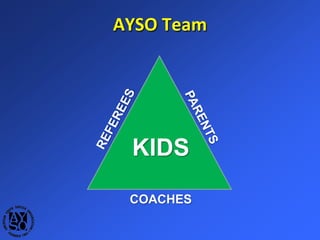
AYSO Team

KIDS
COACHES
AYSO Team
Team Rules
– Work Together
– Help Each Other
– Protect Each Other
– Do Our Best
Every AYSO Venue is a Kids Zone!
Kids Zone guidelines encourage
appropriate sideline behavior – key
to promoting a fun, safe, familyfriendly environment.
Parents and Spectators pledge to
respect the tenets of Kids Zone.
Coaches, Referees, Parents and
Players abide by a Code of Conduct.
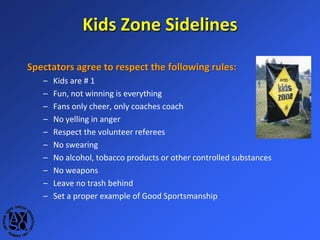
Kids Zone Sidelines
Spectators agree to respect the following rules:
–
–
–
–
–
–
–
–
–
–

Kids are # 1
Fun, not winning is everything
Fans only cheer, only coaches coach
No yelling in anger
Respect the volunteer referees
No swearing
No alcohol, tobacco products or other controlled substances
No weapons
Leave no trash behind
Set a proper example of Good Sportsmanship
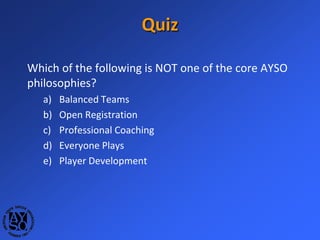
Quiz
Which of the following is NOT one of the core AYSO
philosophies?
a)
b)
c)
d)
e)

Balanced Teams
Open Registration
Professional Coaching
Everyone Plays
Player Development
Regional Referee Course
Objectives
•
•
•
•

Know what to expect from U-10 players
Know the parts of the field
Know the number of players in each age group
Recognize ball in and out of play
Objectives
• Successfully manage pre-game duties
• Know how to start,
when to stop,
and how to restart play.
• Understand method of scoring
• Basic understanding of Fouls,
Misconduct and Free Kicks.
Objectives
• Understand basics of Offside
• Use appropriate signals
• Manage post-game situations
History of the Game
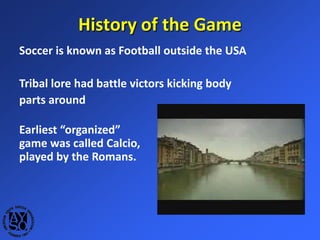
Soccer is known as Football outside the USA

Tribal lore had battle victors kicking body
parts around
Earliest “organized”
game was called Calcio,
played by the Romans.
History of the Game
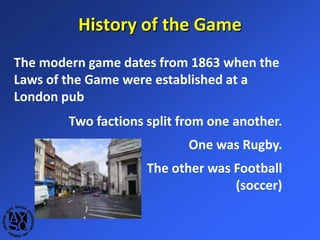
The modern game dates from 1863 when the
Laws of the Game were established at a
London pub
Two factions split from one another.
One was Rugby.
The other was Football
(soccer)
History of the Game
FIFA (Federation International de
Football Association) governs the
worldwide game
USSF (United States Soccer
Federation) is the national
governing body

AYSO is a National Association
member of USSF
History of the Game
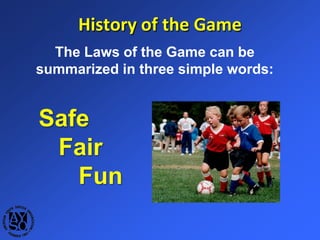
The Laws of the Game can be
summarized in three simple words:

Safe
Fair
Fun
Philosophy of Refereeing
The Laws of the Game are intended to provide that
games should be played with as little interference as
possible, and in this view it is the duty of the referee to
penalize only deliberate breaches of the Law.
Constant whistling for trifling and doubtful breaches
produces bad feelings and loss of temper on the part of
the players and spoils the pleasure of spectators.
Philosophy of Refereeing
• Younger Games:
More a friendly guide than policeman.
• Give younger players a second chance.
• No public humiliation.
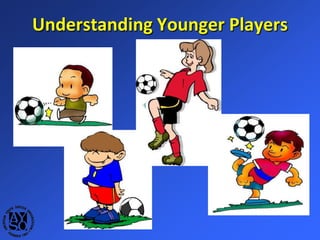
Understanding Younger Players
U-6 Players
Physical Characteristics
• Early stages of development
• Can run, jump and skip,
but motor skills are still developing
• Lots of energy, but in bursts.
• Can still tire easily
• Can’t sit still long
U-6 Players
Social/Emotional Characteristics
•
•
•
•
•

Craves praise and attention
Fearful of unknowns
Needs encouragement
Rapid and unpredictable mood changes
Disposition to telling tall tales
U-6 Players
Thought/Cognitive Characteristics
•
•
•
•

Lacks judgment regarding own safety/abilities
Does not think logically
Asks lots of questions
Fond of stories
U-8 Players
Physical Characteristics
•
•
•
•
•

Plays hard and works at playing hard
Sense of timing is developing
Eye-hand coordination has improved
Agility / endurance much better than U-6
U-8 can now balance on one foot
U-8 Players
Social/Emotional Characteristics
•
•
•
•
•
•

Starting to define likes and dislikes
Friendship is important
“Play” needs a purpose
Afraid of failure
Need for honesty training
Starting to compare self to others
U-8 Players
Social/Emotional Characteristics
•
•
•
•
•
•

Self-esteem and self concept a big issue
Becoming more outgoing
Peer acceptance is very important
Quick to tattle
Cooperative with adults
Interested in belonging to group
U-8 Players
Thought/Cognitive Characteristics
•
•
•
•
•
•
•

Beginning to understand moral rules of behavior
Can solve some problems
Starting to grasp the Team concept
Understands the viewpoint of others
Needs concrete reinforcement
Treats every little mistake as a major crime
Rigidly interprets ideas of justice and fair play
U-10 Players
Physical Characteristics
•
•
•
•

More interested in competitive activities
More interested in improving skills
Attention span is increasing
May accept a physical touch,
but some will begin to reject it
U-10 Players
Social/Emotional Characteristics
•
•
•
•

Group acceptance is important Wants to be liked
Feelings are easily hurt
May blame others to explain their own mistakes
Needs reinforcement
U-10 Players
Thought/Cognitive Characteristics
• Can recall details with accuracy
• Can understand the concept of cause and effect
• Enjoys attention but their reaction to praise may
be more subdued
• Still takes what is said quite literally
Understanding Younger Players
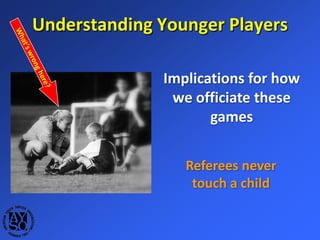
Implications for how
we officiate these
games
Referees never
touch a child
Dealing with Coaches/Spectators
AYSO Team concept to enlist cooperation
•
•

Remain calm and professional
Maintain control of your emotions

Intervene early to prevent escalation
• A smile, wink or look can defuse a bad situation

Keep adults focused on creating an enjoyable
experience for the players
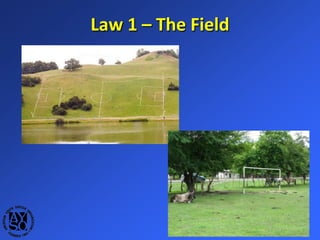
Law 1 – The Field
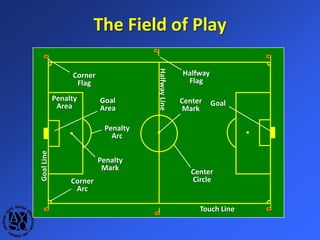
The Field of Play

Penalty
Area

Goal
Area

Halfway Line

Corner
Flag

Halfway
Flag
Center
Mark

Goal

Goal Line

Penalty
Arc
Penalty
Mark
Corner
Arc

Center
Circle

Touch Line
Pre-Game Duties and Activities
•
•
•
•
•
•

Arrive Early
Check Field and Equipment
Introduce Yourself to the Coaches
Check Players Equipment
Brief Assistant Referees
Conduct Coin Toss
Pre-Game Duties and Activities
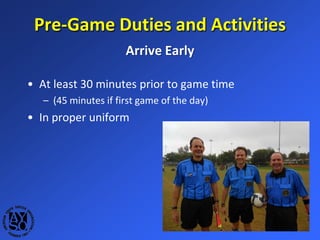
Arrive Early
• At least 30 minutes prior to game time
– (45 minutes if first game of the day)

• In proper uniform
Pre-Game Duties and Activities
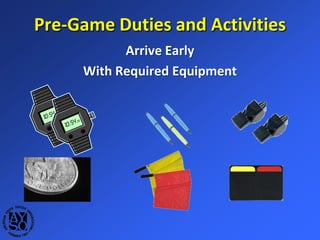
Arrive Early
With Required Equipment
Pre-Game Duties and Activities
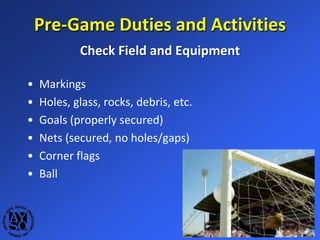
Check Field and Equipment
•
•
•
•
•
•

Markings
Holes, glass, rocks, debris, etc.
Goals (properly secured)
Nets (secured, no holes/gaps)
Corner flags
Ball
Pre-Game Duties and Activities
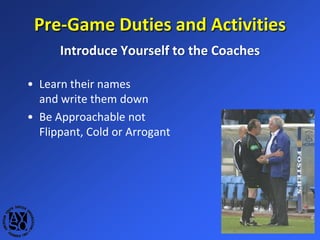
Introduce Yourself to the Coaches
• Learn their names
and write them down
• Be Approachable not
Flippant, Cold or Arrogant
Pre-Game Duties and Activities
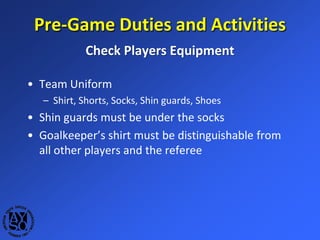
Check Players Equipment
• Team Uniform
– Shirt, Shorts, Socks, Shin guards, Shoes

• Shin guards must be under the socks
• Goalkeeper’s shirt must be distinguishable from
all other players and the referee
Pre-Game Duties and Activities
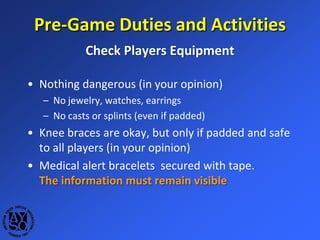
Check Players Equipment
• Nothing dangerous (in your opinion)
– No jewelry, watches, earrings
– No casts or splints (even if padded)

• Knee braces are okay, but only if padded and safe
to all players (in your opinion)
• Medical alert bracelets secured with tape.
The information must remain visible
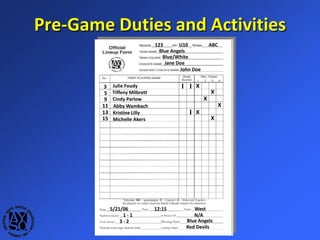
Pre-Game Duties and Activities
123
U10
Blue Angels
Blue/White
Jane Doe
John Doe

3
5
9
11
13
15

I I

Julie Foudy
Tiffeny Milbrett
Cindy Parlow
Abby Wambach
Kristine Lilly
Michelle Akers

5/21/06
1-1
3-2

ABC

X

X
X
X

I

12:15

X

X

West
N/A
Blue Angels
Red Devils
Pre-Game Duties and Activities
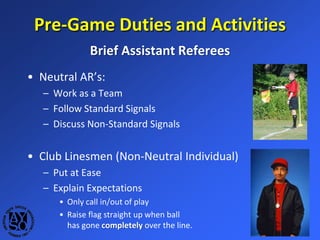
Brief Assistant Referees
• Neutral AR’s:
– Work as a Team
– Follow Standard Signals
– Discuss Non-Standard Signals

• Club Linesmen (Non-Neutral Individual)
– Put at Ease
– Explain Expectations
• Only call in/out of play
• Raise flag straight up when ball
has gone completely over the line.
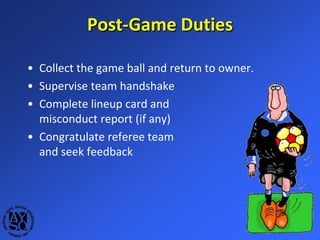
Post-Game Duties
• Collect the game ball and return to owner.
• Supervise team handshake
• Complete lineup card and
misconduct report (if any)
• Congratulate referee team
and seek feedback
Check For Learning
During the safety inspection of the players, the referee
notices that a player is wearing earrings. She explains that
she had her ears pierced the previous day and if she removes
the earrings the holes will close.

What should the referee do?
The referee should explain to the player that earrings are
not permitted; if she wishes to play, she must remove
them. The referee may choose to involve the coach.
Check For Learning
In a U-8 game, the ball offered by the home team is
a size 4 but otherwise acceptable.
What should the referee do?
Point out to the team that provided the ball that it is the
wrong size and ask for a size 3 ball. If the team cannot
provide one, ask the other team for one. If no size 3 ball
is available, play the match with a size 4 ball.
Check For Learning
During the field inspection, the referee notices that
a goal is being held in place by two bricks placed on
the back of the structure.
What should the referee do?
Bricks resting on the goal structure are not sufficient to
anchor it securely. The referee should inform the
coaches that the goals need to be securely anchored
before the match can start.
Check For Learning
The goalkeeper must wear a jersey that is ____ ?
Different from the referee and all other players
It is not necessary to check the field prior to the
start of the match if it is the last game of the day.
(True/False)
False
Check For Learning
A club linesman may indicate whether a corner
kick can be awarded or not. (True/False)
False
Club linesmen can only indicate when the ball has gone
over the touchline or the goal line (not a goal)

Knee braces may be worn by a player. (True/False)
True
But only if padded and if it is safe for all players, in the
opinion of the referee.
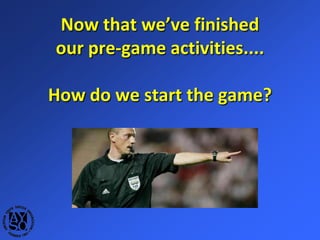
Now that we’ve finished
our pre-game activities....
How do we start the game?
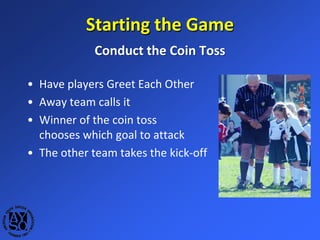
Starting the Game
Conduct the Coin Toss
• Have players Greet Each Other
• Away team calls it
• Winner of the coin toss
chooses which goal to attack
• The other team takes the kick-off
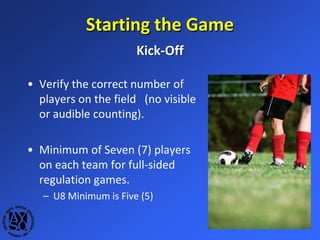
Starting the Game
Kick-Off
• Verify the correct number of
players on the field (no visible
or audible counting).
• Minimum of Seven (7) players
on each team for full-sided
regulation games.
– U8 Minimum is Five (5)
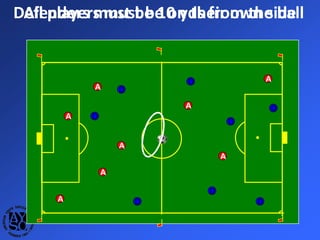
Defenders must be 10 yds from the ball
All players must be on their own side

A

A

D
D
A

A

D

D

D
A
A
A

D
A

D

D
Starting the Game
Kick-Off
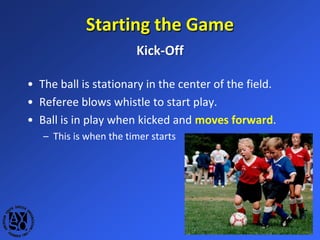
• The ball is stationary in the center of the field.
• Referee blows whistle to start play.
• Ball is in play when kicked and moves forward.
– This is when the timer starts
Keeping Time
• Time starts when the ball has been put into play
(kicked and moves forward).
• The match consists of two equal periods.
• Time is added for excessive time lost due to
substitutions, time wasting or unusual delays.
• The amount of time lost (if any) is determined by
the referee.
Check for Learning
The team that wins the coin toss chooses ____ ?
Which goal to attack
Where should the players be on a kick-off?
Each team should be in its own half of the field.
The team that is not taking the kick-off must be
outside the center circle.
Stopping the Game
There are seven reasons to stop play:
1. Ball goes out of play
2. The referee deems it necessary
3. Goal is scored
4. Foul is committed
5. Injury
6. Substitution
7. Halftime / End of Game
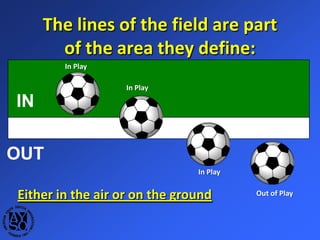
The lines of the field are part
of the area they define:
In Play
In Play

IN
OUT
In Play

Either in the air or on the ground

Out of Play
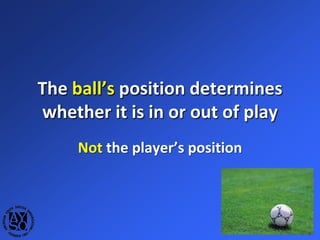
The ball’s position determines
whether it is in or out of play
Not the player’s position
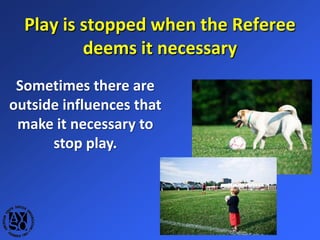
Play is stopped when the Referee
deems it necessary
Sometimes there are
outside influences that
make it necessary to
stop play.
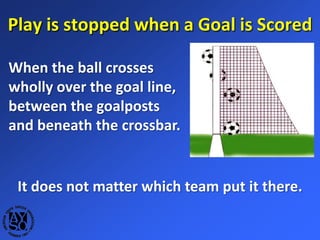
Play is stopped when a Goal is Scored
When the ball crosses
wholly over the goal line,
between the goalposts
and beneath the crossbar.

It does not matter which team put it there.
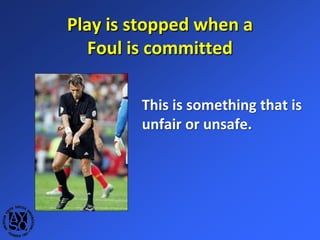
Play is stopped when a
Foul is committed
This is something that is
unfair or unsafe.
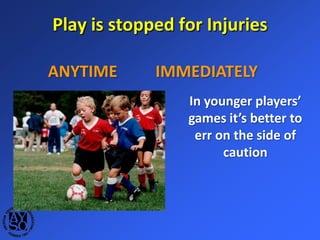
Play is stopped for Injuries
ANYTIME

IMMEDIATELY
In younger players’
games it’s better to
err on the side of
caution
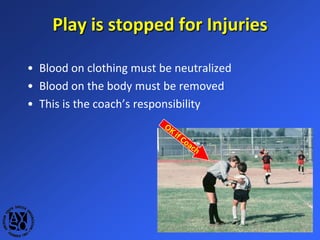
Play is stopped for Injuries
• Blood on clothing must be neutralized
• Blood on the body must be removed
• This is the coach’s responsibility
Play is stopped for Substitutions
There are four opportunities for substitutions:
• Approx. midway through the first half
• Halftime
• Approx. midway through the second half
• Injury
– Coach May Substitute the Player
or Play Short until the Player can return
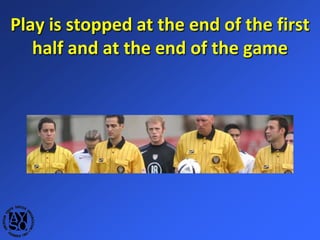
Play is stopped at the end of the first
half and at the end of the game
Check for Learning
When can the referee stop play for an injury?
Anytime / Immediately

A player dribbling the ball steps over the line. The
ball is out of play. (True/False)
False
It’s the position of the ball (not the player) that
determines whether the ball is in play or not.
Checking for Learning
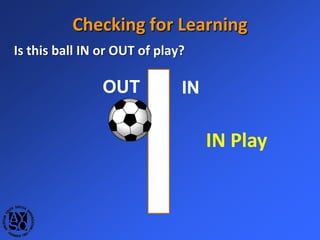
Is this ball IN or OUT of play?

OUT

IN

IN Play
Checking for Learning
How many substitution opportunities are there in
a regulation match?
Four

Name Them
Approx. midway through the first half
Halftime
Approx. midway through the second half
Injury
Checking for Learning
A player is injured and leaves the field
(with the referee’s permission).
What are the coach’s substitution options?
1. The team can play short until the player
returns to the field (with the referee’s
permission)
2. A substitute can replace the injured
player.
Checking for Learning
A player is injured and leaves the field
(with the referee’s permission).
The coach decides to substitute the injured player.
Which player gets credit for the “quarter”?
The player that started the “quarter”.
Checking for Learning
If the boundary line of the field is a rut in the grass
and the ball gets caught in the rut as it rolls, is it in
play?
Yes
The lines are a part of the area they define.
The ball remains in play until the entire ball crosses
the entire line.
Checking for Learning
According to the National Rules and Regulations,
what is the minimum amount of time each team
member must play?
Half the game (two “quarters”)
Break
Fouls and Misconduct
OBJECTIVES
• Explain the two categories of fouls
• Cover fouls that occur in younger players’ games
• Introduce the concept of Misconduct
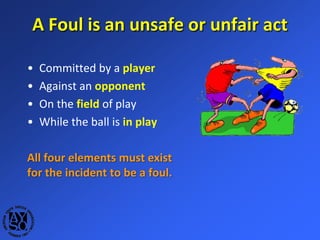
A Foul is an unsafe or unfair act
•
•
•
•

Committed by a player
Against an opponent
On the field of play
While the ball is in play

All four elements must exist
for the incident to be a foul.
Fouls and Misconduct
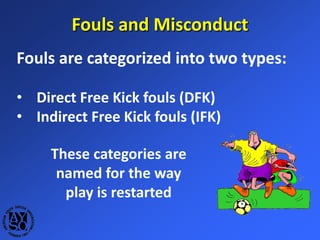
Fouls are categorized into two types:
• Direct Free Kick fouls (DFK)
• Indirect Free Kick fouls (IFK)
These categories are
named for the way
play is restarted
Direct Free Kick Fouls (DFK)
There are 10 DFK Fouls:
7 “CREX” fouls
– Careless, Reckless, or used Excessive Force

3 others
– The offense is always a foul
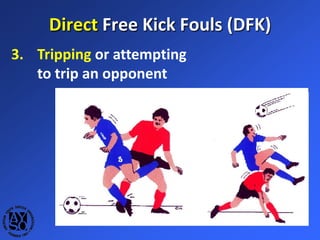
Direct Free Kick Fouls (DFK)
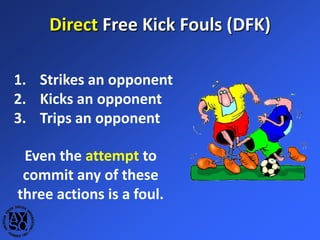
1. Strikes an opponent
2. Kicks an opponent
3. Trips an opponent
Even the attempt to
commit any of these
three actions is a foul.
Direct Free Kick Fouls (DFK)
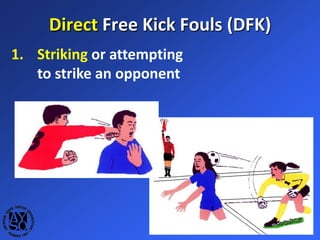
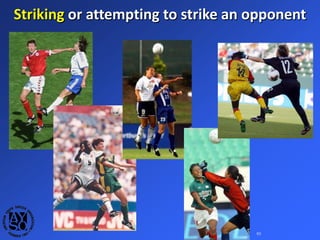
1. Striking or attempting
to strike an opponent
Striking or attempting to strike an opponent

93
Direct Free Kick Fouls (DFK)
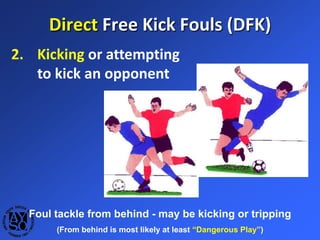
2. Kicking or attempting
to kick an opponent

Foul tackle from behind - may be kicking or tripping
(From behind is most likely at least “Dangerous Play”)
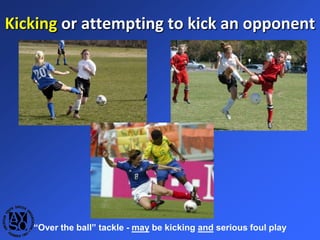
Kicking or attempting to kick an opponent

“Over the ball” tackle - may be kicking and serious foul play
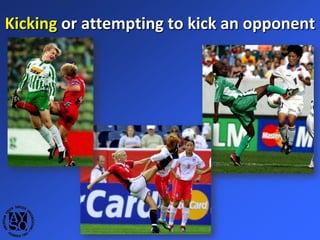
Kicking or attempting to kick an opponent
Direct Free Kick Fouls (DFK)
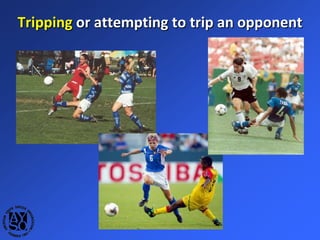
3. Tripping or attempting
to trip an opponent
Tripping or attempting to trip an opponent
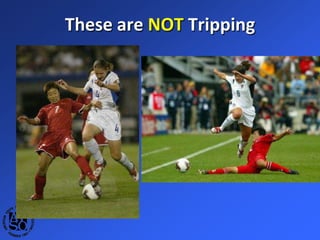
These are NOT Tripping
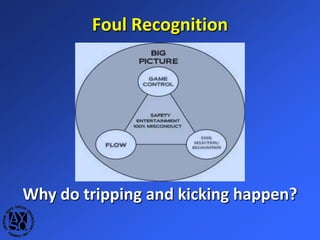
Foul Recognition

Why do tripping and kicking happen?