A COGNITIVE CHASM THOUGHT LEADERSHIP SERIES
AI in Product Management:
Evolution, Adoption, Challenges & Solutions
Dr. Tathagat Varma
Executive Fellow in Management, Indian School of Business
“Theory of Cognitive Chasms: A Grounded Theory of GenAI Adoption"
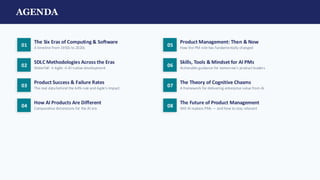
AGENDA
01
The Six Eras of Computing & Software
A timeline from 1950s to 2020s
02
SDLC Methodologies Across the Eras
Waterfall → Agile → AI-native development
03
Product Success & Failure Rates
The real databehind the 64% rule and Agile's impact
04
How AI Products Are Different
Comparative dimensions for the AI era
05
Product Management: Then & Now
How the PM role has fundamentally changed
06
Skills, Tools & Mindset for AI PMs
Actionable guidance for tomorrow's productleaders
07
The Theory of Cognitive Chasms
A framework for delivering enterprise value from AI
08
The Future of Product Management
Will AI replace PMs — and how to stay relevant
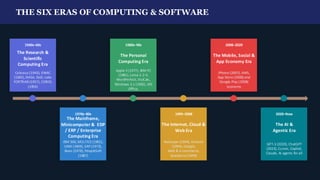
THE SIX ERAS OF COMPUTING & SOFTWARE
1940s–60s
The Research &
Scientific
Computing Era
Colossus (1943), ENIAC
(1945), NASA, DoD, Labs
FORTRAN (1957), COBOL
(1959)
1970s–80s
The Mainframe,
Minicomputer & EDP
/ ERP / Enterprise
Computing Era
IBM 360, MULTICS (1965),
UNIX (1969), SAP(1972),
Baan (1978), PeopleSoft
(1987)
1980s–90s
The Personal
Computing Era
Apple II (1977), IBM PC
(1981), Lotus 1-2-3,
WordPerfect, VisiCalc,
Windows 3.1 (1992), MS
Office,
1995–2008
The Internet, Cloud &
Web Era
Netscape (1994), Amazon
(1994), Google,
Web & e-commerce,
Salesforce (1999)
2008–2020
The Mobile, Social &
App Economy Era
iPhone (2007), AWS,
App Store (2008) and
Google Play (2008)
economy
2020–Now
The AI &
Agentic Era
GPT-3 (2020), ChatGPT
(2023), Cursor, Copilot,
Claude, AI agents forall
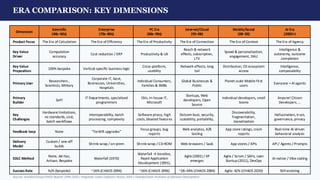
ERA COMPARISON: KEY DIMENSIONS
Dimension
Scientific
(40s–60s)
Enterprise
(70s–80s)
PC Era
(80s–90s)
Internet/Cloud
(95–08)
Mobile/Social
(08–20)
AI Era
(2020+)
Product Focus The Era of Calculation The Era of Efficiency The Era of Productivity The Era of Connection The Era of Context The Era of Agency
Key Value
Driver
Computation
accuracy
Cost reduction / ERP Productivity & UX
Reach & network
effects, subscription,
LTV
Speed & personalization,
engagement, DAU
Intelligence &
autonomy, outcome
completion
Key Value
Proposition
100% bespoke Vertical-specific business logic
Cross-platform,
usability
Network effects, long
tail
Distribution, OS ecosystem
access
Intelligence,
composability
Primary User
Researchers ,
Scientists, Military
Corporate IT, Govt,
Businesses, Universities,
Hospitals
Individual Consumers,
Families & SMBs
Global Businesses &
Public
Planet-scale Mobile-first
users
Everyone + AI agents
Primary
Builder
Self!
IT Departments, specialized
programmers
ISVs, In-house IT,
Microsoft
Startups, Web
developers, Open
Source
Individual developers, small
teams
Anyone! Citizen
Developers, …
Key
Challenges
Hardware limitations,
no standards, cost,
batch workflows
Interoperability, batch
processing, complexity
Software piracy, high
costs, bloated features
Dotcom bust, security,
scalability, portability,
Discoverability,
fragmentation,
monetization
Hallucination, trust,
governance, privacy
Feedback loop None ”Forklift upgrades”
Focus groups, bug
reports
Web analytics, A/B
testing
App store ratings, crash
reports
Real-time AI-driven
behavioral analysis
Delivery
Model
Custom / one-off
builds
Shrink-wrap / on-prem Shrink-wrap / CD-ROM Web browsers / SaaS App stores / APIs API / Agents / Prompts
SDLC Method
None, Ad-hoc,
Artisan, Bespoke
Waterfall (1970)
Waterfall → iterative,
Rapid Application
Development (1991),
Agile (2001) / XP
emerges
Agile / Scrum / SAFe, Lean
Startup(2011), DevOps
AI-native / Vibe coding
Success Rate N/A (bespoke) ~16% (CHAOS 1994) ~26% (CHAOS 1996) ~28–34% (CHAOS 2004) Agile: 42% (CHAOS 2020) Still evolving
Sources: Standish Group CHAOS Reports 1994–2020 | Pragmatic Coders Software History 2026 | GeeksforGeeks Evolution of Software Development
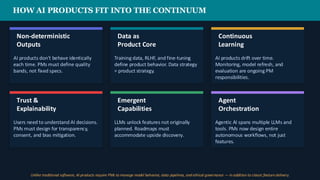
HOW AI PRODUCTS FIT INTO THE CONTINUUM
Non-deterministic
Outputs
AI products don't behave identically
each time. PMs must define quality
bands, not fixed specs.
Data as
Product Core
Training data, RLHF, and fine-tuning
define product behavior. Data strategy
= product strategy.
Continuous
Learning
AI products drift over time.
Monitoring, model refresh, and
evaluation are ongoing PM
responsibilities.
Trust &
Explainability
Users need to understand AI decisions.
PMs must design for transparency,
consent, and bias mitigation.
Emergent
Capabilities
LLMs unlock features not originally
planned. Roadmaps must
accommodate upside discovery.
Agent
Orchestration
Agentic AI spans multiple LLMs and
tools. PMs now design entire
autonomous workflows, not just
features.
Unlike traditional software, AI products require PMs to manage model behavior, data pipelines, and ethical governance — in addition to classic featuredelivery.
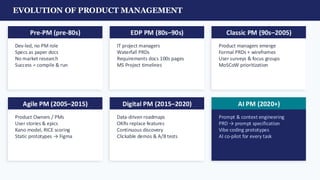
EVOLUTION OF PRODUCT MANAGEMENT
Pre-PM (pre-80s)
Dev-led, no PM role
Specs as paper docs
No market research
Success = compile & run
EDP PM (80s–90s)
IT project managers
Waterfall PRDs
Requirements docs 100s pages
MS Project timelines
Classic PM (90s–2005)
Product managers emerge
Formal PRDs + wireframes
User surveys & focus groups
MoSCoW prioritization
Agile PM (2005–2015)
Product Owners / PMs
User stories & epics
Kano model, RICE scoring
Static prototypes → Figma
Digital PM (2015–2020)
Data-driven roadmaps
OKRs replace features
Continuous discovery
Clickable demos & A/B tests
AI PM (2020+)
Prompt & context engineering
PRD → prompt specification
Vibe coding prototypes
AI co-pilot for every task
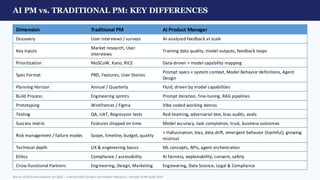
AI PM vs. TRADITIONAL PM: KEY DIFFERENCES
Dimension Traditional PM AI Product Manager
Discovery User interviews / surveys AI-analyzed feedback at scale
Key Inputs
Market research, User
interviews
Training data quality, model outputs, feedback loops
Prioritization MoSCoW, Kano, RICE Data-driven + model capability mapping
Spec Format PRD, Features, User Stories
Prompt specs + system context, Model Behavior definitions, Agent
Design
Planning Horizon Annual / Quarterly Fluid, driven by model capabilities
Build Process Engineering sprints Prompt iteration, fine-tuning, RAG pipelines
Prototyping Wireframes / Figma Vibe-coded working demos
Testing QA, UAT, Regression tests Red-teaming, adversarial test, bias audits, evals
Success metric Features shipped on time Model accuracy, task completion, trust, business outcomes
Risk management / failure modes Scope, timeline, budget, quality
+ Hallucination, bias, data drift, emergent behavior (harmful), growing
mistrust
Technical depth UX & engineering basics ML concepts, APIs, agent orchestration
Ethics Compliance / accessibility AI fairness, explainability, consent, safety
Cross-functional Partners Engineering, Design, Marketing Engineering, Data Science, Legal & Compliance
Source: ACMCommunications Jan 2026 — Essential Skills for Next-Gen Product Managers |Airtable AI PM Guide 2025
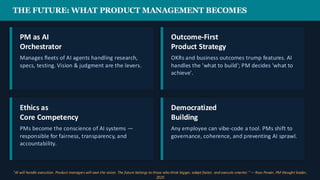
THE FUTURE: WHAT PRODUCT MANAGEMENT BECOMES
PM as AI
Orchestrator
Manages fleets of AI agents handling research,
specs, testing. Vision & judgment are the levers.
Outcome-First
Product Strategy
OKRs and business outcomes trump features. AI
handles the 'what to build'; PM decides 'what to
achieve'.
Ethics as
Core Competency
PMs become the conscience of AI systems —
responsible for fairness, transparency, and
accountability.
Democratized
Building
Any employee can vibe-code a tool. PMs shift to
governance, coherence, and preventing AI sprawl.
"AI will handle execution. Product managerswill own the vision. The future belongs to those who think bigger, adapt faster, and execute smarter." — Ross Power, PM thought leader,
2025
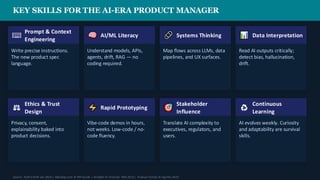
KEY SKILLS FOR THE AI-ERA PRODUCT MANAGER
Prompt & Context
Engineering
Write precise instructions.
The new product spec
language.
AI/ML Literacy
Understand models, APIs,
agents, drift, RAG — no
coding required.
Systems Thinking
Map flows across LLMs, data
pipelines, and UX surfaces.
Data Interpretation
Read AI outputs critically;
detect bias, hallucination,
drift.
Ethics & Trust
Design
Privacy, consent,
explainability baked into
product decisions.
Rapid Prototyping
Vibe-code demos in hours,
not weeks. Low-code / no-
code fluency.
Stakeholder
Influence
Translate AI complexity to
executives, regulators, and
users.
Continuous
Learning
AI evolves weekly. Curiosity
and adaptability are survival
skills.
Source: ACM CACM Jan 2026 | Monday.com AI PM Guide | Airtable AI Tools for PMs 2025 | Product School AI Agents 2025
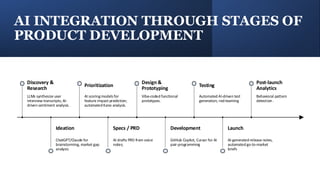
AI INTEGRATION THROUGH STAGES OF
PRODUCT DEVELOPMENT
LLMs synthesize user
interview transcripts; AI-
driven sentiment analysis.
Discovery &
Research
ChatGPT/Claude for
brainstorming, market gap
analysis
Ideation
AI scoringmodelsfor
feature impact prediction;
automated Kano analysis.
Prioritization
AI drafts PRD from voice
notes;
Specs / PRD
Vibe-coded functional
prototypes.
Design &
Prototyping
GitHub Copilot, Cursor for AI
pair-programming
Development
Automated AI-driven test
generation, red-teaming
Testing
AI-generated release notes,
automated go-to-market
briefs
Launch
Behavioral pattern
detection .
Post-launch
Analytics
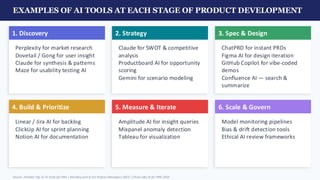
EXAMPLES OF AI TOOLS AT EACH STAGE OF PRODUCT DEVELOPMENT
1. Discovery
Perplexity for market research
Dovetail / Gong for user insight
Claude for synthesis & patterns
Maze for usability testing AI
2. Strategy
Claude for SWOT & competitive
analysis
Productboard AI for opportunity
scoring
Gemini for scenario modeling
3. Spec & Design
ChatPRD for instant PRDs
Figma AI for design iteration
GitHub Copilot for vibe-coded
demos
Confluence AI — search &
summarize
4. Build & Prioritize
Linear / Jira AI for backlog
ClickUp AI for sprint planning
Notion AI for documentation
5. Measure & Iterate
Amplitude AI for insight queries
Mixpanel anomaly detection
Tableau for visualization
6. Scale & Govern
Model monitoring pipelines
Bias & drift detection tools
Ethical AI review frameworks
Source: Airtable Top 21 AI Tools for PMs | Monday.com AI for Product Managers 2025 | Chisel Labs AI for PMs 2025
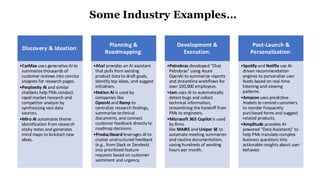
Discovery & Ideation:
•CarMax uses generative AI to
summarize thousands of
customer reviews into concise
snippets for research pages.
•Perplexity AI and similar
chatbots help PMs conduct
rapid market research and
competitor analysis by
synthesizing vast data
sources.
•Miro AI automates theme
identification from research
sticky notes and generates
mind maps to kickstart new
ideas.
Planning &
Roadmapping:
•Aha! provides an AI assistant
that pulls from existing
product data to draft goals,
identify top ideas, and suggest
initiatives.
•Notion AI is used by
companies like
OpenAI and Ramp to
centralize research findings,
summarize technical
documents, and connect
customer feedback directly to
roadmap decisions.
•Productboard leverages AI to
cluster unstructured feedback
(e.g., from Slack or Zendesk)
into prioritized feature
requests based on customer
sentiment and urgency.
Development &
Execution:
•Petrobras developed "Chat
Petrobras" using Azure
OpenAI to summarize reports
and streamline workflows for
over 100,000 employees.
•Jam uses AI to automatically
detect bugs and collect
technical information,
streamlining the handoff from
PMs to engineers.
•Microsoft 365 Copilot is used
by firms
like MAIRE and Uniper SE to
automate meeting summaries
and routine documentation,
saving hundreds of working
hours per month.
Post-Launch &
Personalization:
•Spotify and Netflix use AI-
driven recommendation
engines to personalize user
feeds based on real-time
listening and viewing
patterns.
•Amazon uses predictive
models to remind customers
to reorder frequently
purchased items and suggest
related products.
•Amplitude provides AI-
powered "Data Assistants" to
help PMs translate complex
business questions into
actionable insights about user
behavior.
Some Industry Examples…
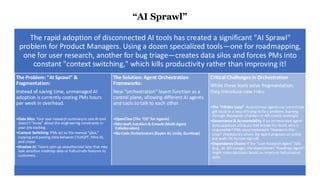
“AI Sprawl”
The rapid adoption of disconnected AI tools has created a significant "AI Sprawl"
problem for Product Managers. Using a dozen specialized tools—one for roadmapping,
one for user research, another for bug triage—creates data silos and forces PMs into
constant "context switching," which kills productivity rather than improving it!
The Problem: "AI Sprawl" &
Fragmentation:
Instead of saving time, unmanaged AI
adoption is currently costing PMs hours
per week in overhead.
•Data Silos: Your user research summary in one AI tool
doesn't "know" about the engineering constraints in
your Jira backlog.
•Context Switching: PMs act as the manual "glue,"
copyingand pasting data between ChatGPT, Miro AI,
and Linear.
•Shadow AI: Teams spin up unauthorized bots that may
leak sensitive roadmap data or hallucinate features to
customers.
The Solution: Agent Orchestration
Frameworks:
New "orchestration" layers function as a
control plane, allowing different AI agents
and tools to talk to each other.
•OpenClaw (The "OS" for Agents)
•Microsoft AutoGen & CrewAI (Multi-Agent
Collaboration)
•No-Code Orchestrators (Zapier AI, Lindy, Gumloop)
Critical Challenges in Orchestration
While these tools solve fragmentation,
they introduce new risks:
•The "Infinite Loop": Autonomous agentscan sometimes
get stuck in a loop of trying to fix a problem, burning
through thousands of dollars in API credits overnight.
•Governance & Accountability: If an orchestrated agent
auto-approves afeature that breaks the build, who is
responsible? PMs must implement "Human-in-the-
Loop" checkpoints where the agentproposes an action
but waits for human sign-off.
•Dependency Chains: If the "User Research Agent" fails
(e.g., an API outage), the downstream "Roadmap Agent"
might make decisions based on empty or hallucinated
data.
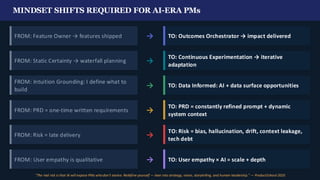
MINDSET SHIFTS REQUIRED FOR AI-ERA PMs
FROM: Feature Owner → features shipped → TO: Outcomes Orchestrator → impact delivered
FROM: Static Certainty → waterfall planning →
TO: Continuous Experimentation → iterative
adaptation
FROM: Intuition Grounding: I define what to
build
→ TO: Data Informed: AI + data surface opportunities
FROM: PRD = one-time written requirements →
TO: PRD = constantly refined prompt + dynamic
system context
FROM: Risk = late delivery →
TO: Risk = bias, hallucination, drift, context leakage,
tech debt
FROM: User empathy is qualitative → TO: User empathy × AI = scale + depth
"The real risk is that AI will expose PMs who don't evolve. Redefine yourself — lean into strategy, vision, storytelling, and human leadership." — ProductSchool 2025
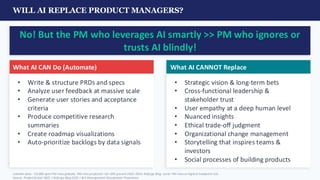
WILL AI REPLACE PRODUCT MANAGERS?
No! But the PM who leverages AI smartly >> PM who ignores or
trusts AI blindly!
What AI CAN Do (Automate)
• Write & structure PRDs and specs
• Analyze user feedback at massive scale
• Generate user stories and acceptance
criteria
• Produce competitive research
summaries
• Create roadmap visualizations
• Auto-prioritize backlogs by data signals
What AI CANNOT Replace
• Strategic vision & long-term bets
• Cross-functional leadership &
stakeholder trust
• User empathy at a deep human level
• Nuanced insights
• Ethical trade-off judgment
• Organizational change management
• Storytelling that inspires teams &
investors
• Social processes of building products
LinkedIn data: ~23,000 open PM roles globally. PM roles projected +10–20% growth 2025–2034. Reforge Blog: Junior PM roles at highest headwind risk.
Source: ProductSchool 2025 | Reforge Blog 2025 | BLS Management Occupations Projections
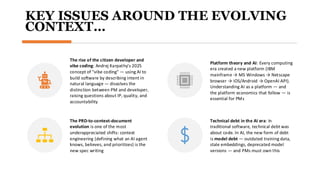
KEY ISSUES AROUND THE EVOLVING
CONTEXT…
The rise of the citizen developer and
vibe coding: Andrej Karpathy's 2025
concept of "vibe coding" — using AI to
build software by describing intent in
natural language — dissolves the
distinction between PM and developer,
raising questions about IP, quality, and
accountability​
Platform theory and AI: Every computing
era created a new platform (IBM
mainframe → MS Windows → Netscape
browser → iOS/Android → OpenAI API).
Understanding AI as a platform — and
the platform economics that follow — is
essential for PMs
The PRD-to-context-document
evolution is one of the most
underappreciated shifts: context
engineering (defining what an AI agent
knows, believes, and prioritizes) is the
new spec writing​
Technical debt in the AI era: In
traditional software, technical debt was
about code. In AI, the new form of debt
is model debt — outdated training data,
stale embeddings, deprecated model
versions — and PMs must own this
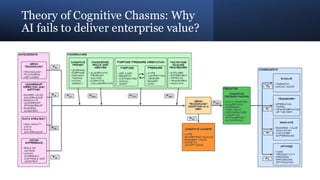
Theory of Cognitive Chasms: Why
AI fails to deliver enterprise value?
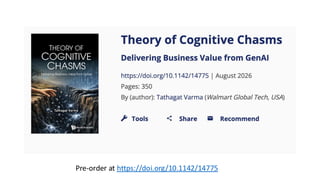
Pre-order at https://doi.org/10.1142/14775
CONCLUSION
The PM Must Evolve…
Software has reinvented itself six times — and each time, PM had to reinvent with it
Agile improved success rates 3× over Waterfall — AI promises another step-change
64–80% of features go unused — AI can finally fix this by building what users truly need
The PM role does not disappear — it elevates from executor to AI strategist
PMs must strive to deliver real business value to the enterprise
AI is not coming for your job. It's coming for your limitations. Embrace it.