Artificial Intelligence
Introduction
Dr. A. B. Shinde
Associate Professor,
Electronics and Computer Science,
PVPIT Budhgaon, Sangli (MS), India
Dr. A. B. Shinde
• What is AI?
• The Foundations of Artificial
Intelligence,
• The History of Artificial Intelligence,
• The State of the Art.
• Introduction: Philosophy of AI,
• Definitions,
• AI Future.
• Stages of AI (ANI, AGI ASI with
examples).
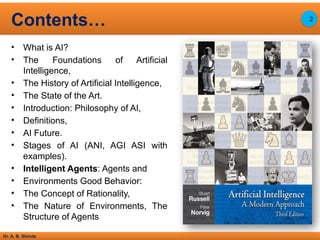
• Intelligent Agents: Agents and
• Environments Good Behavior:
• The Concept of Rationality,
• The Nature of Environments, The
Structure of Agents
Contents… 2
Dr. A. B. Shinde
What is AI ?
Dr. A. B. Shinde
• AI (Artificial Intelligence) is one of the newest fields in science and
engineering.
• Work started after World War II, and the name itself was coined in 1956.
• AI currently encompasses a huge variety of subfields, ranging from the
general (learning and perception) to the specific, such as playing chess,
proving mathematical theorems, writing poetry, driving a car on a
crowded street, and diagnosing diseases.
• AI is relevant to any intellectual task; it is truly a universal field.
What is Artificial Intelligence? 4
Dr. A. B. Shinde
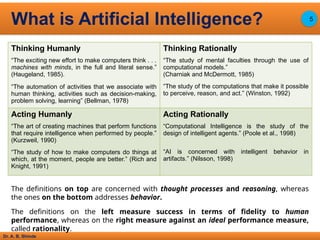
Thinking Humanly
“The exciting new effort to make computers think . . .
machines with minds, in the full and literal sense.”
(Haugeland, 1985).
“The automation of activities that we associate with
human thinking, activities such as decision-making,
problem solving, learning” (Bellman, 1978)
Thinking Rationally
“The study of mental faculties through the use of
computational models.”
(Charniak and McDermott, 1985)
“The study of the computations that make it possible
to perceive, reason, and act.” (Winston, 1992)
Acting Humanly
“The art of creating machines that perform functions
that require intelligence when performed by people.”
(Kurzweil, 1990)
“The study of how to make computers do things at
which, at the moment, people are better.” (Rich and
Knight, 1991)
Acting Rationally
“Computational Intelligence is the study of the
design of intelligent agents.” (Poole et al., 1998)
“AI is concerned with intelligent behavior in
artifacts.” (Nilsson, 1998)
What is Artificial Intelligence? 5
The definitions on top are concerned with thought processes and reasoning, whereas
the ones on the bottom addresses behavior.
The definitions on the left measure success in terms of fidelity to human
performance, whereas on the right measure against an ideal performance measure,
called rationality.
Dr. A. B. Shinde
• A human-centered approach must be in part an empirical science,
involving observations and hypotheses about human behavior.
• A rationalist approach involves a combination of mathematics and
engineering.
• The various group have both criticized and helped each other.
What is Artificial Intelligence? 6
Dr. A. B. Shinde
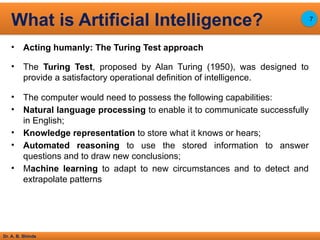
• Acting humanly: The Turing Test approach
• The Turing Test, proposed by Alan Turing (1950), was designed to
provide a satisfactory operational definition of intelligence.
• The computer would need to possess the following capabilities:
• Natural language processing to enable it to communicate successfully
in English;
• Knowledge representation to store what it knows or hears;
• Automated reasoning to use the stored information to answer
questions and to draw new conclusions;
• Machine learning to adapt to new circumstances and to detect and
extrapolate patterns
What is Artificial Intelligence? 7
Dr. A. B. Shinde
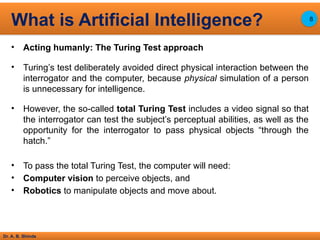
• Acting humanly: The Turing Test approach
• Turing’s test deliberately avoided direct physical interaction between the
interrogator and the computer, because physical simulation of a person
is unnecessary for intelligence.
• However, the so-called total Turing Test includes a video signal so that
the interrogator can test the subject’s perceptual abilities, as well as the
opportunity for the interrogator to pass physical objects “through the
hatch.”
• To pass the total Turing Test, the computer will need:
• Computer vision to perceive objects, and
• Robotics to manipulate objects and move about.
What is Artificial Intelligence? 8
Dr. A. B. Shinde
• Thinking humanly: The cognitive modeling approach
• To say that a given program thinks like a human, we must have some way of
determining how humans think.
• There are three ways to do this:
1. Through introspection—trying to catch our own thoughts as they go by;
2. Through psychological experiments—observing a person in action; and
3. Through brain imaging—observing the brain in action.
 If the program’s input–output behavior matches corresponding human behavior,
that is evidence that some of the program’s mechanisms could also be operating
in humans.
 For example, Allen Newell and Herbert Simon, who developed GPS, the
“General Problem Solver”, a program to solve the problems correctly. They were
more concerned with comparing the trace of its reasoning steps to traces of
human subjects solving the same problems.
 The interdisciplinary field of cognitive science brings together computer models
from AI and experimental techniques from psychology to construct precise and
testable theories of the human mind.
What is Artificial Intelligence? 9
Dr. A. B. Shinde
• Thinking humanly: The cognitive modeling approach
• We will occasionally comment on similarities or differences between AI
techniques and human cognition.
• In the early days of AI there was often confusion between the
approaches: an author would argue that an algorithm performs well on a
task and that it is therefore a good model of human performance.
• Modern authors separate the two kinds of claims; this distinction has
allowed both AI and cognitive science to develop more rapidly.
What is Artificial Intelligence? 10
Dr. A. B. Shinde
• Thinking rationally: The “laws of thought” approach
• The Greek philosopher Aristotle was one of the first to attempt to codify
“right thinking,” that is, unquestionable reasoning processes.
• His syllogisms provided patterns for argument structures that always
yielded correct conclusions when given correct evidences.
• For example, “Socrates is a man; all men are mortal; therefore,
Socrates is mortal.” These laws of thought were supposed to govern the
operation of the mind; their study initiated the field called logic.
• Syllogisms: A form of arguing in which two statements are used to prove that a
third statement is true
What is Artificial Intelligence? 11
Dr. A. B. Shinde
• Thinking rationally: The “laws of thought” approach
• Logicians in the 19th
century developed a precise notation for statements about
all kinds of objects in the world and the relations among them.
• By 1965, programs existed that could, solve any solvable problem described in
logical notation.
• The so-called logicist tradition within artificial intelligence hopes to build on such
programs to create intelligent systems.
• There are two main obstacles to this approach.
• First, it is not easy to take informal knowledge and state it in the formal terms
required by logical notation, particularly when the knowledge is less than 100%
certain.
• Second, there is a big difference between solving a problem “in principle” and
solving it in practice.
• Even problems with just a few hundred facts can exhaust the computational
resources of any computer unless it has some guidance as to which reasoning
steps to try first.
What is Artificial Intelligence? 12
Dr. A. B. Shinde
• Acting rationally: The rational agent approach
• An agent is just something that acts. All computer programs do
something, but computer agents are expected to do more: operate
autonomously, perceive their environment, persist over a prolonged time
period, adapt to change, and create and pursue goals.
• A rational agent is one that acts so as to achieve the best outcome or,
when there is uncertainty, the best expected outcome.
• In the “laws of thought” approach to AI, the emphasis was on correct
interpretations.
• Making correct interpretations is sometimes part of being a rational
agent, because one way to act rationally is to reason logically to the
conclusion that a given action will achieve one’s goals and then to act
on that conclusion.
What is Artificial Intelligence? 13
Dr. A. B. Shinde
• Acting rationally: The rational agent approach
• On the other hand, correct interpretation is not all of rationality; in some
situations, there is no provably correct thing to do, but something must
still be done.
• There are also ways of acting rationally that cannot be said to involve
inference.
• The rational-agent approach has two advantages over the other
approaches.
• First, it is more general than the “laws of thought” approach because
correct inference is just one of several possible mechanisms for
achieving rationality.
• Second, it is more responsive to scientific development than are
approaches based on human behavior or human thought.
What is Artificial Intelligence? 14
Dr. A. B. Shinde
History of AI
Dr. A. B. Shinde
• The growth of artificial intelligence (1943–1955):
• The first work that is now recognized as AI was done by Warren
McCulloch and Walter Pitts (1943). It is build on knowledge of the basic
physiology and function of neurons in the brain.
• They proposed a model of artificial neurons in which each neuron is
characterized as being “on” or “off,” with a switch to “on” occurring in
response to stimulation by a sufficient number of neighboring neurons.
• They showed that any computable function could be computed by some
network of connected neurons, and that all the logical connectives could
be implemented by simple net structures.
• McCulloch and Pitts also suggested that suitably defined networks
could learn.
• Donald Hebb (1949) demonstrated a simple updating rule for modifying
the connection strengths between neurons. His rule, now called
Hebbian learning, remains an influential model to this day.
History of AI 16
Dr. A. B. Shinde
• The growth of artificial intelligence (1943–1955):
• Two undergraduate students at Harvard, Marvin Minsky and Dean
Edmonds, built the first neural network computer in 1950.
• The SNARC, as it was called, used 3000 vacuum tubes and a surplus
automatic pilot mechanism from a B-24 bomber to simulate a network of
40 neurons.
• At Princeton, Minsky studied universal computation in neural networks.
• His Ph.D. committee was doubtful about whether this kind of work
should be considered mathematics, but von Neumann reportedly said,
“If it isn’t now, it will be someday.”
• Minsky was later to prove influential theorems showing the limitations of
neural network research.
History of AI 17
Dr. A. B. Shinde
• The birth of artificial intelligence (1956):
• After receiving his PhD in 1951 and working for two years as an
instructor, McCarthy moved to Stanford and then to Dartmouth College,
which was to become the official birthplace of the AI field.
• Two researchers from Carnegie Tech, Allen Newell and Herbert Simon,
rather stole the show.
• Simon claimed, “We have invented a computer program capable of
thinking non-numerically, and thereby solved the mind–body problem.”
• Simon showed that the program had come up with a proof for one
theorem.
• The editors of the Journal of Symbolic Logic were less impressed; they
rejected a paper co-authored by Newell, Simon, and Logic Theorist.
History of AI 18
Dr. A. B. Shinde
• Early enthusiasm, great expectations (1952–1969):
• The early years of AI were full of successes—in a limited way.
• Newell and Simon’s early success was followed up with the General
Problem Solver, or GPS.
• Unlike Logic Theorist, this program was designed from the start to
imitate human problem-solving protocols. Within the limited class of
puzzles it could handle, it turned out that the order in which the program
considered sub-goals and possible actions was similar to that in which
humans approached the same problems.
• Thus, GPS was probably the first program to embody the “thinking
humanly” approach.
History of AI 19
Dr. A. B. Shinde
• Early enthusiasm, great expectations (1952–1969):
• The success of GPS and subsequent programs as models of cognition
led Newell and Simon (1976) to formulate the famous physical symbol
system hypothesis, which states that “a physical symbol system has the
necessary and sufficient means for general intelligent action.”
• At IBM, Nathaniel Rochester and his colleagues produced some of the
first AI programs.
• Herbert Gelernter (1959) constructed the Geometry Theorem Prover,
which was able to prove theorems that many students of mathematics
would find quite tricky.
History of AI 20
Dr. A. B. Shinde
• Early enthusiasm, great expectations (1952–1969):
• In 1958 at MIT AI Lab, McCarthy defined the high-level language Lisp,
which was to become the dominant AI programming language for the
next 30 years.
• Also in 1958, McCarthy published a paper entitled Programs with
Common Sense, in which he described the Advice Taker, a hypothetical
program that can be seen as the first complete AI system.
• McCarthy’s program was designed to use knowledge to search for
solutions to problems.
History of AI 21
Dr. A. B. Shinde
• Early enthusiasm, great expectations (1952–1969):
• The work of Winograd and Cowan (1963) showed how a large number
of elements could collectively represent an individual concept, with a
corresponding increase in robustness and parallelism.
• Hebb’s learning methods were enhanced by Bernie Widrow (Widrow
and Hoff, 1960; Widrow, 1962), who called his networks adalines, and
by Frank Rosenblatt (1962) with his perceptrons.
• The perceptron convergence theorem (Block et al., 1962) says that
the learning algorithm can adjust the connection strengths of a
perceptron to match any input data, provided such a match exists.
History of AI 22
Dr. A. B. Shinde
• A dose of reality (1966–1973):
• Herbert Simon in 1957 is quoted,
“It is not my aim to surprise or shock you—
but the simplest way I can summarize is to say that
there are now in the world machines that think, that learn and that create.
Moreover, their ability to do these things is going to increase rapidly until—
in a visible future—the range of problems they can handle
will be equivalent with the range to which the human mind
has been applied.”
History of AI 23
Dr. A. B. Shinde
• A dose of reality (1966–1973):
• Simon made more concrete predictions: that within 10 years a computer
would be chess champion, and a significant mathematical theorem
would be proved by machine.
• These predictions came true (or approximately true) within 40 years
rather than 10.
• Simon’s overconfidence was due to the promising performance of early
AI systems on simple examples.
History of AI 24
Dr. A. B. Shinde
• A dose of reality (1966–1973):
• Most of the early AI programs solved problems by trying out different
combinations of steps until the solution was found.
• Early experiments in machine evolution (now called genetic
algorithms) were based on the undoubtedly correct belief that by
making an appropriate series of small alterations to a machine-code
program, one can generate a program with good performance for any
particular task.
• Modern genetic algorithms use better representations and have shown
more success.
History of AI 25
Dr. A. B. Shinde
• Knowledge-based systems: The key to power? (1969–1979):
• Ed Feigenbaum (a former student of Herbert Simon), Bruce Buchanan (a
philosopher turned computer scientist), and Joshua Lederberg (a Nobel
laureate geneticist) teamed up to solve the problem of inferring molecular
structure from the information provided by a mass spectrometer.
• DENDRAL (the first AI expert system) was powerful because
All the relevant theoretical knowledge to solve these problems has
been mapped over from its general form in the efficient special forms
(“cookbook recipes”). (Feigenbaum et al., 1971)
• The DENDRAL was the first successful knowledge-intensive system:
• Later systems also incorporated the main theme of McCarthy’s Advice
Taker approach—the clean separation of the knowledge (in the form of
rules) from the reasoning component.
History of AI 26
Dr. A. B. Shinde
• Knowledge-based systems: The key to power? (1969–1979):
• The importance of domain knowledge was also apparent in the area of
understanding natural language.
• Although Winograd’s SHRDLU system for understanding natural
language whose dependence on syntactic analysis caused some of the
same problems as occurred in the early machine translation work.
• Several researchers, including Eugene Charniak, suggested that robust
language understanding would require general knowledge about the
world and a general method for using that knowledge.
History of AI 27
Dr. A. B. Shinde
• Knowledge-based systems: The key to power? (1969–1979):
• Schank and his students built a series of programs that had the task of
understanding natural language.
• The emphasis, however, was less on language and more on the
problems of representing and reasoning with the knowledge required for
language understanding.
• The problems included representing stereotypical situations, describing
human memory organization, and understanding plans and goals.
History of AI 28
Dr. A. B. Shinde
• AI becomes an industry (1980–present):
• The first successful commercial expert system, R1, began operation at
the Digital Equipment Corporation (1982).
• The program helped configure orders for new computer systems; by
1986.
• By 1988, DEC’s AI group had 40 expert systems deployed.
• Nearly every major U.S. corporation had its own AI group and was either
using or investigating expert systems.
History of AI 29
Dr. A. B. Shinde
• AI becomes an industry (1980–present):
• The United States formed the Microelectronics and Computer
Technology Corporation (MCC) as a research association designed to
assure national competitiveness.
• Overall, the AI industry boomed from a few million dollars in 1980 to
billions of dollars in 1988, including hundreds of companies building
expert systems, vision systems, robots, and software and hardware
specialized for these purposes.
History of AI 30
Dr. A. B. Shinde
• The return of neural networks (1986–present):
• In the mid-1980s at least four different groups reinvented the back-
propagation learning algorithm first found in 1969 by Bryson and Ho.
• The algorithm was applied to many learning problems in computer
science and psychology, and the widespread dissemination of the
results in the collection Parallel Distributed Processing (Rumelhart and
McClelland, 1986) caused great excitement.
History of AI 31
Dr. A. B. Shinde
• AI adopts the scientific method (1987–present):
• In the 1970s, a wide variety of different architectures and approaches
were tried.
• Many of these were rather ad hoc and fragile, and were demonstrated
on only a few specially selected examples.
• In recent years, approaches based on Hidden Markov models (HMMs)
have come to dominate the area.
• Two aspects of HMMs are relevant. First, they are based on a rigorous
mathematical theory. Second, they are generated by a process of
training on a large corpus of real data.
History of AI 32
Dr. A. B. Shinde
• AI adopts the scientific method (1987–present):
• Using improved methodology and theoretical frameworks, the field
arrived at an understanding in which neural nets can now be compared
with corresponding techniques from statistics, pattern recognition, and
machine learning, and the most promising technique can be applied to
each application.
• As a result of these developments, so-called data mining technology
has produced a strong new industry.
History of AI 33
Dr. A. B. Shinde
• The emergence of intelligent agents (1995–present):
• One of the most important environments for intelligent agents is the
Internet.
• AI systems have become so common in Web-based applications that
the “-bot” suffix has entered everyday language.
• Moreover, AI technologies underlie many Internet tools, such as search
engines, recommender systems, and Web site aggregators.
• One consequence of trying to build complete agents is the realization
that the previously isolated subfields of AI might need to be reorganized
somewhat when their results are to be tied together.
• Second major consequence of the agent perspective is that AI has been
drawn into much closer contact with other fields, such as control theory
and economics, that also deal with agents.
History of AI 34
Dr. A. B. Shinde
• The emergence of intelligent agents (1995–present):
• Some influential founders of AI, including John McCarthy (2007), Marvin
Minsky (2007), Nils Nilsson (1995, 2005) and Patrick Winston (Beal and
Winston, 2009), have expressed discontent with the progress of AI.
• They think that AI should put less emphasis on creating ever-improved
versions of applications that are good at a specific task, such as driving
a car, playing chess, or recognizing speech.
• Instead, they believe AI should return to its roots of striving for,
“machines that think, that learn and that create.”
• They call the effort human-level AI or HLAI; their first symposium was in
2004. The effort will require very large knowledge bases.
History of AI 35
Dr. A. B. Shinde
• The availability of very large data sets (2001–present):
• Some recent work in AI suggests that for many problems, it makes more
sense to worry about the data and be less picky about what algorithm to
apply.
• Work like this suggests that the “knowledge bottleneck” in AI—the
problem of how to express all the knowledge that a system needs—may
be solved in many applications by learning methods, provided the
learning algorithms have enough data to go on (Halevy et al., 2009).
History of AI 36
Dr. A. B. Shinde
Foundations of AI
Dr. A. B. Shinde
• Philosophy
• Mathematics
• Economics
• Neuroscience
• Psychology
• Computer engineering
• Control theory and cybernetics
• Linguistics
Foundations of AI 38
Dr. A. B. Shinde
• Philosophy
• Can formal rules be used to draw valid conclusions?
• How does the mind arise from a physical brain?
• Where does knowledge come from?
• How does knowledge lead to action?
• Aristotle (384–322 B.C.), was the first to formulate a precise set of laws
governing the rational part of the mind.
• He developed an informal system of syllogisms for proper reasoning,
which in principle allowed one to generate conclusions mechanically,
given initial evidences.
• Much later, Ramon Lull (d. 1315) had the idea that useful reasoning
could actually be carried out by a mechanical artifact.
Foundations of AI 39
Dr. A. B. Shinde
• Philosophy
• Thomas Hobbes (1588–1679) proposed that reasoning was like numerical
computation, that “we add and subtract in our silent thoughts.”
• Around 1500, Leonardo da Vinci (1452–1519) designed but did not build a
mechanical calculator; recent reconstructions have shown the design to be
functional.
• The first known calculating machine was constructed around 1623 by the
German scientist Wilhelm Schickard (1592–1635), although the Pascaline, built
in 1642 by Blaise Pascal (1623–1662), is more famous.
• Pascal wrote that “the arithmetical machine produces effects which appear
nearer to thought than all the actions of animals.”
• Gottfried Wilhelm Leibniz (1646–1716) built a mechanical device intended to
carry out operations on concepts rather than numbers.
• Leibniz did surpass Pascal by building a calculator that could add, subtract,
multiply, and take roots, whereas the Pascaline could only add and subtract.
• In his 1651 book Leviathan, Thomas Hobbes suggested the idea of an “artificial
animal
Foundations of AI 40
Dr. A. B. Shinde
• Philosophy
• Ren´e Descartes (1596–1650) gave the first clear discussion of the
distinction between mind and matter and of the problems that arise.
• Descartes was a strong believer of the power of reasoning in
understanding the world, a philosophy now called rationalism.
• Descartes was also a supporter of dualism. He held that there is a part
of the human mind (or soul or spirit) that is outside of nature, exempt
from physical laws, whereas animals did not possess this dual quality;
they could be treated as machines.
• An alternative to dualism is materialism, which holds that the brain’s
operation according to the laws of physics constitutes the mind.
Foundations of AI 41
Dr. A. B. Shinde
• Philosophy
• Rudolf Carnap (1891–1970), developed the logical positivism.
• This principle holds that all knowledge can be characterized by logical
theories connected, ultimately, to observation sentences that
correspond to sensory inputs; thus logical positivism combines
rationalism and empiricism.
Foundations of AI 42
Dr. A. B. Shinde
• Mathematics:
• What are the formal rules to draw valid conclusions?
• What can be computed?
• How do we reason with uncertain information?
• Philosophers staked out some of the fundamental ideas of AI, but the
leap to a formal science required a level of mathematical formalization in
three fundamental areas: logic, computation, and probability.
• The idea of formal logic can be traced back to the philosophers of
ancient Greece, but its mathematical development really began with the
work of George Boole (1815–1864), who worked out the details of
propositional, or Boolean, logic (Boole, 1847).
Foundations of AI 43
Dr. A. B. Shinde
• Mathematics:
• In 1879, Gottlob Frege (1848–1925) extended Boole’s logic to include
objects and relations, creating the first order logic that is used today.
Alfred Tarski (1902–1983) introduced a theory of reference that shows
how to relate the objects in a logic to objects in the real world.
• The next step was to determine the limits of what could be done with
logic and computation. The first nontrivial algorithm is thought to be
Euclid’s algorithm for computing greatest common divisors.
• The word algorithm (and the idea of studying them) comes from al-
Khowarazmi, a Persian mathematician of the 9th
century.
• Boole and others discussed algorithms for logical deduction, and, by the
late 19th
century, efforts were under way to formalize general
mathematical reasoning as logical deduction.
Foundations of AI 44
Dr. A. B. Shinde
• Mathematics:
• In 1931, Godel showed that limits on deduction do exist.
• His incompleteness theorem showed that in any formal theory as
strong as Peano arithmetic (the elementary theory of natural numbers),
there are true statements that are undecidable in the sense that they
have no proof within the theory.
• This fundamental result can also be interpreted as showing that some
functions on the integers cannot be represented by an algorithm—that
is, they cannot be computed.
• This motivated Alan Turing (1912–1954) to try to characterize exactly
which functions are computable — capable of being computed.
• The Church–Turing thesis, which states that the Turing machine (Turing,
1936) is capable of computing any computable function,
Foundations of AI 45
Dr. A. B. Shinde
• Mathematics:
• Although decidability and computability are important to an
understanding of computation, the notion of tractability has had an
even greater impact.
• Roughly speaking, a problem is called intractable if the time required to
solve instances of the problem grows exponentially with the size of the
instances.
• The distinction between polynomial and exponential growth in
complexity was first emphasized in the mid-1960s (Cobham, 1964;
Edmonds, 1965).
• It is important because exponential growth means that even moderately
large instances cannot be solved in any reasonable time. Therefore, one
should strive to divide the overall problem of generating intelligent
behavior into tractable subproblems rather than intractable ones.
Foundations of AI 46
Dr. A. B. Shinde
• Mathematics:
• The theory of NP-completeness, pioneered by Steven Cook (1971) and
Richard Karp (1972).
• Cook and Karp showed the existence of large classes of canonical
combinatorial search and reasoning problems that are NP-complete.
• Any problem class to which the class of NP-complete problems can be
reduced is likely to be intractable.
• These results contrast with the optimism with which the popular press
greeted the first computers—“Electronic Super-Brains” that were “Faster
than Einstein!”
• Despite the increasing speed of computers, careful use of resources will
characterize intelligent systems.
• Work in AI has helped explain why some instances of NP-complete
problems are hard, yet others are easy (Cheeseman et al., 1991).
Foundations of AI 47
Dr. A. B. Shinde
• Mathematics:
• Besides logic and computation, the third great contribution of mathematics
to AI is the theory of probability.
• The Italian Gerolamo Cardano (1501–1576) first framed the idea of
probability, describing it in terms of the possible outcomes of gambling
events.
• In 1654, Blaise Pascal (1623–1662), in a letter to Pierre Fermat (1601–
1665), showed how to predict the future of an unfinished gambling game
and assign average payoffs to the gamblers.
• Probability quickly became an invaluable part of all the quantitative
sciences, helping to deal with uncertain measurements and incomplete
theories.
• James Bernoulli (1654–1705), Pierre Laplace (1749–1827), and others
advanced the theory and introduced new statistical methods.
• Thomas Bayes (1702–1761), proposed a rule for updating probabilities in
the light of new evidence. Bayes’ rule underlies most modern approaches to
uncertain reasoning in AI systems.
Foundations of AI 48
Dr. A. B. Shinde
• Economics:
• The science of economics got its start in 1776, when Scottish
philosopher Adam Smith (1723–1790) published An Inquiry into the
Nature and Causes of the Wealth of Nations.
• Most people think of economics as being about money, but economists
will say that they are really studying how people make choices that lead
to preferred outcomes.
• The mathematical treatment of “preferred outcomes” or utility was first
formalized by Leon Walras (pronounced “Valrasse”) (1834-1910) and
was improved by Frank Ramsey (1931) and later by John von Neumann
and Oskar Morgenstern in their book The Theory of Games and
Economic Behavior (1944).
Foundations of AI 49
Dr. A. B. Shinde
• Economics:
• Decision theory, which combines probability theory with utility theory,
provides a formal and complete framework for decisions (economic or
otherwise) made under uncertainty— that is, in cases where
probabilistic descriptions appropriately capture the decision maker’s
environment.
• For “small” economies, the situation is much more like a game: the
actions of one player can significantly affect the utility of another (either
positively or negatively).
• Von Neumann and Morgenstern’s development of game theory
included the surprising result that, for some games, a rational agent
should adopt policies that are (or least appear to be) randomized.
• Unlike decision theory, game theory does not offer an unambiguous
prescription for selecting actions.
Foundations of AI 50
Dr. A. B. Shinde
• Economics:
• Economists did not address the question, how to make rational
decisions when payoffs from actions are not immediate but instead
result from several actions taken in sequence.
• This topic was pursued in the field of operations research, which
emerged in World War II from efforts in Britain to optimize radar
installations, and later found civilian applications in complex
management decisions.
• The work of Richard Bellman (1957) formalized a class of sequential
decision problems called Markov decision processes.
Foundations of AI 51
Dr. A. B. Shinde
• Economics:
• The pioneering AI researcher Herbert Simon (1916–2001) won the
Nobel Prize in economics in 1978 for his early work showing that
models based on satisficing—making decisions that are “good
enough,” rather than laboriously calculating an optimal decision—gave a
better description of actual human behavior (Simon, 1947).
• Since the 1990s, there has been a resurgence of interest in decision-
theoretic techniques for agent systems (Wellman, 1995).
Foundations of AI 52
Dr. A. B. Shinde
• Neuroscience:
• Neuroscience is the study of the nervous system, particularly the brain.
• Although the exact way in which the brain enables thought is one of the
great mysteries of science.
• It has also long been known that human brains are somehow different;
in about 335 B.C. Aristotle wrote, “Of all the animals, man has the
largest brain in proportion to his size.”
• Still, it was not until the middle of the 18th
century that the brain was
widely recognized as the seat of consciousness.
Foundations of AI 53
Dr. A. B. Shinde
• Neuroscience:
• Paul Broca’s (1824–1880) study of aphasia (speech deficit) in brain-
damaged patients in 1861 demonstrated the existence of localized areas of
the brain responsible for specific cognitive functions.
• In particular, he showed that speech production was localized to the portion
of the left hemisphere now called Broca’s area.
• By that time, it was known that the brain consisted of nerve cells, or
neurons, but it was not until 1873 that Camillo Golgi (1843–1926)
developed a staining technique allowing the observation of individual
neurons in the brain.
• This technique was used by Santiago Ramon y Cajal (1852–1934) in his
pioneering studies of the brain’s neuronal structures.
• Nicolas Rashevsky (1936, 1938) was the first to apply mathematical models
to the study of the nervous system.
Foundations of AI 54
Dr. A. B. Shinde
• Neuroscience:
Foundations of AI 55
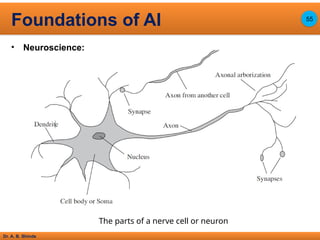
The parts of a nerve cell or neuron
Dr. A. B. Shinde
• Neuroscience:
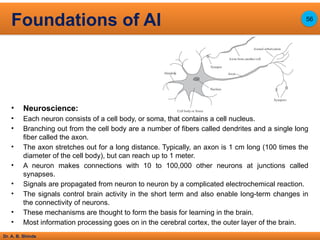
• Each neuron consists of a cell body, or soma, that contains a cell nucleus.
• Branching out from the cell body are a number of fibers called dendrites and a single long
fiber called the axon.
• The axon stretches out for a long distance. Typically, an axon is 1 cm long (100 times the
diameter of the cell body), but can reach up to 1 meter.
• A neuron makes connections with 10 to 100,000 other neurons at junctions called
synapses.
• Signals are propagated from neuron to neuron by a complicated electrochemical reaction.
• The signals control brain activity in the short term and also enable long-term changes in
the connectivity of neurons.
• These mechanisms are thought to form the basis for learning in the brain.
• Most information processing goes on in the cerebral cortex, the outer layer of the brain.
Foundations of AI 56
Dr. A. B. Shinde
• Neuroscience:
• The measurement of intact brain activity began in 1929 with the
invention by Hans Berger of the electroencephalograph (EEG).
• The recent development of functional magnetic resonance imaging
(fMRI) is giving neuroscientists unprecedentedly detailed images of
brain activity.
• These are augmented by advances in single-cell recording of neuron
activity. Individual neurons can be stimulated electrically, chemically, or
even optically, allowing neuronal input – output relationships to be
mapped.
• Despite these advances, we are still a long way from understanding how
cognitive processes actually work.
• The truly amazing conclusion is that a collection of simple cells can
lead to thought, action, and consciousness.
Foundations of AI 57
Dr. A. B. Shinde
• Neuroscience:
Foundations of AI 58
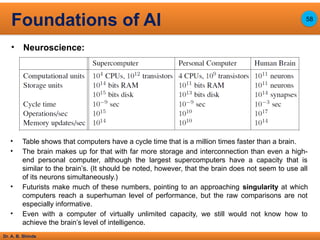
• Table shows that computers have a cycle time that is a million times faster than a brain.
• The brain makes up for that with far more storage and interconnection than even a high-
end personal computer, although the largest supercomputers have a capacity that is
similar to the brain’s. (It should be noted, however, that the brain does not seem to use all
of its neurons simultaneously.)
• Futurists make much of these numbers, pointing to an approaching singularity at which
computers reach a superhuman level of performance, but the raw comparisons are not
especially informative.
• Even with a computer of virtually unlimited capacity, we still would not know how to
achieve the brain’s level of intelligence.
Dr. A. B. Shinde
• Psychology:
• The origins of scientific psychology are usually traced to the work of the
German physicist Hermann von Helmholtz (1821–1894) and his student
Wilhelm Wundt (1832–1920).
• In 1879, Wundt opened the first laboratory of experimental psychology,
at the University of Leipzig.
• Wundt insisted on carefully controlled experiments in which his workers
would perform a perceptual or associative task while introspecting on
their thought processes.
• The careful controls went a long way toward making psychology a
science, but the subjective nature of the data made it unlikely that an
experimenter would ever disconfirm his or her own theories.
Foundations of AI 59
Dr. A. B. Shinde
• Psychology:
• Biologists studying animal behavior, on the other hand, lacked
introspective data and developed an objective methodology, as
described by H. S. Jennings (1906) in his influential work Behavior of
the Lower Organisms.
• Applying this viewpoint to humans, the behaviorism movement, led by
John Watson (1878–1958), rejected any theory involving mental
processes on the grounds that introspection could not provide reliable
evidence.
• Behaviorists insisted on studying only objective measures of the
percepts (or stimulus) given to an animal and its resulting actions (or
response).
• Behaviorism discovered a lot about rats and pigeons but had less
success at understanding humans.
Foundations of AI 60
Dr. A. B. Shinde
• Psychology:
• Cognitive psychology, which views the brain as an information-
processing device, can be traced back at least to the works of William
James (1842–1910).
• Helmholtz also insisted that perception involved a form of unconscious
logical inference.
• The Nature of Explanation, by Bartlett’s student and successor Kenneth
Craik (1943), forcefully reestablished the legitimacy of such “mental”
terms as beliefs and goals.
• Craik specified the three key steps of a knowledge-based agent:
• (1) The stimulus must be translated into an internal representation,
• (2) The representation is manipulated by cognitive processes to derive
new internal representations, and
• (3) These are in turn retranslated back into action.
Foundations of AI 61
Dr. A. B. Shinde
• Psychology:
• After Craik’s death in 1945, his work was continued by Donald
Broadbent, whose book Perception and Communication (1958) was one
of the first works to model psychological phenomena as information
processing.
• Meanwhile, in the United States, the development of computer modeling
led to the creation of the field of cognitive science. The field can be
said to have started at a workshop in September 1956 at MIT.
• At the workshop, George Miller presented The Magic Number Seven,
Noam Chomsky presented Three Models of Language, and Allen Newell
and Herbert Simon presented The Logic Theory Machine.
• These three influential papers showed how computer models could be
used to address the psychology of memory, language, and logical
thinking, respectively.
Foundations of AI 62
Dr. A. B. Shinde
• Computer Engineering:
• The first operational computer was the electromechanical Heath
Robinson, built in 1940 by Alan Turing’s team for a deciphering German
messages.
• The first operational programmable computer was the Z-3, the invention
of Konrad Zuse in Germany in 1941.
• Zuse also invented floating-point numbers and the first high-level
programming language.
• The first electronic computer, the ABC, was assembled by John
Atanasoff and his student Clifford Berry between 1940 and 1942 at Iowa
State University.
• Atanasoff’s research received little support or recognition; it was the
ENIAC, developed as part of a secret military project at the University of
Pennsylvania by a team including John Mauchly and John Eckert, that
proved to be the most influential forerunner of modern computers.
Foundations of AI 63
Dr. A. B. Shinde
• Computer Engineering:
• Each generation of computer hardware has brought an increase in speed and
capacity and a decrease in price.
• Performance doubled every 18 months or so until around 2005, when power
dissipation problems led manufacturers to start multiplying the number of CPU
cores rather than the clock speed.
• Current expectations are that future increases in power will come from
massive parallelism—a curious convergence with the properties of the brain.
• AI is software side of computer science, which has supplied the operating
systems, programming languages, and tools needed to write modern
programs.
• Work in AI has pioneered many ideas that have made their way back to
mainstream computer science, including time sharing, interactive interpreters,
personal computers with windows and mice, rapid development environments,
the linked list data type, automatic storage management, and key concepts of
symbolic, functional, declarative, and object-oriented programming.
Foundations of AI 64
Dr. A. B. Shinde
• Control theory and cybernetics:
• Ktesibios of Alexandria (c. 250 B.C.) built the first self-controlling
machine: a water clock with a regulator that maintained a constant flow
rate.
• Previously, only living things could modify their behavior in response to
changes in the environment.
• Self-regulating feedback control systems is the steam engine governor,
created by James Watt (1736–1819), and the thermostat, invented by
Cornelis Drebbel (1572–1633), who also invented the submarine.
• The mathematical theory of stable feedback systems was developed in
the 19th century.
• The central figure in the creation of what is now called control
theory was Norbert Wiener (1894–1964).
Foundations of AI 65
Dr. A. B. Shinde
• Control theory and cybernetics:
• Like Craik, Wiener and his colleagues Arturo Rosenblueth and Julian
Bigelow viewed purposive behavior as arising from a regulatory
mechanism trying to minimize “error”—the difference between current
state and goal state.
• In the late 1940s, Wiener, along with Warren McCulloch, Walter Pitts,
and John von Neumann, organized a series of influential conferences
that explored the new mathematical and computational models of
cognition.
• Wiener’s book Cybernetics (1948) became a bestseller and awoke the
public to the possibility of artificially intelligent machines.
• Ashby’s Design for a Brain (1948, 1952) elaborated on his idea that
intelligence could be created by the use of homeostatic devices
containing appropriate feedback loops to achieve stable adaptive
behavior.
Foundations of AI 66
Dr. A. B. Shinde
• Control theory and cybernetics:
• Modern control theory, has a goal: The design of systems that maximize
an objective function over time. This roughly matches our view of AI:
designing systems that behave optimally.
• Calculus and matrix algebra, the tools of control theory, lend themselves
to systems that are describable by fixed sets of continuous variables,
whereas AI was founded in part as a way to escape from the these
perceived limitations.
• The tools of logical inference and computation allowed AI researchers to
consider problems such as language, vision, and planning that fell
completely outside the control theorist’s purview.
Foundations of AI 67
Dr. A. B. Shinde
• Linguistics:
• How does language relate to thought?
• Modern linguistics and AI, were “born” at about the same time, and grew
up together, intersecting in a hybrid field called computational
linguistics or natural language processing.
• The problem of understanding language soon turned out to be
considerably more complex than it seemed in 1957.
• Understanding language requires an understanding of the subject
matter and context, not just an understanding of the structure of
sentences.
• Much of the early work in knowledge representation (the study of how
to put knowledge into a form that a computer can reason with) was tied
to language and informed by research in linguistics.
Foundations of AI 68
Dr. A. B. Shinde
AI: The State of the Art
Dr. A. B. Shinde
• What AI can do?
• Robotic vehicles:
• A driverless robotic car named STANLEY sped through the rough terrain
of the Mojave dessert at 22 mph, finishing the 132-mile course first to win
the 2005 DARPA Grand Challenge.
• STANLEY is a Volkswagen Touareg outfitted with cameras, radar, and
laser rangefinders to sense the environment and onboard software to
command the steering, braking, and acceleration (Thrun, 2006).
• The following year CMU’s BOSS won the Urban Challenge, safely driving
in traffic through the streets of a closed Air Force base, obeying traffic
rules and avoiding pedestrians and other vehicles.
• Speech recognition:
• A traveler calling United Airlines to book a flight can have the entire
conversation guided by an automated speech recognition and dialog
management system.
AI: The State of the Art 70
Dr. A. B. Shinde
• What AI can do?
• Autonomous planning and scheduling:
• A hundred million miles from Earth, NASA’s Remote Agent program
became the first on-board autonomous planning program to control the
scheduling of operations for a spacecraft (Jonsson et al., 2000).
• REMOTE AGENT generated plans from high-level goals specified from
the ground and monitored the execution of those plans—detecting,
diagnosing, and recovering from problems as they occurred.
• Successor program MAPGEN (Al-Chang et al., 2004) plans the daily
operations for NASA’s Mars Exploration Rovers, and MEXAR2 (Cesta et
al., 2007) did mission planning—both logistics and science planning—
for the European Space Agency’s Mars Express mission in 2008.
AI: The State of the Art 71
Dr. A. B. Shinde
• What AI can do?
• Game playing:
• IBM’s DEEP BLUE became the first computer program to defeat the world
champion in a chess match when it bested Garry Kasparov by a score of 3.5 to
2.5 in an exhibition match (Goodman and Keene, 1997).
• Kasparov said that he felt a “new kind of intelligence” across the board from him.
• Newsweek magazine described the match as “The brain’s last stand.”
• The value of IBM’s stock increased by $18 billion. Human champions studied
Kasparov’s loss and were able to draw a few matches in subsequent years.
• Spam fighting:
• Each day, learning algorithms classify over a billion messages as spam, saving
the recipient from having to waste time deleting what, for many users, could
comprise 80% or 90% of all messages, if not classified away by algorithms.
• Because the spammers are continually updating their tactics, it is difficult for a
static programmed approach to keep up, and learning algorithms work best
(Sahami et al., 1998; Goodman and Heckerman, 2004).
AI: The State of the Art 72
Dr. A. B. Shinde
• What AI can do?
• Logistics planning:
• During the Persian Gulf crisis of 1991, U.S. forces deployed a Dynamic
Analysis and Replanning Tool, DART (Cross and Walker, 1994), to do
automated logistics planning and scheduling for transportation.
• This involved up to 50,000 vehicles, cargo, and people at a time, and
had to account for starting points, destinations, routes, and conflict
resolution among all parameters.
• The AI planning techniques generated in hours a plan that would have
taken weeks with older methods.
• The Defense Advanced Research Project Agency (DARPA) stated that
this single application more than paid back DARPA’s 30-year investment
in AI.
AI: The State of the Art 73
Dr. A. B. Shinde
• What AI can do?
• Robotics:
• The iRobot Corporation has sold over two million Roomba robotic
vacuum cleaners for home use.
• The company also deploys the more rugged PackBot to Iraq and
Afghanistan, where it is used to handle hazardous materials, clear
explosives, and identify the location of snipers.
• Machine Translation:
• A computer program automatically translates from Arabic to English.
• The program uses a statistical model built from examples of Arabic-to-
English translations and from examples of English text totaling two trillion
words (Brants et al., 2007).
• None of the computer scientists on the team speak Arabic, but they do
understand statistics and machine learning algorithms.
AI: The State of the Art 74
Dr. A. B. Shinde
Philosophy of AI
Dr. A. B. Shinde
• The philosophy of AI explores fundamental questions about intelligence,
consciousness, ethics, and the nature of mind by examining whether
machines can think, understand, or be conscious.
Philosophy of AI 76
Dr. A. B. Shinde
• Philosophical Questions:
• What is Intelligence/Mind?
Can machines truly understand, or just simulate understanding?
Is human cognition fundamentally computational?
• Consciousness:
Can AI ever possess subjective experience, self-awareness, or a "mind" in the
human sense?
• Epistemology:
How does AI acquire knowledge, and what constitutes genuine understanding
versus pattern matching?
• Ethics & Morality:
What moral obligations do we have towards AI, and what are our duties in creating
autonomous agents? How do we program fairness, accountability, and prevent bias?
• Free Will & Identity:
How does AI challenge human uniqueness, free will, and our understanding of
ourselves?
• Existential Risk:
What are the long-term dangers of superintelligent AI?
Philosophy of AI 77
Dr. A. B. Shinde
• Definition:
• Artificial intelligence (AI) is technology that enables computers and
machines to simulate human learning, comprehension, problem solving,
decision making, creativity and autonomy.
AI: Introduction 78
Dr. A. B. Shinde
• Artificial Intelligence (AI) is a technology that enables machines and
computers to perform tasks that typically require human intelligence.
• It helps systems learn from data, recognize patterns and make
decisions to solve complex problems.
• It is used in healthcare, finance, e-commerce and transportation offering
personalized recommendations and enabling self-driving cars.
AI: Introduction 79
Dr. A. B. Shinde
• Concepts of AI:
• 1. Machine Learning (ML): Is a subset of artificial intelligence (AI) that
focuses on building systems that can learn from and make decisions
based on data.
• 2. Generative AI
• It is designed to create new content whether it's text, images, music or
video. Unlike traditional AI which typically focuses on analyzing and
classifying data, it goes a step further by using patterns it has learned
from large datasets to generate new original outputs. It "creates" rather
than just "recognizes."
• 3. Natural Language Processing (NLP)
• NLP allows machines to understand and interact with human language
in a way that feels natural. It enables speech recognition systems like
Siri or Alexa to interpret what we say and respond accordingly.
AI: Introduction 80
Dr. A. B. Shinde
• Concepts of AI:
• 4. Expert Systems
• They are designed to simulate the decision-making ability of human
experts. These systems use a set of predefined "if-then" rules and
knowledge from specialists in specific fields to make informed decisions
similar to how a medical professional would diagnose a disease.
AI: Introduction 81
Dr. A. B. Shinde
• Working of Artificial Intelligence
• AI works by simulating intelligent behavior to perform tasks autonomously.
• Data Collection: AI systems rely on large sets of data which could include images, text or
sensor readings. For example, teaching an AI to recognize cats, we collect a dataset of labeled
cat images.
• Processing and Learning: It uses algorithms to analyze data and identify patterns. For
example, it learns to recognize key features like a cat’s shape, ears or whiskers helping it
understand the data.
• Model Training: The AI model is trained using the data, adjusting its internal settings to
improve its predictions. With more data, the model becomes more accurate and better at
recognizing new examples like unseen images of cats.
• Decision Making: Once trained, it can use what it has learned to make decisions. For example,
it can find whether a new image contains a cat based on the patterns it learned during training.
• Feedback and Improvement: It can improve through feedback, especially in methods like
reinforcement learning. In this case, the AI receives rewards or penalties, refining its ability to
make better decisions over time.
AI: Introduction 82
Dr. A. B. Shinde
• Future AI Trends (2026-2030)
• Agentic AI and Autonomous Workflows: By 2026, AI is evolving from answering
questions to acting as partners that can take on specific, multi-step tasks at human
direction
• Robotics Revolution: Household robots and autonomous machines in logistics will
become capable of navigating complex, real-world environments.
• Healthcare Advancements: AI will drive "personalized medicine," with diagnostic
engines analyzing data for custom treatment plans and accelerating drug discovery.
• Workforce Transformation: While AI will replace repetitive, rule-based jobs by
2030, it will simultaneously create a need for a "hybrid" workforce that uses AI as a
daily "digital co-pilot".
• Advanced Generative Capabilities: AI will dominate content creation, from real-
time multilingual voice agents to fully customizable, AI-generated movies and, by
2029, video game characters with near-human intelligence.
• Scientific Breakthroughs: AI is expected to accelerate biological research tenfold,
potentially compressing 50-100 years of innovation into the next 5-10 years.
Future of AI 83
Dr. A. B. Shinde
• Types of Artificial Intelligence:
• Based on Capabilities:
• Narrow AI (Weak AI): This type of AI is designed to perform a specific
task or a narrow set of tasks such as voice assistants or
recommendation systems. It is good in one area like recommending
products or recognizing speech but lacks general intelligence.
• General AI (Strong AI): It is a theoretical concept where AI can perform
any intellectual task that a human can do. It shows human-like
reasoning and understanding across multiple domains, making it
capable of tackling a variety of tasks.
• Super intelligent AI: It is a hypothetical form of AI that would surpass
human intelligence in all areas. It would be capable of performing tasks
more efficiently and effectively than humans.
Stages of AI 84
Dr. A. B. Shinde
• Types of Artificial Intelligence:
• Based on Functionalities:
• Reactive Machines: These AI systems only react to specific tasks without storing
past experiences. They don’t learn from previous actions but respond in a set
way. For example is a chess-playing AI that evaluates the board and makes a
move based on the current position.
• Limited Memory: These AI systems can use past data to improve future
decisions. Self-driving cars are a good example, as they use data from previous
trips to navigate roads and avoid obstacles.
• Theory of Mind: The theory of mind is a theoretical type of AI that would be able
to understand emotions, beliefs, intentions and other mental states. This would
allow the AI to interact with humans in a more natural and empathetic manner.
• Self-Aware AI: It is a hypothetical form of AI that possesses consciousness and
self-awareness. It would have an understanding of its own existence and could
make decisions based on that awareness.
Stages of AI 85
Dr. A. B. Shinde
• Supervised Learning Models
• AI is trained on labeled data with clear input-output pairs, helping the
system to learn the relationship between them.
• The model is adjusted during training to reduce the difference between
its predictions and the correct outputs.
• It’s used for tasks like image classification, spam filtering and medical
diagnosis where labeled datasets are available.
AI Models 86
Dr. A. B. Shinde
• Unsupervised Learning Models
• AI works with unlabeled data and identifies patterns, trends or groupings
without direct guidance.
• It is valuable when exploring hidden structures in complex datasets such
as detecting fraud.
• This method helps in tasks like customer segmentation, data clustering
and irregularity detection.
AI Models 87
Dr. A. B. Shinde
• Reinforcement Learning Models
• AI learns by interacting with an environment and receiving feedback in
the form of rewards or penalties.
• Over time, the model optimizes its decision-making process to maximize
positive outcomes.
• It is used in robotics, gaming (e.g AlphaGo) and autonomous systems
where actions lead to varying consequences and the AI learns through
experience.
AI Models 88
Dr. A. B. Shinde
• ANI (Artificial Narrow Intelligence):
• Often called Weak AI.
• ANI is super-human at specific singular tasks. Like teaching an AI
machine to play chess…. It will master singular tasks beyond human
potential with incredible consistency.
• This machine can only play chess.
• ANI has already transformed the way we live, but it has its limitations.
• You might have already interacted with ANI on a daily basis, perhaps
without knowing it. Think of talking with Siri or Alexa on your smart
devices.
Stages of AI 89
Dr. A. B. Shinde
• AGI (Artificial General Intelligence):
• If we are to see a world like the movies with artificial intelligence, AGI
will need to come into full execution.
• AGI would mean a machine would be capable of understanding the
world as well as any human. All while maintaining the same capacity to
learn how to carry out a huge range of tasks.
• It is a hypothetical form of AI.
• According to a study by Muller and Vincent C., the top-cited 100 AI
researchers have a collective 90% confidence that AGI will be among us
by 2070.
Stages of AI 90
Dr. A. B. Shinde
• ASI (Artificial Super Intelligence):
• Super-Intelligence is quite self-explanatory.
• Oxford Philosopher Nick Bostrom describes ASI as: “any intellect that
greatly exceeds the cognitive performance of humans in virtually all
domains of interest.”
• Again, this is a hypothetical agent and one which is decades away.
• ASI has huge potential but it also has huge risk. Stephen Hawking
feared its development could be the worst event in the history of our
civilization, and even ‘spell the end of the human race‘.
• If we create super-intelligent machines we may put our own existence at
risk.
Stages of AI 91
Dr. A. B. Shinde
Intelligent Agents
Dr. A. B. Shinde
• Agent:
• An agent is anything that can be viewed as perceiving its environment
through sensors and acting upon that environment through actuators.
• A human agent has eyes, ears, and other organs for sensors and
hands, legs, vocal tract, and so on for actuators.
• A robotic agent might have cameras and infrared range finders for
sensors and various motors for actuators.
• A software agent receives keystrokes, file contents, and network
packets as sensory inputs and acts on the environment by displaying on
the screen, writing files, and sending network packets.
Intelligent Agents 93
Dr. A. B. Shinde
• Agent:
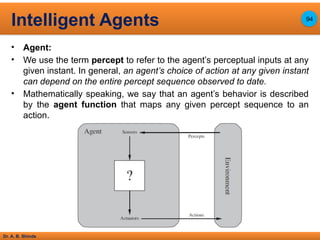
• We use the term percept to refer to the agent’s perceptual inputs at any
given instant. In general, an agent’s choice of action at any given instant
can depend on the entire percept sequence observed to date.
• Mathematically speaking, we say that an agent’s behavior is described
by the agent function that maps any given percept sequence to an
action.
Intelligent Agents 94
Dr. A. B. Shinde
• Good Behavior:
• A rational agent is one that does the right thing—conceptually
speaking, every entry in the table for the agent function is filled out
correctly.
• When an agent is plunked down in an environment, it generates a
sequence of actions according to the percepts it receives.
• This sequence of actions causes the environment to go through a
sequence of states.
• If the sequence is desirable, then the agent has performed well.
• This notion of desirability is captured by a performance measure that
evaluates any given sequence of environment states.
Intelligent Agents 95
Dr. A. B. Shinde
• Rationality:
• What is rational at any given time depends on four things:
– The performance measure that defines the criterion of success.
– The agent’s prior knowledge of the environment.
– The actions that the agent can perform.
– The agent’s percept sequence to date.
• This leads to a definition of a rational agent:
For each possible percept sequence, a rational agent should select
an action that is expected to maximize its performance measure, given the
evidence provided by the percept sequence and whatever built-in
knowledge the agent has.
Intelligent Agents 96
Dr. A. B. Shinde
• Omniscience, learning, and autonomy:
• An omniscient agent knows the actual outcome of its actions and can
act accordingly; but omniscience is impossible in reality.
• Rationality maximizes expected performance, while perfection
maximizes actual performance.
• Doing actions in order to modify future percepts—sometimes called
information gathering—is an important part of rationality.
Intelligent Agents 97
Dr. A. B. Shinde
• Omniscience, learning, and autonomy:
• To the extent that an agent relies on the prior knowledge of its designer
rather than on its own percepts, we say that the agent lacks autonomy.
• A rational agent should be autonomous—it should learn what it can to
compensate for partial or incorrect prior knowledge.
• For example, a vacuum-cleaning agent that learns to foresee where and
when additional dirt will appear will do better than one that does not.
• When the agent has had little or no experience, it would act randomly
unless the designer gave some assistance. It would be reasonable to
provide an artificial intelligent agent with some initial knowledge as well
as an ability to learn.
• After sufficient experience of its environment, the behavior of a rational
agent can become effectively independent of its prior knowledge.
Intelligent Agents 98
Dr. A. B. Shinde
The Nature of Environment
Dr. A. B. Shinde
• To build rational agent, we must think about task environments, which
are essentially the “problems” to which rational agents are the
“solutions.”
• The task environment directly affects the appropriate design for the
agent program.
• We have to specify the performance measure, the environment, and the
agent’s actuators and sensors.
• Group all these under the heading of the task environment.
• We call this as the PEAS (Performance, Environment, Actuators,
Sensors) description.
Nature of Environment 100