Artificial Intelligence Applications for Advanced Environmental Monitoring and Disaster Prediction
Explores AI-driven solutions for pollution detection, disaster prediction, and real-time air and water quality monitoring, addressing challenges and sustainability in environmental management.
Artificial Intelligence Applications for Advanced Environmental Monitoring and Disaster Prediction
1.
Arti f ic i al I nte l l i gence
( AI )
for Environmental Monitoring
Artificial intelligence - Environmental monitoring - Pollution detection -
Disaster prediction - Air and water quality
Artificial intelligence Environmental monitoring
Pollution detection Disaster prediction
Seminar | Sem VI| DCST | APCRP | 2025-’26
A c h a r y y a P r a f u l l a
C h a n d r a R a y P o l y t e c h n i c
Diplo ma in Co mpu ter S c i ence a nd
Te chn o lo g y
T E A M M E M B E R S
Shubhrangshu Mallik
Registration No: D242500017 | DCST – Sem VI
Abdul Rahman
Registration No: D232401492| DCST – Sem VI
Biswanath Haldar
Registration No: D242500016| DCST – Sem VI
Sk Shamim Rahaman
Registration No: D232430799| DCST – Sem VI
2.
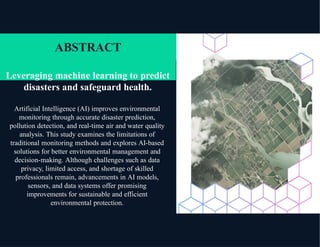
ABSTRACT
Leveraging machine learningto predict
disasters and safeguard health.
Artificial Intelligence (AI) improves environmental
monitoring through accurate disaster prediction,
pollution detection, and real-time air and water quality
analysis. This study examines the limitations of
traditional monitoring methods and explores AI-based
solutions for better environmental management and
decision-making. Although challenges such as data
privacy, limited access, and shortage of skilled
professionals remain, advancements in AI models,
sensors, and data systems offer promising
improvements for sustainable and efficient
environmental protection.
Limitations of Monitoring
Traditionalenvironmental monitoring
methods are severely constrained by
prohibitive costs, slow turnaround times, and
significant data accuracy issues, hindering
effective responses during crises.
5.
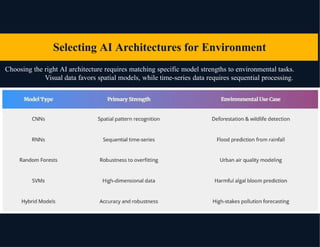
Selecting AI Architecturesfor Environment
Choosing the right AI architecture requires matching specific model strengths to environmental tasks.
Visual data favors spatial models, while time-series data requires sequential processing.
6.
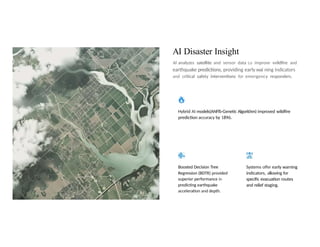
AI Disaster Insight
Alanalyzes satellite and sensor data Lo improve vvildfire and
earthquake predictions, providing early wai ning indicators
and critical safety interventions for emergency responders.
Hybrid AI models(ANFlS-Genetic AlgoriŁhm) improved wildfire
prediction accuracy by 189ó.
Boosted Decision Tree
Regression (BDTR) provided
superior performance in
predicting earthquake
acceleration and depth.
Systems offer early warning
indicators, allowing for
specific evacuation routes
and relief staging.
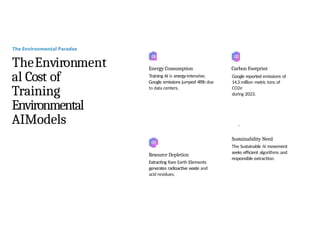
TheEnvironment
al Cost of
Training
Environmental
AIModels
EnergyConsumption
Training AI is energy-intensive;
Google emissions jumped 489b due
to data centers.
Resource Depletion
Extracting Rare Earth Elements
generates radioactive waste and
acid residues.
Carbon Footprint
Google reported emissions of
14.3 million metric tons of
CO2e
during 2023.
•
Sustainability Need
The Sustainable AI movement
seeks efficient algorithms and
responsible extraction.
10.
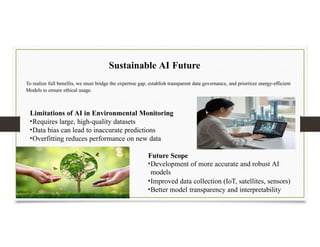
Sustainable AI Future
Torealize full benefits, we must bridge the expertise gap, establish transparent data governance, and prioritize energy-efficient
Models to ensure ethical usage.
Limitations of AI in Environmental Monitoring
•Requires large, high-quality datasets
•Data bias can lead to inaccurate predictions
•Overfitting reduces performance on new data
Future Scope
•Development of more accurate and robust AI
models
•Improved data collection (IoT, satellites, sensors)
•Better model transparency and interpretability