Overview of AquacultureBackground, Career &
Business Opportunities, Fish Culture Phases, and Fish
Identification
Presented by: Borcelle Group
AQUACULTURE
AND
FISHERIES
2.
WHAT IS AQUACULTURE?
Aquacultureis the practice of breeding, raising, and harvesting aquatic organisms — including fish,
shellfish, and aquatic plants — under controlled or semi-controlled conditions.
Unlike traditional fishing, aquaculture actively manages the growth of aquatic life, making it a vital
science and industry in today's world.
Aquaculture & Fisheries:
As natural fish populations face increasing scarcity due to overfishing and environmental changes,
aquaculture plays a critical role in supplementing the natural fish supply. It helps meet growing food
demands, supports local economies, and promotes sustainable use of aquatic resources.
Key Terms:
• Aquaculture — controlled cultivation of aquatic organisms
• Fisheries — the industry of catching, processing, and selling fish and other aquatic life
3.
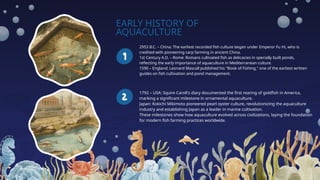
EARLY HISTORY OF
AQUACULTURE
2953B.C. – China: The earliest recorded fish culture began under Emperor Fu Hi, who is
credited with pioneering carp farming in ancient China.
1st Century A.D. – Rome: Romans cultivated fish as delicacies in specially built ponds,
reflecting the early importance of aquaculture in Mediterranean culture.
1590 – England: Leonard Mascall published his "Book of Fishing," one of the earliest written
guides on fish cultivation and pond management.
1792 – USA: Squire Caroll's diary documented the first rearing of goldfish in America,
marking a significant milestone in ornamental aquaculture.
Japan: Kokichi Mikimoto pioneered pearl oyster culture, revolutionizing the aquaculture
industry and establishing Japan as a leader in marine cultivation.
These milestones show how aquaculture evolved across civilizations, laying the foundation
for modern fish farming practices worldwide.
4.
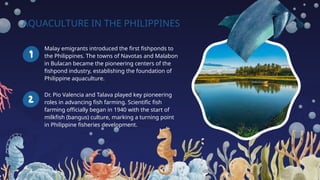
AQUACULTURE IN THEPHILIPPINES
Malay emigrants introduced the first fishponds to
the Philippines. The towns of Navotas and Malabon
in Bulacan became the pioneering centers of the
fishpond industry, establishing the foundation of
Philippine aquaculture.
Dr. Pio Valencia and Talava played key pioneering
roles in advancing fish farming. Scientific fish
farming officially began in 1940 with the start of
milkfish (bangus) culture, marking a turning point
in Philippine fisheries development.
5.
LEADING
AQUACULTURE
RESEARCH CENTERS
SEAFDEC
ICLARM
CLSU FreshwaterAquaculture
Center
The Philippines is home to world-class aquaculture
research institutions that drive innovation, education,
and sustainable fisheries development. These centers
provide training, research, and technical support to fish
farmers and the industry nationwide.
Southeast Asian Fisheries Development Center — Located in
Tigbauan, Iloilo. Conducts regional research on aquaculture
technology, fisheries management, and training programs for
Southeast Asian nations.
International Center for Living Aquatic Resources Management —
Based in Makati City. Focuses on improving aquatic resource
management, genetic research, and global fisheries sustainability
initiatives.
Central Luzon State University's Freshwater Aquaculture Center —
Located in Nueva Ecija. Specializes in freshwater fish culture
research, fingerling production, and training programs for local
fish farmers.
6.
GOVERNMENT
SUPPORT FOR
AQUACULTURE
Model FishFarms
Hatcheries & Fingerling Distribution
Technical Assistance Programs
The Philippine government actively supports aquaculture
development through nationwide programs. These initiatives
empower local fish farmers, boost production, and promote
sustainable fishery practices across the country.
The government established model fish farms nationwide to demonstrate
best practices in aquaculture. These farms serve as learning centers for
local farmers, showcasing modern and sustainable fish farming techniques.
Government-operated hatcheries and nurseries produce and distribute
fingerlings to fish farmers at low or no cost. This ensures a steady supply of
quality fish stocks to support grow-out operations across the country.
Trained fishery technicians and extension workers provide hands-on technical
assistance to fish farmers. Programs include training on fish health
management, water quality monitoring, and proper aquaculture systems
management.
7.
TYPES OF AQUACULTURESYSTEMS
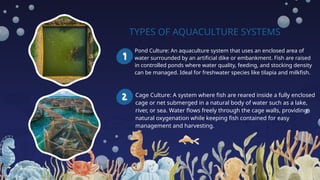
Pond Culture: An aquaculture system that uses an enclosed area of
water surrounded by an artificial dike or embankment. Fish are raised
in controlled ponds where water quality, feeding, and stocking density
can be managed. Ideal for freshwater species like tilapia and milkfish.
Cage Culture: A system where fish are reared inside a fully enclosed
cage or net submerged in a natural body of water such as a lake,
river, or sea. Water flows freely through the cage walls, providing
natural oxygenation while keeping fish contained for easy
management and harvesting.
8.
TYPES OF AQUACULTURESYSTEMS
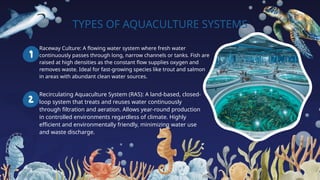
Raceway Culture: A flowing water system where fresh water
continuously passes through long, narrow channels or tanks. Fish are
raised at high densities as the constant flow supplies oxygen and
removes waste. Ideal for fast-growing species like trout and salmon
in areas with abundant clean water sources.
Recirculating Aquaculture System (RAS): A land-based, closed-
loop system that treats and reuses water continuously
through filtration and aeration. Allows year-round production
in controlled environments regardless of climate. Highly
efficient and environmentally friendly, minimizing water use
and waste discharge.
9.
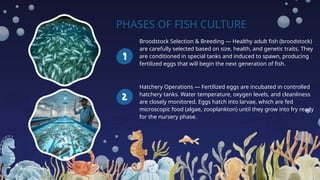
PHASES OF FISHCULTURE
Broodstock Selection & Breeding — Healthy adult fish (broodstock)
are carefully selected based on size, health, and genetic traits. They
are conditioned in special tanks and induced to spawn, producing
fertilized eggs that will begin the next generation of fish.
Hatchery Operations — Fertilized eggs are incubated in controlled
hatchery tanks. Water temperature, oxygen levels, and cleanliness
are closely monitored. Eggs hatch into larvae, which are fed
microscopic food (algae, zooplankton) until they grow into fry ready
for the nursery phase.
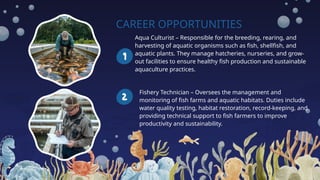
CAREER OPPORTUNITIES
Aqua Culturist– Responsible for the breeding, rearing, and
harvesting of aquatic organisms such as fish, shellfish, and
aquatic plants. They manage hatcheries, nurseries, and grow-
out facilities to ensure healthy fish production and sustainable
aquaculture practices.
Fishery Technician – Oversees the management and
monitoring of fish farms and aquatic habitats. Duties include
water quality testing, habitat restoration, record-keeping, and
providing technical support to fish farmers to improve
productivity and sustainability.
12.
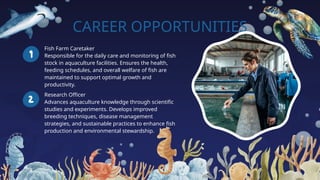
CAREER OPPORTUNITIES
Fish FarmCaretaker
Responsible for the daily care and monitoring of fish
stock in aquaculture facilities. Ensures the health,
feeding schedules, and overall welfare of fish are
maintained to support optimal growth and
productivity.
Research Officer
Advances aquaculture knowledge through scientific
studies and experiments. Develops improved
breeding techniques, disease management
strategies, and sustainable practices to enhance fish
production and environmental stewardship.
13.
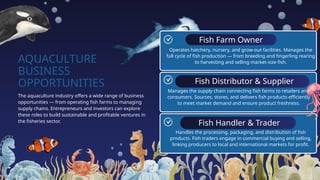
AQUACULTURE
BUSINESS
OPPORTUNITIES
Fish Farm Owner
FishDistributor & Supplier
Fish Handler & Trader
The aquaculture industry offers a wide range of business
opportunities — from operating fish farms to managing
supply chains. Entrepreneurs and investors can explore
these roles to build sustainable and profitable ventures in
the fisheries sector.
Operates hatchery, nursery, and grow-out facilities. Manages the
full cycle of fish production — from breeding and fingerling rearing
to harvesting and selling market-size fish.
Manages the supply chain connecting fish farms to retailers and
consumers. Sources, stores, and delivers fish products efficiently
to meet market demand and ensure product freshness.
Handles the processing, packaging, and distribution of fish
products. Fish traders engage in commercial buying and selling,
linking producers to local and international markets for profit.
14.
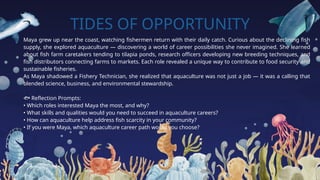
TIDES OF OPPORTUNITY
Mayagrew up near the coast, watching fishermen return with their daily catch. Curious about the declining fish
supply, she explored aquaculture — discovering a world of career possibilities she never imagined. She learned
about fish farm caretakers tending to tilapia ponds, research officers developing new breeding techniques, and
fish distributors connecting farms to markets. Each role revealed a unique way to contribute to food security and
sustainable fisheries.
As Maya shadowed a Fishery Technician, she realized that aquaculture was not just a job — it was a calling that
blended science, business, and environmental stewardship.
🐟 Reflection Prompts:
• Which roles interested Maya the most, and why?
• What skills and qualities would you need to succeed in aquaculture careers?
• How can aquaculture help address fish scarcity in your community?
• If you were Maya, which aquaculture career path would you choose?
15.
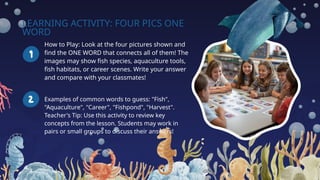
LEARNING ACTIVITY: FOURPICS ONE
WORD
How to Play: Look at the four pictures shown and
find the ONE WORD that connects all of them! The
images may show fish species, aquaculture tools,
fish habitats, or career scenes. Write your answer
and compare with your classmates!
Examples of common words to guess: "Fish",
"Aquaculture", "Career", "Fishpond", "Harvest".
Teacher's Tip: Use this activity to review key
concepts from the lesson. Students may work in
pairs or small groups to discuss their answers!
16.
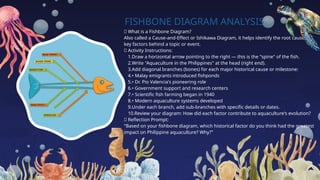
FISHBONE DIAGRAM ANALYSIS
📌What is a Fishbone Diagram?
Also called a Cause-and-Effect or Ishikawa Diagram, it helps identify the root causes or
key factors behind a topic or event.
🎯 Activity Instructions:
1.Draw a horizontal arrow pointing to the right — this is the "spine" of the fish.
2.Write "Aquaculture in the Philippines" at the head (right end).
3.Add diagonal branches (bones) for each major historical cause or milestone:
4.• Malay emigrants introduced fishponds
5.• Dr. Pio Valencia's pioneering role
6.• Government support and research centers
7.• Scientific fish farming began in 1940
8.• Modern aquaculture systems developed
9.Under each branch, add sub-branches with specific details or dates.
10.Review your diagram: How did each factor contribute to aquaculture's evolution?
💬 Reflection Prompt:
"Based on your fishbone diagram, which historical factor do you think had the greatest
impact on Philippine aquaculture? Why?"
17.
QUIZ CHALLENGE!
Who introducedthe first fishponds in the Philippines, and what two towns pioneered the
fishpond industry?
A) Dr. Pio Valencia – Manila and Cavite
B) Malay emigrants – Navotas and Malabon
C) Leonard Mascall – Iloilo and Cebu
D) Fu Hi – Bulacan and Pampanga
When did scientific fish farming officially begin in the Philippines, and what species was first
cultured?
A) 1920 – Tilapia
B) 1935 – Carp
C) 1940 – Milkfish (Bangus)
D) 1955 – Prawns
18.
CAREER OR JOBIDENTIFICATION
Identify each item: write CO if it is a Career
Opportunity or JO if it is a Job Opportunity.
1.Fish Supplier
2.Aqua Culturist
3.Research Officer
Think carefully! A Career Opportunity (CO) involves
professional growth, specialized training, and long-
term development. A Job Opportunity (JO) refers to
specific tasks or positions with defined daily duties.
Write your answers on a sheet of paper!
19.
SUMMARY &
REFLECTION
Aquaculture &Fisheries
Multiple Aquaculture Systems
Diverse Career & Business Paths
Reflect on what you have learned:
"I understand that..."
Aquaculture plays a vital role in supplementing fisheries and addressing fish
scarcity worldwide.
"I realize that..."
There are diverse career paths and business opportunities in the aquaculture
sector.
"I need to learn more about..."
The specific systems and techniques used in modern fish culture.
Aquaculture supplements natural fisheries by breeding, raising, and
harvesting aquatic organisms in controlled environments, helping address
fish scarcity and food security needs.
Five key systems — Pond, Cage, Pen, Raceway, and Recirculating
Aquaculture Systems — each adapted to different environments, water
sources, and production goals.
From Aqua Culturist to Fish Farm Owner, the sector offers numerous career and
business opportunities including hatchery operations, distribution, trading,
research, and resource protection.
20.
FORMATIVE ASSESSMENT
Choose thecorrect answer for each question:
1.Who introduced the first fishponds in the Philippines?
a) Dr. Pio Valencia b) Malay emigrants c) Fu Hi d) Mikimoto
2.What is aquaculture primarily concerned with?
a) Hunting wild fish b) Breeding & harvesting aquatic organisms
c) Ocean exploration d) Ship building
3.Which system uses flowing water for dense fish populations?
a) Pond Culture b) Cage Culture c) Raceway Culture d) Pen Culture
4.Which career involves monitoring, management & habitat restoration?
a) Fish Trader b) Fishery Technician c) Fish Handler d) Fish Wharf Operator
4.When did scientific fish farming begin in the Philippines?
a) 1792 b) 1590 c) 1940 d) 1953
21.
THANK
YOU!
Thank you foryour participation! Questions?
For further learning, visit: BFAR.da.gov.ph | seaf.da.gov.ph
Presented by: Agriculture & Fishery Arts Class
 Most read
 Most read
 Most read